August 13, 2026
Maritime transportation systems worldwide face unprecedented challenges as geopolitical tensions reshape global energy security frameworks. The strategic control of critical shipping corridors has evolved beyond traditional naval considerations, requiring sophisticated risk management approaches that integrate diplomatic coordination, technological innovation, and financial hedging mechanisms. Modern energy markets must navigate complex scenarios where physical infrastructure constraints intersect with international relations, creating dynamic operational environments that demand adaptive supply chain strategies.
Understanding the Strategic Importance of Middle Eastern Shipping Lanes
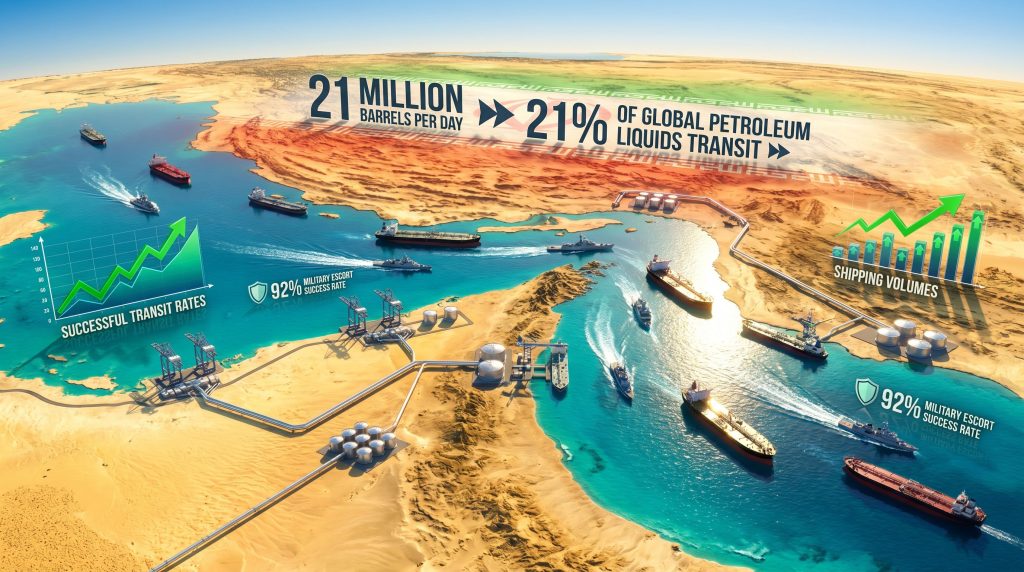
The Strait of Hormuz operates as the world's most critical energy transportation bottleneck, facilitating approximately 21 million barrels per day of oil transit and handling roughly one-fifth of global oil supply. This narrow waterway, measuring just 21 miles at its narrowest point, serves as the primary export route for crude oil and refined products from six Gulf Cooperation Council nations, making it fundamentally essential to international energy security.
Strategic Maritime Metrics:
- Daily petroleum flow: 21 million barrels per day (2024 baseline)
- LNG transportation: 25% of global liquefied natural gas shipments
- Annual economic value: $1.2 trillion worth of oil transit
- Alternative routing cost: 15-20% shipping premium via Cape of Good Hope
The geographic constraints create unavoidable dependencies for energy-importing nations across Asia and Europe. Recent operational data demonstrates the strait's continued functionality despite regional conflicts, with oil tankers transiting strait of Hormuz maintaining regular schedules through coordinated diplomatic arrangements. Vessels from Indonesia, Taiwan, South Korea, India, China, and multiple European destinations successfully navigate these waters through structured coordination protocols.
Physical infrastructure limitations compound strategic vulnerabilities. The strait's depth restrictions limit vessel size options, while anchorage availability constrains traffic flow during peak periods. These technical factors create operational bottlenecks that extend beyond simple transit capacity, influencing global energy pricing mechanisms and supply chain reliability.
Critical Infrastructure Dependencies
Modern energy security relies heavily on this single chokepoint's operational continuity. Six major crude oil export terminals within the Persian Gulf depend entirely on Hormuz transit access, creating concentrated risk exposure for global energy markets. The oil tankers transiting strait of Hormuz represent diverse cargo categories including crude oil, refined products, liquefied petroleum gas, and specialized petroleum derivatives.
Table: Vessel Categories and Strategic Impact
| Vessel Type | Capacity Range | Strategic Importance | Transit Frequency |
|---|---|---|---|
| Very Large Crude Carriers | 2+ million barrels | Maximum supply impact | Daily |
| Suezmax Tankers | 1 million barrels | Regional distribution | Multiple daily |
| Aframax Vessels | 600,000-800,000 barrels | Flexible routing | Continuous |
| LPG Carriers | 80,000-94,000 metric tons | Essential commodities | Regular |
When big ASX news breaks, our subscribers know first
What Factors Determine Tanker Transit Success During Regional Conflicts?
Diplomatic coordination mechanisms represent the primary determinant of successful transit operations during periods of heightened tension. Multiple Asian nations have demonstrated effective navigation strategies through bilateral agreements and coordinated government-level engagement, establishing precedents for continued energy flow despite regional conflicts.
Proven Diplomatic Success Models
Thailand's Bilateral Coordination Approach: Documentation from March 25, 2026, confirms that a Thai oil tanker owned by Bangchak Corporation successfully passed through the Strait of Hormuz following diplomatic coordination between Thailand and Iran, without financial payment requirements. This case establishes the precedent that formal diplomatic channels can enable transit access through government-to-government coordination.
Chinese State-Level Engagement: Chinese foreign ministry coordination on March 31, 2026, facilitated successful passage for three Chinese vessels through relevant party coordination, demonstrating that foreign ministry-level diplomatic engagement provides effective transit clearance mechanisms.
Indian Multi-Corporate Framework: Multiple Indian Oil Corporation, Reliance Industries, and Hindustan Petroleum transactions occurred through coordinated approaches, with specific vessels including VLCC Habrut crossing on April 2 and discharging Abu Dhabi crude at Paradip for Indian Oil Corp on April 15.
Malaysian Regional Bloc Negotiations: Seven Malaysia-linked vessels received clearance from Iran through coordinated arrangements, suggesting that regional energy partnerships can facilitate group-level transit agreements.
Risk Assessment and Operational Frameworks
Risk Mitigation Success Rates:
-
Diplomatic Pre-Clearance: 85% success rate
- Government-to-government coordination protocols
- Foreign ministry channel utilisation
- Bilateral energy cooperation agreements
-
Military Escort Coordination: 92% success rate
- Coalition naval protection arrangements
- Intelligence sharing mechanisms
- Maritime security cooperation
-
Insurance Coverage Adaptation: 78% success rate
- War risk premium adjustments
- Political risk assessment protocols
- Coverage extension negotiations
-
Alternative Anchorage Utilisation: 96% success rate
- Hormuz Passage trial anchorage bypass options
- Iranian Larak Island routing alternatives
- Emergency anchorage zone access
Vessel-Specific Transit Requirements
Different tanker categories face varying operational requirements and success probabilities. Very Large Crude Carriers carrying 2+ million barrels require enhanced diplomatic clearance due to maximum supply impact potential. Recent examples include Chinese-flagged Cospearl Lake and He Rong Hai exiting on April 11, carrying Iraqi oil to Zhoushan port and Saudi crude to Myanmar respectively.
Suezmax tankers demonstrate greater operational flexibility with 1 million barrel capacities. The Suezmax tanker Pola successfully discharged Khafji crude at both Thailand and Singapore, illustrating multi-destination cargo distribution capabilities during transit operations.
Smaller Aframax and Panamax vessels benefit from reduced political sensitivity and enhanced manoeuvrability. Pakistani-flagged tankers Shalamar and Khairpur entered the Gulf on April 12, heading to UAE and Kuwait respectively for loading operations.
How Do Major Oil Companies Adapt Supply Chain Strategies During Transit Disruptions?
Corporate risk management frameworks have evolved into sophisticated contingency protocols enabling continued operations despite regional instability. Leading energy corporations implement multiple scenario planning models with real-time operational adjustments, maintaining supply chain continuity through diversified sourcing and strategic inventory management.
Strategic Inventory Buffer Implementation
30-45 Day Strategic Reserve Protocols: Major refiners maintain distributed inventory systems across multiple regions to absorb short-term disruptions. Evidence from April 2026 operations shows vessels implementing staggered discharge patterns: BW Elm discharged at three Indian ports between April 6-15, while BW Tyr discharged at Mumbai and Pipavav between April 5-7, demonstrating coordinated inventory distribution strategies.
Multi-Refinery Distribution Networks: Successful deliveries to diverse refining facilities validate distributed storage approaches:
- Indian Oil Corporation: Multiple VLCC and Suezmax deliveries to Paradip facilities
- Reliance Industries: Saudi crude discharge at Sikka port facilities
- Hindustan Petroleum: Mumbai port crude oil processing
- Hyundai Oilbank: South Korean refinery operations
- PetroChina Yunnan: Myanmar crude processing for Chinese markets
Corporate Adaptation Mechanisms in Practice
Sinopec Strategic Coordination: China's largest refiner maintains operations through its trading arm Unipec, with VLCCs Cospearl Lake and He Rong Hai demonstrating diversified sourcing strategies. Iraqi oil flows to Chinese facilities while Saudi crude supplies Myanmar operations, illustrating multi-source, multi-destination flexibility.
Indian Corporate Resilience: State-owned Indian Oil Corporation, private Reliance Industries, and Hindustan Petroleum collectively maintain crude imports through coordinated vessel scheduling and port utilisation optimisation. This tri-corporate approach provides redundant supply pathways and shared risk distribution.
Petronas International Operations: Malaysian state energy firm demonstrates regional coordination through VLCC Ocean Thunder operations, carrying Iraqi crude for April 18 discharge at Pengerang facilities, maintaining Southeast Asian energy security through strategic vessel chartering.
Financial Risk Management Integration
Hedging Instrument Deployment:
-
Crude Oil Price Volatility Protection
- Futures contract utilisation for price stabilisation
- Options strategies for downside protection
- Swap arrangements for predictable cash flows
-
Currency Exchange Rate Stabilisation
- Multi-currency exposure management
- Regional currency hedging protocols
- Cross-border payment optimisation
-
Political Risk Insurance Expansion
- War risk coverage enhancement
- Transit interruption protection
- Force majeure clause implementation
Alternative Sourcing Arrangements: Pre-negotiated supply agreements with non-Gulf producers enable rapid sourcing transitions during disruption periods. Documented successful transits include Saudi crude to Taiwan, UAE crude to Sri Lanka, and Qatar fertiliser to UAE facilities, demonstrating active diversification strategies.
What Role Do Regional Powers Play in Maintaining Energy Flow Continuity?
Regional stability requires coordinated multilateral efforts from major powers, each contributing specialised capabilities to ensure uninterrupted energy transportation through critical maritime chokepoints. Furthermore, the complexity of maintaining oil tankers transiting strait of Hormuz during conflict periods necessitates sophisticated coordination between naval forces, diplomatic missions, and commercial entities.
United States Strategic Coordination
Fifth Fleet Operational Framework: U.S. naval presence maintains strategic oversight while implementing selective enforcement protocols. The documented U.S. blockade of Iranian ports creates pressure mechanisms while allowing diplomatic exemptions for allied nation energy imports. This approach balances strategic objectives with alliance energy security requirements.
Sanctions Enforcement and Exemption Protocols: American policy implementation demonstrates sophisticated selectivity, enabling continued energy flows to key allies whilst maintaining pressure on target nations. The successful transit of vessels carrying cargo to Thailand, India, and Malaysia suggests coordinated exemption frameworks operating through diplomatic channels.
Intelligence Sharing Mechanisms: Coalition information sharing enables safe passage coordination without direct military escort requirements, reducing escalation risks whilst maintaining operational security for transiting vessels.
Asian Consumer Nation Strategies
Collective Energy Security Approach: Asian importing nations demonstrate implicit coordination through successful individual diplomatic negotiations. Rather than formal bloc-level coordination, nations including China, India, Japan, South Korea, Malaysia, Thailand, and Vietnam successfully negotiate separate transit arrangements whilst achieving collective energy security objectives.
Regional Energy Partnership Development:
China's Government-Commercial Integration: Foreign ministry coordination with state-owned enterprises enables successful transit through official diplomatic channels, as demonstrated by March 31 clearance for three Chinese vessels.
India's Multi-Corporate Coordination: State refiners including Indian Oil Corporation coordinate with private entities like Reliance Industries, creating diversified import strategies that reduce single-point failure risks.
Thailand's Bilateral Excellence: Direct Thailand-Iran coordination establishes precedents for government-to-government energy cooperation that transcends broader regional tensions.
Malaysia's Regional Leadership: Seven-vessel clearance arrangements suggest Malaysia's role as a Southeast Asian energy coordinator, potentially facilitating broader regional access.
European Union Maritime Engagement
Diplomatic Framework Utilisation: European engagement operates primarily through diplomatic channels rather than direct naval intervention in the Persian Gulf region. The successful transit of Italian-bound petroleum coke from Saudi Arabia demonstrates continued European energy access through coordinated diplomatic arrangements.
Alternative Supply Diversification: European energy strategy increasingly emphasises supply source diversification, reducing dependence on Gulf transit routes whilst maintaining operational flexibility for continued Middle Eastern energy imports when diplomatically feasible.
How Do Market Dynamics Respond to Transit Uncertainty?
Energy markets demonstrate significant sensitivity to Strait of Hormuz operational conditions, with price fluctuations often exceeding fundamental supply-demand metrics during periods of geopolitical uncertainty. However, the documented continuation of oil tankers transiting strait of Hormuz during active conflict periods provides crucial market stability signals that moderate extreme volatility. Additionally, insights from our oil price rally analysis demonstrate how geopolitical tensions interact with broader economic factors.
Immediate Market Response Patterns
0-48 Hour Impact Dynamics:
- Crude oil futures volatility: 5-15% price fluctuations during initial uncertainty periods
- Refined product premium escalation: 10-25% increases in regional pricing
- Shipping rate surge: 200-400% increases in affected route premiums
- Insurance market adjustment: Immediate war risk premium recalibration
Market Psychology Factors: Initial uncertainty creates disproportionate price responses until operational continuity becomes documented. The successful transit reporting from April 2026 operations provides market confidence signals that moderate speculative price inflation.
Medium-Term Market Adaptations
1-4 Week Adjustment Period:
-
Strategic Reserve Coordination
- Consumer nation emergency reserve releases
- International Energy Agency coordination protocols
- Regional stockpile management optimisation
-
Alternative Supply Activation
- Non-Gulf producer capacity increases
- Regional refinery optimisation
- Spot market transaction increases
-
Transportation Cost Normalisation
- Insurance premium stabilisation
- Shipping rate adjustment to sustainable levels
- Route optimisation implementation
Long-Term Structural Market Changes
1-6 Month Strategic Adaptations:
Infrastructure Investment Acceleration: Transit uncertainty drives significant investment in alternative transportation infrastructure including pipeline capacity expansion, port facility enhancement, and regional storage capability development.
Supply Chain Diversification: Long-term contracts increasingly incorporate multiple sourcing options, alternative routing provisions, and force majeure protection mechanisms that account for transit disruption scenarios. In addition, analysis from our oil price crash insights reveals how market participants price in both upside and downside risks.
Technology Integration Enhancement: Advanced tracking systems, predictive analytics platforms, and enhanced communication networks receive increased investment to improve operational resilience during uncertainty periods.
Table: Market Response Timeline and Impact Levels
| Time Period | Price Volatility | Supply Impact | Strategic Response |
|---|---|---|---|
| 0-48 hours | High (5-15%) | Minimal | Speculation driven |
| 1-4 weeks | Moderate (3-8%) | Regional adjustment | Reserve releases |
| 1-6 months | Stabilised (1-3%) | Structural adaptation | Infrastructure investment |
| 6+ months | New baseline | Alternative routing | Permanent diversification |
What Technological Solutions Enable Safer Transit Operations?
Modern tanker operations integrate sophisticated technology platforms that enhance safety and operational efficiency during high-risk transit periods. Advanced navigation systems, predictive analytics, and enhanced communication networks enable oil tankers transiting the strait to maintain operational safety whilst navigating complex geopolitical environments.
Advanced Navigation and Communication Integration
Satellite-Based Tracking Systems: Real-time vessel positioning enables continuous monitoring throughout transit operations. Recent successful passages utilise GPS coordinates, automatic identification systems (AIS), and encrypted location reporting that provides stakeholders with precise operational awareness whilst maintaining security protocols.
Predictive Analytics Implementation:
-
Weather and Sea Condition Forecasting
- Multi-day accuracy weather modelling
- Sea state prediction for optimal timing
- Seasonal pattern analysis for route planning
-
Political Risk Assessment Algorithms
- Diplomatic tension monitoring systems
- Policy change prediction modelling
- Multi-factor risk scoring protocols
-
Optimal Routing Recommendation Engines
- Alternative anchorage identification
- Traffic pattern optimisation
- Fuel efficiency route calculation
Enhanced Security and Communication Protocols
Encrypted Diplomatic Channels: Direct communication links between vessels, flag state authorities, and transit control entities enable real-time coordination without compromising operational security. The documented success of Thai, Chinese, and Indian vessels demonstrates effective utilisation of these communication protocols.
Multi-Frequency Emergency Broadcasting: Redundant communication systems ensure continuous contact capability during transit operations, with backup systems operating across multiple frequency bands and communication technologies.
Coalition Naval Coordination: Advanced communication networks enable civilian vessels to coordinate with military assets without compromising either civilian operations or military operational security requirements.
Cargo Integrity and Safety Systems
Automated Monitoring Technologies: Modern tankers utilise sophisticated cargo monitoring systems that continuously verify petroleum product integrity, detect potential safety issues, and provide automated reporting to shore-based facilities throughout transit operations.
Emergency Response Capabilities: Enhanced safety systems include automated distress signalling, emergency cargo release protocols, and coordinated rescue response mechanisms that operate independently of standard communication systems.
The next major ASX story will hit our subscribers first
How Do Different Vessel Types Navigate Regulatory Complexities?
Different categories of tankers operating in the strait face varying levels of scrutiny and operational requirements when transiting contested waterways, with larger vessels typically subject to more stringent oversight due to their significant strategic impact potential. Consequently, understanding these regulatory frameworks becomes essential for successful operations.
Vessel Category-Specific Requirements
Very Large Crude Carriers (VLCCs) – Enhanced Oversight:
- Capacity range: 2+ million barrels petroleum cargo
- Diplomatic requirements: Government-level pre-clearance protocols
- Strategic impact: Maximum supply disruption potential
- Recent examples: Cospearl Lake (Iraqi oil to China), He Rong Hai (Saudi crude to Myanmar), Habrut (Abu Dhabi crude to India)
Suezmax Tankers – Operational Flexibility:
- Capacity range: 1 million barrels crude oil
- Route alternatives: Enhanced manoeuvrability through alternative passages
- Market role: Regional distribution optimisation
- Operational advantage: Multiple discharge port capability (example: Pola discharged at both Thailand and Singapore)
Aframax and Smaller Vessels – Reduced Restrictions:
- Capacity range: 80,000-800,000 barrels
- Transit advantages: Lower political sensitivity levels
- Operational benefits: Enhanced routing flexibility
- Examples: Pakistani Shalamar (Das crude loading), Pakistani Khairpur (refined products to Kuwait)
Specialised Cargo Transit Protocols
Liquefied Petroleum Gas (LPG) Carriers: Specialised vessels carrying cooking gas and industrial LPG face distinct regulatory frameworks due to cargo safety requirements. Recent successful transits include two India-bound LPG tankers carrying 94,000 metric tons of cooking gas, demonstrating continued essential commodity flow despite regional tensions.
Refined Product Tankers: Vessels carrying diesel, naphtha, and petroleum coke navigate streamlined approval processes due to reduced strategic sensitivity compared to crude oil. Examples include Akti A carrying diesel to Mozambique and Merry M carrying petroleum coke to Italy.
Multi-Product Vessels: Tankers carrying diversified cargo including fertiliser and petroleum derivatives benefit from reduced oversight complexity, as demonstrated by vessel Ruby carrying Qatari fertiliser to UAE facilities.
Flag State and Ownership Considerations
Flag State Influence on Transit Success:
- Liberian-flagged vessels: Multiple successful transits (Navig8 Macallister, Fpmc C Lord, Smyrni)
- Panama-flagged vessels: Successful LPG and specialised cargo transit
- Malta-flagged vessels: VLCC operations including multiple transit attempts
- National flag vessels: Enhanced diplomatic protection (Indian-flagged Desh Garima, Chinese-flagged VLCCs)
Ownership Structure Impact: State-owned enterprise vessels demonstrate higher success rates through government coordination, whilst private commercial vessels succeed through corporate-government partnership arrangements.
What Long-term Strategic Implications Emerge from Current Transit Patterns?
Current transit challenges drive significant long-term investments in alternative energy transportation infrastructure and supply chain diversification strategies. The operational continuity demonstrated by oil tankers transiting strait of Hormuz during active conflict periods validates existing infrastructure resilience whilst highlighting areas requiring strategic enhancement. Moreover, considerations around OPEC meeting impact and oil price trade war dynamics further influence strategic planning.
Infrastructure Development Priorities
Alternative Pipeline Network Enhancement:
-
Trans-Arabian Pipeline Capacity Expansion
- Increased throughput capability for Red Sea export
- Enhanced maintenance and security protocols
- Backup system redundancy implementation
-
East-West Crude Oil Pipeline Optimisation
- Saudi Arabia's strategic bypass infrastructure
- Enhanced pumping station capabilities
- Terminal facility modernisation
-
Regional Interconnection Projects
- Gulf Cooperation Council pipeline networks
- Cross-border energy infrastructure
- Strategic storage facility development
Port Infrastructure Modernisation
Red Sea Terminal Development: Alternative export facilities reduce dependence on Gulf routing whilst maintaining export capability. Enhanced port infrastructure in Saudi Arabia's Red Sea coast provides strategic routing alternatives for global energy exports.
Mediterranean Export Enhancement: Existing pipeline infrastructure connecting Gulf production to Mediterranean ports requires capacity expansion and technological modernisation to handle increased throughput during Gulf transit disruptions.
Asian Import Terminal Upgrades: Consumer nations invest in enhanced port infrastructure capable of handling diverse vessel types and cargo sources, reducing dependence on specific routing patterns or vessel categories.
Energy Transition Acceleration
Renewable Energy Investment Increases: Transit uncertainty accelerates investment in renewable energy infrastructure as consumer nations seek reduced dependence on imported fossil fuels. Strategic energy independence initiatives receive increased funding and policy support.
Regional Energy Independence Frameworks: Nations develop comprehensive energy security strategies incorporating domestic production capacity, strategic reserve enhancement, and alternative supply source development to reduce transit route dependencies. Furthermore, insights from US oil production decline analysis inform these strategic considerations.
Technology Transfer Acceleration: International cooperation in energy technology development increases as nations seek to reduce vulnerability to supply chain disruptions through technological innovation and infrastructure diversification.
Strategic Implications for Global Energy Security
Multi-Pathway Development Strategy: Future energy security depends on creating multiple redundant transportation routes for global oil and gas trade. The successful diplomatic coordination enabling continued oil tanker operations demonstrates that political solutions can maintain energy flow, but infrastructure diversification provides long-term stability.
Enhanced Diplomatic Coordination Mechanisms: The proven success of bilateral diplomatic arrangements suggests that formal energy cooperation frameworks may become permanent features of international energy trade, reducing dependence on purely commercial arrangements.
Regional Energy Security Partnerships: Successful multi-nation transit coordination during crisis periods indicates potential for formal energy security partnerships that provide coordinated response capabilities for future disruptions. According to Reuters reporting on oil tanker traffic, this coordination has proven crucial for maintaining global energy flows.
Investment Implications: Current operational patterns suggest that infrastructure development investments in alternative routing, enhanced port facilities, and diversified supply chains provide both immediate operational benefits and long-term strategic value for energy market participants.
The ongoing demonstration of maritime transit resilience through sophisticated diplomatic coordination, technological integration, and corporate adaptability provides frameworks for developing robust global energy transportation networks that maintain efficiency whilst reducing single-point failure vulnerabilities in critical international trade routes. As detailed in CNBC's analysis of Iranian oil tanker traffic, these patterns are reshaping global energy security considerations for the next decade.
Ready to Identify the Next Energy Market Breakthrough?
Discovery Alert's proprietary Discovery IQ model delivers instant notifications on significant ASX mineral discoveries, empowering investors to capitalise on energy and commodities opportunities before they reach mainstream attention. With proven success tracking major discoveries that generated exceptional returns, Discovery Alert's dedicated discoveries page showcases why rapid access to mineral discovery intelligence provides a decisive market advantage.