June 20, 2026
Market-Driven Capital Allocation: The Evolution of Mining Sector Investment Strategy
The global mining industry stands at a critical juncture where traditional growth models through large-scale acquisitions face unprecedented challenges. Rising commodity prices, regulatory complexity, and structural demand shifts from artificial intelligence infrastructure development have fundamentally altered the investment landscape. This environment demands sophisticated capital allocation frameworks that balance immediate shareholder returns with long-term production capacity expansion, as detailed in comprehensive industry evolution insights.
Mining companies increasingly recognise that acquisition-dependent growth strategies create operational vulnerabilities during market volatility. The preference for organic development pathways, strategic partnerships, and disciplined capital deployment reflects lessons learned from previous market cycles where over-leveraged expansion led to significant value destruction. Understanding these dynamics provides crucial insight into how major mining operations navigate modern investment decisions.
When big ASX news breaks, our subscribers know first
Strategic Capital Allocation Philosophy in Modern Mining Operations
The Disciplined Growth Framework
BHP merger and acquisition strategy has undergone fundamental transformation, shifting from acquisition-dependent growth to organic development prioritisation. The company deliberately positioned itself to avoid M&A dependency, recognising historical lessons about strategic vulnerability. This approach creates multiple growth pathways while maintaining capital allocation flexibility.
The strategic discipline framework emphasises conditional M&A engagement rather than systematic acquisition programs. Leadership articulates clear criteria for external transactions: opportunities must demonstrate narrow strategic alignment, substantial scale potential, and differential shareholder value creation compared to organic alternatives.
Risk Mitigation Through Portfolio Diversification
Modern mining operations develop parallel growth options to reduce execution dependency on any single pathway. This methodology ensures production expansion targets remain achievable regardless of external market conditions or transaction failures. The approach balances immediate cash generation through operational excellence with long-term capacity building through selective capital deployment.
Furthermore, portfolio diversification extends beyond commodity exposure to include geographic distribution, development timeline variation, and partnership structure optimisation. Companies maintain strategic optionality by developing multiple project pipelines at different maturity levels, creating flexibility to accelerate or defer investments based on market conditions.
Organic Development Versus Acquisition Economics
Capital Deployment Efficiency Analysis
The economic comparison between organic mine development and major acquisitions reveals significant structural differences in risk profiles and return characteristics. Organic development typically requires extended timeframes but provides greater operational control and cost predictability. In addition, acquisition strategies offer immediate production capacity but introduce integration complexity and valuation uncertainty.
Financial Comparison Framework:
| Development Strategy | Initial Capital | Timeline | Risk Factors | Control Level |
|---|---|---|---|---|
| Organic Greenfield Projects | $15-25 billion | 8-12 years | Geological, regulatory | Full operational control |
| Major Asset Acquisitions | $30-60 billion | 2-4 years integration | Valuation, cultural | Inherited operational constraints |
| Joint Venture Partnerships | $8-18 billion shared | 6-10 years | Partner alignment | Shared decision-making |
The Partnership Model Advantage
Joint venture structures combine organic development benefits with risk-sharing mechanisms. These arrangements enable access to world-scale opportunities while distributing capital requirements and operational risks among multiple parties. However, partnership models prove particularly valuable in challenging geographic regions or technically complex projects.
The Vicuña Joint Venture exemplifies this approach, targeting over 500,000 tonnes of copper annually at peak production through an $18 billion investment shared between partners. Consequently, this structure provides substantial scale while maintaining capital allocation flexibility for other strategic initiatives.
Market Dynamics Shaping Investment Decisions
Commodity Price Volatility Impact
Recent copper market performance demonstrates the significant influence of price movements on capital allocation decisions. Realised copper prices increased 32% during the most recent reporting period, driven by artificial intelligence infrastructure demand and energy transition requirements. This appreciation creates both opportunities and challenges for acquisition valuation, particularly given current silver market dynamics affecting broader precious metals sectors.
Elevated commodity prices increase acquisition target valuations, potentially making organic development more economically attractive by comparison. However, strong prices also improve the economics of existing development projects, creating a relative stability in investment decision calculus despite absolute cost increases.
Technology-Driven Demand Structural Shifts
Artificial intelligence infrastructure development and renewable energy system deployment represent structural rather than cyclical demand drivers for copper and other critical minerals. These long-term consumption trends justify substantial capital commitments to organic development projects spanning multiple decades, aligning with the broader critical minerals pivot occurring across the mining sector.
The rapid expansion of AI data centers and clean energy infrastructure has fundamentally altered copper demand projections, supporting investment decisions that might have appeared economically marginal under traditional industrial consumption patterns.
Industry Transaction Failure Patterns
Recent major mining M&A attempts have demonstrated elevated failure rates, including unsuccessful bids for Anglo American, Glencore's failed Teck Resources acquisition, and abandoned Rio Tinto-Glencore merger discussions. These patterns suggest that current market conditions create valuation gaps, regulatory scrutiny, or strategic divergence that prevents transaction completion.
For instance, the industry-wide M&A failure pattern reinforces the strategic value of organic development capabilities and partnership structures that provide growth optionality without transaction dependency.
Copper's Strategic Emergence as Growth Driver
Revenue Contribution Transformation
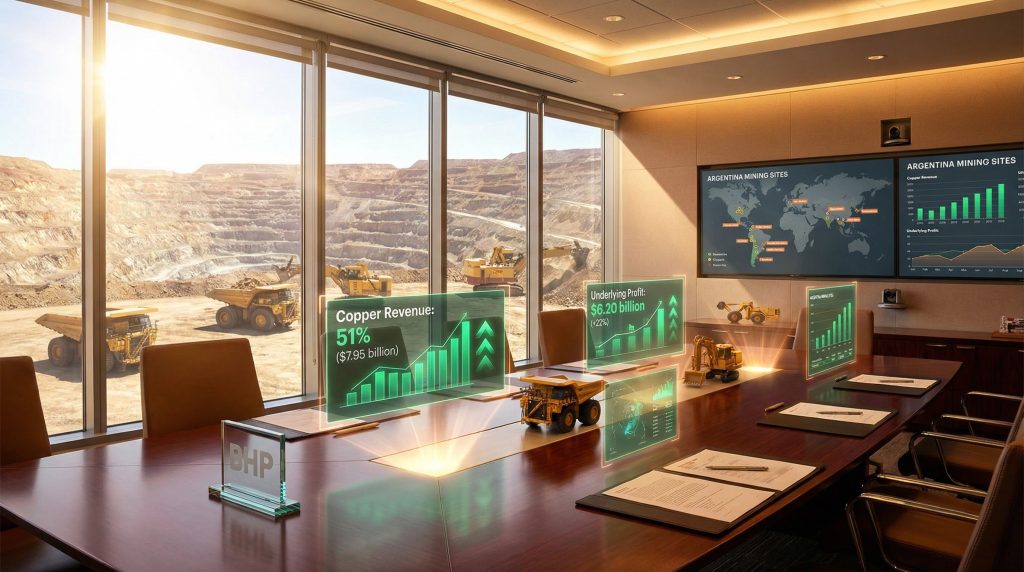
For the first time in operational history, copper operations (including by-products) contributed $7.95 billion to BHP's operating earnings, surpassing iron ore's $7.50 billion contribution. This represents 51% of total underlying operating earnings of $15.46 billion, marking a fundamental shift in the company's earnings profile.
This transformation reflects both commodity price appreciation and strategic positioning decisions made over multiple years. Furthermore, the copper-centric growth strategy anticipates continued demand strength from infrastructure modernisation, electric vehicle adoption, and renewable energy system deployment.
Long-term Production Capacity Planning
Strategic Growth Timeline Analysis:
- 2025-2030 Period: Potash and iron ore production expansion
- Post-2030 Growth: Copper production becomes primary expansion driver
- Argentine Operations: Target 500,000+ tonnes annually at peak output
- Geographic Diversification: Reduced dependency on single-region operations
This timeline structure provides near-term cash generation through established commodity operations while positioning for long-term structural demand growth in copper markets. However, similar strategic planning can be observed in other significant mining projects, such as the Tamarack Project insights which demonstrate comparable approaches to resource development.
Technology Infrastructure Demand Drivers
Copper's centrality to growth planning reflects its essential role in multiple technology infrastructure categories:
Critical Applications:
- Data centre electrical infrastructure and connectivity systems
- Renewable energy generation equipment (solar panels, wind turbines)
- Electric vehicle powertrain systems and charging infrastructure
- Smart grid development and energy storage integration
These applications represent decades of sustained demand growth, contrasting with traditional construction-driven copper consumption that correlates with economic cycles.
Financial Performance and Capital Allocation Results
Operational Excellence Metrics
BHP's recent financial performance demonstrates the effectiveness of disciplined capital allocation strategies. First-half underlying attributable profit reached $6.20 billion, representing 22% growth compared to the prior period and exceeding analyst consensus expectations of $6.03 billion.
The interim dividend of 73 cents per share substantially exceeded market expectations of 63 cents, indicating strong cash generation capabilities that support both shareholder returns and organic growth investment. Consequently, this performance level provides financial flexibility for pursuing strategic opportunities without compromising dividend consistency.
Asset Monetisation Strategy
The $4.3 billion silver streaming agreement with Wheaton Precious Metals represents part of a broader $10 billion asset monetisation program. This approach generates capital for organic growth projects without equity dilution or debt increase, maintaining balance sheet strength while funding expansion initiatives.
Asset monetisation provides capital recycling opportunities that optimise portfolio composition while funding high-return development projects. Therefore, this strategy enables simultaneous debt reduction, dividend maintenance, and growth investment without compromising financial stability.
The next major ASX story will hit our subscribers first
Geopolitical Considerations in Strategic Planning
How Do Trade Tensions Affect Mining Strategies?
Cross-border mining transactions face increasing regulatory scrutiny related to critical mineral security, foreign investment restrictions, and environmental compliance requirements. These factors influence the relative attractiveness of organic development versus acquisition strategies, particularly for copper and battery mineral projects. Understanding trade war impacts becomes crucial for strategic planning in this environment.
Recent regulatory developments emphasise supply chain security for strategic minerals, creating both opportunities and constraints for international expansion strategies. However, companies must balance growth ambitions with compliance requirements across multiple jurisdictions.
Supply Chain Resilience Requirements
Growing emphasis on critical mineral supply security drives strategic focus toward copper and battery metals development. Government policies increasingly favour domestic or allied nation production capacity, influencing location decisions for major development projects.
This environment creates competitive advantages for companies with development capabilities in politically stable jurisdictions, supporting organic growth strategies over acquisition-dependent expansion in challenging regulatory environments.
Risk Management Through Strategic Flexibility
Scenario Planning Framework
Modern mining capital allocation incorporates multiple scenario analysis to ensure strategic resilience across different market outcomes:
Scenario Outcome Analysis:
- High Copper Demand Environment: Organic projects deliver substantial returns
- M&A Opportunity Emergence: Financial flexibility enables selective acquisitions
- Commodity Market Downturn: Reduced capital commitments protect cash flows
- Technology Disruption Events: Partnership structures provide adaptation pathways
This multi-scenario approach ensures strategic positioning remains effective regardless of external market developments or technological changes.
Operational Flexibility Maintenance
BHP merger and acquisition strategy maintains operational flexibility through diversified development options and partnership structures. Rather than committing to single pathways, the company develops multiple growth options that can be accelerated, deferred, or restructured based on market conditions.
This flexibility proves particularly valuable during commodity cycles, regulatory changes, or technology disruptions that might render single-option strategies vulnerable to external shocks.
Partnership Models and Risk Distribution
Joint Venture Strategic Benefits
Strategic partnerships enable access to large-scale opportunities while sharing capital requirements, operational risks, and technical expertise. Joint venture structures prove particularly effective for projects requiring specialised regional knowledge or technically challenging development profiles.
Additionally, partnership models also provide political risk mitigation in emerging markets, regulatory compliance support in complex jurisdictions, and operational expertise sharing that enhances project execution probability.
Technology and Expertise Integration
Joint ventures facilitate combination of complementary capabilities that individual companies might lack. These arrangements enable operational excellence through expertise sharing, technology integration, and best practice adoption across partner organisations.
The partnership approach creates competitive advantages that pure acquisition or organic development strategies might not deliver, particularly for projects requiring diverse technical capabilities or market access.
Long-term Value Creation Strategy
Sustainable Growth Framework
BHP merger and acquisition strategy balances immediate shareholder returns through consistent dividends with long-term growth investments in strategic commodities. This approach creates sustainable value generation across market cycles while maintaining financial discipline.
The framework prioritises cash generation through operational excellence, selective capital deployment in high-return projects, and strategic flexibility maintenance through diversified development options. Furthermore, this methodology has influenced how other major mining companies approach merger and acquisition strategies, creating industry-wide strategic evolution.
Market Cycle Resilience
Strategic positioning across multiple commodities, development timelines, and geographic regions provides resilience during market volatility. The company maintains growth momentum during favourable markets while protecting cash flows and balance sheet strength during downturns.
This cycle management capability enables consistent strategic execution regardless of external market conditions, creating competitive advantages over more narrowly focused competitors.
Disclaimer: This analysis incorporates forward-looking statements and strategic projections that involve inherent uncertainties. Commodity markets, regulatory environments, and technology developments may differ materially from current expectations. Investment decisions should consider multiple scenarios and professional advisory consultation.
Mining industry investments involve substantial risks including commodity price volatility, regulatory changes, operational challenges, and geopolitical factors. Historical performance does not guarantee future results, and strategic frameworks may require adjustment based on evolving market conditions.
Ready to Capitalise on Major Mineral Discoveries?
Discovery Alert's proprietary Discovery IQ model delivers real-time notifications on significant ASX mineral discoveries, instantly transforming complex geological announcements into actionable investment opportunities. Explore Discovery Alert's discoveries page to understand how historic mineral discoveries have generated substantial market returns, and begin your 14-day free trial today to position yourself ahead of the market.