June 9, 2026
Market Dynamics Reshaping Aluminum Production Economics
The global aluminum industry faces unprecedented structural shifts as electrification accelerates, trade policies evolve, and supply chains adapt to geopolitical realities. Production economics increasingly favor companies capable of navigating complex operational challenges while capitalising on emerging demand patterns across aerospace, automotive, and infrastructure sectors.
Against this backdrop, Emirates Global Aluminium's 2025 financial performance illustrates the tensions between operational excellence and upstream asset risk management. The company's results demonstrate how modern aluminum producers must balance vertical integration strategies with market access positioning to maintain competitive advantage.
When big ASX news breaks, our subscribers know first
Operational Performance Metrics Reveal Strategic Positioning
Emirates Global Aluminium delivered mixed financial signals in 2025, with underlying operational strength masked by significant upstream asset impairments. The company's core smelting operations demonstrated remarkable resilience, achieving record production volumes while managing substantial supply chain disruption.
Core Financial Performance Analysis:
| Metric | 2025 Result | 2024 Comparison | Year-over-Year Change |
|---|---|---|---|
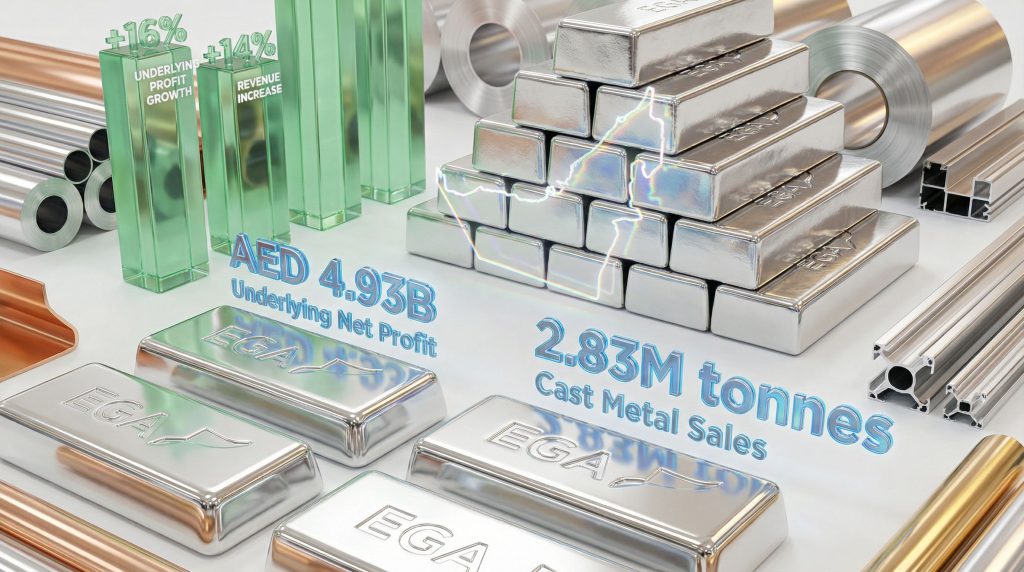
| Underlying Net Profit (ex-Guinea) | AED 4.93B ($1.34B) | AED 4.25B ($1.16B) | +16% |
| Reported Net Profit | AED 2.12B ($577M) | AED 2.62B ($713M) | -19% |
| Cast Metal Sales Volume | 2.83M tonnes | 2.77M tonnes | +2.2% |
| Total Revenue | AED 31.98B ($8.71B) | AED 28.07B ($7.64B) | +14% |
| EBITDA | AED 9.28B ($2.53B) | AED 8.67B ($2.36B) | +7% |
The divergence between underlying and reported profitability reflects the materialisation of geopolitical risk in Guinea, where mining concession revocation eliminated a significant upstream asset. This USD 765 million impairment charge highlights the vulnerability of resource-control strategies in politically volatile regions, particularly in sectors where bauxite project benefits are subject to regulatory and political changes.
Premium Product Portfolio Drives Margin Protection
EGA's strategic focus on value-added aluminum products provided critical earnings protection during 2025's supply chain volatility. The company achieved an 81% premium product classification across total sales volume, representing a sophisticated shift away from commodity-only production models.
Premium Product Categories:
• High-strength aerospace-grade alloys commanding 15-25% price premiums
• Automotive body sheet for lightweight vehicle construction
• Consumer electronics components requiring precise specifications
• Infrastructure-grade conductors benefiting from copper substitution trends
This product mix optimisation reflects deliberate commercial positioning rather than market accident. Premium aluminum products maintain superior margin sustainability during commodity price downturns, as customers prioritise supply security over absolute pricing.
Record Production Despite Supply Chain Stress
The achievement of 2.83 million tonnes in annual sales, despite upstream bauxite supply disruption, demonstrates EGA's operational sophistication. This record performance resulted from multiple efficiency improvements implemented across the company's smelting portfolio.
Operational Excellence Indicators:
• AED 235 million in systematic cost improvements across facilities
• Enhanced capacity utilisation rates maximising existing smelting infrastructure
• Energy efficiency gains reducing power consumption per tonne produced
• Labour productivity optimisation through automation and process enhancement
The simultaneous achievement of volume growth and cost reduction indicates management's ability to extract operational leverage from existing asset base. However, this success occurred even while managing external supply chain challenges, which reflects broader trends in mining industry evolution.
Aluminum Pricing Dynamics Support Revenue Expansion
Global aluminum market conditions provided favourable pricing support throughout 2025, contributing significantly to EGA's revenue performance. The London Metal Exchange base price averaged $2,610 per tonne, representing a 9.1% increase from 2024's $2,392 per tonne average.
Regional Premium Analysis:
| Region | 2025 Average Premium | 2024 Comparison | Primary Market Driver |
|---|---|---|---|
| Japan (MJP) | $125/tonne | $145/tonne (-13.8%) | Supply chain normalisation |
| Europe (MB) | $250/tonne | $315/tonne (-20.6%) | Energy cost stabilisation |
| United States (MW) | $1,300/tonne | $425/tonne (+205.9%) | Import tariff escalation |
United States Tariff Policy Creates Market Disruption
The most dramatic regional pricing development occurred in the United States, where import tariff implementation drove the Midwest duty-paid premium from approximately $500 per tonne to above $2,000 per tonne by year-end. This 205.9% premium escalation represents a fundamental structural shift in US aluminum market dynamics.
Tariff Impact Timeline:
• Early 2025: MW premium maintained historical $425-500/tonne range
• Mid-year: Tariff implementation begins driving scarcity premiums
• Year-end: Peak pricing exceeded $2,000/tonne on import restrictions
• Annual average: $1,300/tonne representing new structural pricing level
This tariff impact analysis reveals both opportunities and challenges for EGA. While existing customers face higher input costs, the company's strategic US smelter investment with Century Aluminum positions for future tariff protection benefits. Furthermore, these developments align with broader US tariff implications affecting global commodity markets.
Japanese Premium Volatility Reflects Seasonal Demand
The Japanese premium exhibited significant intra-year volatility, ranging from approximately $65 per tonne in August to $220 per tonne during early months. This variation reflects:
• Seasonal automotive production scheduling affecting aluminum consumption
• Japanese steel mill capacity utilisation rates driving regional demand
• Supply adequacy fluctuations based on shipping logistics and inventory management
The annual average of $125 per tonne, down from $145 per tonne in 2024, suggests regional supply-demand balance normalisation following post-pandemic disruptions.
Guinea Bauxite Disruption Exposes Upstream Integration Risk
The revocation of Guinea Alumina Corporation's mining concession represents the most significant strategic challenge in EGA's 2025 performance. The $765 million impairment charge fundamentally altered the company's upstream positioning and forced comprehensive supply chain restructuring.
Guinea Disruption Impact Analysis:
| Impact Category | 2025 Effect | Strategic Response |
|---|---|---|
| Financial Charge | $765M impairment | Asset write-down completion |
| Supply Security | 70%+ alternative sourcing implemented | Geographic diversification |
| Operational Continuity | Minimal production disruption | Flexible procurement strategy |
Alternative Sourcing Strategy Implementation
EGA successfully redirected bauxite procurement to alternative sources, securing over 70% of requirements through diversified supply channels. This rapid supply chain adaptation demonstrates operational agility but potentially impacts competitive cost positioning.
Primary Alternative Sources:
-
Australia: Established bauxite exporter with reliable supply chains but higher transport costs to UAE facilities
-
Ghana: Emerging bauxite producer offering cost advantages but requiring infrastructure development support
-
Brazil: Major global producer with mature supply relationships but extended ocean transit requirements
Each alternative source carries distinct cost structures, quality specifications, and supply reliability profiles, requiring sophisticated procurement management to optimise total delivered cost.
Geopolitical Risk Reassessment
The Guinea situation exposed limitations of upstream integration strategies in governance-challenged jurisdictions. EGA's significant capital investment in bauxite mining and alumina production was designed to:
• Secure long-term raw material supply at cost-advantaged rates
• Control vertical margins across the bauxite-to-aluminum value chain
• Reduce supply chain dependency through integrated operations
However, the concession revocation demonstrates how geopolitical risk can eliminate entire upstream assets with minimal advance notice, regardless of operational performance or capital investment levels.
Cash Flow Performance Demonstrates Financial Resilience
Despite the Guinea asset impairment, EGA maintained robust cash generation capabilities throughout 2025. Underlying operating cash flow reached AED 8.27 billion ($2.25 billion), with cash conversion ratios improving to 80% from 64% in the previous year.
Financial Strength Indicators:
"EGA's ability to maintain strong cash generation while absorbing a $765 million asset write-down demonstrates the underlying quality of its core smelting operations and market positioning."
• Total Debt Reduction: Decreased to AED 14.08 billion from AED 15.96 billion
• Leverage Metrics: Net debt-to-EBITDA maintained at healthy 1.35x ratio
• Dividend Distribution: AED 3.7 billion payment representing 75% of underlying profit
• Debt Service: Completed scheduled repayments totalling AED 2.5 billion plus GAC loan retirement of AED 1.94 billion
Capital Allocation Strategy Signals Management Confidence
The simultaneous achievement of substantial debt reduction and 75% dividend payout ratio suggests management confidence in long-term cash generation sustainability. This capital allocation approach indicates:
• Strong conviction in underlying business model resilience
• Adequate liquidity management during supply chain transition
• Shareholder value prioritisation despite upstream challenges
However, the decision to maintain high dividend distribution during a year marked by significant asset impairment raises questions about optimal capital preservation versus return strategies.
Strategic Positioning for Future Market Evolution
EGA's 2025 performance reflects a fundamental strategic recalibration from resource-control positioning toward market-access and operational excellence focus. This shift manifests across multiple business development initiatives designed to enhance competitive positioning.
United States Market Entry Strategy
The partnership with Century Aluminum to develop America's first new primary aluminum smelter in over four decades represents strategic market positioning rather than capacity expansion alone. The proposed 750,000-tonne annual capacity facility, with EGA holding a 60% ownership stake, provides multiple competitive advantages.
US Smelter Strategic Benefits:
• Tariff Protection: Domestic production avoids import duties affecting international competitors
• Market Proximity: Reduced transportation costs and improved customer service capabilities
• Supply Chain Security: Local production reduces logistics complexity and delivery risk
• Regulatory Advantage: Domestic operations benefit from "Buy American" preferences in infrastructure spending
This investment prioritises market access over raw material control, representing a strategic pivot following the Guinea disruption.
Low-Carbon Product Portfolio Expansion
EGA achieved 70% growth in low-carbon aluminum sales, reaching 196,000 tonnes annually through its CelestiAL (solar-produced) and RevivAL (recycled) product lines. This expansion addresses increasing customer focus on Scope 3 emissions reduction requirements, aligning with broader mining reclamation trends across the industry.
Sustainability Market Positioning:
• Premium Pricing: Low-carbon products command price premiums over standard aluminum
• Customer Retention: Sustainability positioning strengthens relationships with environmentally conscious customers
• Regulatory Compliance: Products help customers meet increasingly stringent environmental reporting requirements
• Market Differentiation: Sustainability focus distinguishes EGA from commodity-focused competitors
Recycling Platform Geographic Expansion
The company expanded recycling operations across multiple geographic markets, including new capacity in the United States, expanded UAE facilities, and planned major expansion of the Leichtmetall facility near Hannover, Germany.
Recycling Strategy Advantages:
• Raw Material Security: Reduces primary bauxite dependency following Guinea disruption
• Energy Efficiency: Recycled aluminum production requires 95% less energy than primary production
• Customer Demand: Automotive and packaging customers increasingly specify recycled content requirements
• Regulatory Trends: Circular economy policies favour recycling-capable producers
The next major ASX story will hit our subscribers first
Structural Demand Drivers Support Long-Term Growth
EGA's strategic positioning benefits from multiple secular trends driving aluminum demand growth across key end-market applications. These structural drivers provide fundamental support for the company's operational focus shift.
Electrification Megatrend Impact
Electric vehicle adoption creates significant aluminum demand growth opportunities, as each EV requires approximately three times more aluminum content than traditional internal combustion engines. This demand increase stems from:
• Battery Housing: Aluminum structures provide lightweight protection for lithium-ion battery systems
• Heat Management: Superior thermal conductivity enables efficient battery cooling systems
• Weight Reduction: Aluminum body panels offset battery weight while maintaining vehicle performance
• Charging Infrastructure: Aluminum components essential for charging station construction and electrical distribution
Copper Substitution Acceleration
Aluminum's price advantage over copper (approximately one-third the cost per pound) drives accelerating substitution across electrical applications. Key substitution opportunities include:
Power Infrastructure Applications:
• Electrical transmission lines benefiting from aluminum's conductivity-to-weight ratio
• Distribution transformers utilising aluminum windings for cost reduction
• Renewable energy interconnection requiring extensive conductor installations
• Grid modernisation projects prioritising cost-effective materials
Aerospace and Defence Demand Growth
The aerospace sector provides significant addressable market expansion, driven by commercial aircraft production recovery and defence spending increases. Aluminum's role in aerospace applications includes:
• Commercial Aviation: Boeing and Airbus production ramp-up following pandemic recovery
• Defence Applications: Military aircraft and missile system production increases
• Space Technology: Satellite and launch vehicle construction utilising specialised aluminum alloys
• Infrastructure Support: Airport and maintenance facility construction requiring aluminum components
Investment Analysis Framework
EGA's mixed 2025 results require nuanced interpretation distinguishing between operational performance and asset valuation events. The Emirates Global Aluminium net profit slip in reported earnings masks underlying business model resilience and strategic positioning improvements.
Risk-Adjusted Performance Assessment
Operational Excellence Metrics:
• Record sales volume achievement (+2.2%) despite supply chain disruption
• Premium product mix expansion (81% classification) protecting margin quality
• EBITDA growth (+7%) demonstrating earnings power sustainability
• Cash conversion improvement (80% vs. 64%) indicating working capital optimisation
Strategic Risk Factors:
• Geographic concentration in Middle East operations creating political risk exposure
• Supply chain vulnerability highlighted by Guinea disruption requiring ongoing management
• Capital intensity of aluminum production limiting operational flexibility during market downturns
• Energy cost sensitivity affecting competitive positioning relative to low-cost producers
Investment Thesis Evaluation
Bull Case Fundamentals:
-
Structural Demand Growth: Electrification and infrastructure renewal driving long-term volume increases
-
Premium Product Focus: Value-added positioning provides margin protection and customer loyalty
-
Geographic Diversification: US smelter investment reduces Middle East concentration risk
-
Sustainability Leadership: Low-carbon product portfolio addresses customer environmental requirements
Bear Case Considerations:
-
Upstream Integration Risk: Guinea situation demonstrates asset vulnerability in volatile jurisdictions
-
Trade Policy Exposure: Tariff changes can dramatically alter regional competitive dynamics
-
Energy Cost Inflation: Rising power costs potentially erode UAE-based production advantages
-
Capital Requirements: Growth investments require substantial cash flow allocation reducing shareholder returns
Strategic Outlook and Market Positioning
EGA's 2025 performance illustrates the evolution of modern aluminum production strategy, where operational excellence and market access increasingly outweigh vertical integration and resource control. The company's strategic recalibration positions it for multiple growth scenarios while reducing exposure to single-country political risk.
Future Competitive Positioning:
• Technology Leadership: Next-generation smelting technology development maintaining cost competitiveness
• Market Access: US operations providing tariff protection and customer proximity benefits
• Sustainability Differentiation: Low-carbon products commanding premium pricing in environmentally conscious markets
• Supply Chain Flexibility: Diversified sourcing reducing dependency on politically volatile regions
According to EGA's latest financial report, the Emirates Global Aluminium net profit slip in 2025 reflects the materialisation of previously underestimated geopolitical risk rather than fundamental business model deterioration. Strong underlying operational metrics suggest the company's strategic pivot toward market access and operational excellence provides sustainable competitive advantages in evolving global aluminum markets.
Furthermore, industry analysts at MarketScreener emphasise that the company's underlying performance remains robust despite external challenges. This perspective supports the view that EGA's operational fundamentals continue to demonstrate resilience even while navigating complex geopolitical circumstances.
Disclaimer: This analysis is based on publicly available financial information and should not be considered investment advice. Aluminum commodity prices, geopolitical developments, and regulatory changes can significantly impact company performance. Investors should conduct independent research and consider their risk tolerance before making investment decisions.
Looking for Opportunities in Global Aluminium Markets?
Discovery Alert's proprietary Discovery IQ model delivers real-time alerts on significant ASX mineral discoveries, instantly empowering subscribers to identify actionable opportunities ahead of the broader market. Begin your 14-day free trial today and secure your market-leading advantage.