August 22, 2026
Market Dynamics and Supply-Demand Fundamentals Drive Price Trajectory Forecasts
Oil markets operate within complex ecosystems where production capabilities, inventory accumulations, and demand patterns create intricate pricing mechanisms. The global petroleum industry currently faces a critical juncture where supply growth trajectories are outpacing consumption increases, creating conditions that fundamentally reshape price expectations across multiple forecast horizons. Understanding these dynamics requires examination of how market participants respond to inventory builds, floating storage economics, and strategic stockpile policies that influence both spot prices and forward curve structures.
The interaction between observable and hidden inventory patterns creates particularly significant implications for price discovery mechanisms. When crude oil accumulates in floating storage or strategic reserves rather than visible commercial inventories, market signals become distorted, often leading to price movements that appear disconnected from traditional supply-demand indicators.
When big ASX news breaks, our subscribers know first
Understanding the EIA's 2026-2027 Brent Price Trajectory
Projected Price Decline Patterns and Market Structure Implications
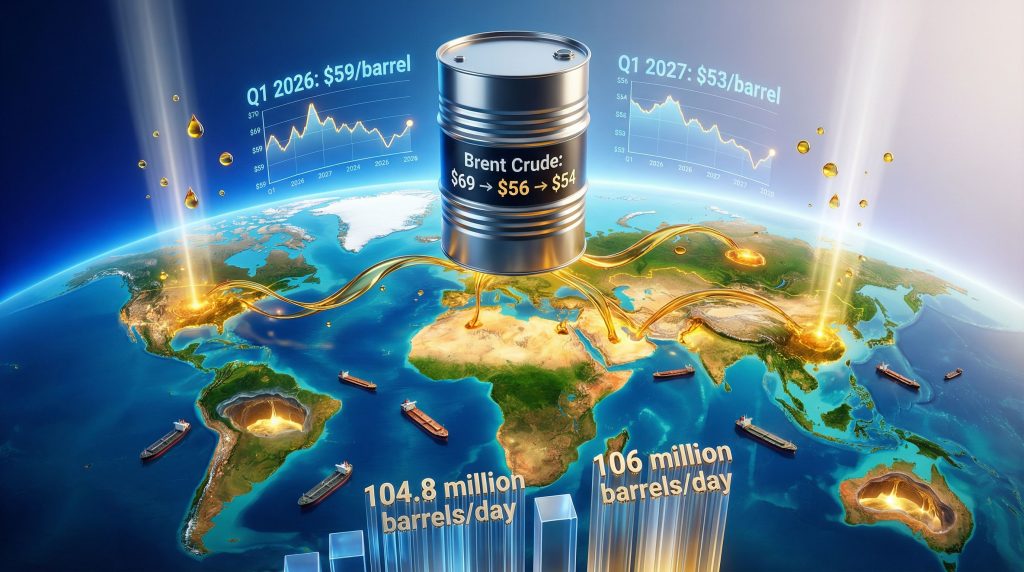
The Energy Information Administration's latest forecasting models indicate substantial downward pressure on Brent crude prices through 2027, with EIA Brent price forecast 2026 2027 projections showing a decline from $69.04 per barrel in 2025 to $55.87 per barrel in 2026, followed by further reduction to $54.02 per barrel in 2027. This represents a 19% decrease from current levels to the 2026 forecast and a 22% total decline by 2027.
Furthermore, the quarterly progression reveals accelerating downward momentum throughout 2026, beginning at $58.93 per barrel in Q1 and declining to $53.34 per barrel by Q4. The 2027 trajectory shows stabilisation, with prices hovering between $53-55 per barrel across all quarters, suggesting market equilibrium at significantly lower levels than recent historical averages.
Market Structure Evolution and Contango Dynamics
These price forecasts reflect fundamental shifts in market structure, particularly the development of contango conditions where near-term prices trade below forward delivery prices. Such conditions typically emerge when supply exceeds immediate demand requirements, creating economic incentives for market participants to store crude oil rather than sell immediately.
The EIA's analysis indicates that lower near-term oil prices relative to future delivery contracts will encourage strategic storage accumulation until supply-demand imbalances moderate. Consequently, this storage dynamic becomes self-reinforcing, as increased storage demand temporarily supports prices whilst simultaneously building future supply overhang.
Global Production Dynamics Reshaping Market Balance
OPEC+ Strategy and Production Target Adherence
OPEC+ coordination mechanisms face increasing complexity as member countries navigate between collective production discipline and individual economic pressures. Current projections suggest the organisation will produce approximately 0.9 million barrels per day below stated targets in 2026, though this shortfall reflects structural challenges rather than strategic curtailment decisions.
Key Production Dynamics by Member Category:
- Core OPEC Members: Nine countries subject to production targets expected to maintain close adherence to stated quotas
- Underperforming Members: Russia and Mexico facing systematic production challenges due to sanctions and declining productivity respectively
- Strategic Capacity Assessment: 2027 production targets dependent on Q4 2026 evaluations of sustainable capacity levels
The organisation's January 2026 reaffirmation of flat first-quarter production plans, combined with provisions for future adjustments, signals recognition that market conditions may require extended production restraint beyond current planning horizons.
Non-OPEC+ Supply Growth and Regional Variations
Global oil production growth patterns reveal significant regional disparities that collectively contribute to market oversupply conditions. For instance, South American production, particularly from countries like Guyana and Brazil, continues expansion programmes that add substantial volumes to global markets.
Regional Production Growth Analysis:
| Region | 2026 Growth (mb/d) | 2027 Growth (mb/d) | Primary Drivers |
|---|---|---|---|
| OPEC+ Coalition | +1.4 | +0.2 | Coordinated production increases |
| South America | +0.3 | +0.4 | Offshore capacity expansions |
| North America | -0.1 | -0.3 | Shale decline rate acceleration |
| Other Non-OPEC+ | +0.2 | +0.1 | Marginal field developments |
Geopolitical Supply Disruption Scenarios
Venezuelan production disruptions currently remove approximately 0.6 million barrels per day from global markets, with equivalent production capacity shuttered due to sanctions enforcement. These volumes, which would primarily serve Chinese markets under normal conditions, represent significant supply-side uncertainty that could materially alter price trajectories.
Critical Market Risk: Any relaxation of Venezuelan sanctions or policy changes could introduce additional downward price pressure by returning substantial production volumes to global markets during a period of existing oversupply.
Demand Fundamentals and Market Structure Evolution
Global Consumption Patterns and Growth Trajectories
Oil demand dynamics reveal a complex picture where overall growth continues despite efficiency improvements and energy transition initiatives in developed economies. Global consumption is projected to reach 104.8 million barrels per day in 2026 with 1.1 mb/d year-over-year growth, accelerating to 106 million barrels per day in 2027 with enhanced 1.3 mb/d growth.
This demand growth acceleration in 2027 reflects several factors:
- Emerging market consumption: Continued industrial development and transportation fuel requirements
- Economic recovery momentum: Post-recession demand normalisation in key consuming regions
- Strategic stockpile building: Government and commercial inventory accumulation programmes
- Seasonal consumption patterns: Weather-driven heating and cooling fuel demands
China's Strategic Stockpiling Impact on Market Dynamics
China's strategic petroleum reserve building represents one of the most significant demand-side factors supporting global oil markets during periods of inventory accumulation. The country maintains stockpile building rates of approximately 1.0 million barrels per day throughout 2026, with plans to reduce this rate by nearly one-third in 2027.
This strategic stockpiling serves multiple market functions:
- Price support mechanism: Removes surplus volumes from commercial markets during oversupply periods
- Strategic security enhancement: Builds energy independence capabilities for geopolitical contingencies
- Economic stabilisation: Provides counter-cyclical demand during price weakness
- Market timing optimisation: Allows accumulation during favourable price environments
Inventory Accumulation Patterns and Storage Economics
Global oil inventory builds averaging 2.8 million barrels per day in 2026, moderating to 2.1 million barrels per day in 2027, reflect the fundamental supply-demand imbalance driving price weakness. However, the geographic and structural distribution of these inventories creates important market nuances.
Inventory Build Characteristics:
- Floating storage increases: Growing volumes in transit creating hidden supply pressure
- Strategic vs. commercial: Government stockpiles versus market-driven accumulation
- Geographic distribution: Regional variations in storage capacity and utilisation
- Observable inventory gaps: Disconnect between estimated builds and visible storage statistics
Investment and Industry Implications
Capital Allocation Strategies in Lower Price Environment
Energy companies operating in sustained lower price environments typically implement several strategic adjustments to maintain financial viability and shareholder returns. These adaptations become particularly critical when price forecasts indicate multi-year periods below previous planning assumptions.
Operational Efficiency Focus Areas:
- Cost structure optimisation: Emphasis on lowest-cost, highest-return asset portfolios
- Technology deployment acceleration: Enhanced recovery techniques and automation adoption
- Workforce optimisation: Strategic staffing adjustments aligned with reduced activity levels
- Supply chain renegotiation: Leveraging service cost reductions during market weakness
Energy Transition Economics and Competitive Dynamics
Lower oil prices create complex implications for energy transition timing and investment patterns. While reduced fossil fuel costs may slow some renewable adoption rates, they also provide economic breathing room for transition-related investments and infrastructure development.
Transition Impact Analysis:
- Renewable competitiveness: Potential delays in grid-scale solar and wind economics
- Electric vehicle adoption: Slower consumer adoption rates due to lower fuel costs
- Government policy responses: Increased intervention likelihood to maintain climate targets
- Technology investment cycles: Potential shifts in clean energy funding priorities
Risk Scenarios and Market Sensitivity Analysis
What Are the Key Upside Risk Factors?
Despite bearish base-case forecasts, several scenarios could provide significant upward price pressure and disrupt projected trajectories. Understanding these risk factors enables market participants to assess potential volatility ranges and hedge appropriately.
Primary Upside Risk Categories:
- Geopolitical escalation: Middle East tensions affecting critical supply routes and production facilities
- Weather-related disruptions: Hurricane seasons impacting Gulf of Mexico production and refining capacity
- Economic growth surprises: Stronger-than-expected global demand recovery exceeding forecast parameters
- Supply shock events: Unplanned production outages or infrastructure failures in key producing regions
Price Sensitivity Analysis and Variable Impact Assessment
Oil price forecasts demonstrate significant sensitivity to key variables, with relatively small changes in supply-demand fundamentals creating disproportionate price impacts. This sensitivity reflects the inelastic nature of both oil supply and demand in the short term.
Variable Impact Analysis:
| Factor Change | Price Impact Range | Duration | Confidence Level |
|---|---|---|---|
| 1% demand growth variance | ±$3-5/barrel | 6-12 months | High |
| 500,000 bpd supply disruption | $8-12/barrel spike | 2-6 months | Medium |
| China stockpile acceleration | $2-4/barrel support | 12-18 months | High |
| OPEC+ compliance improvement | $5-8/barrel increase | 3-9 months | Medium |
Downside Risk Scenarios and Market Vulnerabilities
Several factors could drive prices below base-case forecasts, potentially creating significant challenges for higher-cost producers and oil-dependent economies. These downside scenarios require particular attention given the already bearish EIA Brent price forecast 2026 2027 baseline.
Critical Downside Drivers:
- Accelerated sanctions relief: Venezuelan and other restricted production returning to markets
- Demand destruction events: Economic recession or pandemic-related mobility restrictions
- Technology disruptions: Faster electric vehicle adoption or autonomous transport deployment
- Strategic stockpile releases: Coordinated government inventory releases during price spikes
The next major ASX story will hit our subscribers first
Strategic Implications for Market Participants
Producer Adaptation Strategies and Operational Excellence
Oil and gas companies facing extended periods of lower prices must implement comprehensive strategic adjustments to maintain profitability and competitive positioning. These adaptations extend beyond simple cost reduction to encompass fundamental business model evolution.
Strategic Adaptation Framework:
- Portfolio optimisation: Focus on highest-margin, most resilient asset bases
- Technology integration: Digital transformation and automation to reduce operating costs
- Financial hedging: Forward price protection strategies for cash flow stability
- Merger and acquisition preparation: Positioning for industry consolidation opportunities
Energy Security Planning and Government Policy Responses
Lower oil prices create both opportunities and challenges for energy-importing nations and their strategic planning processes. Additionally, government responses to sustained price weakness often include adjustments to strategic reserve policies, taxation structures, and energy transition support mechanisms.
Policy Response Considerations:
- Strategic reserve timing: Optimal periods for government stockpile accumulation
- Carbon pricing adjustments: Potential policy changes to maintain transition incentives
- Infrastructure investment: Transportation and storage capacity development priorities
- Supply chain diversification: Reducing dependence on concentrated supply sources
Long-Term Market Structure Evolution
Industry Consolidation Dynamics and Scale Economics
Sustained lower oil prices historically accelerate industry consolidation as financial pressure creates acquisition opportunities and scale economics become increasingly important for survival. Current market conditions suggest potential for significant merger and acquisition activity across multiple segments.
Consolidation Drivers:
- Stressed valuations: Creating attractive acquisition targets for financially strong operators
- Scale economy benefits: Larger operators achieving cost advantages through combined operations
- Technology leverage: Merged entities better positioned for digital transformation investments
- Capital efficiency: Combined companies accessing lower-cost financing for development projects
What Does This Mean for Future Supply Investment?
Lower price forecasts significantly impact long-term supply investment decisions, particularly for high-cost, long-cycle projects that require sustained higher prices for economic viability. This investment reduction creates potential for future supply constraints as current oversupply conditions eventually normalise.
Investment Impact Analysis:
- Offshore project delays: Deep-water developments facing extended evaluation periods
- Shale production responses: US tight oil sensitivity to price signals affecting drilling activity
- International project sanctioning: Reduced approvals for complex, capital-intensive developments
- Technology development funding: Potential reductions in enhanced recovery research and deployment
The current oil price movements environment represents a critical inflection point where short-term oversupply conditions may inadvertently create longer-term supply constraints through reduced investment in future production capacity. Moreover, understanding easing oil prices analysis alongside oil price stagnation factors becomes crucial for market participants positioning themselves appropriately.
Furthermore, recent developments in Saudi exploration licenses and the broader US‑China trade war impact on global markets demonstrate the interconnected nature of geopolitical factors and energy market dynamics. Market participants who understand these relationships and position appropriately may find significant opportunities as market cycles eventually normalise.
According to recent EIA analysis, the agency continues to refine its forecasting models to account for evolving market conditions and supply-demand fundamentals. This ongoing EIA Brent price forecast 2026 2027 revision process ensures that market participants receive updated guidance as new data becomes available and market conditions evolve.
However, the fundamental expectation remains that oversupply conditions will persist through the forecast horizon, creating sustained pressure on oil prices across both WTI and Brent benchmarks. This outlook reflects not only increased production capacity but also the gradual moderation in demand growth rates as energy efficiency improvements and electrification trends continue to influence consumption patterns globally.
Disclaimer: This analysis is based on current market forecasts and available data. Oil market conditions are inherently volatile and subject to rapid change due to geopolitical events, economic shifts, and unforeseen disruptions. Price forecasts should not be considered investment advice, and market participants should conduct independent analysis before making investment decisions.
Ready to Capitalise on Energy Market Opportunities?
While oil markets face significant headwinds, Discovery Alert's proprietary Discovery IQ model identifies actionable mineral discovery opportunities across the ASX that could provide portfolio diversification during volatile energy periods. Explore how major mineral discoveries have delivered exceptional returns by visiting Discovery Alert's discoveries page, and begin your 30-day free trial today to access real-time alerts on significant mineral discoveries.