
July 12, 2026
Market Forces Driving Indonesia's Resource Optimization Strategy
Global battery metals markets face unprecedented transformation as resource-controlling nations adopt strategic supply management frameworks rather than passive price-taking positions. The nickel sector exemplifies this shift, with geological constraints and government intervention creating complex dynamics that traditional forecasting models struggle to capture.
Indonesia's approach to Indonesia nickel supply management represents a calculated response to fundamental resource challenges rather than opportunistic market manipulation. The archipelago nation controls approximately two-thirds of global nickel production, positioning it uniquely to influence pricing through policy mechanisms that extend far beyond conventional mining regulations.
This strategic positioning emerges against a backdrop of declining ore quality, robust electric vehicle adoption, and systematic underestimation of supply constraints by international forecasting organisations. Furthermore, understanding these interconnected forces provides critical insight into emerging investment opportunities across the nickel development sector, particularly when considering critical minerals strategy developments globally.
When big ASX news breaks, our subscribers know first
Indonesia's Multi-Layered Policy Architecture for Supply Control
Indonesia's nickel supply management strategy operates through sophisticated regulatory frameworks designed to maximise resource value extraction while maintaining long-term market influence. The cornerstone mechanism involves systematic permit modifications that enable granular production control on an annual basis.
Core Policy Implementation Timeline:
- August 2025: Mining licence terms reduced from three-year to one-year validity
- September 2025: Multiple smaller operations closed for forestry violations
- December 2025: Substantial per-hectare penalties implemented for compliance failures
- November 2025: Ban announced on new HPAL and NPI processing facilities
The Rencana Kerja & Anggaran Biaya (RKAB) permit system underwent fundamental restructuring to transition from multi-year certainty to annual discretionary approval cycles. This modification provides Indonesian authorities with precise control over production quotas while maintaining legal frameworks that comply with international mining investment agreements.
Resource Quality Degradation as Strategic Driver
The policy intensification directly correlates with measurable geological constraints affecting Indonesia's saprolite ore deposits. These laterite formations, which supply approximately 50% of global nickel production through NPI and matte processing, have experienced significant grade deterioration that necessitates strategic resource preservation.
Technical Processing Classifications:
- HPAL (High-Pressure Acid Leaching): Laterite ore processing producing nickel matte
- NPI (Nickel Pig Iron): Lower-grade nickel product from smelting operations
- Downstream processing: Value-added refining beyond primary metal production
The restriction on new HPAL and NPI facilities while permitting downstream processing expansion represents calculated supply chain optimisation. This approach forces international buyers to invest in higher value-added processing within Indonesia rather than exporting raw materials for processing elsewhere.
Historical Evolution of Indonesian Resource Strategy
Indonesia's current supply management represents the third phase of a decade-long strategy to maximise value capture from finite nickel resources. The progression demonstrates sophisticated understanding of global supply chain dependencies and price formation mechanisms.
Phase 1 (2014-2020): Raw ore export prohibition forced Chinese processing capacity relocation from China to Indonesia, fundamentally restructuring regional supply chains.
Phase 2 (2020-2024): Minimum pricing mechanisms tied to London Metal Exchange benchmarks prevented Chinese industrial buyers from suppressing purchase prices below market levels.
Phase 3 (2025-present): Direct supply management through licensing restrictions and processing facility limitations enables precise production control. Additionally, this phase demonstrates how comprehensive mining permitting insights become crucial for understanding resource development timelines.
Analytical Disconnect Between Forecasts and Observable Market Data
The most significant challenge facing nickel market participants involves the substantial gap between published surplus projections and verifiable physical inventory accumulation. This disconnect creates systematic analytical blind spots that affect institutional investment decisions and strategic planning across the sector.
Inventory Reconciliation Discrepancies
International forecasting organisations report surplus conditions that fundamentally contradict observable market fundamentals. The International Nickel Study Group (INSG) projects annual surplus conditions of approximately 300,000 tonnes for 2025, yet physical inventory data suggests dramatically different supply-demand balances.
| Metric | INSG Projection | Observable Evidence | Variance |
|---|---|---|---|
| Annual Surplus 2025 | 300,000 tonnes | ~100,000 tonnes | 200,000 tonne gap |
| Q4 Monthly Builds | 60,000 tonnes | 10,000 tonnes | 83% overestimate |
| Total Exchange Inventory | Not specified | <300,000 tonnes | Baseline constraint |
Critical Analytical Gap: If substantial surplus inventory existed as projected, market participants maintaining short positions would document and publicise warehouse stockpiles with photographic evidence and detailed location data. The absence of such documentation, combined with minimal inventory builds during reported surplus periods, suggests systematic overestimation of available supply.
Structural Limitations in Traditional Modelling
Conventional nickel market forecasting employs methodologies that inadequately capture Indonesian supply management dynamics. Traditional models assume market-driven optimisation where producers respond to price signals by maximising output, rather than policy-directed resource optimisation that deliberately constrains supply below geological maximums.
Modelling Inadequacies:
- Historical price elasticity assumptions fail to account for government supply discipline
- Capacity-based production estimates ignore ore grade degradation constraints
- Linear trend extrapolation cannot capture policy intervention effects
- Supply/demand balance methodology overlooks strategic resource preservation
These limitations create opportunities for market participants who focus on empirical evidence rather than published projections. Historical patterns suggest forecasting organisations will quietly revise historical figures within 12 months to reconcile observed discrepancies with published estimates.
Electric Vehicle Demand Resilience Despite Regional Policy Variations
Global electric vehicle adoption demonstrates robust momentum that supports sustained nickel consumption growth, particularly for premium battery chemistries requiring high energy density. Regional variations in policy support create nuanced demand patterns, but underlying fundamentals remain positive across major markets outside North America.
Global EV Sales Performance Through November 2025
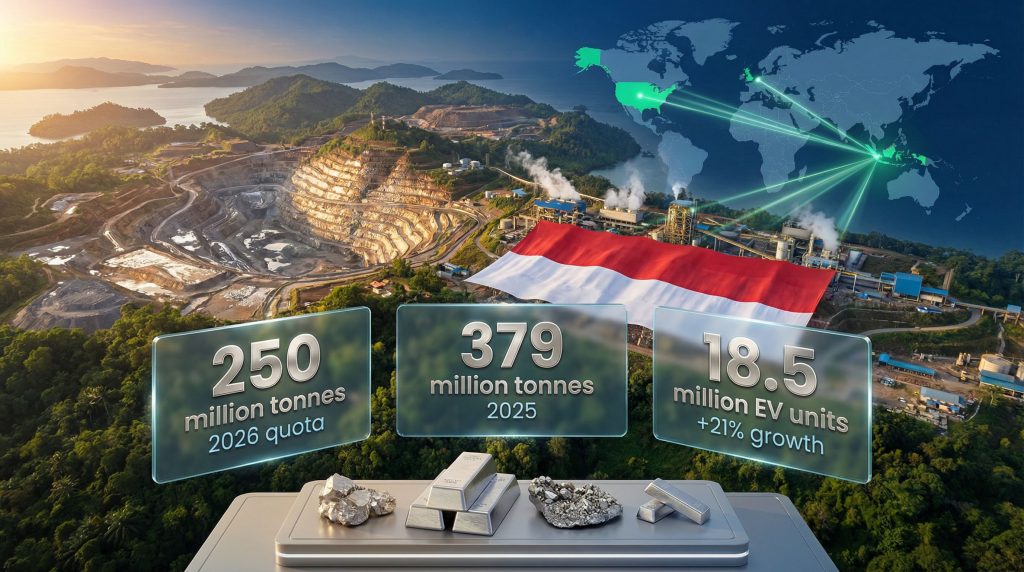
Worldwide electric vehicle sales reached 18.5 million units through November 2025, representing 21% year-over-year growth that exceeded industry expectations despite concerns about demand weakness in specific regions.
Regional Market Performance:
- Europe: 3.8 million units (+33% growth, adjusted for subsidy timing effects)
- China: 11.6 million units (+19% sustained expansion)
- Rest of World: 1.5 million units (+48% emerging market acceleration)
- North America: Declining trajectory (-1% due to policy reversals)
The European growth figure includes timing distortions from subsidy-related demand shifts across 2023-2025, suggesting underlying growth rates closer to 20-25%. Nevertheless, this represents healthy expansion supporting nickel demand for nickel-intensive battery applications, as evidenced by broader North American mining trends analysis.
Battery Chemistry Implications for Nickel Demand
The relationship between EV adoption and nickel consumption involves complex chemistry considerations that extend beyond simple vehicle sales correlations. Lithium Iron Phosphate (LFP) batteries gain market share in cost-sensitive segments but cannot serve applications requiring extended range and performance characteristics.
Battery Technology Segmentation:
LFP (Lithium Iron Phosphate):
- Energy density: ~160-170 Wh/kg
- Nickel content: Zero
- Applications: Urban delivery, short-range vehicles
NCA/NCM (Nickel Cobalt Aluminum/Manganese):
- Energy density: ~200-260 Wh/kg
- Nickel content: 60-80% of cathode material
- Applications: Premium vehicles, long-range segments, commercial/heavy-duty
Vehicle electrification penetration into commercial and heavy-duty segments requires nickel-intensive battery chemistries for performance characteristics that LFP cannot provide. This structural demand supports sustained nickel consumption growth beyond passenger vehicle adoption rates.
Geopolitical Supply Chain Restructuring
North American policy developments create indirect benefits for non-Chinese nickel suppliers through Chinese content restrictions that force automakers to diversify supply chains. The Trump administration's reversal of EV support programmes coincided with strengthened restrictions on Chinese battery materials, benefiting North American and European nickel development projects.
However, the tariffs market impact extends beyond automotive applications, creating broader implications for global nickel trade flows. This dynamic supports premium valuations for projects in politically stable jurisdictions with established mining infrastructure, as automakers seek supply security beyond cost optimisation.
Price Recovery Dynamics and Trajectory Modelling
Nickel pricing experienced significant movement from approximately $14,200 per tonne in mid-November to $16,500 per tonne by late December 2025, representing an advance of $2,200 per tonne that reflects initial market recognition of Indonesian supply discipline effectiveness.
Current Price Recovery Analysis
The November-December price advancement occurred despite broader commodity market weakness, suggesting nickel-specific supply dynamics rather than general inflationary pressures. The timing coincided with Indonesian processing facility restrictions and Canadian government support for major development projects.
Price Progression Framework:
- Current consolidation range: $16,000-$16,500/tonne
- Next advance target: $18,200-$18,500/tonne
- Strategic ceiling: $19,500-$20,000/tonne
At $20,000 per tonne, numerous development projects achieve economic viability, potentially triggering supply responses from alternative jurisdictions. However, legacy operations at century-old mines may face profitability challenges at elevated price levels, creating complex supply response dynamics.
Seasonal Supply Constraints
Philippine ore production experiences significant seasonality that provides natural supply constraints supporting price advancement during the first quarter. Production typically drops to approximately 25% of peak third-quarter levels during January-March due to monsoon weather patterns affecting mining and transportation.
This seasonal constraint coincides with Indonesian supply management measures to create compound supply tightness during traditionally weak demand periods, supporting price stability during market consolidation phases.
Supply Response Threshold Analysis
Indonesian strategy appears focused on testing price elasticity of global supply responses from alternative jurisdictions. The $20,000 threshold represents a critical inflection point where numerous projects achieve investment-grade economics, but timing delays for new supply development provide extended windows for elevated pricing.
Development Timeline Considerations:
- Permitting and construction timelines: 3-5 years minimum
- Community engagement and infrastructure: 2-3 years
- Financing and detailed engineering: 18-24 months
- Environmental impact assessment: 12-18 months
These extended development timelines provide Indonesian policymakers with substantial lead times to adjust supply management strategies before significant new production enters global markets.
Development Projects Benefiting from Strategic Government Support
Well-positioned nickel development projects with government backing demonstrate how strategic resource policies create asymmetric investment opportunities in premier mining jurisdictions. Canada's approach to critical mineral development exemplifies coordinated policy support that reduces development risks and accelerates project timelines.
Canada Nickel's Strategic Government Designation
Canada Nickel Corporation's Crawford project received National-Building Project designation in December 2025, providing substantial government support infrastructure that differentiates it from competing development opportunities globally.
Government Support Framework:
- Dedicated major projects office for financing facilitation
- Accelerated permitting processes targeting 12-month completion
- Federal financing components through existing programmes
- Provincial government coordination for streamlined approvals
The designation provides more than rhetorical support, as both Prime Minister Mark Carney and Natural Resources Minister Tim Hodgson possess investment banking backgrounds with Goldman Sachs experience, creating institutional incentives to demonstrate tangible programme results within 18-month timeframes.
Timmins Nickel District Consolidation Potential
Canada Nickel has developed eight resources across the Timmins Nickel District, containing over 20 million tonnes of nickel across all resource categories. This district-scale opportunity enables template engineering replication similar to First Quantum Mining's African operations strategy that delivered projects 30% cheaper and 25% faster than competitor benchmarks.
District Value Proposition Components:
- Crawford represents initial project with multi-billion dollar potential valuation
- Current market capitalisation: C$300 million (significant valuation gap)
- Multiple larger, higher-quality deposits identified (Reid, Mann West, Midlothian)
- Established infrastructure and community support advantages
Template Engineering Strategy: The company's approach involves standardising processing technology developed for Crawford and replicating it across other district deposits, reducing engineering costs and construction timelines for subsequent projects while maintaining operational consistency.
District Consolidation Investment Thesis
Beyond individual project economics, the Timmins district represents potential consolidation value that significantly exceeds single-project net asset value calculations. Historical precedents demonstrate that major mining companies pay substantial premiums for district-scale opportunities requiring only two competing majors to create bidding dynamics.
Consolidation Value Drivers:
- Premier jurisdiction with political stability and established mining law
- Complete infrastructure access (rail, road, power, skilled workforce)
- Community acceptance and environmental baseline approvals
- Multiple development-ready deposits reducing exploration risk
- Strategic resource positioning amid supply chain security concerns
For district consolidation scenarios, valuations can substantially exceed engineering economics of individual projects, as strategic acquirers value long-term supply security and development pipeline optionality.
The next major ASX story will hit our subscribers first
Geopolitical Factors Reshaping Global Nickel Supply Security
Supply chain security considerations increasingly influence nickel market dynamics as consuming nations prioritise resource access reliability alongside traditional cost optimisation. Indonesia nickel supply management creates opportunities for alternative jurisdiction development while simultaneously demonstrating the strategic value of resource concentration.
Chinese Content Restrictions and Supply Diversification
Strengthened Chinese content restrictions in North American markets force automakers to source battery materials from non-Chinese controlled sources, creating premium demand for projects in allied jurisdictions. This policy shift coincides with Indonesian supply management to support elevated valuations for Western-controlled development projects.
Strategic Supply Chain Implications:
- Automakers require alternative sourcing beyond Chinese-controlled Indonesian operations
- Premium pricing acceptance for politically stable jurisdiction sourcing
- Long-term supply agreement structures favouring development financing
- Government support programmes prioritising domestic processing capability
Furthermore, recent developments such as the critical minerals order demonstrate how policy frameworks evolve to address supply security concerns across essential materials.
Resource Nationalism and Strategic Competition
Indonesian supply management strategy demonstrates how resource-controlling nations increasingly view mineral wealth as strategic assets requiring optimisation rather than market-driven exploitation. This approach influences policy development across other critical mineral producing jurisdictions.
Global Resource Management Trends:
- Argentina lithium processing requirements and export controls
- Australian critical minerals processing incentives and strategic reserve policies
- Canadian critical minerals strategy prioritising domestic value-added processing
- Chilean lithium nationalisation proposals and production quota systems
These trends support sustained premium valuations for development projects that align with consuming nation supply security objectives while maintaining competitive production economics. Consequently, comprehensive analysis of nickel supply chain management complexities becomes essential for understanding long-term market dynamics.
Investment Framework for Nickel Market Transformation
The transition from Chinese industrial price suppression to Indonesian government supply management creates asymmetric investment opportunities characterised by multiple expansion potential and strategic consolidation premiums. Understanding these dynamics enables identification of projects positioned for both near-term price recovery and longer-term strategic value recognition.
Asymmetric Value Opportunity Identification
High-Probability Investment Scenarios:
- Continued Indonesian supply discipline through 2026-2027
- EV demand growth maintenance at 20-25% underlying rates
- Price advancement toward $18,500-$20,000/tonne range
- Government support for strategic resource development projects
Risk-Adjusted Return Analysis:
Projects demonstrating government support, district-scale potential, infrastructure access, and community acceptance offer superior risk-adjusted returns compared to single-asset development opportunities in frontier jurisdictions.
Portfolio Construction Considerations
Primary Investment Criteria:
- Government designation and policy support reducing development risks
- District consolidation potential enabling multiple expansion beyond single-project economics
- Infrastructure advantages reducing capital requirements and development timelines
- Strategic jurisdiction positioning benefiting from supply chain security premiums
Secondary Evaluation Factors:
- Management execution capability and institutional relationships
- Community engagement history and environmental baseline status
- Financing pathway clarity and government programme alignment
- Technical processing advantages and operational cost positioning
Additionally, investors must consider how global mining industry discussions, such as those found in specialized mining forums, provide valuable insights into market sentiment and operational challenges.
Market Psychology and Timing Dynamics
The nickel market demonstrates classic characteristics of sector rotation from oversupply concerns to strategic resource recognition. Investment timing benefits from current valuation discounts while fundamental supply-demand dynamics support sustained price recovery toward development-enabling levels.
Market Sentiment Indicators:
- Analyst forecast discrepancies creating institutional blind spots
- Chinese industrial buyer price suppression ending through Indonesian policy
- Government strategic resource prioritisation across consuming nations
- Supply response lead times providing extended pricing windows
Strategic Market Implications for Long-Term Positioning
Indonesia nickel supply management represents a fundamental shift toward policy-directed resource optimisation that creates sustained opportunities for well-positioned development projects in premier jurisdictions. The combination of declining ore grades, strategic government intervention, and robust global demand establishes multi-year dynamics favouring systematic supply discipline over market-driven optimisation.
Current market pricing reflects initial recognition of these structural changes, but substantial upside potential remains as participants adjust forecasting methodologies to incorporate policy-directed supply management rather than traditional elasticity assumptions. The analytical disconnect between published surplus projections and observable inventory accumulation suggests significant opportunity for empirical analysis over institutional consensus.
For investors, the transition creates particularly attractive scenarios for development projects combining government support, district-scale potential, and strategic jurisdiction advantages. Canada Nickel's Timmins District operations exemplify how coordinated policy support, engineering template replication, and consolidation potential generate valuation opportunities extending beyond individual project economics.
The Indonesian strategy appears sustainable because it aligns with geological constraints while implemented through systematic policy evolution rather than dramatic interventions that could trigger immediate international responses. Combined with strengthening demand fundamentals and development project economics requiring $18,000-$20,000 per tonne for attractive returns, the nickel market setup represents material departure from the suppressed conditions characterising 2024-2025.
Investment positioning benefits from recognition that traditional commodity cycle dynamics increasingly give way to strategic resource competition between nations prioritising supply security alongside economic optimisation. Projects positioned within this framework offer asymmetric opportunity through both near-term price recovery and longer-term strategic consolidation dynamics as major mining companies seek district-scale exposure in politically stable jurisdictions with established community acceptance and infrastructure advantages.
Looking to Capitalise on Strategic Nickel Investment Opportunities?
Discovery Alert's proprietary Discovery IQ model instantly identifies high-potential mineral discoveries across ASX-listed companies, helping investors position themselves ahead of major market movements like those transforming the nickel sector. With Indonesia's supply management strategy creating new dynamics and government-backed projects gaining momentum, subscribers receive real-time alerts on actionable opportunities that could benefit from these structural market changes, ensuring informed decisions when timing matters most.