June 30, 2026
Mars Crude Premium Volatility During Market Disruption Events
Complex market dynamics govern petroleum pricing structures across regional production zones, with medium sour crude grades exhibiting pronounced sensitivity to supply disruption scenarios. Furthermore, mars crude premium swings down patterns reveal how mathematical relationships between benchmark futures contracts and physical crude differentials create cascading adjustment patterns that can reshape entire trading sessions within hours.
Regional crude oil markets demonstrate heightened volatility during geopolitical uncertainty periods, with certain grade classifications experiencing amplified price movements compared to benchmark contracts. However, recent market data illustrates how quickly established premium structures can collapse when supply disruption expectations shift rapidly, creating opportunities to analyse oil price crash dynamics across different market scenarios.
Recent Mars Crude Premium Fluctuations:
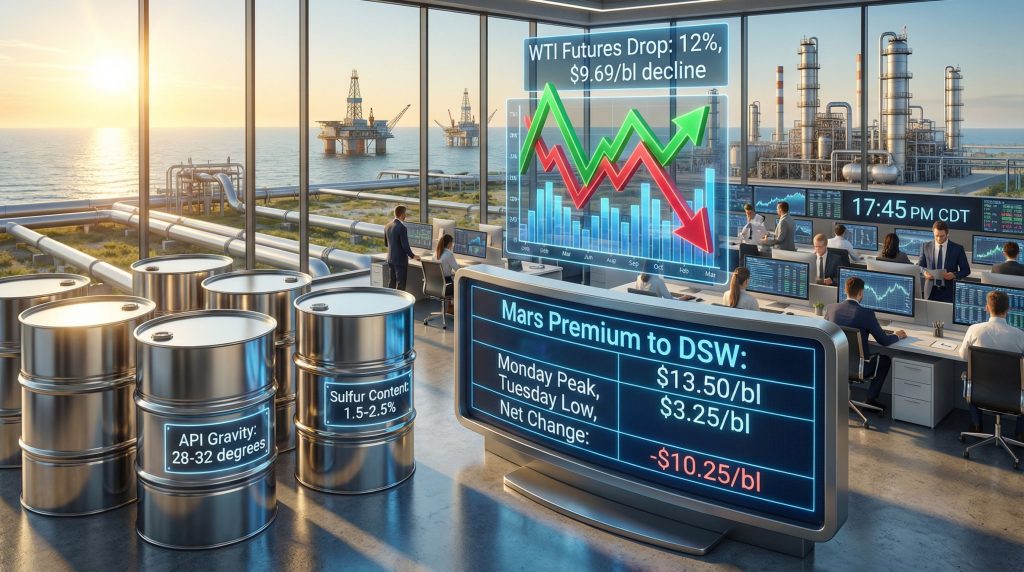
| Metric | Monday Peak | Tuesday Low | Net Change |
|---|---|---|---|
| Mars Premium to DSW | $13.50/bl | $3.25/bl | -$10.25/bl |
| Mars to Ice Brent | $13.80/bl | $2.40/bl | -$11.40/bl |
| WTI Futures Drop | – | 12% | $9.69/bl decline |
The mathematical precision of these adjustments reflects sophisticated algorithmic trading systems responding simultaneously to multiple data streams. Louisiana-delivered Mars crude settled at $87.65/bl, representing approximately $20/bl decline from previous assessments, while the Mars volume-weighted average premium compressed to $4.20/bl, down $8.50/bl from the prior session.
Backwardation Structure Impact on Physical Differentials
The relationship between forward curve structures and physical crude premiums creates specific transmission mechanisms during volatile periods. Consequently, when prompt-month contract prices decline more rapidly than deferred positions, the narrowing backwardation directly pressures regional crude differentials through mathematical pricing formulas embedded in physical contracts.
Key Backwardation Effects:
- Time spread compression: Narrowing prompt-to-deferred spreads
- Physical premium pressure: Mathematical linkage reduces differential values
- Contract settlement mechanics: Forward averaging formulas adjust automatically
- Trading behaviour shifts: Market participants adjust hedging strategies
Southern Green Canyon crude demonstrated this relationship clearly, trading to parity with DSW compared to a $7.07/bl premium in the previous session. This 7+ barrel deterioration within a single trading day illustrates how backwardation changes cascade through quality grade premiums across entire regional production systems, particularly when examining oil price stagnation insights during similar market conditions.
When big ASX news breaks, our subscribers know first
Medium Sour Crude Grade Volatility Amplification Factors
Medium sour crude oils exhibit distinct market behaviour patterns due to their unique quality specifications and competitive positioning relative to global supply sources. These grades compete directly with Middle Eastern production of similar API gravity and sulphur content, creating correlation patterns that amplify during supply uncertainty periods.
Technical Specifications Framework:
- API Gravity Range: 28-32 degrees (medium density classification)
- Sulphur Content: 1.5-2.5% (sour grade designation)
- Distillate Yield: Enhanced diesel and jet fuel production capacity
- Refinery Processing: Optimised for complex configuration facilities
The import substitution effect creates direct price correlation between Gulf of Mexico medium sours and Middle Eastern crude supplies. For instance, market analysis indicates that most US crude imports from conflict regions possess similar quality characteristics to domestic Gulf sour production, establishing a direct competitive relationship that intensifies during geopolitical disruption scenarios.
Distillate Yield Advantage in Supply Disruption Context
Medium sour crude grades provide superior distillate yields compared to lighter alternatives, creating additional value channels during periods when global diesel and jet fuel supplies face constraints. This technical characteristic becomes particularly significant when major distillate-exporting regions experience production disruptions.
Yield Optimisation Benefits:
- Higher diesel output: 2-5% additional distillate yield through complex refining
- Jet fuel production: Enhanced aviation fuel recovery rates
- Seasonal demand matching: Optimal for distillate-heavy demand periods
- Refinery margin enhancement: Premium capture during product shortage scenarios
The eight consecutive daily gains preceding the recent correction period demonstrate how sustained supply concerns can drive medium sour premiums to multi-year highs. These grades reached $13.50/bl premiums before political statements suggesting conflict resolution triggered rapid premium compression to $3.25/bl levels, highlighting patterns similar to recent oil price movements during trade uncertainty.
Algorithmic Trading Systems and Differential Adjustment Mechanisms
Modern energy trading incorporates sophisticated automated systems capable of processing multiple information streams simultaneously, creating rapid adjustment patterns in physical crude differentials that can exceed human reaction capabilities. Furthermore, these systems respond to OPEC production impact decisions with unprecedented speed and precision.
Algorithmic Response Triggers:
- Geopolitical sentiment analysis: Natural language processing of news flows
- Futures price velocity tracking: Momentum-based position adjustments
- Statistical correlation monitoring: Arbitrage opportunity identification
- Volume threshold activation: Liquidity-driven execution protocols
The 12% WTI futures decline to approximately $83/bl triggered immediate algorithmic responses across regional crude pricing systems. However, Permian-quality WTI at Magellan East Houston terminal adjusted from $96.72/bl to $84.88/bl, with premium structures narrowing from $1.95/bl to discussed ranges of $1.25-1.35/bl.
Mathematical Transmission Through Pricing Formulas
Physical crude contracts incorporate mathematical formulas linking futures prices to quality differentials through time-weighted averaging mechanisms. In addition, the narrowing backwardation directly influences these calculations, creating automatic adjustment pressures on physical premiums.
The trade month average pricing structure means that differential adjustments during prompt delivery periods automatically cascade through contract settlement mechanisms, creating systematic pressure on quality premiums when futures curves flatten.
For April delivery contracts, final pricing incorporates the average of May and June Nymex prompt-month settlements combined with differential components, ensuring mathematical linkage between futures curve changes and physical crude values.
Refinery Economics and Gate Value Calculations
Refinery gate values provide the fundamental economic framework for crude premium calculations, reflecting theoretical revenue potential based on current refined product prices and processing yields. These calculations adjust continuously as product markets respond to supply and demand changes.
RGV Calculation Components:
- Product slate optimisation: Gasoline, diesel, jet fuel yield maximisation
- Processing cost variables: Complexity requirements and operational expenses
- Quality upgrade costs: Desulphurisation and hydrotreating investments
- Timing premiums: Seasonal product demand pattern adjustments
Complex refineries achieve higher gate values from medium sour crudes during periods when distillate products command premium pricing. The recent supply disruption scenario created conditions where refineries optimised for maximum diesel and jet fuel output, increasing demand for crude grades providing superior yields in these categories.
Transportation Infrastructure Constraints and Regional Pricing
Pipeline capacity limitations and logistical constraints create regional pricing anomalies that can persist during high volatility periods. Understanding these infrastructure bottlenecks provides crucial context for differential sustainability analysis.
Infrastructure Impact Assessment:
- Pipeline utilisation rates: Capacity constraints during peak production periods
- Storage facility availability: Tank farm limitations affecting prompt delivery options
- Marine transportation logistics: Tanker scheduling and waterborne movement capacity
- Weather-related disruptions: Seasonal factors affecting transportation reliability
The $10-11/bl swing range observed in mars crude premium swings down scenarios reflects not only supply expectations but also the physical infrastructure's ability to accommodate rapid shifts in crude flow patterns. When geopolitical premium unwinds occur rapidly, the existing transportation network must absorb sudden changes in shipping demand and storage requirements.
Strategic Market Implications for Energy Participants
Different market participants face distinct strategic considerations when navigating crude differential volatility periods, requiring specialised risk management approaches and operational flexibility. Consequently, understanding how oil prices ease amid tariffs provides crucial context for strategic planning.
Producer Strategy Framework:
- Differential hedging: Basis risk management through swap instruments
- Quality grade targeting: Production optimisation based on premium forecasts
- Contract structure design: Pricing mechanisms capturing differential value
- Storage timing strategies: Inventory management during premium cycles
Refinery Optimisation Approaches:
- Feedstock flexibility programmes: Crude grade switching capabilities
- Run rate adjustments: Processing optimisation based on margin analysis
- Product inventory management: Strategic refined product storage
- Long-term supply agreements: Contract structures managing differential risk
The volume-weighted average of $3.20/bl for the DSW premium to CMA Nymex, representing the first narrowing in three sessions, indicates how quickly established trading relationships can shift during geopolitical uncertainty periods.
Financial Market Risk Assessment Frameworks
Energy market participants utilise sophisticated correlation analysis and volatility modelling to assess differential risk exposure during geopolitical events. These frameworks incorporate multiple variables beyond simple price movements.
Risk Evaluation Components:
- Historical correlation patterns: Grade-to-grade relationship analysis
- Volatility forecasting models: GARCH applications for differential prediction
- Mean reversion calculations: Long-term equilibrium level identification
- Breakout pattern recognition: Technical signals for differential expansion
The $13.80/bl to $2.40/bl premium swing for Mars relative to Ice Brent represents approximately 11.4 barrels of adjustment within a single trading session, providing quantitative data for risk model calibration and scenario planning exercises.
Technical Analysis Applications in Crude Differential Trading
Statistical relationships between crude grades provide quantitative frameworks for differential trading strategies, incorporating both fundamental supply-demand analysis and technical pattern recognition. Furthermore, recent Mars crude premium analysis provides valuable insights into market behaviour patterns.
Statistical Relationship Analysis:
- Correlation coefficient tracking: Historical relationships between premium structures
- Volatility surface modelling: Options-implied differential expectations
- Regression analysis applications: Causation identification between variables
- Time series decomposition: Seasonal and cyclical pattern isolation
The transition from multi-year highs to compressed premium levels within days illustrates how technical analysis must adapt to accommodate regime changes driven by fundamental shifts in supply expectation scenarios.
Quality Grade Premium Structure Evolution
Long-term shifts in refining configurations and product demand patterns influence the fundamental relationships between crude grades, creating evolving premium structures that require continuous analysis and strategic adjustment.
Premium Structure Drivers:
- Refinery complexity growth: Advanced processing capability expansion
- Product specification evolution: Environmental regulation influence
- Global trade pattern shifts: Supply source diversification impacts
- Technology integration effects: Processing efficiency improvements
The recent $20/bl absolute price decline in Louisiana-delivered Mars crude, combined with differential compression, demonstrates how geopolitical premium cycles can create both absolute and relative value adjustments simultaneously, particularly when mars crude premium swings down patterns align with broader market volatility.
The next major ASX story will hit our subscribers first
Future Evolution of Differential Market Structures
Crude oil differential markets continue evolving in response to technological advancement, infrastructure development, and regulatory framework changes. Understanding these structural trends provides strategic context for long-term market participation.
Structural Development Trends:
- Electronic trading platform expansion: Price discovery mechanism enhancement
- Pipeline network optimisation: Infrastructure capacity improvements
- Refinery technology advancement: Processing flexibility improvements
- Environmental specification changes: Quality requirement evolution
The integration of automated trading systems with physical delivery networks creates increasingly efficient differential adjustment mechanisms, potentially reducing the duration of premium anomalies while potentially increasing their initial magnitude during shock events.
Disclaimer: This analysis incorporates market data and statistical relationships for educational purposes. Crude oil markets involve substantial price volatility and risk. Past performance does not guarantee future results. Market participants should conduct independent analysis and risk assessment before making trading or investment decisions.
Are You Tracking High-Impact Market Opportunities in Energy Sectors?
Whilst crude oil volatility creates significant trading opportunities, mineral discoveries offer even more dramatic potential returns when investors receive immediate notifications. Discovery Alert's proprietary Discovery IQ model delivers real-time alerts on significant ASX mineral discoveries, empowering subscribers to identify actionable opportunities ahead of the broader market and capitalise on major discoveries before widespread market recognition occurs.