
August 11, 2026
Material Economics Reshape HVAC Manufacturing Strategies
Heat exchanger manufacturing has reached a critical inflection point where traditional material hierarchies face unprecedented disruption. The global HVAC industry confronts a complex matrix of commodity price volatility, regulatory mandates, and evolving performance requirements that challenge decades-established copper-centric design philosophies. This convergence creates opportunities for manufacturers willing to fundamentally reimagine thermal management systems through advanced metallurgy and manufacturing processes.
The aluminium-for-copper shift in air conditioning and refrigeration represents more than simple material substitution. It embodies a strategic response to market pressures that demand both cost optimization and performance enhancement across residential and commercial cooling applications. Understanding these dynamics requires examining the technical, economic, and operational factors driving this transformation.
When big ASX news breaks, our subscribers know first
Economic Drivers Behind Material Substitution Strategies
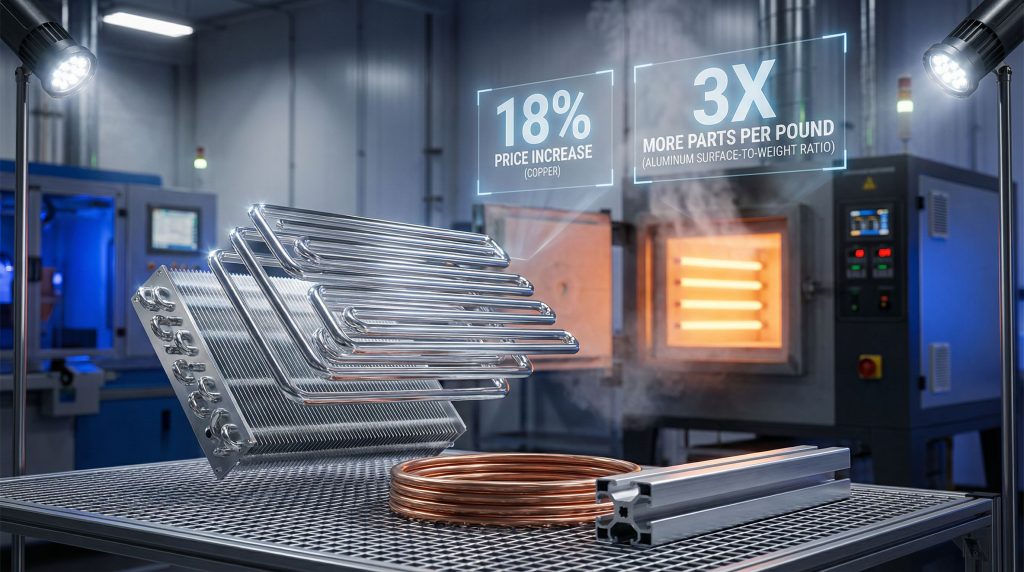
Copper pricing dynamics have created substantial manufacturing cost pressures throughout 2026. Market data indicates copper prices surged approximately 18 percent during recent months, directly impacting heat exchanger production economics where copper traditionally represents 40-60% of raw material costs. Furthermore, comprehensive global copper supply analysis reveals significant supply constraints that will likely sustain these elevated price levels.
This price escalation coincides with government-mandated energy efficiency upgrades that increase overall system complexity and manufacturing expenses. The economic rationale extends beyond immediate material costs. Aluminum demonstrates three times greater surface-to-weight ratio compared to copper, enabling manufacturers to achieve equivalent thermal performance using substantially less material by weight.
Key Economic Factors Driving Aluminum Adoption:
• Material cost reduction through improved surface area efficiency
• Reduced transportation expenses due to lower component weight
• Decreased structural support requirements in installations
• Simplified installation procedures reducing labor costs
• Enhanced manufacturing throughput through automated production processes
The timing of this economic pressure coincides with regulatory requirements mandating higher energy efficiency standards. Manufacturers face dual pressures: rising material costs and increased system complexity required to meet performance regulations. Consequently, this creates compelling incentives for material innovation strategies.
Advanced Aluminum Alloy Performance Characteristics
Modern aluminum heat exchanger designs leverage metallurgical advances that address historical limitations. Contemporary aluminum alloys demonstrate superior corrosion resistance properties, particularly regarding formicary corrosion that affects approximately 10 percent of copper-based indoor air conditioning units. This chemical reaction between copper, oxygen, water, and organic acids from lubricating oils creates measurable warranty claims and service costs.
Aluminum vs Copper Material Performance Comparison
| Performance Factor | Aluminum Systems | Copper Systems |
|---|---|---|
| Formicary corrosion resistance | Complete immunity | Susceptible to failure |
| Salt spray corrosion performance | 40% superior test results | Baseline performance |
| Galvanic balance | Optimised (single material) | Compromised (dissimilar metals) |
| Weight per equivalent surface area | 30% of copper weight | Reference standard |
| Thermal conductivity | 210 W/m·K | 401 W/m·K |
Independent testing conducted in 2022 demonstrated that aluminum microchannel coils performed 40 percent better in salt spray corrosion tests compared to traditional copper-tube designs. This performance advantage proves particularly valuable for coastal installations where marine environments accelerate copper degradation through pitting corrosion mechanisms.
The elimination of galvanic couples when both tubes and fins utilise aluminum creates superior electrochemical balance. Mixed-metal systems create potential corrosion pathways that aluminum-only designs entirely avoid, contributing to extended service life and reduced maintenance requirements.
Micro-Channel Design Innovation Capabilities
Aluminum's superior formability enables micro-channel heat exchanger architectures impossible to achieve cost-effectively with copper. These designs redistribute refrigerant flow across numerous small-diameter channels (typically 1-3 millimetres) rather than traditional larger tubes, increasing total surface area while reducing refrigerant volume requirements.
The manufacturing process leverages aluminum's excellent extrusion properties to create complex channel geometries through automated production lines. However, copper cannot match this manufacturing flexibility at comparable cost points, creating fundamental design advantages for aluminum-based systems.
Manufacturing Process Breakthroughs Enable Scale Production
Traditional aluminum brazing faced critical technical limitations where brazing materials melted too close to base metal temperatures, creating narrow process windows difficult to control reliably. Contemporary flux-cored aluminum brazing materials overcome these constraints through advanced chemistry enabling automated inline brazing processes.
Recent industry innovation trends show that manufacturing technology evolution includes additive manufacturing capabilities for complex geometries, advanced surface treatments, and automated quality inspection systems. These developments further strengthen aluminum's competitive position versus traditional copper-based approaches.
Modern Aluminum Brazing Capabilities:
• Reliable joint integrity at 290-500 psi operating pressures
• Elimination of post-braze flux removal requirements
• Copper-to-aluminum transition joints for auxiliary connections
• Automated temperature control throughout brazing chambers
• Consistent quality across high-volume production runs
These technical advances represent categorical improvements rather than incremental enhancements. The ability to maintain brazing material metallurgy separate from flux chemistry until application enables lower melting point fillers (approximately 900-950°F) that achieve proper flow without approaching aluminum base metal melting temperatures.
Production facilities implementing these technologies achieve manufacturing consistency previously impossible with aluminum systems. The documented pressure capability range encompasses both low-pressure residential applications (150-300 psi) and higher-pressure commercial refrigeration systems, spanning the complete industry spectrum.
Service and Maintenance Considerations
The aluminium-for-copper shift in air conditioning and refrigeration introduces different service protocols that impact lifecycle economics. Aluminum's rapid oxidation characteristics create challenges for field repairs that copper systems do not experience.
Service Comparison Analysis
| Service Factor | Aluminum Systems | Copper Systems |
|---|---|---|
| Field repair feasibility | Extremely difficult | Highly repairable |
| Typical failure response | Complete replacement | Spot repair/brazing |
| Technician skill requirements | Specialised training | Standard HVAC skills |
| Out-of-warranty repair costs | Higher (replacement) | Lower (spot repair) |
| Service call duration | Extended (replacement) | Reduced (repair) |
Aluminum forms aluminum oxide (Al₂O₃) at exposed surfaces when contacted by atmospheric oxygen and moisture. This oxide layer melts at approximately 3,700°F (2,040°C), far exceeding aluminum base metal or brazing material temperatures. The oxide's electrical insulation properties prevent metallurgical bonding with repair materials, rendering field repairs ineffective.
Copper oxide formation creates different thermal and chemical properties that permit reliable re-brazing in field conditions. This fundamental material difference requires HVAC service protocols to emphasise:
• Early leak detection before oxide formation progresses
• Component replacement procedures rather than repair techniques
• Proper handling protocols preventing installation damage
• Diagnostic methods specific to aluminum heat exchanger systems
The service complexity trade-off requires evaluation against aluminum's performance and cost advantages. Many manufacturers address this through extended warranty programmes and improved initial quality control reducing field failure rates.
Market Adoption Patterns and Industry Precedents
The automotive sector completed its transition to all-aluminum heat exchangers decades ago, providing proven performance validation for HVAC applications. This established track record demonstrates long-term viability across varied operating conditions and service environments.
Contemporary mini-split and ductless systems increasingly feature all-aluminum components, though hybrid approaches using aluminum-insulated copper tubing represent intermediate solutions. These designs attempt to combine copper's thermal properties with aluminum's protective characteristics during the transition period.
Market Segment Adoption Timeline:
- Automotive applications – Completed transition (1990s-2000s)
- Commercial refrigeration – Active transition phase (2020-2026)
- Residential ductless systems – Accelerating adoption (2024-2026)
- Central air conditioning – Early implementation phase (2025-2027)
The automotive precedent proves particularly relevant because vehicle heat exchangers operate under more severe conditions than most HVAC applications. Temperature cycling, vibration, and corrosive environments in automotive applications exceed typical building system requirements, validating aluminum's durability for stationary installations.
The next major ASX story will hit our subscribers first
Regional Manufacturing and Investment Developments
Global aluminum consumption trends support the material transition across multiple sectors. Industry data projects consumption increasing from 96.92 million tonnes in 2023 to 106.8 million tonnes by 2026, driven by transportation, construction, and renewable energy applications. The HVAC sector represents a growing component of this demand.
Investment patterns reflect industry confidence in aluminum heat exchanger technology. Recent developments include:
• Egyptalum's $22.4 million cold rolling line upgrade targeting downstream capabilities
• European Bank funding $15.88 million for new aluminum extrusion facilities
• Indian beer industry planning $55 billion investment in aluminum can production over three years
These investments demonstrate capital commitment to aluminum processing capabilities across multiple end-use applications, creating supply chain infrastructure supporting HVAC industry adoption. In addition, evolving copper market dynamics further reinforce the economic incentives for aluminum adoption.
Energy Efficiency and Regulatory Alignment
Government-mandated energy efficiency upgrades compound economic pressures favouring aluminum adoption. Higher efficiency requirements increase system complexity and costs, making material cost reduction through aluminum implementation attractive for maintaining competitive pricing whilst meeting regulatory obligations.
The regulatory environment creates sustained pressure rather than temporary market conditions. Energy efficiency standards continue tightening globally, ensuring long-term incentives for cost-effective materials and manufacturing processes. Aluminum's weight advantages also contribute to transportation efficiency and installation simplification, supporting broader sustainability objectives.
Furthermore, the industry's focus on decarbonisation benefits aligns with aluminum's reduced environmental impact through improved manufacturing efficiency and extended service life.
Future Technology Development Trajectories
Advanced aluminum alloy research focuses on HVAC-specific applications addressing remaining technical challenges:
Next-Generation Aluminum Technologies:
• Enhanced thermal conductivity through specialised alloy compositions
• Improved brazing characteristics for complex geometries
• Better formability enabling advanced heat exchanger designs
• Specialised surface treatments for specific environmental conditions
Manufacturing technology evolution includes additive manufacturing capabilities for complex geometries, advanced surface treatments, and automated quality inspection systems. These developments further strengthen aluminum's competitive position versus traditional copper-based approaches.
The integration of IoT monitoring capabilities with aluminum heat exchangers enables predictive maintenance strategies that may offset field repair limitations through early detection and preventive replacement protocols.
What Investment Opportunities Does This Transition Create?
The aluminium-for-copper shift in air conditioning and refrigeration creates investment opportunities across the supply chain. Component manufacturers investing in aluminum brazing capabilities, alloy development, and micro-channel production technologies position themselves advantageously for market transitions.
End users evaluating system replacements should consider total lifecycle costs including initial purchase price, energy efficiency, maintenance requirements, and expected service life. Aluminum systems may justify higher initial costs through reduced operating expenses and extended service intervals. For those evaluating broader opportunities, understanding investment strategies becomes crucial for capitalising on this material transition.
Recent industry analysis reveals that manufacturers are increasingly switching to aluminum due to copper's elevated pricing, creating significant market opportunities for aluminum suppliers and processing equipment manufacturers.
Disclaimer: This analysis contains forward-looking statements regarding material adoption trends, manufacturing capabilities, and market developments. Actual results may vary based on technological advances, regulatory changes, commodity pricing, and competitive dynamics. Investment decisions should incorporate comprehensive due diligence and professional consultation.
The transition from copper to aluminum in heat exchanger applications represents a fundamental shift driven by economic necessity and enabled by technological advancement. Whilst service complexity presents challenges, the combination of cost reduction, corrosion immunity, weight advantages, and manufacturing flexibility creates compelling long-term value propositions. Success requires comprehensive system redesign, manufacturing process optimisation, and service protocol adaptation rather than simple material substitution. The automotive industry's successful transition provides validation for HVAC applications, whilst ongoing technological developments continue strengthening aluminum's competitive position in thermal management systems.
Looking to Capitalise on Metal Commodity Transitions?
Discovery Alert's proprietary Discovery IQ model delivers instant notifications on significant ASX mineral discoveries, including those related to aluminium and copper exploration companies positioning themselves for this major HVAC industry shift. With comprehensive coverage of over 30 commodities simplified into actionable insights, subscribers gain immediate market advantages as material demand patterns evolve across industrial applications like the copper-to-aluminium transition documented in major manufacturing sectors.