July 17, 2026
Why Materials Science Drives Artificial Intelligence Infrastructure
The convergence of exponential computing demands and immutable physics creates unprecedented material requirements across modern artificial intelligence systems. Unlike software optimization that can theoretically improve indefinitely, hardware infrastructure operates within fixed thermodynamic and electrical constraints that cannot be virtualised away. When computational workloads scale beyond traditional server capacity, material selection transforms from cost optimisation to performance necessity.
Furthermore, silver in AI infrastructure emerges as a strategic bottleneck material precisely because its fundamental properties—electrical conductivity, thermal management, and oxidation resistance—become critically important as power densities reach extreme levels. The infrastructure supporting AI model training and inference operates at sustained maximum loads where even marginal efficiency gains compound into significant operational advantages across facility-scale deployments.
The Physics Behind Silver's Critical Role in High-Performance Computing
Silver possesses the highest electrical conductivity of any element at room temperature, measured at 63.0 × 10⁶ siemens per meter (S/m) at 20 degrees Celsius. This property represents a fundamental physical constant rather than an engineering variable, making silver's performance advantages immutable regardless of technological advancement. In AI training clusters operating under sustained computational loads, resistance losses translate directly into heat generation and performance degradation.
The electrical conductivity differential between silver and alternatives becomes material under specific operational conditions. Copper, the standard conductor in most applications, achieves approximately 94% of silver's conductivity at ambient temperatures. Within individual components, this 6% difference appears negligible. However, within complex power distribution networks containing thousands of connection points and switching nodes, resistance losses compound exponentially.
Quantifying the Infrastructure Expansion Scale
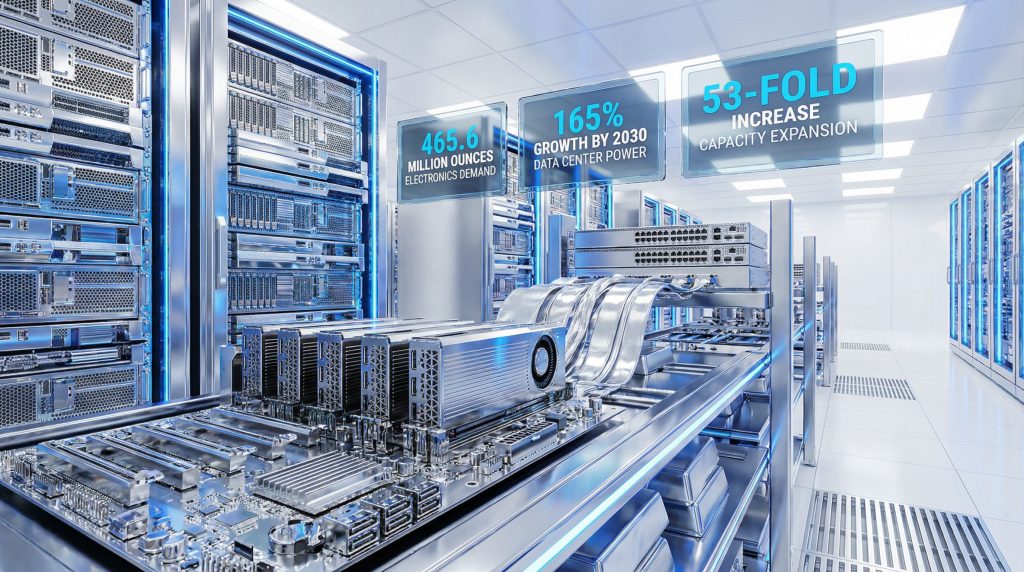
Global data center power capacity has expanded from under 1 gigawatt in 2000 to nearly 50 gigawatts by 2025, representing a 53-fold increase over 25 years. This expansion accelerated dramatically beginning in 2020, with AI workloads driving the most recent growth phase. Goldman Sachs projects an additional 165% growth in data center power demand by 2030, with artificial intelligence requirements representing the primary driver of this unprecedented infrastructure buildout.
The scale of planned investment validates the structural nature of this expansion. The five largest U.S. hyperscalers collectively plan capital expenditures of $736 billion specifically allocated to data center infrastructure during 2025 and 2026. This figure excludes research and development spending on AI models themselves, representing purely physical infrastructure investment at a scale exceeding most national infrastructure programmes.
When big ASX news breaks, our subscribers know first
Where Silver Functions Within AI Hardware Ecosystems
High-Density Power Distribution Networks
AI data centres operate at power densities 4-8 times higher than conventional facilities, creating electrical distribution requirements that exceed traditional server infrastructure capabilities. Standard server racks consume 10-15 kilowatts of electrical power, while AI training racks require 60-130 kilowatts or more. This concentration demands specialised switching components, circuit breakers, and busbar systems capable of handling extreme electrical loads without degradation over millions of operational cycles.
Power Density Comparison Across Infrastructure Types
| Infrastructure Type | Power per Rack (kW) | Silver Applications | Critical Performance Factor |
|---|---|---|---|
| Traditional Server | 10-15 | Standard connectors | Cost optimisation |
| Cloud Computing | 20-30 | Enhanced switching | Reliability focus |
| AI Training | 60-130+ | Premium silver components | Zero-failure tolerance |
| Quantum Computing | 150+ | Specialised silver alloys | Extreme precision required |
Circuit breaker contacts that manage power distribution from 480V to 48V specifications must interrupt current at microsecond speeds while maintaining dimensional stability across thermal cycling. Silver-plated copper contacts achieve repeatable performance through 100,000+ switching cycles before requiring replacement, while copper alternatives require replacement after 30,000-50,000 cycles due to contact oxidation and degradation.
Thermal Interface Materials in GPU Clusters
Modern AI processors generate concentrated heat loads that must be continuously removed to prevent thermal throttling and performance degradation. NVIDIA's H100 GPU consumes up to 700 watts in maximum performance mode, generating heat that requires precision thermal management. A single server containing 8 H100 GPUs operating in parallel generates approximately 5,600 watts of continuous heat.
Additionally, AI hardware demand continues to accelerate as companies invest heavily in computational infrastructure. Silver-loaded thermal interface materials achieve thermal conductivity ratings of 6-8 W/(m·K), substantially outperforming ceramic alternatives at 2-3 W/(m·K). This performance differential directly determines whether GPU cores can sustain maximum clock speeds or throttle to lower performance levels, potentially reducing training throughput by 15-25 percent.
High-Speed Interconnect Infrastructure Requirements
PCIe 5.0 interfaces operating at 32 gigatransfers per second require signal integrity maintenance across physical connector paths where resistance increases exponentially affect error rates. Testing by industry standards organisations demonstrates that silver-plated connectors maintain signal integrity within specification across full operating temperature ranges (0-70 degrees Celsius for enterprise equipment), while copper-plated alternatives exhibit 8-12% increased error rates after thermal cycling.
In distributed AI training environments where multiple servers coordinate training across cluster networks, even small increases in bit error rates can propagate system-wide, causing training run failures that waste days of computational effort. The material cost of silver in AI infrastructure represents less than 0.01% of total server investment, making performance reliability the primary specification criterion.
How AI Infrastructure Demand Compares to Competing Silver Markets
Electronics and Electrical Sector Growth Trajectory
Silver electronics and electrical demand reached 465.6 million ounces in 2024, representing a 4% year-over-year increase despite elevated prices in the $28-32 per ounce range during 2024. This demand persistence at historically elevated price levels indicates that substitution is not economically feasible for mission-critical applications, confirming that performance requirements rather than cost considerations drive material selection.
The electronics and electrical sector now accounts for nearly 40% of total industrial silver consumption, with AI infrastructure contributing an accelerating portion alongside 5G network deployment, electric vehicle manufacturing, and grid modernisation projects. This diversified demand profile creates resilience against cyclical downturns in individual sectors while adding multiple simultaneous growth vectors.
Moreover, the silver market squeeze has intensified as industrial demand outpaces supply. Industry experts report that the cumulative silver supply shortfall from 2021 through 2025 approaches 820 million ounces, roughly equivalent to one full year of global mine production. This deficit exists before accounting for accelerated AI infrastructure deployment, creating structural supply constraints that cannot be quickly resolved through increased mining activity.
Competitive Demand from Parallel Technology Buildouts
AI infrastructure competes for silver supply with simultaneous expansions across multiple technology sectors, creating unprecedented demand concentration within a compressed timeframe:
• Solar photovoltaic installations: Requiring 20+ grams per panel for electrical contacts and conductive pathways
• Electric vehicle production: Consuming 8-28 grams per vehicle depending on electrical system complexity
• 5G network deployment: Incorporating enhanced antenna systems and high-frequency switching components
• Grid modernisation projects: Utilising smart grid components for electrical distribution optimisation
• Defence system upgrades: Employing silver in radar, communications, and electronic warfare systems
Each sector operates under policy mandates or strategic imperatives that make demand relatively inelastic to price increases, creating competition for finite supply rather than substitution toward alternative materials.
What Makes Silver Irreplaceable in Critical AI Applications
The Copper Substitution Analysis
While copper costs approximately 1% of silver's price, substitution involves engineering trade-offs that become prohibitive in high-performance applications. Copper oxidises rapidly in air to form copper oxide (Cu₂O) and copper hydroxide (Cu(OH)₂), creating surface resistance that accumulates over millions of switching cycles. Silver remains dimensionally and electrically stable under normal atmospheric conditions indefinitely.
In switching equipment operating at high frequency and cycle counts—potentially millions of operations annually—surface oxidation creates micro-layer resistance that degrades contact integrity over operational lifetimes. Hyperscale operators specify silver-plated contacts specifically to avoid contact degradation across equipment service periods typically lasting 5-7 years.
Reliability Economics in Mission-Critical Systems
Hyperscale operators investing $10+ billion in data centre facilities cannot risk component failures that trigger system-wide outages. The cost of silver in AI infrastructure represents less than 0.01% of total facility investment, while a single unplanned outage affecting 1% of capacity can cost $27,000 per minute in lost revenue opportunity for major cloud service providers.
Replacement of failed switching hardware in live production environments creates downtime costs that dwarf material cost differentials between silver and alternatives. For operators generating gross margins of $10+ billion annually, reliability specifications prioritise performance over material costs in component selection.
Performance Requirements vs. Available Alternatives
Material Performance Comparison for AI Hardware Applications
| Property | Silver | Copper | Gold | Aluminum |
|---|---|---|---|---|
| Electrical Conductivity (MS/m) | 63.0 | 59.6 | 45.2 | 37.8 |
| Oxidation Resistance | Excellent | Poor | Excellent | Moderate |
| Thermal Conductivity (W/m·K) | 429 | 401 | 318 | 237 |
| Cost Factor (relative) | 100x | 1x | 2000x | 0.5x |
| AI Infrastructure Suitability | Optimal | Limited | Prohibitive | Inadequate |
Gold provides superior oxidation resistance but costs approximately 20 times more than silver while offering 28% lower electrical conductivity. Aluminium costs half of copper's price but provides only 60% of silver's conductivity and moderate oxidation resistance. These performance-cost trade-offs make silver in AI infrastructure the optimal material for applications requiring both high conductivity and long-term reliability.
How Supply Constraints Impact AI Infrastructure Deployment
Structural Supply Deficit Analysis
Consequently, the silver market has operated in deficit for five consecutive years (2021-2025), with demand exceeding mine production annually. Silver supply deficits have reached critical levels as total silver demand exceeded 1.2 billion ounces in 2024, while global mine production remained relatively static. The cumulative shortfall through 2025 approaches 820 million ounces, equivalent to approximately one full year of global mine output.
Approximately 70-80% of silver originates as a byproduct of zinc, lead, and copper mining, making supply relatively inelastic to silver price signals. Primary silver mines represent a small portion of global output, and their development requires extensive lead times that cannot accommodate rapid demand acceleration.
Mine Development Timeline Constraints
Primary silver mine development requires 5-10 years from discovery to production, including geological assessment, permitting processes, environmental impact studies, and infrastructure construction. This timeline cannot accommodate rapid AI infrastructure scaling requirements, creating potential supply bottlenecks for hardware manufacturers and facility operators.
Existing mines operate near capacity, and expansion projects face similar permitting and development timelines. The supply response mechanism to demand surges operates on geological and regulatory timescales rather than market-responsive adjustment periods, creating structural supply inelasticity.
Geopolitical Supply Concentration Risks
Major silver-producing regions include Mexico (23% of global output), Peru (17%), and China (12%). Supply disruptions in these regions through mining strikes, environmental regulations, or geopolitical tensions could impact AI infrastructure deployment schedules for hyperscale operators with aggressive expansion timelines.
Unlike software systems that can be deployed globally through digital distribution, AI infrastructure requires physical materials sourced from geographically concentrated locations. This creates supply chain vulnerabilities that cannot be mitigated through technological innovation alone.
Investment Implications of Silver's AI Infrastructure Role
Demand Durability Assessment
Unlike cyclical technology adoption patterns, AI infrastructure represents permanent capacity expansion driven by structural economic forces rather than speculative investment cycles. Furthermore, the mining industry evolution reflects these changing demand patterns:
• Government AI competitiveness initiatives: National strategies treating AI capability as strategic infrastructure
• Corporate digital transformation requirements: Operational necessities rather than discretionary technology spending
• National security considerations: Defence and intelligence applications requiring domestic AI capacity
• Energy transition dependencies: Smart grid systems requiring AI-optimised electrical distribution
Each driver operates independently of traditional business cycles, creating demand stability that differs fundamentally from consumer electronics or discretionary technology spending.
Price Discovery Mechanisms
Silver's dual role as industrial input and monetary metal creates unique pricing dynamics where industrial demand provides fundamental support while monetary demand can amplify price movements during periods of currency uncertainty or geopolitical instability. This creates asymmetric risk profiles where downside protection from industrial demand combines with upside leverage from monetary premium expansion.
The Silver Institute's December 2025 forecast explicitly identifies data centres and AI infrastructure as contributors to projected industrial demand growth through 2030, providing official validation that AI infrastructure silver demand has reached sufficient scale to warrant separate market forecasting consideration.
Portfolio Positioning Considerations
Strategic Investment Framework for Silver Exposure:
• Direct physical ownership: Silver bullion or coins for long-term structural demand capture
• Mining company equity exposure: Leverage to silver price appreciation through producing companies
• Technology infrastructure investments: Companies with silver-intensive AI hardware operations
• Commodity fund allocation: Professional management of precious metals exposure
• Supply chain investments: Companies controlling silver processing and distribution networks
Each approach offers different risk-return profiles and exposure to various aspects of the silver-AI infrastructure relationship, allowing portfolio construction tailored to individual risk tolerance and investment timeframes. Additionally, critical minerals demand continues to shape these markets as technology adoption accelerates.
The next major ASX story will hit our subscribers first
Strategic Outlook for Silver Demand Through 2030
The convergence of AI infrastructure expansion, renewable energy deployment, electric vehicle adoption, and 5G network buildout creates simultaneous demand across multiple growth sectors that historically developed sequentially. However, the unprecedented pace of change in technology adoption has accelerated these demand patterns. Supply constraints inherited from five consecutive years of market deficits position silver as a potential strategic bottleneck material for critical technology infrastructure development.
Investment positioning should consider silver's unique role as both industrial commodity and monetary asset, with AI infrastructure providing fundamental demand support that operates independently of broader economic conditions. The material requirements of artificial intelligence cannot be optimised away through software improvement, creating durable demand that scales with computational capacity rather than economic cycles.
For investors seeking comprehensive investment strategy insights, the structural nature of this demand, combined with supply constraints operating on geological timescales, suggests that silver's role in AI infrastructure represents a permanent shift in market fundamentals rather than a cyclical opportunity. Portfolio allocation strategies should account for this structural demand when evaluating precious metals exposure within diversified investment frameworks.
This analysis is provided for informational purposes and does not constitute financial or investment advice. Commodity investments involve substantial risks, including price volatility and potential total loss. Investors should conduct independent research and consult qualified financial advisors before making investment decisions.
Looking for the Next Major Silver Discovery?
Discovery Alert's proprietary Discovery IQ model delivers real-time notifications on significant ASX mineral discoveries, instantly empowering subscribers to identify actionable silver opportunities ahead of the broader market. Begin your 14-day free trial today and secure your market-leading advantage in the rapidly expanding critical minerals sector.