June 12, 2026
The Copper Supply Chain Gap Canada Has Long Ignored
Global copper demand is accelerating faster than new mine supply can respond. The International Energy Agency projects that clean energy transitions alone could drive a tripling of copper demand by 2040, yet the pipeline of new copper mines reaching production is historically thin. Canada, a nation with enormous geological endowment, has consistently underperformed its potential as a copper producer, partly due to project development timelines, partly due to infrastructure constraints, and partly due to a concentrated production footprint in British Columbia and Quebec.
Against this backdrop, the McIlvenna Bay production milestone — specifically the June 7, 2026 production of first copper concentrate at the project in Saskatchewan — carries significance that extends well beyond a single operational achievement. It signals that Canada's copper geography is expanding, that polymetallic volcanic massive sulphide (VMS) deposits in the prairies are economically viable at scale, and that major gold producers are increasingly willing to diversify into base metals in pursuit of copper's superior long-term demand profile.
When big ASX news breaks, our subscribers know first
Why McIlvenna Bay Matters: Situating the Project Within Canada's Critical Minerals Landscape
The Role of Copper in Canada's Industrial and Energy Transition Agenda
Copper is irreplaceable in electrification infrastructure. Every electric vehicle contains roughly 83 kilograms of copper, compared to approximately 23 kilograms in a conventional internal combustion engine vehicle. Offshore wind turbines require up to 9,000 kilograms per unit. Grid modernisation programmes across North America are driving sustained copper consumption growth that is structurally different from historical demand cycles tied to construction and manufacturing output.
Canada's Critical Minerals Strategy, updated in 2022 and refined through subsequent policy reviews, explicitly identifies copper among the 31 minerals considered essential to economic security and the clean energy transition. Yet despite this designation, domestic copper mine production has remained relatively flat, with Canada contributing less than 3% of global refined copper output despite holding mineral reserves that justify a far larger share.
The consequence is a supply chain vulnerability. Canadian manufacturers, particularly in the automotive, electrical, and construction sectors, depend heavily on imported refined copper. Increasing domestic production from projects like McIlvenna Bay creates optionality to reduce this structural import dependency over time, particularly as critical minerals demand intensifies and geopolitical risks associated with copper supply chains from South America and the Democratic Republic of Congo worsen.
How Saskatchewan Is Emerging as a Polymetallic Mining Jurisdiction
Saskatchewan's mining identity has historically been defined by potash and uranium, two commodities where the province holds globally significant market positions. Copper and zinc production at meaningful scale represents a genuine diversification of the provincial minerals economy.
The geological foundation for this transition lies in Saskatchewan's Flin Flon greenstone belt, a Paleoproterozoic volcanic arc terrain that hosts numerous VMS ore deposits. These form through submarine hydrothermal activity that concentrates copper, zinc, lead, gold, and silver in lens-shaped bodies at or near ancient seafloors. The Flin Flon belt has been mined since the 1930s, providing a well-understood geological template for deposit discovery and development.
What makes this moment strategically distinct is that modern exploration technologies, including deep-penetrating geophysics and 3D geological modelling, are enabling discovery of deeper deposit extensions that were previously invisible to conventional techniques. The McIlvenna Bay deposit itself illustrates this dynamic, with near-mine exploration targets identified along strike and at depth that could materially extend the resource base beyond current estimates.
From Acquisition to Output: Eldorado Gold's Strategic Rationale for the Foran Mining Purchase
Eldorado Gold's decision to acquire Foran Mining earlier in 2026, thereby gaining control of the McIlvenna Bay project, reflects a strategic calculation that resonates with a broader trend among senior gold producers seeking copper exposure. Gold prices have delivered strong returns in recent years, generating substantial free cash flow for producers, but gold demand fundamentals are structurally different from copper in the energy transition context.
Copper price drivers are underpinned by physical necessity in electrification, not investor sentiment or central bank purchasing behaviour. For a gold producer seeking to deploy balance sheet strength into assets with long duration and strong structural demand, a near-production copper-polymetallic project in a stable Canadian jurisdiction represents a compelling strategic acquisition.
The Foran Mining acquisition also brought with it a management team experienced in VMS deposit development and a permit and approvals framework already substantially advanced. In an environment where greenfield mine permitting timelines regularly exceed a decade in Canada, acquiring a project already at the commissioning stage eliminates substantial execution risk.
What Exactly Is the McIlvenna Bay Production Milestone?
Defining First Concentrate vs. Commercial Production: What the Distinction Means for Investors
The production of first copper concentrate on June 7, 2026 and the targeted achievement of commercial production in Q3 2026 represent meaningfully different financial and operational thresholds that investors should understand clearly.
First concentrate confirms that ore has successfully moved through the complete processing circuit and that saleable product has been generated. It validates the engineering design, the metallurgical assumptions embedded in the feasibility study, and the operational competence of the commissioning team. However, it does not confirm that the plant is operating at nameplate throughput, at target recovery rates, or at cost levels consistent with the economic model.
Commercial production, by contrast, is a sustained operational threshold — typically defined as achieving a specified percentage of nameplate throughput consistently over a defined period, often 60 or 90 days. The declaration of commercial production triggers significant accounting changes, including the cessation of capitalising operating costs and the commencement of depreciation on plant and equipment. It also typically resets financial reporting obligations for mining companies operating under IFRS standards.
The gap between first concentrate and commercial production is where significant investment risk concentrates. Metallurgical circuit adjustments, equipment reliability issues, and reagent optimisation can extend ramp-up timelines by months, adding costs that were not anticipated in feasibility projections.
Key Technical Milestones Leading to June 7, 2026
The pathway to first concentrate follows a structured commissioning sequence that reflects the engineering complexity of a modern polymetallic processing facility.
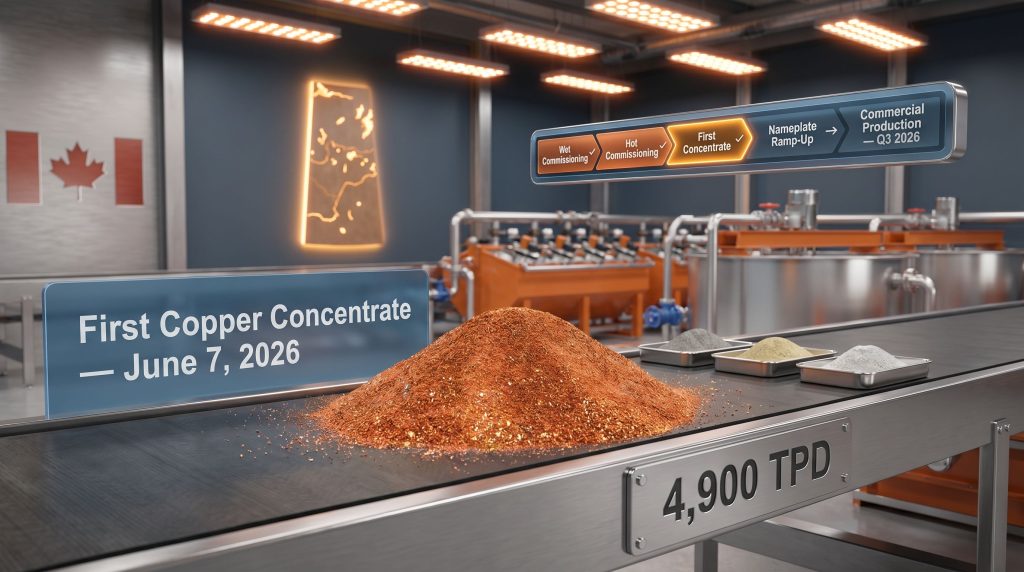
| Commissioning Phase | Description | Status as of June 2026 |
|---|---|---|
| Wet Commissioning | Water-based circuit testing without ore feed | Completed |
| Hot Commissioning | Live ore introduced through full processing circuit | Completed |
| First Copper Concentrate | Initial saleable product produced from hot commissioning ore | Achieved June 7, 2026 |
| Nameplate Capacity Ramp-Up | Achieving 4,900 tpd sustained throughput | In progress |
| Commercial Production | Sustained output meeting defined threshold | Targeted Q3 2026 |
Wet commissioning tests mechanical systems, identifying seal failures, bearing issues, and alignment problems without the abrasive wear and metallurgical complications introduced by ore. Hot commissioning introduces actual ore into the circuit, generating real metallurgical data on recovery rates, concentrate grade, and circuit behaviour under production conditions. The successful completion of both phases before June 7 demonstrates structured, competent project execution. Furthermore, construction progress at McIlvenna Bay soared through July, reinforcing the momentum behind this milestone.
What Is Nameplate Capacity and Why Does 4,900 Tonnes Per Day Matter?
Nameplate capacity refers to the design throughput of a processing facility under optimal operating conditions. At 4,900 tonnes per day, McIlvenna Bay sits in the mid-tier range for copper concentrators globally, but represents a meaningful addition to Canada's domestic copper production capacity.
For context, processing 4,900 tonnes of ore daily over a full year translates to approximately 1.79 million tonnes of ore processed annually. At copper grades and recoveries consistent with VMS deposits in the Flin Flon belt, this throughput rate can generate tens of millions of pounds of copper in concentrate per year, alongside meaningful zinc, gold, and silver byproduct credits that materially improve the economics relative to a single-metal copper operation.
The 4,900 tpd figure also carries significance in terms of the project's economics. Processing plant capital costs scale with capacity, but operating costs per tonne can become increasingly efficient as throughput increases. Achieving and sustaining nameplate capacity is therefore both a production and a unit cost objective, with the two metrics closely interconnected in mine planning.
How Does the McIlvenna Bay Ramp-Up Compare to Industry Benchmarks?
Typical Copper Project Ramp-Up Timelines: A Sector-Wide Perspective
Mining industry data consistently shows that new copper processing facilities rarely achieve nameplate throughput immediately following first concentrate. A retrospective analysis of copper mine ramp-ups indicates that the median time from first concentrate to sustained commercial production for copper concentrators globally is approximately six to nine months, with polymetallic operations often requiring additional time to optimise recovery circuits for each metal simultaneously.
Several factors influence ramp-up duration:
- Ore hardness variability relative to feasibility study assumptions
- Flotation reagent selection and dosage optimisation for the specific ore chemistry encountered in early mining areas
- Grinding circuit calibration to achieve target particle size distribution for optimal liberation
- Thickener and filtration performance under variable feed conditions
- Operator training and shift-by-shift consistency in process control
McIlvenna Bay's Q3 2026 target for commercial production, following June 7 first concentrate, implies a ramp-up window of roughly one to three months, which would be toward the faster end of industry benchmarks if achieved. This compressed timeline may reflect confidence in the metallurgical predictability of the deposit's early mining areas, as well as the operational experience of the commissioning team.
Polymetallic Complexity: Copper, Zinc, Gold, and Silver Recovery Considerations
VMS deposits present a fundamentally different metallurgical challenge than porphyry copper deposits, which dominate global copper production. In a porphyry system, copper is typically the primary economic metal and flotation circuits can be optimised primarily around copper recovery. In a VMS deposit like McIlvenna Bay, however, copper and zinc are both economically significant, and their separation into distinct concentrate streams requires careful circuit design and operational management.
Achieving high copper recovery while simultaneously producing a high-grade zinc concentrate and capturing gold and silver credits requires the processing plant to operate as a genuinely multi-stream facility. Each metal recovery target imposes constraints on the others, and the operating point that maximises total net smelter return may not correspond to the maximum recovery of any individual metal.
Gold and silver in VMS deposits can occur in multiple mineralogical forms, some of which report preferentially to the copper concentrate and others to the zinc concentrate. Understanding the distribution of precious metals across concentrate streams is critical to accurate revenue forecasting and influences smelter terms negotiation.
Processing Plant Performance Metrics to Watch During the Ramp-Up Phase
Investors and analysts monitoring the McIlvenna Bay ramp-up should track the following key operational indicators in Eldorado Gold's quarterly disclosure:
- Mill throughput rate expressed as tonnes per day, compared against the 4,900 tpd nameplate target
- Copper recovery rate as a percentage of feed grade copper recovered to concentrate
- Zinc recovery rate reported separately given its independent economic significance
- Copper concentrate grade measured in percentage copper, which affects smelter terms and payability
- Cash operating cost per pound of copper net of byproduct credits, the primary unit cost metric for investor benchmarking
- Concentrate inventory and offtake volumes confirming that product is being sold rather than accumulating
What Are the Broader Implications for Eldorado Gold's Portfolio Strategy?
Diversification Beyond Gold: Why Eldorado's Copper Exposure Is Strategically Timed
The acquisition of Foran Mining and the successful commissioning of McIlvenna Bay transforms Eldorado Gold's commodity exposure profile at a moment when copper's valuation premium relative to gold is supported by structural rather than cyclical demand factors. Senior gold producers have faced persistent investor questions about capital allocation in a high-gold-price environment, with pressure to either return capital or reinvest in assets with compelling long-term fundamentals.
Consequently, copper satisfies this investment thesis on multiple dimensions: it is essential to electrification infrastructure, it faces a growing supply deficit as existing mine grades decline and new project development lags demand growth, and it benefits from geographic concentration risk in peer countries that creates a premium for production from stable, well-governed jurisdictions like Canada. Indeed, the copper supply crunch is sharpening the strategic appeal of near-production Canadian assets.
Eldorado's existing portfolio, heavily weighted toward operations in Greece and Turkey, already carries non-trivial geopolitical risk. Adding a Canadian polymetallic asset in a stable prairie province both reduces portfolio geopolitical risk and adds copper revenue that provides a natural hedge against gold price softness.
Near-Mine Exploration Targets: Extending McIlvenna Bay's Long-Term Resource Base
One of the most underappreciated aspects of VMS mining districts is their tendency to host multiple deposits in close geographic proximity. The Flin Flon greenstone belt demonstrates this characteristic clearly, having hosted numerous separate mines over its production history. Near-mine exploration at McIlvenna Bay is targeting:
- Copper and zinc extensions along the McIlvenna Bay deposit strike, testing whether the mineralising system continues beyond currently defined resource boundaries
- Gold and silver enriched intervals in adjacent exploration corridors that could add precious metals content to future mine plans
- Deeper VMS lenses below and along strike of the known deposit, guided by 3D structural interpretation of the volcanic stratigraphy
A successful discovery of a significant near-mine resource extension could enable plant throughput expansion without the capital burden of building new processing infrastructure, improving project economics substantially relative to the standalone mine plan.
How McIlvenna Bay Fits Within Eldorado's 2026 Production Guidance Framework
The integration of McIlvenna Bay into Eldorado Gold's production guidance represents a meaningful shift in how the company reports and manages its commodity mix. Copper production from McIlvenna Bay will be reported in addition to Eldorado's existing gold production, with zinc, gold, and silver byproduct revenues from the project flowing through the copper segment economics as credits.
This creates both opportunity and complexity for investors modelling Eldorado's consolidated financials. Copper price movements will introduce a new variable into earnings sensitivity analysis, and the polymetallic revenue structure means that total project economics are sensitive to four separate commodity prices simultaneously. The McIlvenna Bay project overview published by Eldorado Gold provides further detail on how this asset integrates into the company's broader growth strategy.
Key Takeaways: What the McIlvenna Bay Milestone Signals for the Sector
The June 7, 2026 McIlvenna Bay production milestone carries implications that are simultaneously operational, strategic, and systemic for Canadian mining:
- First copper concentrate confirms the project's transition from construction asset to revenue-generating operation, validating the engineering design and feasibility study assumptions that underpinned Eldorado Gold's acquisition rationale
- The 4,900 tpd nameplate processing capacity positions McIlvenna Bay as a meaningful contributor to Canadian copper output at a moment when domestic copper supply chains are attracting both policy attention and commercial interest from U.S. buyers
- Eldorado Gold's acquisition of Foran Mining reflects a broader trend among senior gold producers seeking copper exposure through near-production acquisitions rather than greenfield development, compressing the timeline from capital deployment to cash flow generation
- Saskatchewan's emergence as a copper-producing jurisdiction, built on the geological foundation of the Flin Flon VMS belt, represents a meaningful diversification of Canada's mineral production geography beyond its traditional British Columbia and Quebec copper base
- Near-mine exploration targets in Saskatchewan's VMS belt could extend McIlvenna Bay's resource life materially beyond current estimates, providing optionality that is not yet fully reflected in project economics
- The Q3 2026 commercial production declaration will serve as a critical catalyst for investor reassessment of Eldorado Gold's production guidance, unit cost trajectory, and portfolio copper contribution
The next major ASX story will hit our subscribers first
Frequently Asked Questions About the McIlvenna Bay Production Milestone
What is the McIlvenna Bay project and where is it located?
McIlvenna Bay is a polymetallic mining project situated in Saskatchewan, Canada. It is developed to produce copper, zinc, gold, and silver concentrates from a volcanogenic massive sulphide deposit hosted within the Flin Flon greenstone belt, one of Canada's most historically productive VMS mining districts.
When did McIlvenna Bay produce its first copper concentrate?
First copper concentrate was produced on June 7, 2026, following the successful completion of both wet and hot commissioning phases at the processing facility. This milestone confirmed that the processing plant had successfully moved ore through its complete circuit and generated a saleable product.
What is the nameplate capacity of the McIlvenna Bay processing plant?
The plant is designed to process 4,900 tonnes of ore per day at full nameplate capacity. Achieving and sustaining this throughput rate is a prerequisite for the declaration of commercial production, which Eldorado Gold has targeted for the third quarter of 2026.
When is commercial production expected at McIlvenna Bay?
Eldorado Gold has targeted commercial production in the third quarter of 2026. Commercial production is typically declared when the processing plant has achieved a sustained percentage of nameplate throughput over a defined period — a threshold with both operational and financial reporting significance.
Who owns the McIlvenna Bay project?
Eldorado Gold acquired the project through its purchase of Foran Mining earlier in 2026. Prior to the acquisition, Foran Mining had advanced the project through exploration, feasibility studies, and construction to the commissioning stage.
What other metals does McIlvenna Bay produce beyond copper?
The project's resource base includes zinc, gold, and silver, making it a genuinely polymetallic operation with diversified revenue streams across both base metals and precious metals. The relative contribution of each metal to total revenue depends on prevailing commodity prices and the metallurgical recovery rates achieved during operations.
This article contains forward-looking statements regarding production timelines, capacity targets, and project development milestones. Actual outcomes may differ materially from projections due to metallurgical, operational, regulatory, commodity price, and other risk factors. Nothing in this article constitutes financial or investment advice. Readers should conduct their own due diligence and consult qualified advisors before making investment decisions.
Want to Be First to Know When the Next Major ASX Mineral Discovery Hits?
Discovery Alert's proprietary Discovery IQ model scans ASX announcements in real time, instantly identifying significant mineral discoveries across copper, zinc, gold, and more than 30 other commodities — turning complex geological data into actionable investment insights before the broader market reacts. Explore why historic mineral discoveries have generated extraordinary returns and begin your 14-day free trial today to position yourself ahead of the market.