Mclaren Minerals Ltd
- ASX Code: MML
- Market Cap: $6,570,995
- Shares On Issue (SOI): 505,461,159
Bonanza Grades of Up to 34.6% HM Lift Confidence in McLaren's Resource Expansion Program
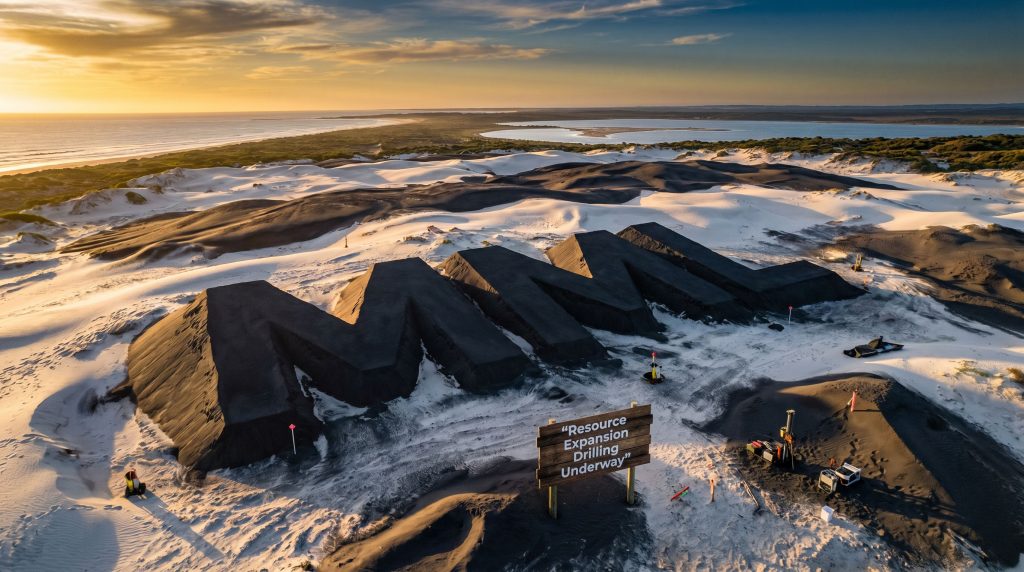
McLaren Minerals Limited (ASX: MML) has reported further assay results from its ongoing 13,000m Phase 2 Mineral Resource Upgrade and Expansion drilling program at the wholly owned McLaren Titanium Project in Western Australia, with peak grades reaching 34.6% heavy minerals (HM). The latest results continue to support resource confidence, highlight broad near-surface mineralisation, and point to a possible south-eastern extension outside the current Indicated Resource footprint.
The update matters for investors because the program is designed to do more than confirm grade. It is intended to improve geological confidence in the existing 529Mt JORC Mineral Resource, provide data for future Ore Reserve estimation, and support progress toward a Bankable Feasibility Study (BFS). With drilling now at 9,768m across 551 holes, McLaren reported the program is approximately 75% complete.
"High grades are always pleasing to see, but the consistency of mineralisation across McLaren is what continues to give us confidence in the project," said Simon Finnis, Managing Director. "The drilling is doing exactly what it was designed to do by increasing confidence in the existing Resource and improving our understanding of the continuity of mineralisation across the deposit."
When big ASX news breaks, our subscribers know first
What the Latest Drilling Results Show
McLaren stated that the latest release includes 502 assays, comprising 435 assays from drilling in the northern section of the deposit and 67 assays from three holes in the south-eastern area. Furthermore, the company said these results continue to confirm broad zones of heavy mineral mineralisation and support its current geological model.
Several intersections stand out for both average grade and peak one-metre grades:
| Hole ID | Thickness | From | Average Grade (% HM) | Peak Grade (% HM) | Peak Interval |
|---|---|---|---|---|---|
| MAC152 | 20m | Surface | 3.88% | 34.61% | 19m to 20m |
| MAC380 | 22m | Surface | 7.62% | 30.65% | 19m to 20m |
| MAC155 | 24m | Surface | 8.01% | 29.68% | 23m to 24m |
| MAC159 | 25m | Surface | 3.21% | 29.68% | 24m to 25m |
| MAC168 | 17m | Surface | 9.20% | 24.28% | 10m to 11m |
| MAC167 | 18m | Surface | 6.16% | 23.07% | 14m to 15m |
| MAC169 | 18m | Surface | 7.36% | 20.80% | 12m to 13m |
| MAC379 | 24m | Surface | 4.75% | 16.73% | 17m to 18m |
One practical detail carries weight in mineral sands projects: all reported intersections commence from surface. For investors, surface-starting mineralisation may support simpler mine design and lower stripping requirements compared with deeper deposits, although economic outcomes remain subject to future studies.
The company also provided a broader statistical view of results received to date:
- 42% of reported intersections grade above 4% HM
- 68% of assays report above 2% HM
- Intersections grading above 4% HM average 7.2% HM
Within the newest batch alone:
- 27% of results grade above 4% HM, averaging 10.3% HM
- 43% of results grade above 2% HM
These distributions suggest that high peak grades are being accompanied by recurring mineralised intervals across the drilled areas, rather than appearing as isolated outliers.
South-Eastern Extension Emerges as a Key Growth Area
A central feature of the ASX update is the early success in the south-eastern extension area, which McLaren said sits outside the current Indicated Resource footprint. Three initial holes in this zone returned mineralisation from surface:
- MAC380: 22m at 7.62% HM, including a peak of 30.65% HM from 19m to 20m
- MAC379: 24m at 4.75% HM, including a peak of 16.73% HM from 17m to 18m
- MAC381: 21m at 3.01% HM
For investors, the importance of this area lies in potential scale rather than just grade. If follow-up drilling confirms continuity, the extension could influence the shape and size of a future updated Mineral Resource Estimate.
McLaren has already completed 12 follow-up holes on 300m by 300m spacing within the interpreted extension area, with assay results still pending. The company said the purpose of this work is to increase geological confidence in the area.
"I am particularly encouraged by the initial results from the south-eastern extension area. The first holes have intersected strong mineralisation and, importantly, we have already completed follow-up drilling in that area," Finnis said. "We now look forward to receiving those results and understanding the broader significance of this emerging extension."
That pending assay set is likely to be one of the next major data points for the market.
Drilling Progress and Geological Understanding Continue to Build
How Is the Program Tracking?
According to the operational update, drilling began on 17 March 2026 and is expected to be completed in late June 2026, subject to access and drilling performance. Recent productivity has improved, with average drilling rates of 260m per day for the week ending 14 June 2026.
| Metric | Detail |
|---|---|
| Program Start | 17 March 2026 |
| Holes Completed | 551 |
| Metres Drilled | 9,768m |
| Program Completed | ~75% |
| Planned Metres | 13,000m |
| Expected Completion | Late June 2026 |
| Recent Drilling Rate | 260m/day |
The company also reported that samples continue to be recovered dry, which is relevant because dry samples can help maintain sample quality and reliability in mineral sands drilling. McLaren stated this has supported strong standards of sample recovery and geological data quality.
Away from the main resource area, the Eastern Shoreline target remains in progress. Drilling there has improved the company's understanding of basement topography, referring to the shape of the older rock surface beneath the mineral-bearing sands. In simple terms, changes in that buried surface can influence where heavy minerals were deposited and preserved.
The announcement confirmed a basement-controlled basin geometry that appears to have acted as a depositional trap for heavy mineral accumulation. McLaren also reported that heavy mineral-bearing sediments draping the basement surface were identified, which the company interprets as an extension of the lower mineralised strand recognised at the McLaren Titanium Project.
The Existing Resource Provides the Base for the Upgrade
The current JORC (2012) Mineral Resource Estimate for the McLaren HM Deposit is already substantial. The resource is stated at a cut-off of HM >2% and slimes <38%.
| Classification | Tonnes (Mt) | HM Grade (%) | In-Situ HM (Mt) | Slimes (%) | Ilmenite (% of HM) | Rutile (% of HM) | Leucoxene (% of HM) | Zircon (% of HM) |
|---|---|---|---|---|---|---|---|---|
| Indicated | 249 | 4.70 | 11.8 | 28.9 | 29.8 | 0.7 | 1.9 | 0.6 |
| Inferred | 280 | 4.20 | 11.9 | 31.3 | 27.8 | 0.7 | 1.8 | 0.5 |
| Total | 529 | 4.50 | 23.7 | 30.1 | 28.7 | 0.7 | 1.8 | 0.5 |
This matters because Phase 2 drilling is not starting from an early exploration base. Instead, it is aimed at improving confidence in an already defined large-scale mineral sands resource. In resource development terms, moving material from Inferred to Indicated can be an important step, as higher-confidence resource categories are generally needed before Ore Reserves can be estimated.
What Heavy Mineral Grade Means in a Mineral Sands Project
How Should Investors Read HM Grade Numbers?
For many investors, heavy mineral grade is the key number in a mineral sands announcement. However, it is worth understanding what it represents.
Heavy minerals are the denser minerals that can be separated from ordinary sand. At the McLaren Titanium Project, these include titanium-bearing minerals such as ilmenite, rutile and leucoxene, along with zircon. The HM grade is the percentage of those heavy minerals within the total sand sample by weight.
A simple way to read it is this:
- 2% HM means 2% of the sampled sand consists of heavy minerals
- 4% HM and above is generally more meaningful in mineral sands evaluation
- Very high one-metre peaks, such as 34.6% HM, indicate locally rich zones within a broader mineralised body
It is also important to separate peak interval grades from average intersection grades. A one-metre peak of 34.6% HM attracts attention, but mine planning and project economics depend more on average grade across mineable widths and continuity across the deposit.
Other useful terms in the McLaren update include:
- Indicated Resource: A higher-confidence resource category under the JORC Code
- Inferred Resource: A lower-confidence category that usually requires more drilling
- Ore Reserve: The economically mineable part of a resource, estimated after technical and economic studies
- BFS: A detailed study used to assess whether a mine development is commercially viable
- Slimes: Fine clay-rich material that can affect processing performance
Understanding these terms helps investors place drilling headlines into their proper development context.
What Comes Next for McLaren Minerals
The ASX announcement outlined a clear sequence of next steps for the project. Near-term catalysts include both remaining assay flow and workstreams that feed into future development studies.
Near-term activities flagged in the report include:
- Completion of the Phase 2 drilling program
- Receipt of outstanding assay results, including from the 12 follow-up holes in the south-eastern extension
- Completion of drilling at the Eastern Shoreline target
- Commencement of variability and metallurgical test work
- Incorporation of results into an updated Mineral Resource Estimate
- Progression of Ore Reserve estimation and BFS work
In addition, Finnis noted the company is "starting to define a broader area of higher-grade mineralised sands in the north-west of the deposit, with many assays still to come." That suggests there may be additional data still pending beyond the south-eastern extension focus.
The next major ASX story will hit our subscribers first
Why Investors Are Watching This Titanium Project
The McLaren update brings together several factors that are typically relevant in mineral sands valuation. First, the project already has scale, with 529Mt at 4.5% HM containing 23.7Mt of in-situ heavy minerals. Second, drilling continues to return surface-starting mineralisation, which may have practical development advantages if supported by future engineering and economic studies.
Third, the company reported growing confidence in the continuity of both upper and lower mineralised strand systems. In mineral sands projects, continuity matters because it can influence mine scheduling, processing consistency and confidence in resource classification.
Fourth, the south-eastern extension introduces room for potential growth outside the current footprint. Whether that becomes material will depend on pending assays and future modelling, but the initial intersections have been sufficient for McLaren to complete follow-up drilling on wider spacing.
Finally, the McLaren Titanium Project is moving along a recognisable development path. The current program is intended to support a resource update, Reserve work and BFS progression. For investors, that means the next stages should be increasingly focused on converting geological potential into development-level confidence.
The strongest message from the update is not simply the high one-metre grades. It is, moreover, the combination of broad mineralised intervals, continuity across the deposit, surface-starting intersections, and emerging extension potential. If the remaining assays continue that pattern, the next resource update could become a central catalyst for McLaren Minerals (ASX: MML).
Want to Catch the Next Major Mineral Discovery Before the Broader Market Does?
Discovery Alert's proprietary Discovery IQ model delivers real-time alerts on significant ASX mineral discoveries — instantly transforming complex data across 30+ commodities into clear, actionable insights for investors at every level. Explore historic examples of major discovery returns and begin a 14-day free trial at Discovery Alert to position yourself ahead of the market.