
May 12, 2026
The global energy landscape has witnessed unprecedented shifts since 2022, with natural gas supply chains undergoing fundamental restructuring across multiple continents. As traditional pipeline routes face geopolitical pressures and renewable energy transitions accelerate, the discovery of new hydrocarbon reserves in established basins presents both strategic opportunities and complex market dynamics. The Eastern Mediterranean has emerged as a critical region where mature infrastructure meets untapped geological potential, creating unique conditions for rapid resource development.
Mediterranean energy markets operate within intricate frameworks of supply security, export capacity constraints, and regional demand fluctuations. The intersection of existing processing facilities with newly identified reservoir targets has become a defining characteristic of modern offshore exploration strategies, particularly where shallow water depths and proven geological formations reduce both technical risk and capital requirements.
Regional Energy Security Implications of Mediterranean Gas Expansion
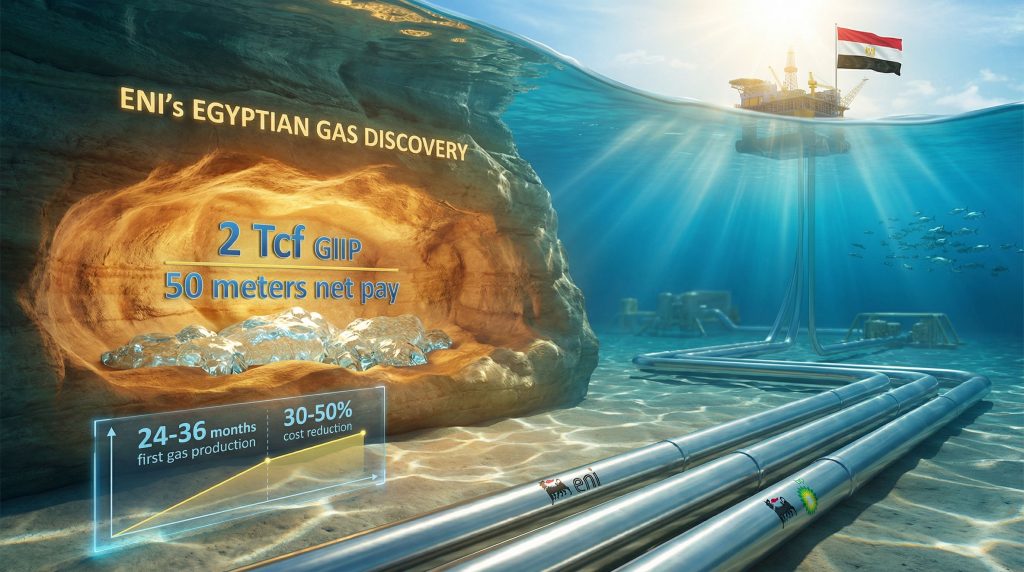
The Eni gas discovery offshore Egypt represents a significant addition to the Eastern Mediterranean's expanding hydrocarbon portfolio, with preliminary estimates indicating approximately 2 trillion cubic feet of gas initially in place within the Denise W-1 exploration well. Located roughly 70 kilometers offshore in 95 meters of water depth, this discovery demonstrates the continued potential of Egypt's offshore territories to contribute meaningfully to both domestic energy security and regional supply networks.
Furthermore, this development aligns with broader energy transition challenges facing global markets, where new discoveries must balance immediate supply needs with long-term sustainability objectives.
How Egypt's Offshore Gas Boom Reshapes North African Export Dynamics
Egypt's transformation from a net natural gas importer to a regional export hub has accelerated significantly over the past decade. The country's offshore gas production capacity has expanded through multiple major discoveries, creating a foundation for sustained export growth while meeting increasing domestic consumption demands.
The strategic positioning of Egyptian offshore fields within the Eastern Mediterranean gas corridor provides direct access to European markets through existing LNG infrastructure and potential pipeline connections. This geographical advantage becomes increasingly valuable as European energy strategies prioritise supply diversification following recent geopolitical disruptions.
Key factors driving Egypt's export positioning include:
• Established LNG liquefaction capacity at Idku and Damietta terminals
• Proximity to major European consumption centres
• Existing subsea pipeline infrastructure connecting offshore fields
• Government policies supporting both domestic supply security and export revenue generation
Infrastructure Leverage as Competitive Advantage in Mature Basins
The economic benefits of proximity-based development models become particularly evident when comparing infrastructure-led projects to greenfield developments. The Eni gas discovery offshore Egypt benefits from its location less than 10 kilometres from existing processing and export facilities, fundamentally altering the project's development economics and timeline expectations.
Established offshore basins offer several competitive advantages over frontier exploration areas:
Technical Risk Reduction:
- Proven reservoir characteristics through analogue field performance
- Established drilling methodologies and completion techniques
- Known subsurface conditions reducing geological uncertainty
- Validated production profiles from similar formations
Economic Optimisation:
- Reduced capital expenditure requirements for infrastructure development
- Accelerated first production timelines through existing facility utilisation
- Lower operating costs through shared infrastructure and established supply chains
- Enhanced project returns through improved capital efficiency metrics
When big ASX news breaks, our subscribers know first
Why Fast-Track Development Models Drive Investment Returns in Mature Offshore Regions
Investment returns in mature offshore regions benefit significantly from established infrastructure networks and proven development methodologies. The ability to leverage existing processing capacity, pipeline systems, and export terminals creates substantial competitive advantages over standalone project developments.
However, these opportunities must be evaluated alongside broader market conditions and LNG market opportunities that influence project economics and strategic positioning.
Capital Efficiency Metrics in Near-Field Exploration Strategy
Near-field exploration strategies demonstrate superior risk-adjusted returns when compared to frontier basin investments. The Eni gas discovery offshore Egypt exemplifies this approach, targeting geological formations with established production histories whilst utilising existing infrastructure to minimise development costs.
Risk mitigation factors in established basins include:
• Reduced exploration risk through proven petroleum systems
• Minimised development risk via existing infrastructure utilisation
• Accelerated regulatory approval processes in established concession areas
• Enhanced technical understanding through analogue field data
The economic benefits extend beyond simple cost reduction, encompassing accelerated cash flow generation and improved project financing terms. Lenders typically view infrastructure-led developments as lower-risk investments, resulting in more favourable financing conditions and enhanced overall project economics.
Joint Venture Dynamics in Egyptian Offshore Operations
The operational structure of Egyptian offshore developments typically involves international oil companies partnering with state-owned entities through established joint venture frameworks. The Eni gas discovery offshore Egypt operates through Petrobel, the joint venture between Eni and the Egyptian General Petroleum Corporation (EGPC), with BP holding a 50% interest alongside Eni's operated 50% stake.
These partnership structures provide several strategic advantages:
Operational Benefits:
- Shared technical expertise and operational capabilities
- Distributed risk exposure across multiple experienced operators
- Enhanced access to Egyptian regulatory and commercial frameworks
- Leveraged capital deployment reducing individual company exposure
Strategic Positioning:
- Long-term concession access through established government relationships
- Integration with national energy security objectives
- Participation in broader Egyptian offshore development programmes
- Access to domestic market opportunities alongside export potential
How Geological Characteristics Influence Commercial Viability Assessment
The technical characteristics of offshore discoveries fundamentally determine their commercial viability and development potential. Reservoir quality, structural complexity, and fluid properties directly impact both development costs and production profiles, making geological assessment a critical component of investment decision-making.
Reservoir Quality Indicators and Production Potential
| Technical Parameter | Denise W-1 Discovery | Significance for Development |
|---|---|---|
| Net Pay Thickness | Approximately 50 metres | Substantial reservoir volume supporting sustained production |
| Water Depth | 95 metres | Shallow water enabling cost-effective drilling operations |
| Distance to Infrastructure | Less than 10 km | Minimal transportation and processing infrastructure required |
| Reservoir Type | High-quality sandstone | Proven formation type with established production characteristics |
| Gas Initially in Place | 2 Tcf preliminary estimate | Significant resource base supporting major development project |
The high-quality sandstone reservoir encountered at Denise W-1 shares similar characteristics with the nearby Temsah field, which has maintained production since 2001. This geological continuity provides valuable technical insights for reservoir modelling and production forecasting, reducing uncertainty in development planning processes.
Gas-in-Place Estimates and Reserve Classification Framework
The preliminary 2 trillion cubic feet of gas initially in place represents the total hydrocarbon volume within the reservoir rock, before accounting for recovery factors and commercial viability assessments. The conversion from gas initially in place to recoverable reserves depends on several technical and economic factors:
Technical Recovery Factors:
- Reservoir drive mechanisms (aquifer support, gas cap expansion, depletion)
- Well spacing optimisation and completion design effectiveness
- Pressure maintenance requirements and artificial lift considerations
- Production decline curve characteristics and ultimate recovery estimates
Commercial Considerations:
- Current and projected natural gas pricing environments
- Development cost estimates and operating expense projections
- Regulatory fiscal terms and government revenue sharing arrangements
- Market access and transportation capacity constraints
Industry benchmarks suggest recovery factors for high-quality sandstone reservoirs typically range between 60-80% of gas initially in place, though site-specific conditions significantly influence ultimate recovery potential.
What Economic Factors Drive Egypt's Domestic Gas Production Strategy?
Egypt's natural gas production strategy balances competing priorities of domestic energy security, industrial development support, and export revenue generation. The country's growing population and expanding industrial base create sustained demand growth for natural gas across power generation, petrochemical production, and direct industrial applications.
Energy Security vs. Export Revenue Balance
The Egyptian government faces complex decision-making regarding natural gas allocation between domestic consumption and export opportunities. Domestic pricing policies often subsidise natural gas for power generation and industrial users, whilst export markets offer potentially higher revenue generation but require significant infrastructure investments.
Domestic consumption drivers include:
• Population growth creating increased residential and commercial demand
• Industrial expansion requiring reliable, cost-effective energy supplies
• Power generation sector dependence on natural gas for baseload capacity
• Government subsidy policies supporting domestic economic development
Export revenue considerations encompass:
• LNG market pricing opportunities in regional and global markets
• Infrastructure capacity constraints limiting export volumes
• Long-term supply contract negotiations with international buyers
• Foreign currency earnings supporting national economic objectives
Regulatory Environment and Concession Renewal Impact
The 20-year renewal of the Temsah concession signed in 2025 with EGPC and the Egyptian Natural Gas Holding Company (EGAS) provides long-term operational certainty for the Eni gas discovery offshore Egypt. This extended concession period enables comprehensive field development planning and significant capital investment commitments.
Egyptian petroleum regulatory frameworks have evolved to attract international investment whilst ensuring national resource management objectives. The regulatory environment includes:
Fiscal Terms Structure:
- Production sharing agreements defining government and contractor revenue splits
- Cost recovery mechanisms for development and operating expenditures
- Bonus payments and royalty rates supporting government revenues
- Corporate tax arrangements for international oil company operations
Operational Requirements:
- Local content and employment targets supporting Egyptian industrial development
- Environmental compliance standards and monitoring requirements
- Safety and operational reporting obligations
- Technology transfer and training programme commitments
How Does This Discovery Fit Within Eni's Global Portfolio Strategy?
Eni's Mediterranean focus represents a core strategic pillar within the company's global portfolio, leveraging decades of regional operational experience and established infrastructure investments. The Eni gas discovery offshore Egypt integrates with existing Egyptian operations including the major Zohr field and Nooros field developments, creating operational synergies and portfolio optimisation opportunities.
Mediterranean Focus as Core Strategic Pillar
The Eastern Mediterranean has become increasingly central to Eni's upstream strategy, offering a combination of proven hydrocarbon potential, established infrastructure, and favourable development economics. The region's proximity to major European gas markets provides direct access to premium pricing opportunities whilst supporting European energy security objectives.
According to industry reports, Eni has announced a 2 trillion cubic feet gas discovery that demonstrates the potential for fast-track development in the region. Furthermore, the discovery aligns with current US natural gas forecast trends showing increasing global demand for reliable gas supplies.
Strategic advantages of Mediterranean concentration include:
• Technical expertise and operational knowledge accumulated through multiple regional projects
• Infrastructure sharing opportunities reducing individual project development costs
• Regulatory relationship establishment facilitating project approval processes
• Supply chain optimisation through concentrated operational activities
The integration of the Denise discovery with existing Egyptian operations creates potential for shared infrastructure utilisation, optimised production profiles, and enhanced overall portfolio returns. This clustering strategy reduces operational complexity whilst maximising resource utilisation efficiency.
Near-Field Exploration ROI vs. Frontier Basin Investment
Eni's strategic emphasis on near-field and infrastructure-led exploration reflects a deliberate portfolio optimisation approach prioritising risk-adjusted returns over absolute resource potential. This strategy becomes particularly valuable in current market environments emphasising capital discipline and predictable cash flow generation.
Comparative advantages of near-field exploration:
• Reduced Technical Risk: Established geological understanding and proven reservoir characteristics
• Lower Capital Requirements: Existing infrastructure utilisation minimising development investments
• Accelerated Cash Flow: Shortened development timelines enabling faster return on investment
• Enhanced Financing Terms: Lower risk profile attracting more favourable project financing conditions
Portfolio optimisation benefits include:
• Predictable Production Profiles: Established analogue performance reducing forecasting uncertainty
• Operational Efficiency: Concentrated activities enabling cost optimisation and expertise leverage
• Market Access: Proven export routes and processing capacity supporting revenue realisation
• Scalability Potential: Platform for additional near-field discoveries and development optimisation
Market Implications and Forward-Looking Analysis
The broader market implications of the Eni gas discovery offshore Egypt extend beyond immediate production additions to encompass regional supply balance adjustments, infrastructure capacity optimisation, and strategic positioning within Eastern Mediterranean energy networks.
Regional Gas Price Dynamics and Supply Chain Integration
Eastern Mediterranean gas markets operate within complex pricing frameworks influenced by European hub pricing, LNG spot market conditions, and regional supply-demand balances. The addition of new production capacity from the Denise discovery contributes to regional supply flexibility whilst potentially influencing long-term pricing dynamics.
These developments occur within the broader context of global oil price movements and key investment strategies that shape energy market valuations.
Pricing mechanism considerations include:
• European Hub Integration: Pricing relationships with Title Transfer Facility (TTF) and other European gas hubs
• LNG Market Linkage: Spot LNG pricing influence on regional gas valuations
• Supply Contract Terms: Long-term agreement structures and pricing escalation mechanisms
• Transportation Costs: Pipeline and shipping cost impacts on delivered gas economics
Timeline Expectations and Production Ramp-Up Scenarios
Development timeline projections for the Eni gas discovery benefit from existing infrastructure proximity and established regulatory frameworks, potentially enabling accelerated project progression compared to greenfield developments.
Anticipated Development Phases:
Phase 1: Appraisal and Planning (6-18 months)
- Additional reservoir characterisation and appraisal drilling programmes
- Development concept selection and detailed engineering design
- Environmental impact assessments and regulatory approval processes
Phase 2: Development Execution (18-36 months)
- Production well drilling and completion operations
- Subsea infrastructure installation and pipeline connections
- Processing facility modifications and capacity optimisation
Phase 3: Production Ramp-Up (36-60 months)
- Initial production commencement and system optimisation
- Progressive well completion and production capacity increases
- Long-term production plateau achievement and maintenance
The fast-track development potential stems primarily from infrastructure proximity rather than simplified reservoir characteristics, enabling rapid connection to existing processing and export systems whilst maintaining comprehensive development standards.
The next major ASX story will hit our subscribers first
Understanding Egyptian Offshore Gas Development
What Makes This Discovery Commercially Attractive?
The commercial attractiveness of the Eni gas discovery derives from multiple convergent factors creating favourable development economics and reduced investment risk profiles compared to frontier exploration projects.
Primary commercial drivers include:
• Infrastructure Proximity: Less than 10-kilometre distance to existing processing facilities substantially reducing development capital requirements
• Proven Reservoir Characteristics: High-quality sandstone formation with established production analogues providing technical confidence
• Shallow Water Operations: 95-metre water depth enabling conventional drilling techniques and reduced operational complexity
• Established Regulatory Framework: Existing concession arrangements and government relationships facilitating project approval processes
How Does Infrastructure Access Impact Development Economics?
Infrastructure access fundamentally alters project economics by eliminating major capital expenditure categories typically required for standalone field developments. The ability to utilise existing processing capacity, pipeline networks, and export terminals creates substantial competitive advantages.
Economic impact categories include:
Capital Expenditure Reduction:
- Eliminated processing facility construction requirements
- Reduced pipeline and subsea infrastructure investments
- Minimised export terminal and loading facility needs
- Shared utility and support infrastructure utilisation
Operational Efficiency Enhancement:
- Established maintenance and operational support systems
- Proven supply chain and logistics networks
- Experienced local workforce and technical expertise
- Optimised production and processing coordination
Risk Mitigation Benefits:
- Reduced construction and commissioning risks through existing facility utilisation
- Minimised environmental permitting complexity in established operational areas
- Enhanced project financing terms through proven infrastructure and operational track records
- Accelerated revenue generation through shortened development timelines
Strategic Outlook: Egypt's Role in Mediterranean Gas Markets
Long-Term Supply Security Implications
Egypt's consolidation as a Mediterranean gas hub reflects broader regional energy security trends and European diversification strategies. The country's unique position combining substantial domestic reserves, established infrastructure, and strategic geographic location creates long-term competitive advantages within regional energy markets.
Strategic positioning factors include:
• Geographic Advantage: Central location between major hydrocarbon reserves and European consumption centres
• Infrastructure Capacity: Established LNG export terminals and pipeline networks supporting flexible supply arrangements
• Regulatory Stability: Proven frameworks for international investment and long-term concession arrangements
• Technical Expertise: Developed local capabilities and international partnership experience
The Eni gas discovery contributes to this strategic positioning by adding incremental production capacity whilst demonstrating continued exploration potential within Egyptian offshore territories.
Investment Climate and Future Exploration Potential
The successful discovery and development of offshore gas resources in Egyptian waters creates positive demonstration effects for continued international investment and exploration activity. The combination of technical success, favourable economics, and established operational frameworks attracts additional exploration commitments and technology deployment.
Industry analysts note that gas discoveries off Egypt's coast continue to demonstrate the region's potential for sustained hydrocarbon development.
Future exploration drivers encompass:
Technical Advancement:
- Enhanced seismic imaging and reservoir characterisation capabilities
- Improved drilling techniques enabling deeper water and more complex targets
- Advanced production technologies optimising recovery from challenging reservoirs
- Digital integration and automation improving operational efficiency
Commercial Framework Evolution:
- Continued regulatory framework refinement supporting international investment
- Infrastructure expansion enabling development of more remote discoveries
- Market access improvements through additional export capacity and route diversification
- Financing innovation reducing project risk and capital requirements
The success of infrastructure-led exploration strategies demonstrates the continued potential for significant hydrocarbon discoveries in mature offshore basins, supporting sustained investment and development activity throughout the Eastern Mediterranean region.
This analysis is based on publicly available information and industry research. Investment decisions should consider comprehensive technical, commercial, and regulatory assessments. Natural gas development projects involve substantial risks including geological uncertainty, market volatility, and regulatory changes that may impact project economics and timeline expectations.
Ready to Capitalise on Mediterranean Energy Discoveries?
Discovery Alert's proprietary Discovery IQ model delivers real-time alerts on significant energy and mineral discoveries across global markets, instantly empowering subscribers to identify actionable opportunities ahead of the broader market. Understand why major discoveries can generate substantial returns by exploring historic examples, then begin your 14-day free trial today to position yourself ahead of the market.