June 14, 2026
Critical Minerals, Geopolitics, and the Frontier Resource Playbook
Commodity markets have always reflected the geopolitical order of their era. During periods of great power competition, the scramble for physical resources intensifies, trade corridors get redrawn, and previously overlooked supply jurisdictions suddenly become strategically vital. That pattern is playing out again today, but with a twist: the targets are not oil fields or coal seams, but the metals underpinning the energy transition and digital economy. Gold, nickel, aluminium, and ferrous materials are now as strategically loaded as crude oil once was, and the nations holding large reserves of these materials are finding themselves repositioned on the global chessboard whether they sought that status or not.
It is within this context that the Mercuria and Heeney Capital Venezuela offtake deals deserve serious analysis, not merely as commercial transactions, but as instruments of a broader industrial and geopolitical strategy.
When big ASX news breaks, our subscribers know first
Venezuela's Mineral Endowment: Scale, Suppression, and Strategic Timing
Venezuela is frequently discussed through the lens of its oil sector, but its non-hydrocarbon mineral wealth represents an equally significant, and far less developed, resource base. The country holds substantial deposits of gold concentrated within the Orinoco Mining Arc, one of South America's most significant gold-bearing geological formations, alongside meaningful reserves of bauxite, iron ore, and nickel-bearing materials.
The suppression of this potential has been almost entirely political rather than geological. Decades of U.S. sanctions, compounded by internal governance challenges and chronic underinvestment in mining infrastructure, have left these deposits largely dormant from the perspective of Western capital markets. The result is a paradox: vast certified and inferred mineral resources sitting within geographic reach of U.S. industrial infrastructure, effectively inaccessible to Western buyers.
Furthermore, what has changed is the calculus of supply chain risk. Western governments and industrial buyers now view over-concentration of critical minerals demand in non-allied nations as a systemic vulnerability, not merely a procurement inconvenience. That anxiety is creating space for pragmatic engagement with jurisdictions previously considered off-limits.
Understanding the Mercuria and Heeney Capital Venezuela Offtake Deal Structure
The Mercuria and Heeney Capital Venezuela offtake deals were announced by Mercuria Energy Group, which confirmed it had partnered with Heeney Capital to secure strategic offtake agreements covering Venezuelan bulk commodities and gold projects. These agreements were advanced alongside a delegation of U.S. government officials and industry participants who travelled to Caracas to facilitate investment frameworks and supply agreements spanning both oil and mining sectors.
What Is an Offtake Agreement and Why Does the Structure Matter?
An offtake agreement is a pre-production or early-production contract in which a buyer commits to purchasing a defined volume of commodity output from a producer. In frontier resource markets, these instruments serve a dual purpose:
- They provide revenue certainty to the producer, enabling project financing and infrastructure development that would otherwise be impossible without guaranteed demand.
- They provide the buyer with secured supply access, locking in volume commitments before competing buyers enter the market.
In Venezuela's case, pairing offtake agreements with investment commitments is particularly significant. Capital deployment being directly linked to supply access means the financial and commercial incentives are structurally aligned, creating a mechanism that is increasingly favoured by traders operating in high-risk jurisdictions where conventional project finance is unavailable.
The Trader-Investor Partnership Model
Mercuria Energy Group is one of the world's largest privately held commodity trading firms, operating across oil, gas, metals, and agricultural markets globally. Its institutional scale provides the balance sheet depth and multi-jurisdictional trading infrastructure required to execute complex commodity flows from a sanctions-adjacent environment.
Heeney Capital functions as the investment structuring partner within the initiative, focused on advancing capital into Venezuela's mining sector. The combination represents what market practitioners describe as a trader-investor hybrid structure, where specialist capital vehicles co-develop frontier opportunities alongside major commodity traders. Each party contributes what the other lacks: Mercuria provides market access and trading expertise, while Heeney Capital provides investment architecture tailored to the specific risk profile of the jurisdiction.
Breaking Down the $5.2 Billion Economic Opportunity
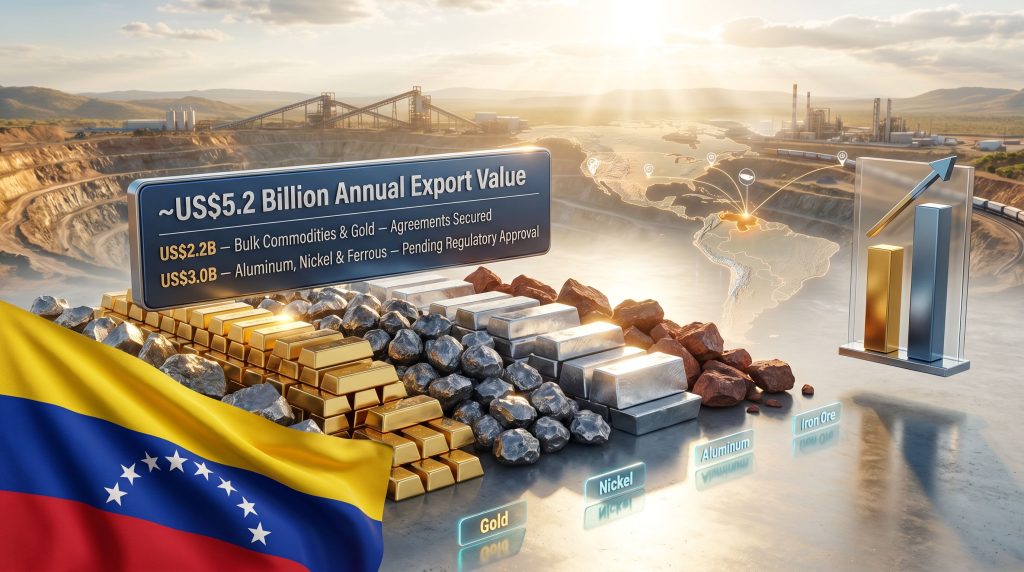
The financial scope of the initiative is substantial. The confirmed agreements are expected to unlock approximately US$2.2 billion in annual mineral export value, focused on Venezuelan bulk commodities and gold projects. Beyond that initial tranche, Mercuria and Heeney Capital are actively pursuing additional opportunities across aluminium, nickel, and ferrous products, which could represent a further US$3.0 billion in annual mineral export value.
| Segment | Estimated Annual Export Value | Current Status |
|---|---|---|
| Bulk commodities and gold projects | ~US$2.2 billion | Offtake agreements secured |
| Aluminium, nickel, and ferrous products | ~US$3.0 billion | Subject to regulatory approvals |
| Combined initiative scope | ~US$5.2 billion | Partially confirmed, partially pending |
The significance of these figures becomes clearer when placed against Venezuela's recent economic history. Years of sanctions-driven compression have dramatically reduced Venezuela's formal export revenues. A successful ramp-up of this initiative, even partially, would represent a structurally meaningful change to the country's external trade position, with corresponding implications for Western commodity supply availability.
The secondary pipeline targeting aluminium, nickel, and ferrous products remains subject to regulatory approvals, which reflects the ongoing complexity of operating within Venezuela's sanctions environment. The gap between the confirmed $2.2 billion and the potential $5.2 billion total is effectively a measure of regulatory and compliance risk.
The Role of U.S. Government Facilitation
The Mercuria and Heeney Capital Venezuela offtake deals are explicitly described as part of a White House-supported initiative. A delegation of U.S. government officials accompanied industry participants to Caracas to establish the investment and supply agreement frameworks underlying these transactions. The stated objective is to support responsible foreign investment in Venezuela's extractive industries while directing commodity supply toward Western markets.
This is a notable geopolitical inflection point. The historically adversarial posture of the U.S. toward Venezuelan governance structures has been a defining feature of bilateral relations for years. A government-facilitated commercial engagement of this scale signals a pragmatic recalibration, driven less by any diplomatic rapprochement and more by the hard logic of supply chain security. Indeed, the geopolitical mining landscape is reshaping how Western governments prioritise resource diplomacy.
Several important clarifications apply here. Government facilitation in this context reflects diplomatic and logistical support for deal-making, including navigating sanctions frameworks, regulatory alignment, and investment architecture. It does not constitute a blanket sanctions waiver or an unconditional endorsement of Venezuelan governance. The complex and evolving nature of U.S. Treasury Office of Foreign Assets Control (OFAC) sanctions means any company transacting with Venezuelan entities requires ongoing legal monitoring and appropriate licensing.
Responsible Investment as a Structural Requirement
The framing of this initiative around responsible foreign investment is not incidental. It reflects a broader shift in how Western institutional capital approaches frontier resource engagement. Environmental, social, and governance standards, chain-of-custody documentation for precious metals, and anti-money laundering compliance frameworks are no longer optional considerations. They are structural requirements embedded into deal architecture, partly because Western regulators demand them and partly because institutional capital allocators increasingly require them as a condition of participation.
For Venezuelan gold specifically, satisfying Know Your Customer and Anti-Money Laundering requirements is technically demanding. Establishing verifiable chain-of-custody from mine to refinery in a jurisdiction with limited institutional infrastructure requires significant investment in documentation, third-party auditing, and operational traceability systems.
Commodity-by-Commodity Analysis: What Is Actually at Stake
Gold and the Orinoco Mining Arc
Venezuela's gold sector is anchored by the Orinoco Mining Arc, a geological formation covering a substantial area of south-eastern Venezuela with significant certified reserves and considerable additional exploration upside. Gold carries unique strategic value in the current environment for two distinct reasons:
- As a financial reserve asset, gold demand from central banks globally has been running at historically elevated levels, with institutions in multiple countries actively diversifying away from U.S. dollar-denominated holdings.
- As a commodity subject to intense compliance scrutiny, Venezuelan gold has historically attracted concerns about informal mining, environmental damage, and illicit financial flows, making compliant structured offtake with KYC/AML infrastructure particularly valuable to buyers.
Nickel: The Battery Economy Connection
Nickel's inclusion in the secondary pipeline is commercially and strategically significant. Battery-grade nickel is a critical input for electric vehicle cathode manufacturing, and Western supply chains for this material are heavily concentrated in Indonesia and, through processing, in China. Venezuelan nickel deposits, if developed to specification, could offer an alternative sourcing pathway at a time when EV supply chain diversification is a policy priority across the U.S., European Union, and allied industrial economies.
However, it is worth noting that not all nickel is created equal. The distinction between Class 1 nickel (high purity, suitable for battery applications) and Class 2 nickel (lower purity, primarily for stainless steel) is commercially material. The viability of Venezuelan nickel for battery supply chains would depend on ore grade, mineralogy, and processing infrastructure, none of which can be confirmed without detailed technical assessment.
Aluminium and Ferrous Products: Industrial Scale Volumes
Venezuela holds significant bauxite deposits, the primary raw material for aluminium production, alongside iron ore resources supporting ferrous product development. These materials operate at industrial volumes and pricing structures very different from precious metals. Their inclusion in the initiative reflects an ambition to establish Venezuela as a broad-spectrum mineral supplier to Western markets, not merely a niche gold exporter.
The next major ASX story will hit our subscribers first
How Offtake Deals in Frontier Markets Are Actually Executed
Understanding how the Mercuria and Heeney Capital Venezuela offtake deals work in practice requires familiarity with the operational mechanics of frontier market commodity structuring:
- Resource verification involves independent technical assessment of deposit volumes, mineral grades, and extraction feasibility, establishing the production baseline that underpins volume commitments.
- Regulatory and sanctions compliance review requires legal analysis of OFAC sanctions applicability, Venezuelan mining law, and any bilateral investment framework modifications, identifying required licences or exemptions.
- Investment commitment structuring aligns capital deployment terms with offtake volume milestones, formalising risk allocation between the investor-trader consortium and Venezuelan counterparties.
- Offtake agreement execution specifies commodity type, volume, pricing mechanism (typically indexed to benchmarks such as the London Metal Exchange or LBMA gold fix), delivery terms, and quality standards.
- Supply chain and logistics activation establishes export corridors, shipping arrangements, and chain-of-custody documentation frameworks.
- Ongoing compliance and reporting ensures continuous monitoring against sanctions developments and regulatory changes throughout the agreement term.
Risk Assessment: What Investors and Analysts Need to Understand
Risk Disclosure: This article is strictly for informational purposes and does not constitute investment advice or a solicitation to trade in commodities, securities, or financial instruments. Venezuela remains subject to a complex and evolving U.S. sanctions framework. Any commercial activity in this jurisdiction requires qualified legal counsel and ongoing regulatory monitoring.
The risk profile of Venezuelan mining investment is multidimensional. Moreover, critical mineral supply risks of this nature are increasingly recognised as systemic concerns rather than isolated project-level issues:
- Sanctions and regulatory risk remains the primary concern. OFAC sanctions have historically created significant legal exposure for companies transacting with Venezuelan state entities. The White House-backed nature of this initiative suggests appropriate policy accommodations are in place, but the regulatory environment is dynamic and subject to change.
- Political and counterparty risk is elevated. Venezuela's governance environment presents genuine exposure to contract renegotiation, nationalisation, or regulatory interference. Government facilitation provides diplomatic context but not contractual guarantees.
- Infrastructure and operational risk is substantial. Venezuela's mining and export infrastructure has experienced significant deterioration following years of underinvestment. Achieving the production volumes implied by the offtake agreements requires meaningful capital expenditure on rehabilitation.
- Currency and financial risk reflects Venezuela's monetary history, including periods of hyperinflation and currency controls. Offtake agreements of this nature are almost certainly denominated in U.S. dollars to mitigate local currency exposure.
Venezuela in the Context of the Global Critical Minerals Race
The Mercuria and Heeney Capital Venezuela offtake deals do not exist in isolation. They are part of a broader, accelerating effort by Western governments and industrial buyers to diversify critical minerals energy security arrangements away from concentrated dependencies. Consequently, commodity market volatility has further intensified the urgency of these supply chain realignments, and commodity market volatility continues to reinforce the case for securing long-term offtake agreements in stable and emerging jurisdictions alike.
| Jurisdiction | Key Minerals | Western Engagement Level | Primary Risk Factors |
|---|---|---|---|
| Venezuela | Gold, nickel, aluminium, iron ore | Emerging | Active sanctions framework, governance risk |
| Democratic Republic of Congo | Cobalt, copper, coltan | Moderate | Conflict risk, governance instability |
| Kazakhstan | Uranium, copper, chromium | Moderate-High | Geopolitical balancing, transit dependencies |
| Indonesia | Nickel, bauxite | High | Export policy unpredictability |
| Greenland | Rare earths, oil | Increasing | Sovereignty sensitivity, infrastructure absence |
What makes Venezuela distinctive in this comparison is the combination of geographic proximity to U.S. industrial infrastructure and the scale of the mineral endowment. No other jurisdiction in the Western Hemisphere offers a comparable breadth of critical materials at comparable proximity to North American markets. That geographic advantage is a permanent structural asset, regardless of the political cycle.
The trader-government partnership model deployed in this initiative, where private commodity traders leverage government diplomatic infrastructure to unlock frontier resource access, may prove to be a replicable template. As Western supply chain anxiety intensifies, the appetite for structured engagement in previously off-limits jurisdictions is likely to grow, and the official press release confirms the Mercuria-Heeney Capital framework provides a commercial and institutional blueprint for how that engagement can be operationalised.
Frequently Asked Questions
What exactly are the Mercuria and Heeney Capital Venezuela offtake deals?
These are strategic long-term supply contracts secured by Mercuria Energy Group in partnership with Heeney Capital, covering Venezuelan bulk commodities and gold projects. The agreements are linked to investment commitments and are expected to unlock approximately US$2.2 billion in annual mineral export value, with additional deals targeting aluminium, nickel, and ferrous products potentially adding a further US$3.0 billion annually.
Why is the U.S. government involved?
A delegation of U.S. government officials accompanied industry participants to Caracas to facilitate investment frameworks and supply agreements. The initiative is described as White House-supported, reflecting a strategic objective of directing Venezuelan commodity supply toward Western markets as part of a broader supply chain security agenda.
What is the total value of the initiative?
The combined potential scope is approximately US$5.2 billion in annual mineral export value, comprising the US$2.2 billion in confirmed agreements and a further US$3.0 billion in deals currently subject to regulatory approvals.
What are the main risks?
Key risks include the complex and evolving U.S. sanctions framework applicable to Venezuela, elevated political and counterparty risk within Venezuela's governance environment, significant infrastructure rehabilitation requirements, and financial structuring complexity arising from Venezuela's monetary history.
What commodities are covered?
The confirmed agreements cover Venezuelan bulk commodities and gold projects. The pending pipeline includes aluminium, nickel, and ferrous products, all subject to regulatory clearances.
Want to Stay Ahead of the Next Major Mineral Discovery?
Discovery Alert's proprietary Discovery IQ model scans ASX announcements in real time, instantly identifying significant mineral discoveries across gold, nickel, aluminium, and critical commodities — transforming complex data into clear, actionable opportunities for investors at every level. Explore historic discoveries and their market returns, then begin your 14-day free trial to ensure you're positioned before the broader market moves.