June 22, 2026
Understanding the Structural Forces Behind Metal Price Acceleration
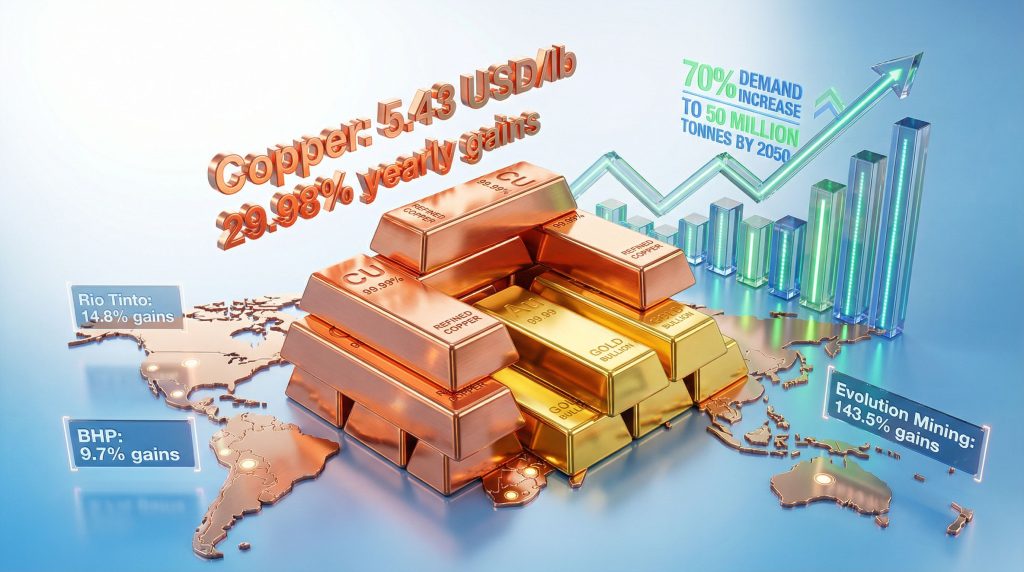
The current mining sector renaissance reflects more than cyclical market adjustments. Structural economic transformations are reshaping commodity valuations through mechanisms that traditional forecasting models struggle to capture. Copper prices have surged 35% year-to-date in 2025, reaching US$11,872 per tonne, while gold has appreciated 63% to US$4,275 per ounce, creating unprecedented investment conditions across resource sectors.
These price movements signal fundamental shifts in global economic architecture rather than temporary market dislocations. Mining companies with diversified commodity exposure are experiencing substantial valuation increases, with Evolution Mining shares gaining 143.5% annually despite carrying only a 1.6% dividend yield. This performance demonstrates how commodity price appreciation can overshadow traditional income-focused investment metrics.
Professional commodity analysts identify genuine supply-demand imbalances developing across multiple industrial metals. The convergence of infrastructure modernisation requirements, monetary policy accommodations, and geological resource constraints creates supportive conditions for sustained metal price elevation throughout the coming decade.
When big ASX news breaks, our subscribers know first
What Economic Factors Are Driving Unprecedented Copper Demand?
The Electrification Infrastructure Revolution
Global electrification initiatives fundamentally alter copper consumption patterns as AI drilling innovations expand data center requirements. Electric vehicle production networks demand substantial copper wiring installations, while renewable energy systems require copper-intensive transmission infrastructure upgrades across developed and emerging economies.
Data centres supporting AI computational requirements consume significantly more copper per square meter than traditional office facilities. Each server rack requires extensive copper wiring for power distribution and cooling systems, creating multiplicative demand effects as technology companies expand processing capabilities globally.
Key Electrification Demand Drivers:
• Electric vehicle charging station networks requiring high-capacity copper cabling
• Solar panel inverter systems incorporating copper-based electrical components
• Wind turbine generator windings utilising substantial copper quantities
• Grid modernisation projects upgrading transmission line infrastructure
Urbanisation and Industrial Development Cycles
Emerging market urbanisation continues generating substantial infrastructure requirements, particularly across Asia-Pacific regions where copper-intensive construction maintains robust growth despite global economic uncertainties. Manufacturing capacity expansion in developing economies creates additional copper demand layers through industrial equipment installation and factory construction projects.
Urban development requires copper plumbing systems, electrical wiring networks, and telecommunications infrastructure. Population migration from rural to urban areas accelerates this demand concentration, creating sustained consumption growth independent of traditional economic cycles.
Why Are Supply Constraints Creating Long-Term Price Support?
Geological Resource Depletion Challenges
Mining operations confront increasingly complex extraction environments as accessible, high-grade deposits become depleted. Ore grade deterioration accelerates across major copper-producing regions, requiring greater processing volumes to achieve equivalent output levels while increasing operational costs substantially.
Modern copper mines extract ore containing significantly lower metal concentrations than historical operations. This fundamental constraint means mining companies must process larger quantities of raw material to produce each tonne of refined copper, creating inherent cost inflation pressures throughout the supply chain.
Supply Constraint Mechanisms:
• Deeper mining operations requiring advanced extraction technologies
• Lower-grade ore deposits necessitating increased processing capacity
• Environmental compliance costs reducing operational efficiency margins
• Geographic remoteness of new deposits increasing transportation expenses
Capital Investment and Development Timeline Bottlenecks
Mining project development faces extended approval processes, environmental compliance requirements, and substantial capital investment needs. These factors create significant lag times between demand identification and production capacity expansion, fundamentally limiting supply responsiveness to price signals.
Major copper mining projects require approximately 15-20 years from initial discovery through production commencement. This extended timeline means current supply decisions were made during entirely different macroeconomic environments, creating persistent supply-demand mismatches as market conditions evolve.
How Are Central Bank Policies Influencing Precious Metal Valuations?
Monetary Policy Transmission Effects
Central bank policy decisions across major economies support precious metal valuations through currency debasement concerns and real interest rate calculations. Gold's 63% appreciation in 2025 reflects investor positioning against potential currency purchasing power erosion as monetary authorities maintain accommodative policies across developed economies.
Professional investors increasingly view physical commodities as portfolio diversification tools against fiat currency risks. Mining company dividends provide additional income streams while offering direct commodity exposure, creating attractive investment propositions during inflationary environments where gold inflation hedge strategies prove valuable.
Currency Devaluation and Inflation Hedging
Commodity price appreciation reflects broader currency purchasing power erosion concerns as central banking systems navigate complex inflationary pressures. Australian mining companies benefit from currency dynamics, with fully franked dividend structures providing tax-efficient income distributions alongside capital appreciation potential.
Australian Mining Company Dividend Yields:
| Company | Dividend Yield | Capital Gains (YTD) |
|---|---|---|
| Rio Tinto | 4.2% (fully franked) | 14.8% |
| BHP Group | 3.7% (fully franked) | 9.7% |
| Evolution Mining | 1.6% (fully franked) | 143.5% |
What Do Professional Forecasting Models Predict for Commodity Prices?
Market Structure Analysis
Professional commodity analysts identify structural market deficits developing across multiple industrial metals, suggesting sustained price elevation rather than cyclical peaks. Iron ore trends demonstrate forecasting challenges, with analyst consensus in December 2024 predicting weakness below US$100 per tonne, yet the commodity traded above US$107 per tonne by early December 2025.
Current iron ore pricing at US$102 per tonne represents significant outperformance versus professional forecasts. Some analysts projected declines toward US$80 per tonne, demonstrating the difficulty of predicting commodity markets during structural economic transitions.
Investment Bank Perspective Integration
Mining sector valuations reflect recognition of sustained commodity price elevation potential. The progression from recent copper price levels (US$11,872 per tonne) toward higher targets suggests moderate additional appreciation based on supply-demand fundamentals rather than speculative positioning.
Technical analysis models incorporating precious metal ratios indicate potential for substantial copper repricing over extended timeframes. These methodologies consider historical relationships between different commodity prices to identify valuation anomalies and correction opportunities.
Which Geographic Regions Benefit Most from Commodity Price Increases?
Australian Resource Sector Performance
Major Australian mining companies experience significant valuation increases as surging copper and gold prices drive sector-wide performance improvements. Diversified resource portfolios capture multiple commodity cycle benefits while providing defensive characteristics through dividend income streams.
Australian Mining Performance Metrics:
• Rio Tinto shares achieving new all-time highs with 14.8% yearly gains
• BHP shares reaching highest levels since February 2024 with 9.7% appreciation
• Evolution Mining establishing record highs with 143.5% annual performance
• All three companies maintaining fully franked dividend distributions
North American Mining Advantage
Trade policy developments provide competitive advantages for North American mining operations through domestic production preferences. Supply chain planning increasingly favours regional sourcing arrangements, benefiting local mining companies with established operational infrastructure and regulatory compliance frameworks, particularly amid ongoing US-China trade war tensions.
Domestic mining operations receive preferential treatment in government infrastructure projects, creating sustained demand visibility for companies with appropriate geographic positioning and production capabilities.
The next major ASX story will hit our subscribers first
How Should Investors Position for Extended Commodity Cycles?
Diversified Resource Exposure Strategies
Investment portfolios benefit from exposure across multiple commodity types rather than concentrated positions in individual metals. Mining companies with diversified operations provide natural hedging against commodity price volatility while capturing upside potential across different market segments.
Resource sector investments offer direct commodity exposure combined with operational leverage effects. When commodity prices increase, mining company profitability typically expands at accelerated rates due to fixed cost structures and operating leverage mechanisms.
Strategic Portfolio Considerations:
• Diversification across copper, gold, and iron ore exposure
• Geographic diversification through international mining operations
• Dividend income streams providing defensive portfolio characteristics
• Operational leverage amplifying commodity price appreciation benefits
Infrastructure and Technology Integration
Mining companies combining traditional extraction operations with technological advancement and sustainable practices position themselves advantageously for long-term commodity demand growth. Automation technologies reduce operational costs while improving safety metrics and environmental compliance capabilities.
Sustainable mining practices become increasingly important for regulatory compliance and social licence maintenance. Companies investing in environmental technologies and community engagement programmes demonstrate superior long-term viability prospects.
What Risks Could Disrupt Current Commodity Price Trends?
Chinese Economic Policy Adjustments
Chinese industrial demand significantly influences global commodity markets through manufacturing capacity and infrastructure spending policies. Economic policy shifts, including state-directed manufacturing adjustments or infrastructure investment changes, could alter demand projections substantially across multiple commodity categories.
China's urbanisation trajectory and industrial modernisation programmes drive substantial commodity consumption. Furthermore, implementing effective volatility hedging strategies becomes crucial as policy changes affecting these development priorities create systematic risks for global commodity pricing mechanisms and mining company revenue projections.
Alternative Technology Development
Technological breakthroughs in material science, recycling efficiency, or substitute materials could reduce traditional commodity demand over extended timeframes. Advanced recycling technologies may increase secondary copper supply availability, potentially moderating demand for primary production.
Potential Disruption Factors:
• Advanced material substitution reducing copper requirements
• Improved recycling technologies increasing secondary metal supply
• Alternative energy storage systems reducing battery metal demand
• Manufacturing process innovations decreasing metal intensity requirements
Long-Term Investment Implications and Portfolio Considerations
Strategic Asset Allocation Adjustments
Current surging copper and gold prices suggest investors should evaluate portfolio exposure to real assets as inflation hedging mechanisms. Resource sector investments provide direct commodity exposure while offering dividend income streams, creating balanced risk-return profiles during inflationary environments.
Mining company valuations reflect both current commodity price levels and long-term production capabilities. Investors benefit from understanding operational leverage effects, where small commodity price changes create amplified profitability impacts due to fixed cost structures.
Risk Management and Volatility Considerations
Commodity investments inherently involve price volatility and operational risks requiring careful portfolio management approaches. Diversification across multiple companies, commodities, and geographic regions helps manage these exposures while capturing upside potential from structural demand growth.
Critical Risk Assessment Framework:
• Regulatory changes affecting mining operation permits and compliance costs
• Environmental compliance expenses impacting operational margins
• Currency fluctuation impacts on international mining operations
• Geopolitical tensions disrupting global supply chain arrangements
• Technical mining challenges in deep or remote deposit locations
Conclusion: Positioning for the Next Commodity Supercycle
Current copper and gold price dynamics reflect fundamental economic restructuring rather than temporary market conditions. Infrastructure electrification, supply constraint realities, and monetary policy environments create supportive conditions for sustained commodity price elevation throughout the coming decade.
The Australian mining sector demonstrates compelling investment characteristics through sustained commodity price appreciation, with copper advancing 35% and gold climbing 63% during 2025. Major mining companies like Rio Tinto, BHP, and Evolution Mining provide diversified commodity exposure combined with attractive dividend yields and operational leverage benefits.
Investors should consider resource sector exposure as part of balanced portfolio strategies, recognising both opportunities and risks inherent in commodity cycle investing. The convergence of technological advancement, environmental transition requirements, and traditional economic growth creates unique investment conditions for the coming decade.
Professional forecasting models suggest continued structural support for metal prices through supply-demand imbalances and infrastructure modernisation requirements. Mining companies with diversified operations, sustainable practices, and strong balance sheets appear well-positioned to capitalise on these long-term trends while providing defensive income characteristics through dividend distributions, supported by comprehensive market analysis from leading financial institutions.
Investment Strategy Synthesis:
• Focus on diversified mining companies with multiple commodity exposures
• Prioritise companies with sustainable operational practices and regulatory compliance
• Consider dividend-paying miners for income generation alongside capital appreciation
• Maintain geographic diversification across different mining jurisdictions
• Monitor supply-demand fundamentals and technological disruption potential
The intersection of global electrification trends, monetary policy accommodations, and genuine supply constraints creates a compelling investment thesis for quality mining companies positioned to benefit from sustained commodity price elevation over the next economic cycle.
Looking to Capitalise on the Next Major Mineral Discovery?
Discovery Alert's proprietary Discovery IQ model delivers real-time notifications on significant ASX mineral discoveries, instantly empowering investors to identify actionable opportunities ahead of the broader market during this unprecedented commodity price surge. Understand why major mineral discoveries can lead to exceptional returns by exploring historic examples of transformational outcomes and begin your 30-day free trial today to position yourself advantageously in this evolving resource sector landscape.