June 16, 2026
The Hidden Infrastructure of Industrial Civilisation: Why Metal Recycling Defines Our Economic Future
Every manufactured object that shapes modern life, from the smartphone in your pocket to the steel frame of the building you work in, relies on metals that were once dug from the earth at enormous environmental cost. Yet the most consequential shift in industrial materials management is not happening underground. It is happening above it, in the sorting facilities, smelters, and chemical processing plants that form the backbone of metal recycling for sustainable economies. Understanding this shift, and why it is accelerating, reveals something fundamental about where industrial civilisation is heading.
When big ASX news breaks, our subscribers know first
Metals Are Not Like Other Materials
The distinction between metals and virtually every other recyclable material lies in a single, remarkable property: metals do not degrade through repeated processing cycles. Glass can be recycled but often loses clarity and strength. Paper fibres shorten with each cycle. Plastics degrade chemically and structurally, limiting the number of useful recycling generations. Metals, by contrast, retain their physical and chemical integrity indefinitely.
This is not a trivial difference. It means that a kilogram of aluminum smelted from bauxite ore in the 1970s could theoretically still be in productive industrial use today, having passed through dozens of product lifetimes. This permanence transforms metal recycling from a waste management activity into something more structurally significant: a secondary raw materials system that runs parallel to primary mining, with the potential to eventually reduce dependence on virgin extraction across entire industrial sectors.
The metals driving the largest global recycling volumes today are steel, aluminum, copper, and zinc. However, the fastest-growing segment is not any of these established commodities. It is the category of critical minerals demand, particularly cobalt, lithium, nickel, and rare earth elements, whose recovery from end-of-life batteries and electronics is rapidly becoming a strategic industrial priority.
The Circular Economy Is Not a Metaphor Here
Circular economy principles are frequently invoked in sustainability discourse as aspirational frameworks. In the metals sector, however, they are operational realities. The closed-loop recycling model, where a metal component is recovered at end of life, reprocessed to specification, and re-entered into active manufacturing, already functions at scale for steel and aluminum.
The distinction between open-loop and closed-loop recycling matters enormously for sustainability accounting. In open-loop recycling, a material is recovered but downcycled into a lower-grade application than its original use. In closed-loop recycling, the recovered material matches or approaches the quality of virgin feedstock and re-enters the same supply chain tier. Closed-loop recovery delivers far greater sustainability value because it genuinely displaces primary production rather than merely delaying disposal.
Steel, for instance, is already one of the most recycled materials on earth by volume. Roughly 85 to 90 percent of structural steel from demolished buildings is recovered and remelted in electric arc furnaces. This is not an environmental aspiration. It is standard industrial practice driven by the economics of scrap metal recycling markets.
The Quantifiable Environmental Advantage
The environmental case for scaling metal recycling for sustainable economies rests on a body of well-documented, quantifiable evidence. The energy savings alone are substantial enough to reshape industrial emissions trajectories if recycling rates were pushed toward their theoretical maximums.
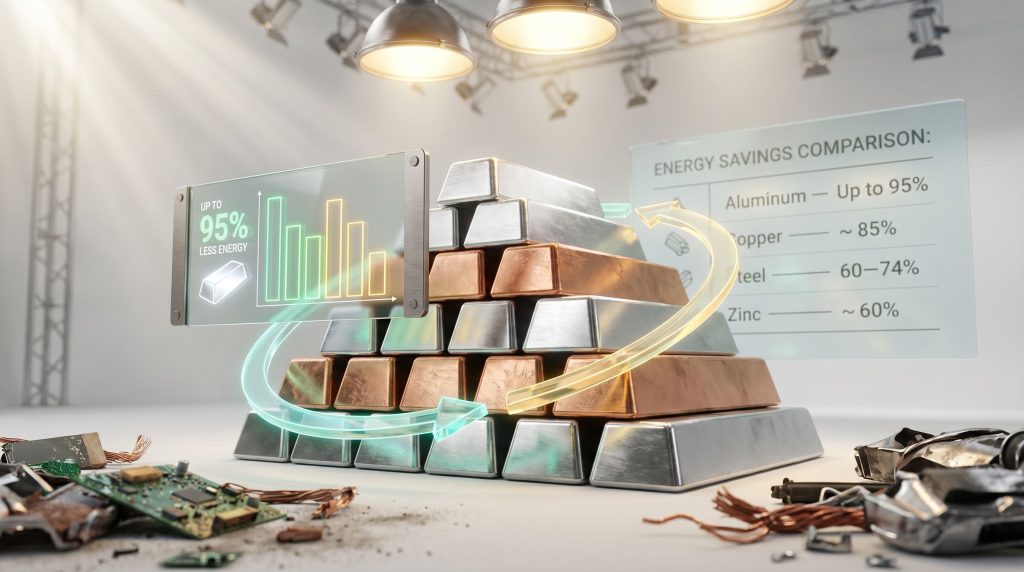
| Metal | Energy Savings vs. Primary Production | Key Environmental Benefit |
|---|---|---|
| Aluminum | Up to 95% | Major reduction in electricity demand and CO₂ |
| Copper | ~85% | Lower smelting emissions and acid drainage |
| Steel | ~60–74% | Reduced coking coal consumption |
| Zinc | ~60% | Decreased sulfur dioxide emissions |
Aluminum is the most striking example. Producing primary aluminum from bauxite ore is one of the most electricity-intensive industrial processes in existence, requiring the energy-hungry Hall-Héroult electrolytic process to break down alumina. Recycling aluminum from scrap requires up to 95% less energy, and because much of the world's primary aluminum smelting is powered by fossil-fuel-derived electricity, this energy saving translates directly into a significant greenhouse gas reduction per tonne of metal produced.
Beyond energy, the environmental benefits extend to pollution prevention and ecosystem protection:
- Using recycled metal instead of virgin ore reduces air pollution by approximately 80% and water pollution by approximately 76%, based on lifecycle comparisons between secondary and primary production pathways
- Water consumption across the production cycle drops by up to 40% when recycled feedstock replaces mined ore
- Soil erosion, deforestation, and habitat disruption associated with open-cut and underground mining are directly reduced as secondary supply displaces primary extraction demand
- Communities near former or active mining operations benefit from downstream water quality improvements as tailings management pressures ease
These environmental figures are not abstract. They represent the difference between an industrial system that relentlessly degrades natural systems and one that progressively closes its material loops. At sufficient scale, the cumulative effect of metal recycling on global emissions accounting is material, not marginal.
From a corporate reporting perspective, recycled metal feedstock increasingly features in Scope 3 emissions reduction strategies. For manufacturers in automotive, construction, and electronics, the embodied carbon of metal inputs represents a significant share of total lifecycle emissions. Sourcing recycled metal rather than primary material is one of the most direct levers available to reduce that footprint, and it is one that Science Based Targets initiative (SBTi)-aligned companies are beginning to mandate through procurement policy. Furthermore, decarbonising metal supply chains has become a boardroom-level priority across several major industrial sectors.
The Economic Architecture of Secondary Metals
The economic case for metal recycling operates at multiple levels simultaneously, from individual firm cost reduction through to national resource security strategy.
At the firm level, recycled metal feedstock consistently offers cost advantages over primary material, particularly during periods of elevated commodity prices. Scrap metal markets provide industrial buyers with an alternative sourcing channel that partially insulates procurement costs from the volatility of primary metal benchmarks like the London Metal Exchange. Sectors with the highest dependency on this dynamic include:
- Automotive manufacturing, where aluminum-intensive vehicle designs are increasingly sourced from secondary alloy producers
- Construction, where recycled steel rebar and structural sections dominate many regional supply chains
- Electronics, where copper reclaim from PCBs and wiring harnesses provides a cost-competitive feedstock for cable manufacturers
- Aerospace, where the value density of titanium and aluminum scrap makes recycling economics compelling even at relatively small volumes
At the macroeconomic level, metal recycling generates employment across a wide range of skill categories. Collection logistics, industrial sorting, metallurgical processing, quality assurance, and engineering operations all require dedicated labour forces. Advanced recycling facilities, particularly those processing electronic waste or battery materials, demand highly skilled workers including metallurgists, process engineers, and analytical chemists. These are not low-skill roles, and the concentration of recycling infrastructure in industrial and peri-urban communities creates genuine economic multiplier effects in regions that have often lost manufacturing employment to automation or offshoring.
Resource Sovereignty: The Strategic Dimension
Perhaps the least appreciated dimension of metal recycling for sustainable economies is its contribution to strategic resource independence. Nations with robust domestic secondary metal capacity are measurably less exposed to geopolitical commodity disruptions, export restrictions, and supply chain shocks driven by the geographic concentration of primary mining assets.
This dynamic is most acute for critical minerals. The primary production of cobalt is concentrated in the Democratic Republic of Congo. Rare earth element refining is dominated by China. Lithium extraction is concentrated in a small number of South American and Australian assets. Any disruption to these primary supply chains, whether from political instability, trade policy, or resource nationalism, cascades directly into the manufacturing sectors that depend on these materials.
Nations and corporations that establish robust battery recycling infrastructure today are positioning themselves to control a critical segment of the future clean energy supply chain. The ability to recover cobalt, lithium, and nickel from domestic waste streams is not merely an environmental achievement. It is a form of strategic resource sovereignty.
Battery recycling processes represent the fastest-growing and most strategically significant segment of the metal recycling industry. As electric vehicle fleets age and reach end-of-life over the coming decade, the volume of battery packs entering waste streams will grow dramatically. The metals contained within those packs, particularly lithium, cobalt, nickel, and manganese, represent a concentrated secondary ore body with grades that in some cases exceed those of operating primary mines.
The next major ASX story will hit our subscribers first
Technology Is Redefining What Is Recoverable
The economics and environmental performance of metal recycling are both heavily dependent on the sophistication of processing technology. Several distinct technological frontiers are reshaping what is recoverable, at what purity, and at what cost.
Sensor-Based Sorting and AI-Driven Classification
Modern scrap metal sorting facilities deploy sensor arrays that were unavailable even a decade ago. Near-infrared (NIR) spectroscopy, X-ray fluorescence (XRF), and eddy current separation systems can identify and separate metal fractions at throughput speeds that manual sorting cannot approach. More recently, machine learning algorithms applied to real-time sensor data have enabled automated grading of mixed scrap streams with a level of precision that materially improves the commercial value of recovered fractions.
The practical implication is that scrap streams previously considered too contaminated or too mixed to be economically processed are now recoverable at commercially viable purity levels. This expands the effective supply of secondary metal feedstock without requiring any increase in collection rates.
Processing Complex Waste Streams
Two primary metallurgical pathways address complex waste streams, each suited to different material compositions:
| Technology | Application | Key Advantage |
|---|---|---|
| Hydrometallurgy | E-waste, battery recycling | High selectivity, lower temperature requirements |
| Pyrometallurgy | Alloy scrap, complex mixed metals | High throughput, broad metal applicability |
| Sensor-Based Sorting | Municipal and industrial scrap | Speed, purity, automation potential |
| AI-Driven Grading | Mixed scrap streams | Real-time classification, reduced human error |
Hydrometallurgy uses aqueous chemical solutions to selectively dissolve and then recover specific metals from complex matrices. It is particularly well suited to electronic waste and lithium-ion battery processing, where the target metals are present at relatively low concentrations but with high enough value to justify selective extraction. The process operates at lower temperatures than smelting, reducing energy intensity and enabling greater selectivity between closely related elements.
Pyrometallurgy, the older and more established approach, uses high-temperature smelting and refining to recover metals from alloy scrap and complex mixed materials. It excels in high-throughput applications and can handle a wider variety of input materials, but offers less selectivity than hydrometallurgical routes and generates slag that requires careful management.
Emerging hybrid process designs are increasingly combining both approaches, using pyrometallurgical pre-concentration followed by hydrometallurgical refining to maximise recovery of multiple target metals from a single complex feed material. In addition, advanced recycling technology is proving particularly relevant for black mass processing in battery recycling, where lithium, cobalt, nickel, and manganese must all be recovered simultaneously to make the economics viable.
Urban Mining: The Above-Ground Ore Body
Urban mining reframes how industrial societies should think about the material stocks they have already created. Cities are, in effect, above-ground ore deposits of extraordinary metal concentration. The challenge is not geological, as the metals exist and their locations are known. It is logistical and technological: efficiently collecting, identifying, and processing the dispersed end-of-life products in which those metals are embedded.
Key urban mining source categories include:
- Electronic waste (e-waste): circuit boards, processors, and connectors containing gold, silver, palladium, and copper at concentrations that significantly exceed those of primary ore bodies in many cases
- End-of-life vehicles: steel, aluminum, copper wiring, and increasingly, battery packs containing critical minerals
- Construction and demolition debris: structural steel, copper plumbing, aluminum cladding, and reinforcement bar
- Municipal solid waste streams: consumer electronics, appliances, and packaging metals
A tonne of mobile phones contains gold concentrations that can be many times higher per kilogram than a tonne of mined gold ore. This comparison illustrates why urban mining is emerging as one of the most economically compelling frontiers in secondary materials recovery. The grade advantage of urban ore bodies over many marginal primary mines is substantial, and unlike conventional mines, urban ore bodies replenish themselves continuously as new generations of consumer products reach end of life.
Blockchain-based traceability systems are beginning to be deployed in urban mining supply chains, enabling verifiable material provenance from collection point through to refined metal output. This transparency is increasingly demanded by industrial buyers seeking to demonstrate responsible sourcing under ESG frameworks.
The Barriers That Still Limit Scale
Despite the compelling economics and environmental case, several structural challenges continue to constrain global metal recycling rates below their theoretical potential.
Collection infrastructure remains the primary bottleneck. The most sophisticated processing technology is irrelevant if end-of-life products are not efficiently gathered into formal recovery systems. Consumer electronics, small appliances, and personal vehicles are dispersed across millions of households and businesses, and collection infrastructure in most economies remains fragmented and incomplete. Extended producer responsibility (EPR) schemes, which shift the cost and obligation of end-of-life management to manufacturers, represent the most effective policy mechanism for improving collection coverage, but implementation varies enormously across jurisdictions.
Alloy complexity and contamination present a different category of technical challenge. The tramp element problem in steel recycling is a well-known example: copper contamination from electrical wiring embedded in scrap vehicles and construction demolition debris accumulates in electric arc furnace steel and limits its applicability in demanding high-grade applications. Solving this problem at scale requires both better sorting technology and a fundamental shift in how products are designed. Design-for-recyclability, the practice of engineering products from the outset with efficient material recovery in mind, is gaining traction in automotive and electronics sectors but remains far from universal.
Economic barriers and commodity price volatility create cyclical challenges for recycling operations. When primary metal prices fall sharply, the economics of secondary production can deteriorate rapidly, potentially making scrap collection and processing unviable at current cost structures. This inverse relationship between virgin metal prices and recycling sector profitability is a structural vulnerability that policy instruments including carbon pricing, recycled content mandates, and production tax credits can partially address by improving the relative economics of secondary material. Consequently, the circular economy's role in stabilising these markets is gaining wider recognition among policymakers.
Climate Policy and the Industrial Demand Pull
The alignment between metal recycling for sustainable economies and the accelerating global net-zero industrial transition is creating a powerful demand pull for secondary materials that did not exist at the same intensity even five years ago.
Major construction and infrastructure projects are increasingly specifying embodied carbon targets that effectively mandate high recycled content in steel and aluminum inputs. Corporate procurement policies in the automotive and electronics sectors are incorporating minimum recycled content thresholds as standard supplier qualification criteria. These procurement-side signals are creating durable, policy-independent demand for secondary metal that operates regardless of short-term commodity price cycles.
The EU Circular Economy Action Plan, provisions within the US Inflation Reduction Act addressing domestic critical mineral supply chains, and various Asia-Pacific national recycling mandates are collectively creating a regulatory architecture that progressively favours secondary metal production over primary extraction. However, it is important to distinguish between broad policy frameworks that improve the operating environment for the recycling sector generally, and specific project-level government support, which requires explicit confirmation to assert.
As the global energy transition demands ever-larger volumes of battery metals, the recycling of lithium-ion battery packs is transitioning from a niche industrial activity to a strategic economic priority. The supply gap between projected critical mineral demand and available primary production capacity is real, and recycling represents one of the few credible mechanisms to partially bridge it at meaningful scale within the relevant timeframe.
Building the Infrastructure of a Secondary Materials Economy
Scaling metal recycling to the level required to meaningfully support sustainable economic systems requires infrastructure investment across multiple layers simultaneously:
- Physical processing capacity: new and upgraded sorting facilities, hydrometallurgical plants, electric arc furnaces, and battery black mass processing lines
- Collection network density: expanded consumer and industrial collection points, formal take-back schemes, and reverse logistics infrastructure
- Workforce development: training pipelines for metallurgists, process engineers, equipment operators, and data scientists specialising in materials recovery
- Digital infrastructure: IoT-enabled asset tracking, AI-driven process optimisation, and blockchain-based material provenance systems that support transparent and verifiable secondary supply chains
- Financing mechanisms: public-private partnerships, green bonds, and blended finance structures that reduce the capital cost and risk profile of large-scale recycling infrastructure investment
The long-term economic case for this investment strengthens structurally over time. As virgin resource extraction costs rise with declining ore grades and increasing depth of primary deposits, as carbon pricing mechanisms expand the cost of emissions-intensive primary smelting, and as ESG-linked procurement criteria embed recycled content requirements more deeply in industrial supply chains, the relative economics of secondary metal production improve. Furthermore, economic impacts on sustainability are increasingly well-documented, reinforcing the investment case for companies and nations that build recycling infrastructure now rather than later.
Metal recycling for sustainable economies is not an environmental add-on to industrial strategy. It is increasingly the industrial strategy itself, the foundation on which resource-efficient, climate-aligned, and geopolitically resilient manufacturing systems will be built.
Frequently Asked Questions: Metal Recycling and Sustainable Economies
What metals are most commonly recycled?
Steel and aluminum account for the largest volumes of recycled metal globally by mass, followed by copper, zinc, and lead. Critical minerals including cobalt, lithium, and rare earth elements represent the fastest-growing segment, driven by battery and electronics recycling demand.
How does metal recycling reduce carbon emissions?
Recycling replaces the energy-intensive sequence of mining, ore processing, and primary smelting with a lower-energy remelting and refining process. Since primary production processes are typically fossil-fuel-intensive, substituting recycled feedstock directly reduces the greenhouse gas emissions embedded in manufactured metal products.
Is recycled metal as high-quality as primary metal?
In most industrial applications, properly processed recycled metal meets the same technical specifications as primary material. Advanced sorting and refining technologies have significantly improved the purity and consistency of recycled metal outputs over the past decade, making them suitable for demanding applications in aerospace, automotive, and electronics manufacturing.
What role does metal recycling play in the circular economy?
Metal recycling is one of the most operationally mature expressions of circular economy principles, keeping materials in productive use across multiple product lifetimes, minimising waste generation, and reducing the extraction pressure on finite natural resources.
Why is metal recycling important for economic resilience?
Domestic secondary metal capacity reduces dependence on imported raw materials and insulates manufacturing supply chains from geopolitical commodity disruptions, primary mine supply shocks, and the price volatility associated with concentrated primary production in politically sensitive jurisdictions.
Want to Track the ASX Companies Mining the Metals That Power the Circular Economy?
Discovery Alert's proprietary Discovery IQ model delivers real-time alerts the moment significant mineral discoveries are announced on the ASX, turning complex geological data into actionable investment insights for both short-term traders and long-term investors. Explore why major mineral discoveries have historically generated substantial returns and begin your 14-day free trial to position yourself ahead of the broader market.