June 18, 2026
The Industrial Logic Behind Metal Separation: Why Precision Recovery Is Reshaping Resource Strategy
The economics of resource extraction have always been governed by a simple tension: the cost of getting materials out of the ground versus the value they deliver once processed. For most of industrial history, virgin mining dominated that equation. Today, however, a structural shift is underway. As ore grades decline at major mining operations globally, and as the metals required for clean energy infrastructure grow scarcer and more strategically sensitive, the ability to recover high-purity metals from existing material stocks is no longer a secondary consideration. It has become a primary industrial priority.
The advantages of metal separation extend well beyond operational efficiency. They touch supply chain resilience, environmental compliance, economic competitiveness, and the long-term viability of circular manufacturing. Understanding these advantages in full requires looking at the technology, the economics, and the broader resource landscape simultaneously.
When big ASX news breaks, our subscribers know first
How Metal Separation Strengthens Resource Conservation and Supply Chain Security
One of the most structurally significant advantages of metal separation is its capacity to extend the productive life of existing metal stocks. Metals are unusual among industrial materials in that they can be recovered, reprocessed, and reused indefinitely without meaningful degradation to their physical or chemical properties. This characteristic makes separation not just an environmental tool but a supply continuity mechanism.
For industries reliant on lithium, cobalt, copper, and rare earth elements, this matters enormously. These materials sit at the intersection of high demand and constrained supply. Cobalt, for example, is predominantly sourced from the Democratic Republic of Congo, while rare earth processing is heavily concentrated in China. For manufacturers of electric vehicles, wind turbines, and advanced electronics, supply disruptions in either region create immediate production risk.
Domestic separation capacity directly addresses this vulnerability. By enabling the recovery of critical minerals demand from end-of-life products and industrial scrap, separation infrastructure functions as a form of supply chain insurance, reducing import dependency without requiring new greenfield mining operations.
Key Insight: The strategic value of metal separation scales with the geopolitical sensitivity of the metal in question. For rare earths and cobalt, recovery through separation is not merely an environmental preference but a supply security necessity.
Why Ore Grade Decline Amplifies the Case for Separation
A less commonly discussed factor reinforcing the importance of separation is the long-term decline in ore grades at primary mining operations. Copper ore grades at major producing mines have fallen significantly over the past century, with average grades at many operations now below 0.5% copper content, compared to grades above 2% that were standard several decades ago. This means miners must process substantially more rock to produce the same volume of refined metal, increasing energy consumption, water use, and waste generation per unit of output.
This grade dilution effect makes secondary recovery through separation increasingly cost-competitive with primary production, particularly for metals where recycling infrastructure is already mature. The crossover point where separation-based recovery becomes the economically preferred source of supply is arriving sooner than many analysts anticipated.
Environmental Benefits: Energy, Waste, and Ecological Impact
The environmental case for metal separation rests on three distinct pillars: energy reduction, waste diversion, and the prevention of ongoing ecological damage from primary extraction.
Energy Savings by Metal Type
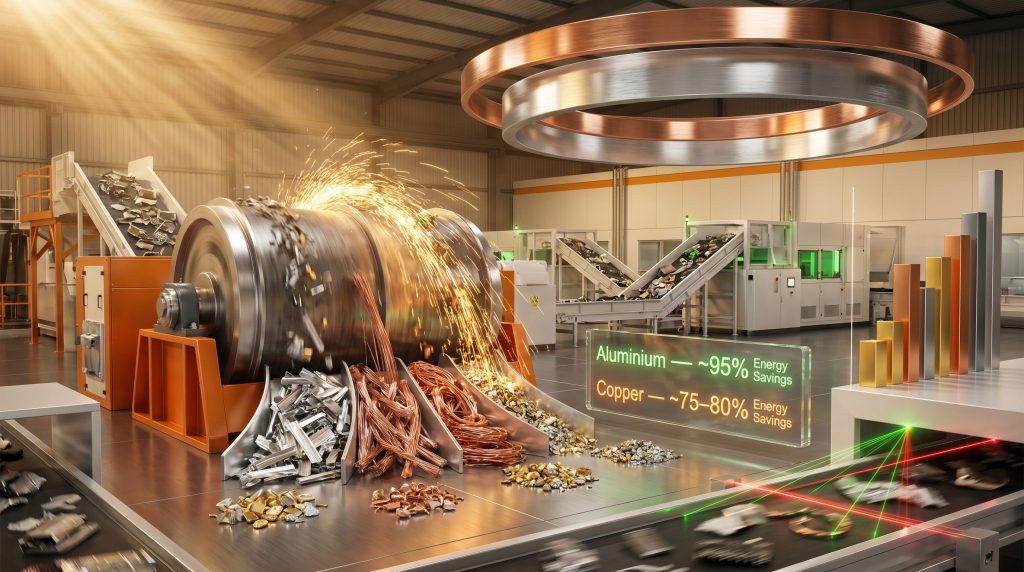
The energy differential between primary production and recycling-based recovery is one of the most compelling arguments in the entire circular economy literature. The figures below illustrate why:
| Metal | Energy to Produce from Raw Ore | Energy to Recover via Recycling | Estimated Savings |
|---|---|---|---|
| Aluminium | ~170 GJ/tonne | ~8.5 GJ/tonne | ~95% |
| Copper | ~60–80 GJ/tonne | ~15–20 GJ/tonne | ~75–80% |
| Steel | ~20–25 GJ/tonne | ~6–9 GJ/tonne | ~60–70% |
| Lead | ~25 GJ/tonne | ~1.5 GJ/tonne | ~94% |
These are not marginal improvements. A 95% reduction in energy consumption for aluminium recovery represents a transformational change in the carbon intensity of production. When multiplied across the billions of tonnes of aluminium currently in circulation globally, the aggregate emissions reduction potential is substantial.
For industrial operators facing increasingly stringent sustainability reporting requirements and carbon pricing mechanisms, these energy savings translate directly into financial advantage, not just environmental goodwill. Furthermore, the benefits of metal separation for reducing overall carbon footprints are increasingly recognised by regulatory bodies and investors alike.
Waste Diversion and Hazardous Material Management
Advanced separation systems play an equally important role in reducing the volume of residual waste entering landfill infrastructure. In the absence of effective separation, mixed industrial and consumer waste streams carry significant quantities of recoverable metal that would otherwise be permanently lost, while simultaneously introducing heavy metals and toxic compounds into soil and groundwater systems.
Electronic waste is particularly problematic in this regard. E-waste contains lead, mercury, cadmium, and hexavalent chromium, all of which are classified as hazardous under major environmental regulatory frameworks. Separation technology that diverts this material from landfill does not merely recover value; it actively prevents contamination of surrounding ecosystems.
Economic Dimensions: Revenue, Purity, and Competitive Positioning
Recovery Rates and Revenue at Industrial Scale
Modern high-gradient magnetic separation systems can achieve ferrous metal recovery rates approaching 99% in optimised configurations. At first glance, the difference between a 95% and 99% recovery rate may appear incremental. At industrial processing volumes, however, that four-percentage-point improvement can represent thousands of tonnes of additional recovered metal annually, with corresponding revenue implications that justify significant capital reinvestment.
The economic case for upgrading separation infrastructure in mature recycling operations is therefore not simply about sustainability compliance. It is a straightforward return-on-investment calculation that increasingly favours higher-precision technology. In addition, critical minerals processing advances are lowering the cost threshold at which these investments become commercially compelling.
The Premium Value of Purity
Separation quality directly determines the commercial value of the recovered material. Secondary metal markets apply meaningful price differentials based on purity levels, with higher-grade outputs commanding premiums that can substantially exceed the cost of the additional processing required to achieve them.
Strategic Note: Higher purity outputs from advanced separation processes command premium pricing in secondary metal markets, creating a direct financial return on separation technology investment.
Consistency of output quality also reduces downstream costs. When a recycled metal stream consistently meets specification, customers face lower reprocessing burdens and rejection rates fall, strengthening the commercial relationship and supporting longer-term contract pricing.
Unlocking Value in E-Waste Streams
One of the least appreciated economic dimensions of metal separation involves the extraordinary concentration of precious metals in electronic waste. A single tonne of mobile phone circuit boards contains more gold than approximately 40 to 50 tonnes of typical gold ore processed at many mining operations. Silver, palladium, indium, and gallium are present in commercially significant concentrations across various e-waste categories.
The challenge has historically been the complexity of separation required to access these materials. Advances in hydrometallurgical processing, laser-assisted sorting, and sensor-based identification are progressively lowering the cost of extraction, making e-waste streams economically viable feedstocks for precious and critical metal recovery at scales that were not previously achievable. Moreover, mechanical separation of metals at the front end of processing lines helps pre-sort material efficiently before more advanced techniques are applied.
Equipment Protection and Operational Safety
Beyond the resource and environmental dimensions, one of the practical advantages of metal separation that is often underweighted in strategic discussions is its role in protecting processing equipment and safeguarding workers.
In food processing, pharmaceutical manufacturing, and bulk materials handling, stray ferrous and non-ferrous metal fragments represent a serious operational risk. Undetected metal contamination can cause catastrophic damage to processing machinery, triggering unplanned downtime that carries costs far exceeding the value of any recovered material. Inline metal separation systems intercept these fragments before they reach sensitive processing stages.
Worker safety considerations reinforce this argument further. Automated separation systems reduce the need for manual inspection of hazardous material streams, limiting human exposure to sharp metal fragments, toxic compounds, and mechanically dangerous environments.
Separation Technologies: Performance Comparison
The field of metal separation encompasses a broad and rapidly evolving technology landscape. The table below summarises the key technologies currently driving performance gains across different application contexts:
| Technology | Primary Application | Key Advantage | Limitation |
|---|---|---|---|
| High-gradient magnetic separation | Ferrous recovery from mixed streams | Near-complete ferrous extraction | Limited to magnetic materials |
| Eddy current separation | Non-ferrous recovery (aluminium, copper) | Effective across wide size ranges | Less effective on fine particles |
| High-resolution flotation | Complex ore and fine particle processing | Excellent fine particle recovery | Significant water consumption |
| Laser-assisted sorting | E-waste and mixed recyclables | High speed with high precision | Substantial capital cost |
| X-ray transmission (XRT) | Dense media and mineral separation | Material density differentiation | Calibration complexity |
| AI-driven sensor sorting | Automated recycling lines | Continuous adaptive optimisation | Data infrastructure requirement |
Dry separation technologies deserve particular attention for their environmental profile. By eliminating water from the separation process entirely, dry systems reduce the operational footprint of processing plants, lower energy requirements associated with water treatment, and enable deployment in remote locations where water availability is constrained. This flexibility is increasingly important as separation capacity is required in geographically diverse settings.
The next major ASX story will hit our subscribers first
Digital Integration and the AI-Driven Separation Facility
Perhaps the most consequential near-term development in metal separation is the integration of artificial intelligence and machine learning into process control systems. Traditional separation facilities operated on fixed parameters that required manual adjustment as feedstock composition changed. AI-driven mining innovation is enabling control systems that can detect shifts in material inputs in real time and dynamically recalibrate separation parameters to maintain output quality without human intervention.
This capability matters most in e-waste and mixed recycling streams, where feedstock composition is highly variable. A separation facility processing consumer electronics, for instance, encounters material from dozens of different product generations, manufacturers, and design specifications within a single processing run. AI systems that can identify and adapt to this complexity in real time represent a genuine step change in operational performance.
Digital twin technology, which creates virtual models of physical separation plants that can be tested and optimised without interrupting production, is also gaining traction. The ability to simulate process changes before implementing them reduces the risk of costly operational experiments and accelerates the adoption of process improvements.
Metal Separation and the Circular Economy: Urban Mining as a Strategic Resource Base
The convergence of separation technology with circular economy principles has given rise to urban mining, the systematic recovery of metals from the built environment rather than from geological deposits. The urban mine is, in many respects, a superior ore body. It is located close to processing infrastructure, requires no exploration expenditure, and carries known metal content that is often higher in grade than equivalent primary ores.
Construction and demolition waste, end-of-life vehicles, consumer electronics, and municipal solid waste all represent quantifiable metal inventories. The challenge is separation. Without the ability to isolate individual metal streams from complex mixed waste with sufficient purity to meet market specifications, the economic case for urban mining cannot be realised.
Eco-design, the practice of designing products from the outset to facilitate end-of-life material recovery, is gradually improving the separability of future waste streams. As manufacturers, recyclers, and technology developers align around this principle, the efficiency and economics of separation-based recovery will continue to improve.
Emerging Opportunity: Urban mining combined with advanced separation technology is increasingly recognised as a viable strategy for reducing primary resource dependency, particularly for critical minerals essential to clean energy infrastructure.
Frequently Asked Questions: Advantages of Metal Separation
What is the primary advantage of metal separation in recycling?
Metal separation enables the recovery of high-purity metals from mixed waste streams, reducing the need for virgin extraction, lowering energy consumption, and generating revenue from recovered materials that would otherwise be lost to landfill.
How much energy does metal separation save compared to primary production?
Energy savings vary significantly by metal type. Aluminium recovery through separation and recycling uses approximately 95% less energy than primary smelting from bauxite ore. Copper recycling saves an estimated 75 to 80% of the energy required for primary production, while steel recycling achieves energy reductions of 60 to 70%.
What recovery rates are achievable with modern ferrous separation systems?
High-performance magnetic separation systems can achieve ferrous metal recovery rates of up to 99% in optimised configurations, making them among the most efficient separation technologies currently deployed at industrial scale.
How does metal separation support environmental compliance?
By reducing waste volumes, diverting hazardous materials from landfill, and lowering greenhouse gas emissions associated with primary metal production, separation processes help industrial operators meet increasingly stringent environmental and sustainability reporting requirements.
What metals can be recovered from e-waste through separation?
Electronic waste contains recoverable quantities of gold, silver, palladium, copper, aluminium, and a range of rare earth elements. Advanced separation techniques, including hydrometallurgical processing and laser-assisted sorting, make it economically viable to extract these materials from complex mixed-component waste streams.
How does metal separation protect industrial equipment?
Inline metal separators intercept stray ferrous and non-ferrous fragments before they enter processing machinery, preventing mechanical damage, reducing unplanned downtime, and extending equipment service life across food processing, pharmaceutical, and industrial manufacturing environments.
Key Takeaways: The Compounding Strategic Value of Metal Separation
The advantages of metal separation compound across multiple dimensions simultaneously, which is what makes this technology category so strategically significant at this point in the industrial cycle.
- Environmental: Energy savings of 60 to 95% compared to primary production, landfill diversion, and hazardous material containment.
- Economic: Higher recovery rates translate directly to revenue gains, while output purity improvements unlock premium pricing in secondary metal markets.
- Supply chain: Domestic separation capacity reduces exposure to geopolitical supply risk for critical minerals.
- Operational: Equipment protection and worker safety improvements deliver measurable cost reductions across industrial processing environments.
- Strategic: Urban mining enabled by advanced separation offers a long-term alternative to new greenfield extraction for a growing range of metals.
The convergence of AI-driven process optimisation, advanced physical separation physics, and circular economy policy frameworks is creating a structural tailwind for separation technology investment. As critical mineral demand intensifies through the global energy transition, and as primary ore grades continue their long-term decline, the industrial and financial logic underpinning investment in high-performance separation infrastructure will only strengthen.
Disclaimer: This article contains forward-looking statements and projections based on current industry trends and publicly available data. These should not be construed as investment advice. Readers should conduct independent research and consult qualified advisers before making investment or operational decisions.
Want to Stay Ahead of the Next Major Critical Mineral Discovery?
As the strategic value of critical minerals intensifies through the global energy transition, Discovery Alert's proprietary Discovery IQ model delivers real-time alerts on significant ASX mineral discoveries — transforming complex geological data into actionable investment insights for traders and long-term investors alike. Explore historic discoveries and their exceptional market returns, then begin your 14-day free trial at Discovery Alert to position yourself ahead of the market.