May 18, 2026
The global metallurgical coal landscape stands at a critical juncture where supply chain security increasingly drives strategic acquisition decisions. As steel manufacturers across Asia seek to diversify their coking coal sources beyond traditional suppliers, premium Australian hard coking coal assets have become coveted strategic assets. This market dynamic creates compelling valuation premiums for high-quality deposits, particularly those offering geographic diversification away from geopolitical risk zones.
Anglo American's Australian steelmaking coal operations have emerged as a prime example of this strategic value, attracting multiple international bidders following the collapse of a previous $3.8 billion transaction. Furthermore, the competitive sale process now underway reflects broader industry consolidation trends and the strategic importance of securing long-term metallurgical coal supplies for Asian steel production.
Strategic Realignment Following BHP Defense
Anglo American's decision to divest its Queensland coal operations represents a fundamental portfolio transformation strategy implemented following successful defense against BHP Group's takeover approach. The company has systematically restructured its asset base, spinning off the platinum business, initiating divestment of the De Beers diamond division, and pursuing acquisition of Canada's Teck Resources whilst simultaneously divesting coal assets. This strategy aligns with BHP's strategic pivot towards critical minerals.
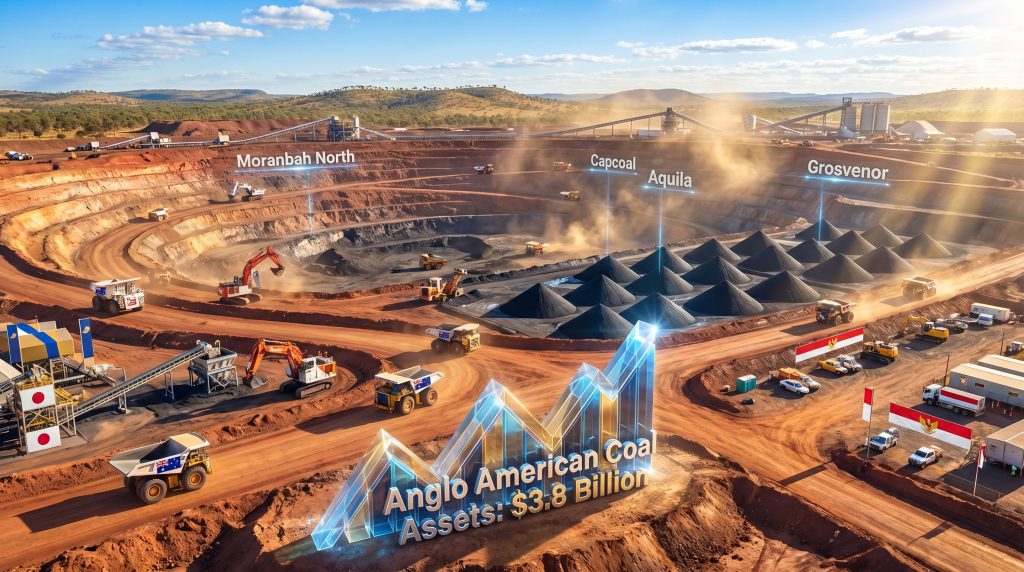
The four Queensland mines under consideration collectively represent 11.3 million tons of annual production capacity, comprising Moranbah North, Capcoal, Aquila, and Grosvenor operations located in the Bowen Basin. These assets produce premium hard coking coal essential for blast furnace steel production across Asian markets.
This strategic pivot toward copper and iron ore reflects Anglo American's assessment of long-term commodity demand trends. Critical minerals exposure provides enhanced growth prospects compared to traditional fossil fuel operations, while positioning the company for potential participation in energy transition infrastructure development.
"The restructuring timeline demonstrates Anglo American's commitment to capital reallocation toward higher-growth opportunities while maintaining operational excellence in divested assets."
Goldman Sachs Group and Morgan Stanley are managing the competitive sale process, indicating the strategic significance and expected transaction scale. Investment banking involvement at this level typically signals deal values exceeding $1 billion and complex international buyer dynamics.
When big ASX news breaks, our subscribers know first
Fire Incidents Derail Peabody Transaction
The collapse of Peabody Energy Corporation's acquisition in August 2025 created significant strategic disruption for Anglo American's divestment timeline. Peabody invoked a Material Adverse Change (MAC) clause following operational disruptions at the Moranbah North mine, which represented approximately 50% of the original $3.8 billion deal value. These developments have contributed to broader coal supply challenges across the industry.
Critical incident timeline:
• 2024: Fire at Grosvenor mine, Anglo's second-largest metallurgical project in Australia
• 2025: Separate fire incident at Moranbah North mine
• August 2025: Peabody invokes MAC clause and terminates acquisition agreement
• Current status: Moranbah North has restarted production; Grosvenor remains offline
The legal interpretation of MAC clauses in mining transactions centres on whether operational disruptions constitute fundamental changes to asset economics versus temporary operational setbacks. Peabody's position reflected concerns that cumulative fire incidents indicated potential systemic operational vulnerabilities across the portfolio.
Anglo American's dispute with Peabody over MAC clause interpretation could extend arbitration proceedings. However, the fire incidents highlighted operational risks inherent in underground coal mining operations, particularly longwall mining systems employed at both affected facilities.
Operational impact assessment:
- Moranbah North production restart suggests successful remediation of fire damage
- Grosvenor's continued offline status indicates more severe infrastructure damage or complex restart requirements
- Combined incidents created uncertainty regarding production forecasts and capital requirements
The Anglo American Peabody coal deal collapse has led to arbitration proceedings, reflecting evolving risk assessment frameworks in mining acquisitions, where operational disruption events receive enhanced scrutiny regarding their implications for long-term asset viability.
Three Strategic Bidders Emerge
Stanmore Resources: Domestic Consolidation Strategy
Sydney-listed Stanmore Resources represents the domestic consolidation option, backed by Golden Energy and Resources, which is controlled by Indonesia's billionaire Widjaja family. Stanmore's current market capitalisation sits below A$2 billion ($1.43 billion), making the potential acquisition transformational for the company's scale and market position.
Strategic advantages:
• Local operational expertise in Queensland coal mining regulations and infrastructure
• Existing relationships with Australian regulatory authorities and supply chain partners
• Indonesian capital backing providing alternative financing channels beyond Australian equity markets
• Potential market leadership position among Australian independent coal producers post-acquisition
The mathematics are compelling: acquiring assets originally valued at $3.8 billion would more than double Stanmore's enterprise value, creating a company worth approximately A$5+ billion upon successful transaction completion. This scale transformation positions Stanmore as a significant competitor to established market leaders.
Golden Energy and Resources' involvement reflects Indonesian strategic interest in securing metallurgical coal supplies for domestic steel production and export-oriented manufacturing sectors. Consequently, the Widjaja family's diversified resource holdings create potential operational synergies across regional mining portfolios.
Mitsubishi: Vertical Integration Strategy
Mitsubishi's participation reflects Japan's strategic commodity security doctrine and desire to control critical supply chains. The Japanese conglomerate already operates the BHP Mitsubishi Alliance (BMA) joint venture, one of the world's largest coking coal producers, providing existing operational expertise and market position.
Competitive positioning factors:
• Existing market dominance through BMA joint venture operations
• Vertical integration opportunities with Japanese steel manufacturing sector
• Operational synergies potential with existing Australian coal mining operations
• Long-term supply security for Asian steel markets
Mitsubishi's acquisition would strengthen the existing oligopoly structure in global metallurgical coal markets, where BMA and Glencore currently dominate supply. In addition, this consolidation could enhance pricing power and supply coordination across Asian markets.
The vertical integration calculus centres on securing non-substitutable inputs for Japan's manufacturing economy. Steel production remains fundamental to automotive, construction, and industrial machinery sectors that drive Japan's export competitiveness.
PT Buma Internasional Grup: Indonesian Expansion Model
PT Buma Internasional brings unique competitive advantages through prior familiarity with the asset portfolio. The Indonesian company had previously agreed to acquire a 51% stake in the Dawson project from Peabody following the original Anglo transaction, providing detailed operational knowledge and established relationships.
Strategic positioning elements:
• Prior due diligence experience on asset quality and operational characteristics
• Existing relationships with operational teams and regulatory stakeholders
• Indonesian government backing for overseas mining investments
• Lower operational cost structure characteristic of Indonesian mining operations
This prior involvement creates asymmetric information advantages compared to competing bidders lacking detailed operational knowledge. The Indonesian government backing suggests national strategic interest in securing metallurgical coal supplies for domestic industrialisation and export manufacturing growth.
Buma Internasional's lower cost base positioning reflects Indonesia's competitive labour costs and operational overhead structure, potentially enabling higher-return acquisition economics compared to developed-market competitors.
Market Dynamics Influencing Valuations
Current metallurgical coal markets operate significantly below the pricing peaks experienced during 2021-2022, creating complex valuation dynamics for asset transactions. Steel production demand patterns across Asia will fundamentally determine long-term asset values and acquisition economics.
Asian steel demand projections:
• China: Continues as primary metallurgical coal consumer despite domestic production capacity
• India: Represents fastest-growing steel market with infrastructure investment cycles driving demand
• Japan and South Korea: Maintain steady demand through export-oriented manufacturing sectors
Supply chain diversification imperatives:
Global steel manufacturers increasingly prioritise geographic diversification of metallurgical coal sourcing. Recent geopolitical disruptions highlighted risks associated with single-source supplier dependencies, particularly regarding Russian and Canadian coal supplies.
Australian premium hard coking coal provides strategic geographic diversification benefits, supporting valuation premiums relative to commodity-linked pricing models. Quality differentials between Australian hard coking coal and alternative suppliers create additional value propositions for steel manufacturers requiring consistent blast furnace performance.
Energy transition timeline considerations:
Hydrogen-based direct reduction technology development continues advancing, though current industry projections suggest metallurgical coal demand will remain robust through 2035-2040. This extended demand visibility supports asset valuations, albeit with declining trajectory assumptions for terminal value calculations. However, the development of renewable energy solutions continues to influence long-term market expectations.
The transition timeline uncertainty creates valuation complexity requiring sophisticated scenario modelling. Early hydrogen steel production adoption could accelerate demand decline, whilst delayed technology deployment extends traditional steel production economics.
Global Market Structure Transformation
Successful transaction completion will reshape competitive dynamics in global metallurgical coal markets currently dominated by BHP Mitsubishi Alliance and Glencore. The identity of the winning bidder will determine specific structural changes to market concentration and pricing coordination capabilities.
Potential market structure scenarios:
| Winning Bidder | Market Structure Impact | Concentration Level |
|---|---|---|
| Mitsubishi | Strengthened BMA dominance | Increased oligopoly power |
| Stanmore Resources | New major Australian independent | Moderate fragmentation |
| Buma Internasional | Asian-controlled competitor | Geographic diversification |
Asian ownership trend acceleration:
Successful acquisition by either Stanmore (Indonesian-backed) or Buma Internasional represents continued trend toward Asian ownership of Australian mining assets. This ownership pattern reflects regional economic integration and strategic resource security planning.
Vertical integration enhancement:
Mitsubishi victory would demonstrate continued viability of steel producer vertical integration strategies, potentially encouraging similar acquisitions by other Asian steel manufacturers seeking supply security.
The transaction outcome will influence future coal asset valuations and consolidation patterns across the industry. Premium metallurgical coal assets increasingly attract strategic buyers willing to pay acquisition premiums for long-term supply security. Furthermore, the critical minerals energy transition continues to shape strategic decision-making.
Anglo American Portfolio Transformation
The coal divestment represents the final component of Anglo American's comprehensive restructuring strategy implemented following successful BHP takeover defence. The company has systematically repositioned toward critical minerals and base metals essential for energy transition infrastructure.
Completed strategic moves:
• Platinum business spinoff completion
• De Beers diamond division sale process initiation
• Teck Resources acquisition integration (Canada-based copper and steelmaking coal operations)
• Coal asset divestment (current process)
Strategic benefits analysis:
• Capital reallocation toward higher-growth copper and critical mineral projects
• ESG positioning enhancement through reduced fossil fuel exposure
• Operational focus simplification on energy transition commodities
• Portfolio optimisation eliminating non-core asset classes
The apparent contradiction between divesting coal assets whilst acquiring Teck Resources (which includes steelmaking coal operations) requires clarification of strategic logic. Potential explanations include geographic consolidation preferences, asset quality differentials, or integration synergy assessments.
Anglo American's transformation reflects broader mining industry evolution toward critical mineral focus whilst divesting traditional fossil fuel operations. Copper demand projections support this strategic pivot given electrification infrastructure requirements and renewable energy system deployment.
The next major ASX story will hit our subscribers first
Transaction Timeline and Valuation Framework
Market sources suggest potential bidder selection within coming months, with transaction completion potentially occurring in Q3 2026 based on regulatory approval timelines. Multiple factors will influence final completion schedules and valuation outcomes.
Valuation considerations:
Downward pressure factors:
• Current metallurgical coal prices below historical peaks
• Operational disruptions from mine fire incidents
• Uncertainty regarding Grosvenor mine restart timeline
Upward pressure factors:
• Competitive bidding process among strategic buyers
• Premium asset quality and geographic location
• Strategic value for Asian steel supply security
The original Peabody transaction provided a $3.8 billion valuation benchmark, though current market conditions and operational disruptions may influence final pricing. Competitive dynamics among strategic buyers could support valuation premiums beyond commodity-based pricing models.
Regulatory approval timeline factors:
• Foreign Investment Review Board (FIRB) approval requirements for international buyers
• Competition authority review for Mitsubishi given existing BMA operations
• Environmental approvals verification for resumed operations
• Mining lease transfers and operational permit assignments
Regulatory approval processes typically require 30-90 days for mining asset reviews, though complex international transactions may extend beyond standard timelines. Anglo American's press release provides additional insight into the company's strategic direction, whilst foreign ownership considerations could influence approval conditions or timeline extensions.
Industry-Wide Implications and Future Outlook
The anglo coal business sale after peabody setback demonstrates broader mining industry evolution toward portfolio optimisation and critical mineral focus. Major mining companies increasingly prioritise assets essential for energy transition whilst divesting traditional fossil fuel operations.
Industry transformation indicators:
• Accelerated consolidation among specialised coal operators
• Increased Asian ownership of Australian mining assets
• Enhanced focus on copper, lithium, and rare earth investments
• Strategic repositioning toward energy transition commodities
The transaction will establish valuation benchmarks for future metallurgical coal asset sales and demonstrate ongoing strategic value of premium coking coal operations despite broader energy transition trends. This precedent influences acquisition multiples and strategic buyer behaviour across the sector.
Long-term market dynamics:
Metallurgical coal will remain essential for steel production through 2035-2040, supporting continued asset values and acquisition interest. However, declining terminal value assumptions reflect hydrogen steel production development and environmental transition pressures.
Asian steel manufacturers' strategic interest in vertical integration suggests continued acquisition activity for premium metallurgical coal assets. Supply chain security considerations support acquisition premiums above commodity-based valuations.
The successful completion of the anglo coal business sale after peabody setback will provide crucial market intelligence regarding strategic buyer behaviour, valuation methodologies, and competitive dynamics in global metallurgical coal markets during this transitional period between traditional steel production and emerging low-carbon alternatives.
Disclaimer: This analysis incorporates forecasts and market projections that involve inherent uncertainties. Metallurgical coal demand, steel production trends, and energy transition timelines remain subject to technological developments, regulatory changes, and economic conditions that could materially affect asset valuations and transaction outcomes. Investors should conduct independent due diligence regarding specific investment opportunities and market conditions.
Ready to Capitalise on Major Mining Transactions Before the Market Reacts?
Discovery Alert's proprietary Discovery IQ model delivers real-time alerts on significant ASX mineral discoveries and strategic developments, enabling subscribers to identify actionable opportunities ahead of broader market movements. Explore how historic discoveries have generated substantial returns and begin your 14-day free trial today to position yourself ahead of the next major announcement.