June 4, 2026
The Invisible Architecture Behind the Modern Metals Trade
Long before a single lithium-ion battery reaches a factory floor, or a copper wire carries electricity through a solar farm, a quiet but consequential decision has already been made: who finances the mine that produces the raw material, and on what terms. The Metals Royalty Company CEO Brian Paes-Braga on the metals trade offers one of the clearest frameworks for understanding why this question now sits at the centre of one of the most consequential industrial transformations in modern history.
The mechanics of how critical minerals get financed determine, with a lag of roughly a decade or more, what materials are actually available to build the infrastructure of the energy transition. Understanding that pipeline, and the royalty-based financing structures that are increasingly shaping it, is essential context for anyone serious about the metals trade.
When big ASX news breaks, our subscribers know first
Why Capital Formation in Mining Has Become a Geopolitical Problem
The conventional narrative around critical minerals and energy security focuses on demand: how many electric vehicles will be sold, how many gigawatts of solar will be installed, how much battery storage will come online. What receives far less attention is the supply side, and specifically the chronic gap between the capital required to develop new mines and the capital actually flowing into the sector.
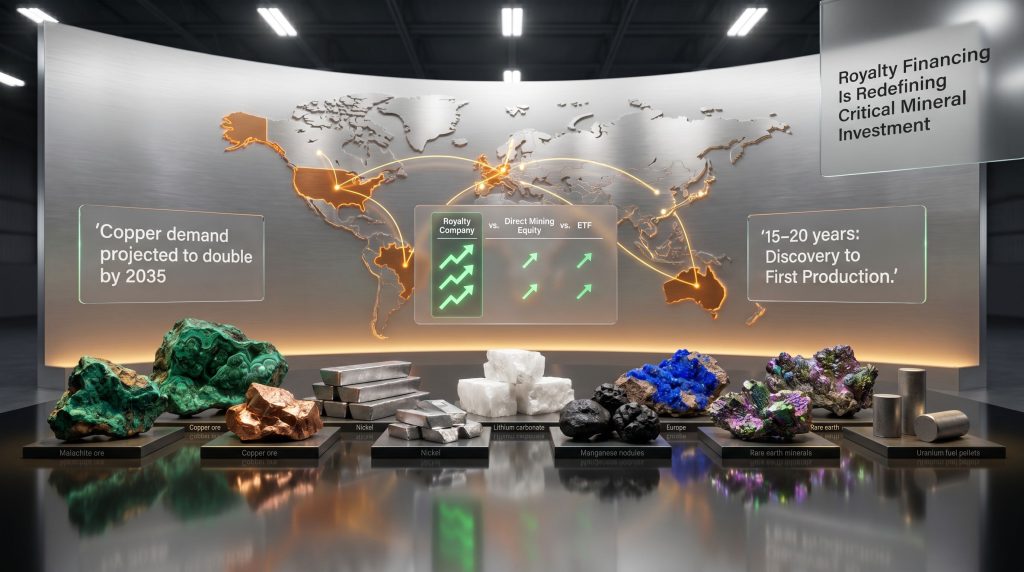
This is not simply a market failure. It reflects a structural mismatch between the risk profile of mining investment and the patience of most institutional capital. A greenfield copper project can require fifteen to twenty years from initial discovery to first production. Lithium projects in geologically complex jurisdictions can take longer still.
Against this backdrop, the investment decisions being made today will not produce supply until well into the 2030s or even 2040s. The consequences of the prolonged under-investment cycle of the 2010s, when persistently low commodity prices drove exploration budgets to multi-decade lows, are only now becoming apparent.
The World Bank has estimated that demand for minerals such as graphite, lithium, and cobalt could increase by nearly 500% by 2050 relative to 2018 levels, driven by clean energy technologies. Furthermore, the copper supply crunch is projected by some analysts to nearly double demand by 2035 under aggressive electrification scenarios, yet no major new copper deposits of significance have been discovered and developed at scale in over two decades.
"The supply pipeline for critical minerals is not just undersupplied. It is structurally insufficient relative to the pace at which downstream demand is accelerating, and no amount of policy ambition changes the geological reality of how long it takes to bring a mine into production."
What Metals Royalty Companies Actually Do and Why the Model Matters
Against this backdrop of capital scarcity and long development timelines, the royalty and streaming model has emerged as one of the most effective financing mechanisms in the mining sector. Brian Paes-Braga, co-CEO of The Metals Royalty Company and a figure who has discussed the mechanics of the metals trade publicly on platforms including CNBC's Fast Money, has articulated why this structure is particularly well-suited to the current environment.
At its core, a royalty agreement in mining works as follows: a royalty company provides upfront capital to a mining operator, and in return receives the contractual right to a percentage of that project's future revenue or production. The royalty holder bears none of the operating costs, capital expenditure requirements, or environmental liability that comes with running the mine.
The mining operator, meanwhile, receives non-dilutive financing without surrendering equity control. A streaming agreement operates on a related but distinct basis. Rather than a revenue percentage, the streaming company pays an upfront sum in exchange for the right to purchase a set volume of metal at a pre-agreed, typically below-market, price over the life of the mine.
Both structures share a common advantage: they provide leveraged exposure to metal prices and production volumes without the operational complexity of running a mine.
Comparing Investment Structures in the Metals Sector
| Investment Structure | Operational Risk | Upside Participation | Capital Intensity | Asset Life Exposure |
|---|---|---|---|---|
| Direct Mining Equity | High | High | High | Medium |
| Metals Royalty Company | Low | Medium to High | Low | Long |
| Commodity ETF | Low | Moderate | Low | Short to Medium |
| Streaming Agreement | Low to Medium | High | Medium | Long |
One aspect of this model that is frequently overlooked by generalist investors is the compounding effect of building a diversified royalty portfolio across multiple metals and jurisdictions. Because a royalty company does not bear operating costs, its margins expand directly as commodity prices rise. A portfolio of twenty or thirty royalties across copper, lithium, nickel, uranium, and antimony projects consequently creates a natural hedge against single-metal price volatility while maintaining full upside participation across the commodity complex.
The Permanent Capital Advantage in Long-Cycle Asset Accumulation
One structural feature of leading royalty vehicles that sets them apart from conventional mining equities or commodity funds is the permanent capital construct. Unlike a private equity fund with a fixed wind-down horizon, a permanent capital vehicle has no redemption pressure and no forced liquidation timeline.
This allows management to accumulate royalty assets through the full commodity price cycle, holding positions through downturns when asset prices are depressed and positioning for recovery without the pressure to sell at the bottom. This matters enormously in an industry where the payoff horizon for individual assets is measured in decades.
A royalty on a copper project in a tier-one jurisdiction may not begin generating meaningful cash flow for eight to twelve years after the initial financing is provided. A fund structure with a ten-year life cannot rationally hold such an asset through its full value creation arc. A permanent capital vehicle can, and this structural patience is a genuine competitive advantage.
Mapping the Critical Minerals Landscape: Which Metals Are at the Centre of the Trade
Not all metals carry equal strategic weight in the current environment. The following metals sit at the intersection of energy transition demand, defence manufacturing requirements, and sovereign supply chain anxiety:
| Metal | Primary Application | Supply Chain Risk | U.S. Domestic Production |
|---|---|---|---|
| Copper | Grid infrastructure, EVs, renewables | Moderate | Limited, import-dependent |
| Lithium | Battery storage, EV cathodes | High | Growing, early stage |
| Nickel | Battery cathodes, stainless steel | High | Minimal domestic supply |
| Uranium | Nuclear power generation | Moderate to High | Recovering |
| Rare Earths | Defence, electronics, permanent magnets | Critical | Early-stage development |
| Antimony | Flame retardants, ammunition, semiconductors | Critical | Near-zero domestic supply |
| Manganese | Steel production, battery anodes | Moderate | Limited |
Copper: The Foundational Metal of the Transition Economy
Copper deserves particular attention because its demand profile is unlike that of any other transition metal. Where lithium is primarily a battery-chemistry material, copper is embedded across virtually every component of the energy transition simultaneously: EV motors and wiring harnesses, solar panel connectors, offshore wind turbines, grid transmission lines, and charging infrastructure.
A single offshore wind turbine requires approximately nine tonnes of copper. A battery electric vehicle contains roughly three to four times the copper content of an internal combustion vehicle. The challenge is that the global copper mining industry is running on ageing deposits with declining ore grades.
Average copper ore grades at major producing mines have fallen by more than 25% over the past two decades, meaning miners must move progressively more rock to produce the same amount of refined metal. This grade degradation, combined with the absence of major new discoveries, creates a structural supply ceiling that demand growth is approaching rapidly.
The Antimony Blind Spot
Of all the metals on the critical minerals list, the antimony shortage risks may represent the most underappreciated supply chain vulnerability. Used in flame retardants, ammunition propellants, semiconductors, and increasingly in next-generation energy storage technologies, antimony has an extraordinarily concentrated global supply base.
China and Russia together account for the overwhelming majority of global antimony production, a concentration that has prompted significant concern within U.S. defence procurement circles. What makes this particularly acute is that antimony is rarely the primary target of any mining project — it is almost always produced as a byproduct of other metal extraction.
"The antimony supply situation illustrates a broader principle in critical minerals: the metals most strategically important to defence and technology sectors are frequently the ones with the least developed domestic or allied-nation supply chains."
Deep-Sea Minerals and Frontier Royalty Structures
One dimension of the evolving metals royalty landscape that merits attention is the application of royalty financing structures to frontier mineral sources. In particular, polymetallic nodules found on the ocean floor at depths of four to six kilometres contain significant concentrations of manganese, nickel, cobalt, and copper in nodule form.
While commercial deep-sea mining remains in early-stage development and faces substantial regulatory, environmental, and technical hurdles, the royalty model is well-suited to providing early-stage capital to these projects. The risk-reward profile of frontier royalty positions in emerging mineral sources is inherently speculative and should be evaluated accordingly, but it reflects the broadening scope of royalty capital deployment in response to terrestrial supply constraints.
The next major ASX story will hit our subscribers first
Investor Psychology and the Perpetual Problem of Commodity Timing
There is a well-documented pattern in how both retail and institutional investors engage with commodity cycles: they systematically underweight metals exposure during the early phases of structural demand shifts, then rotate aggressively into the sector after the price inflection point has already passed.
Metals do not produce earnings in the conventional sense. They do not pay dividends from operations. They sit in the ground, requiring patience and a multi-year thesis that most quarterly-performance-driven capital allocators struggle to maintain. This creates persistent undervaluation in the early stages of commodity up-cycles, followed by crowded entry as momentum investors pile in after the trade has already moved.
Royalty vehicles partially address this problem. Because they generate cash flow from royalty payments rather than from direct commodity exposure, they present a more conventional financial profile: recurring revenue, growing margins as commodity prices rise, and portfolio diversification across assets and metals. This makes them more legible to institutional capital than direct junior mining equities.
The Strategic Case for Private Royalty Capital in Filling the Investment Gap
Public financing mechanisms, including Department of Energy loan programmes and Development Finance Corporation structures, play an important role in the critical minerals ecosystem. However, these instruments are not designed to replace private capital formation. They are better understood as de-risking tools that, when combined with private royalty financing, can unlock institutional participation in projects that would otherwise struggle to attract capital.
The sequence typically works as follows, and understanding it is essential for appreciating how the Metals Royalty Company CEO Brian Paes-Braga on the metals trade has framed the sector's structural role:
- A royalty company provides early-stage financing to a junior or mid-tier miner, allowing the project to advance through exploration and a definitive feasibility study
- Public financing mechanisms or development banks provide additional capital as the project reaches a more de-risked stage
- Institutional debt and equity investors enter as the project approaches construction and production
Without the first step, the entire downstream capital formation process stalls. This is the structural role that metals royalty companies play in the critical minerals ecosystem, and it is why the sector deserves serious attention from investors trying to understand the full architecture of the metals trade. Indeed, The Metals Royalty Company's listing on Nasdaq marked a significant moment in bringing this financing model to broader public market attention.
Key Takeaways for Investors Following the Metals Trade
- The critical minerals investment gap is structural, not cyclical, and will persist for at least the next decade given mining development timelines
- Royalty and streaming structures offer the most capital-efficient path to long-duration exposure across the critical minerals complex
- Copper, antimony, rare earths, and lithium represent the highest-priority supply chain vulnerabilities from both an economic and national security perspective
- Declining ore grades at existing copper mines compound the supply constraint beyond what headline reserve estimates suggest
- Permanent capital vehicles are structurally better positioned than fund-life-constrained vehicles to capture the full value of long-dated royalty assets
- Frontier mineral sources including deep-sea deposits represent speculative but potentially significant supplementary supply, with royalty structures offering a way to participate without bearing operational risk
- Investor timing errors in commodity cycles are systematic and persistent; royalty vehicles with recurring cash flows reduce, but do not eliminate, this timing risk
This article is intended for informational purposes only and does not constitute financial advice. Commodity markets and mining investments involve significant risks, including price volatility, project execution risk, and regulatory uncertainty. Readers should conduct their own due diligence and consult a qualified financial adviser before making investment decisions. Forward-looking statements and demand projections referenced in this article reflect third-party estimates and are inherently uncertain.
Want to Invest in the Metals Powering the Energy Transition Before the Market Moves?
Discovery Alert's proprietary Discovery IQ model delivers real-time alerts on significant ASX mineral discoveries — cutting through the complexity of the critical minerals landscape to surface actionable opportunities in copper, lithium, antimony, and beyond, the moment they hit the market. Explore how historic mineral discoveries have generated substantial returns on Discovery Alert's dedicated discoveries page, and begin your 14-day free trial today to position yourself ahead of the broader market.