July 8, 2026
The Hidden Mechanics Behind Bauxite's Most Misunderstood Shipping Season
Most commodity markets are evaluated through price. Bauxite is different. Because it trades primarily on volume-based, long-term supply agreements rather than spot markets, the operational metrics that matter most to investors are shipping rates, fleet availability, and mine development pace. These variables, not headline prices, determine whether a bauxite producer delivers on its annual commitments. Understanding this distinction is essential before examining what Metro Mining June bauxite shipments data for Q2 2026 actually reveals about the company's trajectory.
When big ASX news breaks, our subscribers know first
Understanding the Operational Footprint Before the Numbers
The Bauxite Hills Mine sits on the Weipa bauxite plateau in Cape York, North Queensland, positioned approximately 95 kilometres north of Weipa and adjacent to the Skardon River coastline. Metro Mining holds 100% ownership of the operation, which produces high-alumina bauxite shipped directly to end customers using very large ore carriers (VLOCs).
What makes this operation commercially distinctive is its geology. The Weipa plateau is one of the most significant bauxite-bearing geological provinces on Earth, characterised by lateritic bauxite profiles with favourable alumina-to-silica ratios. For alumina refiners, this quality specification matters enormously.
High-alumina bauxite with low reactive silica content reduces refinery caustic soda consumption during the Bayer process, directly improving operating economics for downstream alumina producers. This makes Weipa-origin bauxite a preferred feedstock rather than simply a commodity.
The operation is marine-dependent by design. Unlike inland mines that rely on rail or road infrastructure, Bauxite Hills loads product directly onto vessels using floating cranes, which means fleet availability is not a peripheral concern but a core production constraint. This structural characteristic explains why individual crane maintenance events carry outsized significance for quarterly output. For further context, the Bauxite Hills production update from 2025 highlights how these operational dynamics have shaped the mine's performance over time.
What the June 2026 Shipment Numbers Actually Reveal
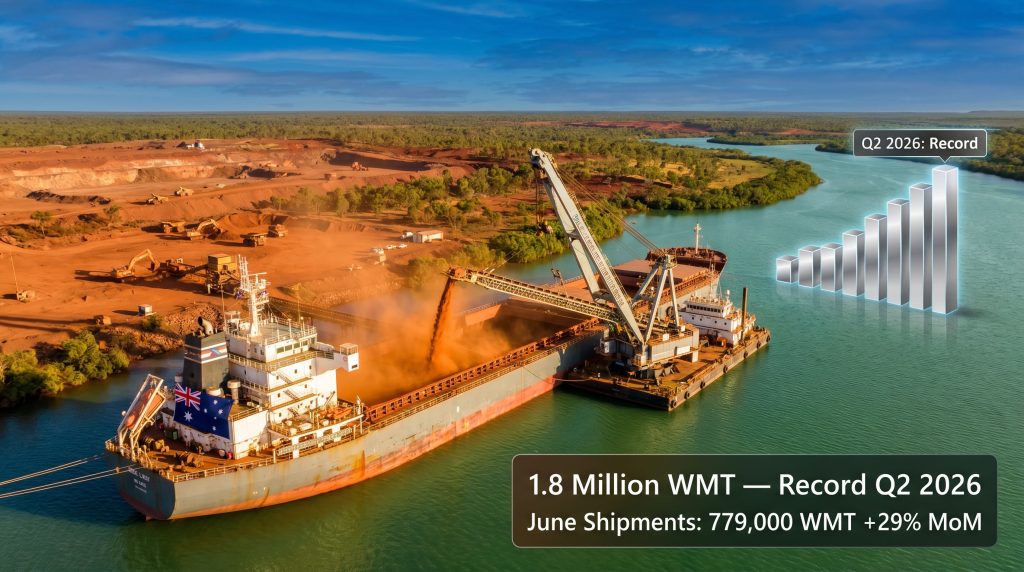
Metro Mining shipped 779,000 wet metric tonnes (WMT) of bauxite in June 2026, a 29% increase compared to May 2026. This sequential improvement follows a clear recovery arc across the April-to-June window, with the monthly progression demonstrating that operational disruptions from the first quarter were systematically addressed.
| Metric | Value | Change |
|---|---|---|
| June 2026 Shipments | 779,000 WMT | +29% month-on-month |
| May 2026 Shipments | 604,000 WMT | +45% vs. April 2026 |
| Year-to-Date (Jan-June 2026) | 1.9 million WMT | Active guidance tracking |
| Q2 2026 Total | 1.8 million WMT | +7% year-on-year |
The year-on-year comparison is particularly instructive. June 2025 itself was a record monthly result at approximately 589,000 WMT. June 2026's result of 779,000 WMT represents a 32% improvement above that prior benchmark, indicating that performance expansion is occurring on top of an already elevated base, not simply recovering from a weak prior-year period.
A critically underappreciated aspect of this comparison is what it implies about infrastructure investment and scheduling maturity. Shipping volumes do not increase by 32% year-on-year through operational effort alone. They require expanded vessel access, improved tidal window utilisation, and reduced berth-to-departure variability. The introduction of Metro's new integrated planning and operating system, which measurably reduced supply-chain variability across the first three weeks of June, appears to represent a structural rather than cyclical improvement in throughput capacity.
What Drove the Record Q2 and What Nearly Derailed It
The 1.8 million WMT shipped across Q2 2026 represents both a 7% year-on-year increase and the highest second-quarter result in the company's operating history. Three distinct factors converged to produce this outcome.
| Period | Shipment Volume (WMT) | Status |
|---|---|---|
| Q2 2025 | ~1.68 million WMT | Prior benchmark |
| Q2 2026 | 1.8 million WMT | Record Q2 result |
| Year-on-Year Growth | +7% | All-time Q2 high |
The recovery factors behind the record quarter included:
- Operational normalisation following Tropical Cyclone Narelle, which disrupted Q1 2026 and created deferred shipping demand that carried forward momentum into Q2
- The recommissioning of the OFT Ikamba after its dry-dock programme, restoring full floating crane capacity during the quarter's most productive loading windows
- The early deployment of the integrated planning system, which compressed scheduling variability and improved vessel turnaround consistency in the first half of June
However, the quarter was not without serious operational risk. In the final week of June, Crane 1 aboard the OFT Ikamba experienced unplanned downtime after debris material contaminated its hydraulic cylinder system. This failure compressed late-June loading volumes and demonstrates a risk characteristic specific to marine-loading bauxite operations that land-based mining investors often underestimate.
The hydraulic cylinder contamination event illustrates a structural vulnerability in floating crane-dependent marine loading systems. Unlike conveyor or rail infrastructure, floating cranes have limited redundancy built into their primary lifting mechanisms. A single contamination event in a hydraulic circuit can immediately halt operations rather than simply reducing throughput.
Repairs have been deferred to the planned July maintenance shutdown, with geared vessels deployed as a contingency measure. This operational response reflects planning maturity, but the incident reinforces the concentration risk embedded in a two-crane-dependent loading system.
The 160% Waste Stripping Surge: A Leading Indicator Most Investors Overlook
Perhaps the most significant operational data point in Metro Mining's Q2 2026 update is not the shipment volume itself but the waste stripping performance. The company stripped 745,000 bank cubic metres (BCM) of waste during Q2 2026, a 160% increase compared to the corresponding quarter of 2025.
| Metric | Q2 2025 | Q2 2026 | Change |
|---|---|---|---|
| Waste Stripping Volume | ~286,500 BCM (implied) | 745,000 BCM | +160% YoY |
| Operating Shift Model | Standard hours | 24-hour continuous operations | Major transition |
Waste stripping, measured in bank cubic metres, is the process of removing overburden to expose ore faces for extraction. In lateritic bauxite mining, where ore bodies sit relatively close to surface, stripping ratios tend to be favourable compared to harder rock mining operations. Nevertheless, the pace of stripping activity directly controls how much ore face is available for future extraction, making BCM volume a genuine leading indicator of forward production capacity.
The transition to 24-hour continuous stripping operations is not a minor scheduling adjustment. It implies significant additional labour costs, equipment utilisation intensity, and management coordination demands. Producers do not absorb these costs without forward conviction. When a bauxite operation accelerates waste stripping at this scale, it typically reflects management confidence in sustained shipping contract coverage and anticipated higher loading rates in subsequent quarters.
The productivity improvements mentioned in Metro's update likely relate to equipment allocation efficiency and shift handover optimisation, both of which are operationally complex to achieve at speed in a remote Cape York setting where workforce logistics are inherently challenging.
Understanding the TSA Skardon Dry-Dock and Its Fleet Implications
The TSA Skardon floating crane has departed for its mandatory five-year statutory dry-dock programme, with return expected in mid-September 2026. This is a regulatory maintenance requirement rather than an elective operational decision, and it carries two implications that are frequently misunderstood.
First, the cost structure is pre-arranged. Metro Mining has confirmed that the dry-dock programme costs are pre-funded under the crane's existing lease agreement with TSA, meaning the company carries no unplanned capital exposure from this event. The financial impact is already embedded in the operating cost structure.
Second, the timing is strategically significant. Mid-September 2026 aligns with the tail end of Q3, positioning the full fleet for reinstatement precisely when Q4 high-volume operations typically begin. Historically, Q4 represents the most productive shipping window for Bauxite Hills, benefiting from the convergence of optimal tidal conditions and dry season loading efficiencies. The sequencing of the TSA Skardon's return relative to this window is not coincidental and reflects careful maintenance scheduling.
During the dry-dock period, marine loading operations are concentrated on the OFT Ikamba and geared vessel alternatives. Given that Crane 1 on the OFT Ikamba is simultaneously undergoing repairs during the July shutdown, the July-to-September window represents the highest operational risk period for the full-year guidance outcome.
The next major ASX story will hit our subscribers first
Is the 6.6-7.1 Million WMT Full-Year Guidance Achievable?
Metro Mining has maintained its calendar year 2026 shipment guidance at 6.6 to 7.1 million WMT. With 1.9 million WMT delivered across the first half of the year, the implied H2 requirement is substantial.
| Guidance Metric | Value |
|---|---|
| Full-Year 2026 Guidance | 6.6 to 7.1 million WMT |
| H1 2026 Shipments (Jan-June) | ~1.9 million WMT |
| Required H2 Shipments (lower bound) | ~4.7 million WMT |
| Required H2 Shipments (upper bound) | ~5.2 million WMT |
| H2 Proportion of Full-Year Target | ~72-74% |
This back-half loading structure is not unusual for North Queensland bauxite operations. It reflects the operational reality that Q3 and Q4 benefit from improved tidal windows, lower product moisture content, and more favourable loading conditions as the tropical wet season recedes. Moisture content is particularly important in bauxite shipping economics because WMT pricing means that drier product delivers more contained value per tonne shipped.
| Scenario | H2 Shipments Required | Key Assumptions |
|---|---|---|
| Lower Bound (6.6M WMT) | ~4.7 million WMT | TSA Skardon returns on schedule; no further crane downtime |
| Midpoint (6.85M WMT) | ~4.95 million WMT | Q3 tidal conditions normalise; OFT Ikamba repairs completed in July |
| Upper Bound (7.1M WMT) | ~5.2 million WMT | Full fleet operational from late September; 24-hour stripping sustains ore access |
The 7% year-on-year growth rate demonstrated in Q2, if sustained through H2, positions Metro within its guidance band. However, the simultaneous absence of the TSA Skardon through mid-September and the OFT Ikamba's Crane 1 repair window in July create a compressed period where contingency fleet capacity must absorb planned loading volumes without disruption. Execution risk during this window remains the primary variable that separates a lower-bound outcome from a midpoint or upper-bound result.
Disclaimer: The scenario modelling presented above is illustrative and based on publicly available operational data. It does not constitute financial advice. Investors should conduct independent research and consider Metro Mining's formal guidance disclosures before making investment decisions.
Where Australian Bauxite Sits in the Global Supply Architecture
Australia retains its position as the world's largest bauxite exporter by volume, with Guinea representing the most significant competitive source of seaborne supply. The Weipa plateau operations, including Bauxite Hills, contribute meaningfully to Australia's total export volume, which has historically accounted for approximately 30% of global seaborne bauxite trade. Furthermore, understanding global bauxite production trends helps contextualise why Australian supply remains so strategically important to international alumina refiners.
Demand-side dynamics in 2026 continue to favour reliable Australian supply for several reasons:
- Chinese alumina refinery capacity has expanded substantially through 2025-2026, sustaining strong aggregate demand for seaborne bauxite feedstock
- Periodic supply disruptions from Guinea-origin producers have elevated the strategic value of operationally consistent Australian alternatives
- Metro Mining's high-alumina product specification from the Weipa plateau carries inherent quality advantages in competitive refinery tender processes, where alumina-to-silica ratios directly affect refinery operating costs through caustic soda consumption rates
A less commonly understood dynamic in the Australian bauxite export market is the role of moisture content management in total delivered cost calculations. Because VLOCs carry bauxite in bulk without processing, the moisture content at loading directly affects the ratio of contained alumina to total shipped mass. Producers with operations in seasonally drier loading environments can offer refiners a more cost-efficient feedstock on a dry-alumina-equivalent basis, even at nominally similar WMT prices. Those seeking broader bauxite and alumina market insights will find that this moisture dynamic is increasingly factored into refinery procurement decisions globally.
In addition, the competitive landscape among leading bauxite mines worldwide reinforces the significance of consistent, high-quality output from operations like Bauxite Hills. The Niagara bauxite project also represents an emerging dimension of Australia's future bauxite supply pipeline worth monitoring alongside established producers. For context on how Guinea's export shifts are affecting global dynamics, Metro Mining's own analysis of Guinea bauxite exports declining by 35% underscores the growing competitive advantage held by reliable Australian producers.
Key Operational Metrics to Monitor Through Q3 2026
The following variables will determine whether Metro Mining's H2 2026 performance converges toward the lower or upper end of its guidance range:
- OFT Ikamba Crane 1 repair completion during the July scheduled maintenance shutdown and confirmation of full hydraulic system integrity before August loading operations resume
- TSA Skardon return timeline relative to the mid-September target and any delays introduced by the dry-dock refurbishment programme
- Monthly shipment trajectory against the implied H2 run-rate of approximately 775,000 to 865,000 WMT per month required to achieve guidance midpoint
- Q3 tidal window performance and product moisture levels compared to historical Q3 benchmarks for the Skardon River loading zone
- Waste stripping continuity under the 24-hour operational model and whether BCM rates sustain the ore face exposure needed for accelerated Q4 loading
The waste stripping acceleration deserves particular investor attention as a forward signal. At 745,000 BCM in a single quarter, Metro is building an ore inventory buffer that should support higher loading rates independently of real-time stripping activity. This creates operational flexibility heading into Q4 that did not exist at the same scale in prior years.
Consequently, Metro Mining June bauxite shipments of 779,000 WMT and the broader Q2 2026 operational performance collectively indicate that the company's infrastructure and scheduling systems are scaling toward its full-year ambitions. The concentration of required volume in H2 2026, combined with a temporary reduction in crane fleet capacity through mid-September, means that execution discipline over the next two quarters will determine whether the record Q2 result becomes the foundation of a record full year.
Frequently Asked Questions: Metro Mining June 2026 Bauxite Shipments
What volume of bauxite did Metro Mining ship in June 2026?
Metro Mining shipped 779,000 wet metric tonnes of bauxite in June 2026, representing a 29% increase compared to May 2026 and a substantial improvement above June 2025's then-record monthly figure of approximately 589,000 WMT.
What was Metro Mining's Q2 2026 total shipment volume?
The company shipped 1.8 million WMT across Q2 2026, a 7% increase year-on-year and the highest second-quarter result in the company's operating history.
Why did Metro Mining experience operational disruptions in late June 2026?
Crane 1 aboard the OFT Ikamba suffered unplanned downtime after debris material contaminated its hydraulic cylinder system. Repairs are scheduled for the July maintenance shutdown, with geared vessels deployed as a contingency measure to sustain shipping rates.
What is Metro Mining's full-year 2026 shipment guidance?
The company has maintained its calendar year 2026 guidance at 6.6 to 7.1 million WMT, with the majority of shipments expected in the second half of the year consistent with seasonal loading conditions.
What caused the 160% surge in waste stripping volumes during Q2 2026?
The increase reflects both productivity improvements and the transition to 24-hour continuous stripping operations, designed to maintain and expand ore face access ahead of anticipated higher Q3 and Q4 shipping rates.
When will the TSA Skardon floating crane return from dry-dock?
The vessel is expected to return in mid-September 2026 following its mandatory five-year statutory maintenance programme. The costs associated with the programme have been pre-funded under the crane's existing lease agreement with TSA, meaning no unplanned capital exposure for Metro Mining.
Want to Track the Next Major ASX Mineral Discovery Before the Broader Market Does?
Discovery Alert's proprietary Discovery IQ model scans ASX announcements in real time, instantly converting complex mineral data across more than 30 commodities into clear, actionable insights for both short-term traders and long-term investors — explore historic discoveries and the returns they generated, then begin your 14-day free trial to position yourself ahead of the market.