
May 20, 2026
The Structural Fault Line Beneath Every Oil Price Spike
Energy economists have long understood that the relationship between a country's oil production status and its vulnerability to crude price shocks is far more nuanced than it first appears. The instinct is to assume that oil-producing nations benefit unconditionally when global prices surge. In practice, the architecture of a country's fiscal system, its energy import dependency, and its subsidy obligations can transform a revenue windfall into a structural liability. Mexico's experience with the Mexican oil price over US$100 threshold in 2026 is one of the clearest modern illustrations of this paradox in action.
Understanding why this matters requires looking past the headline numbers and examining the underlying mechanisms that determine whether an oil price spike is genuinely beneficial for a producing nation's fiscal health or simply shifts the burden from one column of the ledger to another. Furthermore, crude oil price trends suggest that price volatility is becoming increasingly structural rather than episodic.
When big ASX news breaks, our subscribers know first
How the Mexican Export Mix Reached US$106/b
The Geopolitical Trigger and Its Market Transmission
On February 28, 2026, coordinated airstrikes on Iran launched the most significant Middle East energy disruption in more than a decade. The immediate market response was decisive: the Strait of Hormuz, through which approximately 20% of global seaborne oil trade passes, ground to a near-halt. Brent crude breached the US$100 per barrel threshold within days, and regional crude blends moved sharply higher across global benchmarks.
The geopolitical risk premium embedded in crude futures markets is not a static figure. It reflects traders' real-time assessment of supply disruption probability, duration, and substitution availability. When the Hormuz closure materialised from theoretical risk into operational reality, that premium repriced violently across all major crude benchmarks, with secondary transmission to blends like Mexico's export mix following rapidly. Oil geopolitics analysis further illustrates how rapidly these transmission mechanisms can escalate under conflict scenarios.
The MME Price Trajectory: A Week-by-Week Breakdown
The speed and scale of the price movement in Mexico's export blend over the weeks following the conflict escalation was extraordinary by any historical measure.
| Date / Period | MME Price (US$/b) | Change vs Prior Period | Primary Driver |
|---|---|---|---|
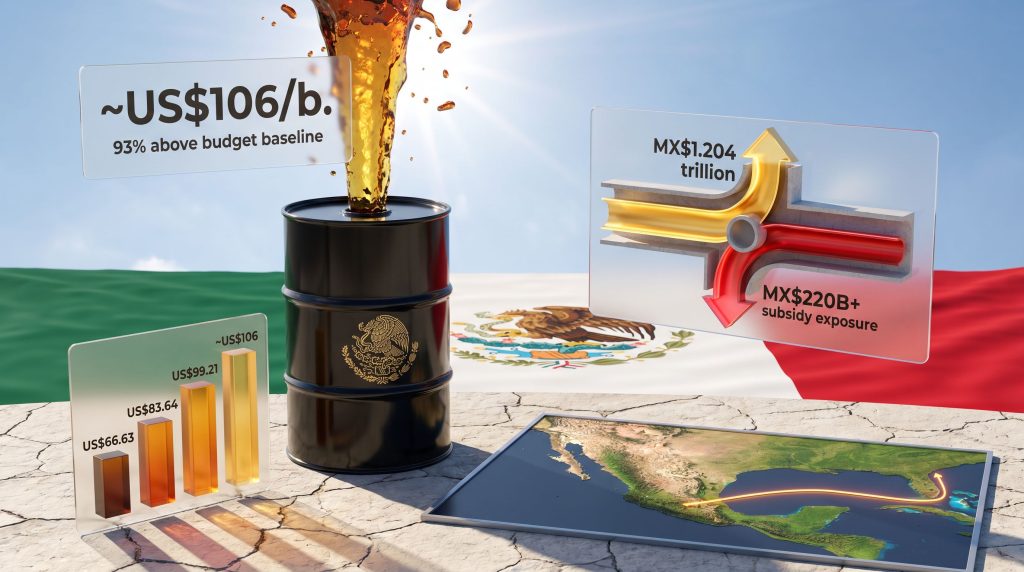
| Week of March 2, 2026 | US$66.63/b | +5.0% week-on-week | Initial Hormuz disruption |
| March 6, 2026 | US$83.64/b | +31.8% week-on-week | Accelerating geopolitical risk premium |
| March 20, 2026 | US$99.21/b | +80.7% above budget baseline | Sustained Middle East conflict |
| May 12, 2026 | ~US$106/b | ~93% above budget baseline | Iran sanctions waiver proposal |
| May 18, 2026 | ~US$106/b (WTI) | Stabilised | Diplomatic uncertainty, nuclear talks stalled |
To put the March 6 spike in historical context, the 31.8% week-on-week jump represented the blend's sharpest single-week advance in years, surpassing even the 6.3% spike recorded in October 2025 when sanctions on Russian energy companies rattled global supply expectations. Banxico spot price data confirmed the MME reaching US$99.21/b on March 20, its highest level in approximately three years and eight months, according to official tracking.
Why the MME Trades at a Discount to WTI
A critical piece of context that shapes Mexico's fiscal calculations is the persistent discount at which the Mexican Export Mix trades relative to benchmark WTI crude. This discount is not arbitrary. It reflects the physical characteristics of Mexico's primary export blend:
- Higher sulfur content makes the MME a sour crude, requiring more expensive refining processes to convert into high-value products
- Heavier API gravity reduces the yield of lighter, higher-value distillates per barrel refined
- Geographic basis differentials and logistics costs further widen the pricing gap relative to landlocked US benchmarks
PEMEX publishes official MME spot pricing, which Banxico incorporates into its fiscal revenue monitoring. When the MME reached approximately US$106/b on May 12, this represented a level nearly US$1 per barrel below contemporaneous WTI futures, consistent with the blend's historical discount structure.
A fragile ceasefire announced on April 8 prompted Goldman Sachs to revise its second-quarter 2026 Brent crude forecast downward, from US$99/b to US$90/b. Prices subsequently recovered toward the US$100/b range as diplomatic progress on the Iran nuclear file stalled. The announcement that Tehran was potentially open to considering a long-term nuclear freeze provided temporary optimism, but unresolved negotiating gaps kept the risk premium elevated. According to reporting on rising $100 oil odds, market participants had already begun pricing in this possibility well before the conflict escalated.
What a 93% Budget Overshoot Actually Means for Mexico's Public Finances
The 2026 Federal Budget Oil Price Assumption
Mexico's Secretaría de Hacienda y Crédito Público (SHCP) constructs the annual federal budget around a reference crude price designed to provide conservative fiscal planning. For 2026, that reference price was set at US$54.9/b, with projected oil revenues of MX$1.204 trillion representing a 1.9% increase over the prior fiscal year.
This conservative baseline methodology serves a deliberate purpose: it reduces the risk of budgeting for revenues that may not materialise if global energy prices soften. The tradeoff is that when actual prices significantly exceed the reference price, the government must simultaneously manage a revenue windfall and the corresponding escalation in subsidy obligations.
Mexico activated its annual oil price hedge in early January 2026. Finance Minister Edgar Amador confirmed the operation while keeping the strike price and covered volumes confidential, a standard practice designed to prevent market participants from positioning against the government's hedge structure and thereby eroding its protective value.
The Revenue Sensitivity Calculation
Key metric: Each US$1 increase in the MME price above the budget baseline generates approximately MX$13.1 billion in additional federal oil revenues, according to data tracked by El Financiero and SHCP revenue models.
At a sustained MME price of US$106/b against a US$54.9/b budget baseline, the theoretical gross revenue upside exceeds MX$667 billion on an annualised basis. This figure, however, represents only half of the fiscal equation. The subsidy offset mechanism working in the opposite direction substantially erodes the net benefit.
The Structural Paradox: Earning More, Spending Far More
Mexico's Dual Energy Exposure
The counterintuitive reality of Mexico's energy position is that the country operates simultaneously as a crude oil exporter and a refined fuel and natural gas importer. This dual exposure is the root cause of the fiscal paradox that emerges when global energy prices surge.
Mexico imports the majority of its refined petroleum products and most of its natural gas supply, predominantly sourced from the United States. When US crude prices rise sharply, American refiners and gas producers benefit from higher margins. Those higher costs are then embedded in the export price of refined products and gas sold to Mexican buyers, creating a direct pass-through mechanism from US energy market inflation to Mexico's industrial and consumer cost base.
The net effect operates across three distinct transmission channels:
- Crude export revenues increase as the MME price rises above the budget baseline
- Refined fuel import costs increase as US refining margins and crude input costs rise in tandem
- Natural gas import costs increase as global LNG market instability amplifies domestic gas price volatility beyond what crude oil prices alone would suggest
The IEPS Subsidy Mechanism: How a Tax Becomes a Liability
The IEPS (Impuesto Especial sobre Producción y Servicios) is one of the least well-understood fiscal mechanisms in Mexico's public finance architecture outside of specialist circles. Under normal price conditions, the IEPS functions as a consumption tax on fuel sales, generating net revenue for the federal government.
The mechanism inverts structurally when global crude prices rise above the level implied by domestic retail fuel price caps. Rather than collecting tax revenue, the government absorbs the differential between global market prices and the capped domestic retail price, effectively converting the IEPS from a revenue-generating tool into a fiscal liability. Consequently, global trade shock impacts from geopolitical events compound this vulnerability significantly.
The Subsidy Inversion Dynamic: When global crude prices are low, IEPS generates tax revenue. When global crude prices are high, IEPS generates fiscal losses. The same legal framework produces opposite fiscal outcomes depending on the external price environment, making it one of the most volatile implicit contingent liabilities in Mexico's budget.
The Mexican Institute of Finance Executives (IMEF) modelled the fiscal exposure under a sustained Hormuz disruption scenario at prevailing price levels, estimating potential federal revenue losses exceeding MX$220 billion (approximately US$12.7 billion) attributable to elevated fuel subsidy costs under the IEPS framework. Under this scenario, the 2026 fiscal deficit could approach approximately 5% of GDP, compared to the government's stated target of 4.1% of GDP.
Which Sectors Bear the Heaviest Cost Burden
Industrial and Manufacturing Sector Exposure
Energy-intensive industries face the most immediate and severe impact when global energy prices sustain above the US$100/b threshold. Cement, steel, heavy manufacturing, and petrochemical processing all carry natural gas and electricity as major components of their production cost structures. When power generation costs rise, these industries face margin compression that their less energy-intensive competitors do not.
The competitiveness dimension extends beyond domestic market dynamics. Mexican manufacturers competing in export markets find their cost advantage eroded relative to peers operating in lower energy-cost environments. This dynamic is particularly relevant given Mexico's positioning as a nearshoring destination for manufacturing capacity relocating from Asia. Sustained energy price inflation directly threatens one of the structural economic narratives driving foreign investment decisions.
Logistics, Transport, and Consumer Price Inflation
The inflationary transmission pathway from elevated crude prices to consumer price indices follows a well-established sequence:
- Diesel and fuel prices rise at the wholesale level
- Freight and logistics operators pass higher fuel costs through to shipping rates
- Elevated transport costs increase the delivered price of goods across supply chains
- Consumer prices for food, essential commodities, and manufactured goods rise
- Headline inflation increases, complicating monetary policy management
For Mexico, this chain is amplified by the country's geographic distribution characteristics. Many consumer goods travel significant distances from production or import entry points to final consumption markets, making logistics cost inflation disproportionately impactful on final consumer prices relative to more compact economies.
Natural Gas: The Amplified Price Shock
Mexico's dependence on US natural gas imports creates a transmission channel that goes beyond what crude oil price movements alone would imply. LNG supply pressures, driven by the same Middle East conflict that pushed crude prices above US$100/b, independently amplify natural gas price volatility. Power generators, industrial users, and residential consumers all face higher effective energy costs through this channel, compounding the direct impact of elevated crude prices.
PEMEX reported its highest refining output in 11 years during the first quarter of 2026, a development that partially mitigates refined fuel import dependency. However, this progress does not eliminate the structural exposure to imported refined products or natural gas, particularly given the scale of Mexico's industrial energy consumption relative to domestic production capacity.
How Mexico's Oil Hedge Strategy Works and Where It Falls Short
The Architecture of Sovereign Oil Hedging
Mexico operates one of the most sophisticated sovereign oil price hedging programmes globally. The programme typically employs put options to establish a price floor for crude export revenues, protecting the federal budget against scenarios where the MME falls sharply below the budget reference price.
The asymmetric nature of this protection is the critical insight for understanding Mexico's current fiscal exposure:
| Scenario | Oil Price Direction | Hedge Outcome | IEPS Subsidy Outcome |
|---|---|---|---|
| Price collapse | Below strike price | Hedge pays out, protecting revenues | IEPS generates tax revenue |
| Price spike | Above budget baseline | Hedge provides no additional benefit | IEPS becomes fiscal liability |
The hedge is designed as downside revenue protection, not as a comprehensive energy cost management tool. When prices surge above the budget baseline rather than falling below it, the hedge position neither compensates for the subsidy cost escalation nor caps the IEPS fiscal exposure. Mexico's fiscal risk profile is therefore fundamentally asymmetric: partially protected on the downside through the hedge, but fully exposed on the upside through the subsidy channel.
The next major ASX story will hit our subscribers first
Key Data Summary: Mexico's Oil Price Shock at a Glance
| Metric | Value |
|---|---|
| 2026 Federal Budget Oil Price Reference | US$54.9/b |
| MME Price (May 12, 2026) | ~US$106/b |
| Premium Above Budget Baseline | ~93% |
| Revenue Sensitivity Per US$1/b Increase | MX$13.1 billion |
| Projected 2026 Oil Revenues (Budget Assumption) | MX$1.204 trillion |
| Estimated IEPS Subsidy Exposure (Hormuz scenario) | MX$220B+ (~US$12.7B) |
| Modelled 2026 Fiscal Deficit (Hormuz scenario) | ~5% of GDP |
| Government Fiscal Deficit Target | 4.1% of GDP |
| Goldman Sachs 2Q26 Brent Forecast (post-ceasefire) | US$90/b (revised from US$99/b) |
Broader Policy Implications for Mexico's Energy and Fiscal Strategy
Rethinking the Subsidy Architecture
The 2026 oil price episode exposes a structural fragility in Mexico's approach to domestic fuel price stabilisation that has periodically surfaced during historical oil price spikes, including during the 2008 commodity cycle. The IEPS inversion dynamic is not a design flaw in isolation; it reflects a deliberate social policy choice to shield domestic consumers from global energy market volatility. The fiscal cost of that choice, however, becomes unsustainable when global prices sustain above the US$100/b level for extended periods.
Policy options available to Mexican authorities include:
- Gradual domestic price liberalisation, allowing retail fuel prices to partially reflect global market movements and reducing the fiscal subsidy burden
- Enhanced subsidy cost hedging, complementing the existing export revenue hedge with instruments that cap the cost of the IEPS liability under high-price scenarios
- Accelerated domestic refining investment, building on PEMEX's progress toward reducing refined product import dependency over the medium term
- Diversification of natural gas supply sources, reducing concentration risk from US pipeline imports through LNG terminal development or domestic production expansion
The Competitiveness Dimension
Mexico's positioning as a nearshoring investment destination for manufacturers seeking supply chain diversification from Asia is one of the more significant structural economic narratives of the mid-2020s. That thesis rests on several competitive advantages, including labour costs, geographic proximity to the US market, and trade infrastructure. Furthermore, OPEC market influence over global crude benchmarks means that Mexican energy costs can shift sharply in response to decisions made far beyond its borders.
Sustained periods during which global energy price shocks translate directly into elevated Mexican industrial electricity and gas costs could incrementally erode this competitive positioning. Energy cost stability is therefore not a purely fiscal concern but a strategic economic competitiveness issue with implications for long-term investment decisions by multinational manufacturers evaluating Mexico against alternative production locations.
Frequently Asked Questions
What is the Mexican Export Mix (MME) and why does it trade at a discount to WTI?
The MME is Mexico's primary crude export blend. Its heavier API gravity and higher sulfur content classify it as a heavy sour crude, requiring more intensive refining compared to lighter, sweeter benchmarks like WTI. These physical characteristics result in a consistent pricing discount. PEMEX publishes official MME spot price data tracked by Banxico for fiscal monitoring.
Why did Mexico set its 2026 budget oil price at US$54.9/b?
The SHCP deliberately uses conservative oil price assumptions in federal budget construction to reduce fiscal vulnerability to price volatility. When actual prices significantly exceed the reference price, the government manages a revenue windfall alongside escalating subsidy costs. The 2026 reference price of US$54.9/b reflected expectations at the time of budget preparation and was not designed to anticipate a geopolitical disruption of the magnitude that materialised.
How does the Strait of Hormuz closure transmit to Mexico's fiscal position specifically?
The Strait of Hormuz handles roughly one-fifth of global seaborne oil trade. Its disruption triggers global crude price spikes that raise Mexico's export revenues while simultaneously increasing the cost of imported refined fuels and natural gas. The net fiscal outcome depends on whether export revenue gains exceed or are offset by subsidy cost increases, a balance that shifts unfavourably for Mexico at sustained price levels above approximately US$80–90/b. Analysts tracking commodities pricing data have noted how rapidly these thresholds can be breached during geopolitical events.
Does Mexico's annual oil hedge protect against high-price fiscal losses?
No. The hedge provides downside revenue protection, compensating Mexico if oil prices fall below the strike price. It does not offset the IEPS subsidy cost escalation that occurs when prices spike above the budget baseline. The hedge and the subsidy liability operate in opposite fiscal directions, creating an asymmetric risk profile for the Mexican oil price over US$100 scenario specifically.
Disclaimer: This article contains forward-looking estimates, including fiscal deficit projections and oil revenue sensitivity calculations, sourced from IMEF modelling and third-party analyst forecasts. These figures are subject to significant uncertainty and should not be construed as definitive fiscal outcomes. Actual results will depend on the duration of geopolitical disruptions, the effectiveness of diplomatic negotiations, domestic fuel price policy decisions, and broader macroeconomic conditions. This article does not constitute financial or investment advice.
Want to Spot the Next Major Resource Opportunity Before the Market Does?
While Mexico's complex oil price dynamics illustrate how commodity shocks ripple across global markets, Discovery Alert's proprietary Discovery IQ model cuts through the noise by delivering real-time alerts on significant ASX mineral discoveries — explore historic discoveries that generated exceptional returns or start your 14-day free trial today to position yourself ahead of the broader market.