
August 14, 2026
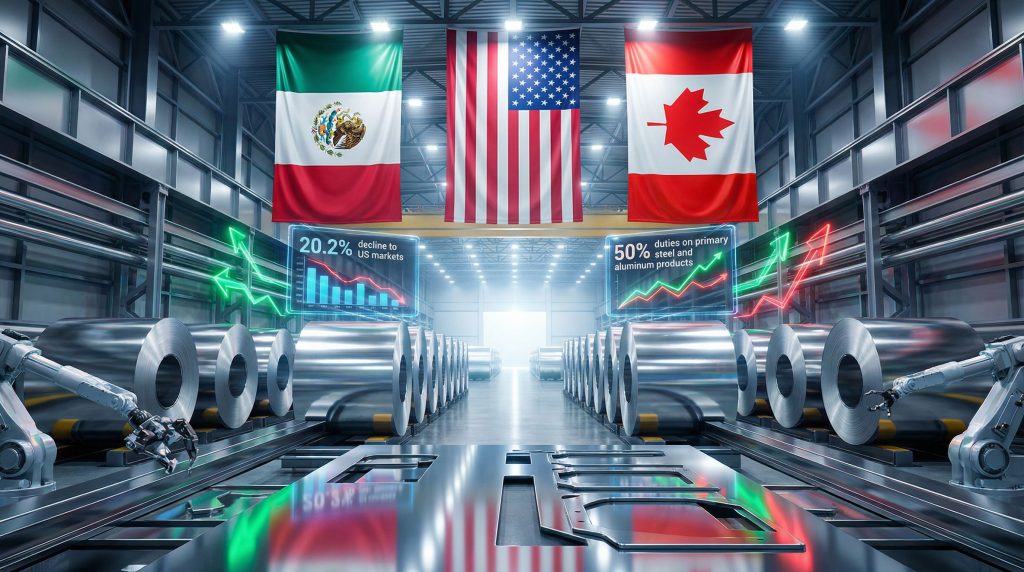
North American trade dynamics face unprecedented transformation as manufacturing competitiveness shifts across regional boundaries. The integration of supply chains, originally designed to optimise efficiency, now confronts geopolitical pressures that prioritise security and domestic production capacity over pure cost optimisation. This strategic realignment creates both vulnerabilities and opportunities for nations positioned within established trade frameworks, particularly as tariffs impact investment markets across the region.
How Will USMCA Review Reshape North American Steel Trade Dynamics?
The 2026 Mexican steel industry USMCA review timeline represents a critical inflection point for trilateral manufacturing relationships across North America. With steel production serving as the foundation for automotive, construction, and infrastructure sectors, the review process will determine whether current trade barriers remain permanent fixtures or evolve toward greater regional integration.
Furthermore, the broader implications of US tariffs on industries demonstrate how trade policy shifts can fundamentally alter competitive dynamics across North American manufacturing sectors.
Understanding the 2026 USMCA Review Timeline and Steel Industry Stakes
The formal review mechanism embedded within the USMCA framework creates a six-year evaluation cycle that coincides with changing political administrations and evolving economic priorities. For Mexico's steel sector, this timing presents both challenges and strategic opportunities to demonstrate the economic value of integrated North American production networks.
Current capacity utilisation across Mexican steel facilities has declined to approximately 68-72% of total production potential, significantly below the industry benchmark of 85% typically required for profitable operations. This underutilisation stems from multiple factors including reduced export access, domestic demand fluctuations, and competitive pressures from both North American and international suppliers.
The review process involves technical working groups examining rules of origin, tariff classifications, and supply chain requirements that directly impact steel trade flows. Mexican negotiators face the challenge of demonstrating that bilateral steel trade creates net economic benefits for all USMCA partners while addressing U.S. concerns about import competition and supply chain security.
Mexico's Strategic Position in Trilateral Steel Market Integration
Mexico's geographic advantage as a low-cost production platform with proximity to major North American consumption centres positions the country uniquely within regional supply chains. However, this advantage has been significantly diminished by current tariff structures that effectively price Mexican steel products out of competitive range in key markets.
The country's steel industry employs approximately 50,000 direct workers and supports an estimated 150,000 indirect jobs across mining, transportation, and manufacturing sectors. This employment base provides political leverage during trade negotiations while highlighting the economic consequences of prolonged trade barriers.
Mexican steel producers have invested heavily in environmental compliance and modernisation programs, with major facilities meeting or exceeding international standards for emissions control and energy efficiency. This positioning aligns with North American sustainability objectives and provides negotiating advantages during the Mexican steel industry USMCA review process.
When big ASX news breaks, our subscribers know first
What Economic Pressures Are Driving Mexico's Steel Industry Transformation?
Economic transformation within Mexico's steel sector reflects broader global trends toward supply chain regionalisation and technological modernisation. The industry confronts simultaneous pressures from international competition, domestic market demands, and regulatory requirements that necessitate strategic repositioning.
Production Capacity Utilisation Trends Across Major Mexican Steel Facilities
Capacity utilisation metrics across Mexico's largest steel production facilities reveal significant operational challenges:
- Ternium Mexico: Operating at approximately 65% capacity due to reduced automotive demand
- ArcelorMittal Lázaro Cárdenas: Maintaining 70% utilisation through diversified product mix
- Regional mini-mills: Averaging 60% capacity utilisation with high variability by location
- Integrated facilities: Experiencing 62% average utilisation due to export market constraints
These utilisation rates fall substantially below the 80-85% threshold typically required for profitable steel production, creating financial pressure that limits capital investment and workforce retention. The underutilisation particularly affects flat-rolled steel products used in automotive applications, where demand has shifted toward domestic suppliers in key export markets.
Production efficiency improvements have partially offset utilisation challenges, with energy consumption per ton declining by approximately 12% since 2020 through technological upgrades and operational optimisation. However, these efficiency gains cannot fully compensate for volume reductions caused by market access limitations.
Raw Material Cost Structures and Supply Chain Dependencies
Mexican steel producers face complex raw material sourcing challenges that affect competitive positioning:
| Raw Material Category | Primary Sources | Cost Impact | Supply Chain Risk |
|---|---|---|---|
| Iron Ore | Domestic mines (60%), Brazilian imports (25%) | Moderate cost advantage | Low risk due to diversification |
| Metallurgical Coal | Colombian imports (70%), U.S. imports (20%) | High transportation costs | Moderate risk from logistics |
| Scrap Steel | Domestic collection (40%), U.S. imports (35%) | Variable pricing volatility | High risk from trade barriers |
| Natural Gas | Domestic production (80%), pipeline imports (15%) | Significant cost advantage | Low risk with stable supply |
Energy costs represent a substantial competitive advantage for Mexican steel production, with industrial electricity rates approximately 20-25% lower than comparable U.S. markets. This advantage partially offsets higher transportation costs for raw material imports and finished product exports.
The dependency on U.S. scrap metal imports creates particular vulnerability, as these materials face potential tariff increases or supply restrictions during trade disputes. Mexican producers have invested in domestic scrap collection infrastructure, but supply volumes remain insufficient to meet total production requirements.
Investment Climate Analysis for Steel Sector Capital Allocation
Capital investment patterns within Mexico's steel sector reflect cautious approaches to expansion amid trade policy uncertainty:
- Maintenance capital expenditure: Averaging 3.5% of revenue, focused on equipment reliability
- Expansion investments: Delayed pending USMCA review outcomes
- Environmental upgrades: Prioritised due to regulatory requirements and market access benefits
- Technology modernisation: Selective investments in high-efficiency production systems
Foreign direct investment in Mexican steel has declined by approximately 35% since peak levels in 2018, with international investors adopting wait-and-see approaches pending trade agreement clarifications. This investment decline limits the sector's ability to implement productivity improvements and capacity expansions.
How Are US Section 232 Tariffs Restructuring Mexican Steel Export Strategies?
Section 232 tariffs fundamentally altered competitive dynamics for Mexican steel exports by implementing substantial duties that effectively price many products out of traditional markets. The tariff structure varies by product category, creating complex strategic considerations for production planning and market targeting.
In addition to direct steel tariffs, the broader Trump tariffs implications continue to reshape trade relationships throughout North America.
Tariff Rate Structure Impact on Product Category Performance
The implementation of Section 232 tariffs created a multi-tiered barrier system affecting different steel products:
- 25% tariffs on most steel mill products, including flat-rolled sheets, structural shapes, and pipe products
- Additional duties of up to 15% on certain specialised steel categories
- Aluminium tariffs of 10% affecting integrated producers with aluminium operations
- Derivative product tariffs cascading through downstream manufacturing
Export performance data demonstrates severe market access erosion, with total steel exports to the U.S. declining by approximately 62% from pre-tariff baseline levels. This decline disproportionately affects high-volume, low-margin products where price sensitivity creates immediate demand destruction.
Flat-rolled steel products experienced the most significant export reductions, with shipment volumes falling by over 70% as automotive and construction customers shifted to domestic suppliers. Conversely, specialty steel products with limited domestic production capacity maintained relatively stable export volumes despite tariff burdens.
Market Access Scenarios Under Different Trade Policy Frameworks
Strategic planning for Mexican steel exports requires modelling multiple potential outcomes from the Mexican steel industry USMCA review process:
Scenario 1: Tariff Elimination
- Complete removal of Section 232 tariffs for Mexican products
- Estimated export volume recovery of 85-95% within 18 months
- Market share restoration in automotive and construction sectors
- Capital investment resumption for capacity expansion
Scenario 2: Partial Tariff Reduction
- Reduced tariff rates of 10-15% for specific product categories
- Selective market access improvements in high-value segments
- Continued market share constraints in price-sensitive categories
- Limited investment expansion with focus on efficiency improvements
Scenario 3: Status Quo Maintenance
- Continued 25% tariff rates across most product categories
- Further market share erosion as customers establish alternative supply chains
- Potential facility closures and workforce reductions
- Reorientation toward domestic and alternative export markets
Revenue Impact Modelling Across Steel Product Categories
Financial analysis of tariff impacts reveals substantial revenue losses across Mexican steel operations:
| Product Category | Pre-Tariff Revenue | Current Revenue | Revenue Decline | Market Share Loss |
|---|---|---|---|---|
| Flat-rolled Steel | $2.8 billion | $1.1 billion | 61% | 68% |
| Long Steel Products | $1.4 billion | $0.8 billion | 43% | 52% |
| Tubular Products | $0.9 billion | $0.4 billion | 56% | 63% |
| Specialty Steel | $0.6 billion | $0.5 billion | 17% | 22% |
These revenue declines translate directly into reduced employment levels, with approximately 8,500 direct jobs eliminated across Mexican steel operations since tariff implementation. Additional indirect employment impacts affect mining, transportation, and service sectors supporting steel production.
Moreover, the broader US–China trade impact on global markets continues to create additional uncertainty for Mexican steel producers seeking alternative export destinations.
Strategic Market Reality: The persistence of high tariff rates has fundamentally restructured North American steel supply chains, with many end-users establishing permanent alternative sourcing relationships that may not reverse even with tariff elimination.
What Defensive Trade Measures Is Mexico Implementing to Protect Domestic Steel Markets?
Mexico's response to U.S. trade barriers involves comprehensive defensive tariff measures designed to protect domestic steel markets while maintaining compliance with international trade agreements. These measures target non-USMCA countries, particularly China and other Asian steel exporters, while preserving preferential access for North American partners.
Import Substitution Strategy Through Selective Tariff Implementation
The Mexican government implemented retaliatory tariff measures affecting over 1,400 product categories with duties ranging from 10% to 50% depending on product classification and country of origin. This tariff structure creates preferential treatment for USMCA partners while raising barriers for competitors from other regions.
Key elements of Mexico's defensive strategy include:
- Comprehensive product coverage across steel and steel-containing manufactured goods
- Country-specific targeting prioritising Chinese and Southeast Asian suppliers
- USMCA exemptions maintaining zero additional duties for U.S. and Canadian products
- Graduated rate structure with higher tariffs on products competing directly with domestic production
Import data indicates these measures have achieved partial success in redirecting demand toward domestic suppliers. Mexican steel consumption from domestic sources increased by approximately 15% following tariff implementation, though total consumption declined due to price effects on end-user industries.
The tariff structure differentiates between raw steel products and finished manufactured goods, with higher rates applied to products that compete directly with Mexican manufacturing capabilities. This approach supports both steel producers and downstream industries that utilise steel as a key input material.
Domestic Content Requirements and Local Production Incentives
Beyond tariff measures, Mexico has implemented domestic content initiatives encouraging local steel consumption:
- Government procurement preferences requiring domestic steel for infrastructure projects
- Tax incentives for manufacturers using Mexican-produced steel
- Accelerated depreciation allowances for steel production equipment investments
- Worker training subsidies for companies expanding steel-related employment
These initiatives create demand stability for Mexican steel producers while encouraging supply chain localisation. Government infrastructure projects now specify Mexican steel content requirements of 65% minimum for eligible projects, providing market support during periods of export constraint.
| Policy Measure | Target Sector | Incentive Structure | Estimated Impact |
|---|---|---|---|
| Infrastructure Steel Requirements | Construction | 65% domestic content mandate | 180,000 tons additional demand |
| Manufacturing Tax Credits | Automotive/Appliance | 8% tax reduction for domestic steel use | 12% increase in domestic consumption |
| Investment Depreciation Benefits | Steel Production | Accelerated 3-year depreciation | $450 million in deferred tax liability |
Regional Security Framework Development for Steel Trade
Mexico's defensive trade strategy incorporates supply chain security considerations that align with broader North American economic security objectives. This framework emphasises reducing dependency on non-regional suppliers while strengthening intra-USMCA trade relationships.
Supply chain security initiatives include:
- Strategic stockpile development for critical steel grades used in defence applications
- Supplier qualification programs emphasising North American production capabilities
- Technology transfer restrictions limiting access to advanced steel production methods
- Investment screening for foreign acquisitions of Mexican steel assets
These security-oriented policies create long-term structural changes in North American steel trade patterns, potentially outlasting current tariff disputes. The emphasis on regional self-sufficiency aligns with U.S. strategic priorities while positioning Mexico as a reliable partner within North American supply chains.
How Are Industry Stakeholders Positioning for USMCA Renegotiation Success?
Strategic positioning for the Mexican steel industry USMCA review involves coordinated efforts between government officials, industry associations, and private sector stakeholders. The approach emphasises economic data demonstrating mutual benefits while addressing security and competitiveness concerns raised by U.S. counterparts.
CANACERO's Economic Justification Strategy for Tariff Removal
The Mexican steel industry association CANACERO has developed comprehensive economic arguments supporting tariff elimination during the USMCA review process. Their strategy focuses on demonstrating net positive impacts for all three North American economies through integrated steel supply chains, particularly given ongoing commodity market volatility affecting global steel prices.
Key elements of CANACERO's approach include:
- Trade balance documentation showing Mexican steel imports exceed exports to the U.S. by value
- Employment impact analysis quantifying job losses in both countries from trade barriers
- Supply chain efficiency studies demonstrating cost advantages of integrated North American production
- Environmental compliance documentation highlighting Mexican facilities' adherence to international standards
Economic modelling prepared by CANACERO indicates that tariff elimination could restore approximately 12,000 direct jobs in Mexico while creating an estimated 8,500 indirect jobs in the U.S. through increased demand for steel-making equipment, raw materials, and transportation services.
The organisation has compiled detailed facility-specific data demonstrating modernisation investments totalling over $2.8 billion since 2018, with environmental improvements that meet or exceed North American standards. This documentation supports arguments that Mexican steel production contributes to regional sustainability objectives.
Senate Working Group Coordination on Federal Steel Policy
The Mexican Senate has established specialised committees addressing technical aspects of steel trade negotiations. These working groups coordinate policy positions across multiple government agencies while ensuring alignment with broader economic development objectives.
Committee structure includes:
- Trade Relations Committee: Focusing on bilateral negotiation strategies
- Industrial Development Committee: Addressing domestic production capacity and modernisation
- Labour Affairs Committee: Managing workforce transition and retraining programmes
- Environmental Committee: Ensuring compliance with sustainability requirements
Inter-committee coordination ensures consistent messaging during USMCA review discussions while addressing diverse stakeholder concerns. The committees have developed technical position papers on rules of origin, environmental standards, and labour requirements affecting steel trade.
Legislative support for the steel industry includes budgetary allocations for worker retraining programmes and technology modernisation initiatives. These investments demonstrate government commitment to maintaining competitive steel production capabilities regardless of trade agreement outcomes.
Private Sector Investment Planning Under Policy Uncertainty
Mexican steel companies have adopted cautious investment strategies during the trade uncertainty period, focusing on maintaining operational flexibility whilst preparing for multiple potential outcomes from the USMCA review.
Investment priorities include:
- Operational efficiency improvements that provide benefits regardless of trade policy outcomes
- Product diversification toward specialty steels with limited domestic competition
- Market diversification developing export relationships outside North America
- Technology upgrades improving cost competitiveness and environmental performance
Major steel producers have deferred expansion projects totalling approximately $1.2 billion pending clarification of long-term market access conditions. However, companies continue maintenance capital expenditure and selective modernisation investments that enhance operational flexibility.
Private sector stakeholders participate actively in government consultation processes, providing technical expertise and market intelligence supporting negotiation positions. This collaboration ensures industry concerns receive appropriate consideration during policy development.
What Regional Integration Models Could Emerge from USMCA Steel Negotiations?
The Mexican steel industry USMCA review process may establish precedents for deeper regional economic integration extending beyond traditional trade agreements. Potential outcomes range from enhanced market access to comprehensive supply chain coordination mechanisms.
Trilateral Supply Chain Optimisation Scenarios
Advanced integration models under consideration involve coordinated production planning across North American steel facilities, optimising capacity utilisation and specialisation by geographic region and product category.
Potential integration frameworks include:
- Capacity sharing agreements allowing production flexibility during demand fluctuations
- Feedstock coordination optimising raw material sourcing across regional suppliers
- Technology transfer programmes facilitating modernisation investments
- Joint research initiatives developing next-generation steel production methods
Such integration would create economies of scale impossible to achieve within individual national markets whilst maintaining supply chain security through regional diversification. Mexican facilities could specialise in energy-intensive primary production whilst U.S. and Canadian facilities focus on high-value finishing operations.
Geographic optimisation studies suggest potential cost savings of 8-12% through coordinated regional production compared to current fragmented approaches. These savings would benefit consumers whilst strengthening the competitiveness of North American steel against global competitors.
Technology Transfer and Modernisation Investment Frameworks
Regional integration may facilitate accelerated technology adoption through coordinated investment programmes and shared research initiatives. Mexican facilities could benefit from advanced production technologies whilst contributing lower-cost manufacturing capabilities.
Technology collaboration areas include:
- Electric arc furnace optimisation for improved energy efficiency
- Emissions control systems meeting continental environmental standards
- Quality control automation ensuring consistent product specifications
- Predictive maintenance systems maximising equipment reliability
Joint investment programmes could provide financing advantages for modernisation projects whilst ensuring technology compatibility across regional facilities. Such coordination would strengthen North American steel competitiveness against Asian and European producers.
Environmental Standards Harmonisation for Competitive Parity
Environmental standards harmonisation represents a critical component of potential regional integration, ensuring competitive parity whilst advancing sustainability objectives across all three USMCA countries.
Harmonisation initiatives would address carbon emissions standards, waste management requirements, and energy efficiency benchmarks creating level playing fields for competition whilst advancing environmental protection goals.
The next major ASX story will hit our subscribers first
How Will Global Steel Market Dynamics Influence USMCA Review Outcomes?
Global steel market conditions significantly influence North American trade negotiations, as overcapacity in major producing regions creates competitive pressures affecting all regional markets.
Chinese Steel Production Capacity and North American Market Implications
Chinese steel production capacity exceeds 1.0 billion tons annually, representing approximately 50% of global production capacity. This massive scale creates persistent overcapacity conditions that depress international steel prices and create competitive challenges for higher-cost producers worldwide.
Chinese capacity implications include:
- Export pressure during domestic demand downturns affecting global markets
- Price competition that challenges North American producers regardless of trade barriers
- Technology advancement through scale economies and government investment
- Raw material demand affecting global input costs for all producers
North American steel producers face strategic choices between protecting domestic markets through trade barriers or enhancing competitiveness through regional integration and efficiency improvements. The USMCA review occurs within this broader competitive context.
European Union Trade Policy Precedents for Regional Steel Agreements
European Union steel trade policies provide precedents for regional coordination whilst maintaining global competitiveness. EU approaches to anti-dumping measures, environmental standards, and technology collaboration offer models for North American consideration.
Relevant EU precedents include:
- Graduated tariff structures providing protection whilst maintaining competitive pressure
- Carbon border adjustments addressing environmental cost disparities
- Research coordination programmes facilitating technology development
- Skills development initiatives supporting workforce transitions
These precedents suggest potential pathways for USMCA steel integration that balance protection and competitiveness whilst advancing shared environmental and security objectives.
Emerging Market Competition and Cost Structure Comparisons
Steel production growth in emerging markets including India, Vietnam, and Turkey creates additional competitive pressure for North American producers. These countries often combine lower labour costs with modern production technology, challenging traditional competitive advantages.
Cost structure analysis reveals energy costs and environmental compliance as key differentiating factors where North American producers maintain advantages. Regional integration could leverage these advantages whilst addressing scale disadvantages through coordinated production, as highlighted by a recent steel industry report examining Latin American market conditions.
What Investment Opportunities Are Created by Mexican Steel Industry Restructuring?
Industrial restructuring within Mexico's steel sector creates investment opportunities across multiple categories, from operational efficiency improvements to market expansion initiatives.
Modernisation Capital Requirements for Competitive Positioning
Mexican steel facilities require estimated $3.2 billion in modernisation investments over the next five years to achieve competitive parity with global best practices. These investments focus on energy efficiency, environmental compliance, and product quality improvements.
Investment priorities include:
- Electric arc furnace upgrades improving energy efficiency by 15-20%
- Emissions control systems meeting international environmental standards
- Automation systems reducing labour costs and improving consistency
- Product finishing capabilities enabling higher-value product mix
Investment financing options include development bank lending, private equity participation, and equipment leasing arrangements. Government incentive programmes provide tax benefits and accelerated depreciation for qualifying investments.
Merger and Acquisition Potential in Consolidating Markets
Market consolidation pressures create acquisition opportunities as smaller producers seek strategic partnerships or exit strategies. Financial distress among high-cost producers may create favourable acquisition conditions for efficient operators.
Consolidation drivers include:
- Scale economies favouring larger, more efficient operations
- Capital requirements for environmental and technology upgrades
- Market access challenges requiring diversified operations
- Financial leverage limiting investment capacity for independent operators
Strategic acquirers include integrated steel producers, financial investors with industrial expertise, and foreign companies seeking North American market access. Regulatory considerations require competition authority approval and foreign investment screening.
Infrastructure Development Needs for Enhanced Productivity
Supporting infrastructure investments could enhance Mexican steel industry competitiveness through improved transportation access, reliable energy supply, and skilled workforce development.
Infrastructure investment opportunities include:
- Rail transportation improvements reducing raw material and product shipping costs
- Port facility upgrades facilitating international trade
- Industrial park development creating integrated manufacturing clusters
- Training facility construction supporting workforce development programmes
These infrastructure investments benefit multiple industries whilst specifically addressing steel sector competitive constraints. Public-private partnerships may provide financing mechanisms for large-scale infrastructure development, as discussed in a comprehensive USMCA review report from Mexico's business community.
Frequently Asked Questions About Mexican Steel Industry USMCA Review
What specific tariff rates currently apply to Mexican steel exports to the US?
Current U.S. Section 232 tariffs impose 25% duties on most steel mill products imported from Mexico, including flat-rolled sheets, structural shapes, bars, rods, and pipe products. Aluminium products face 10% tariffs, whilst certain specialised steel categories may face additional duties up to 15% depending on specific product classifications.
These tariff rates apply uniformly regardless of the Mexican producer or specific facility of origin, creating comprehensive barriers to Mexican steel exports. Certain specialty products with limited U.S. production capacity may qualify for exclusion processes, though these involve lengthy application procedures and uncertain outcomes.
How do Mexico's retaliatory tariffs affect international steel pricing?
Mexico's retaliatory tariffs covering over 1,400 product categories with rates from 10% to 50% create pricing advantages for North American suppliers whilst raising costs for Asian competitors. These measures particularly affect Chinese steel imports, which face maximum tariff rates across most product categories.
The tariff structure creates price premiums for USMCA-origin steel products in Mexican markets, partially offsetting the competitive disadvantages Mexican producers face in export markets. However, total steel consumption in Mexico has declined due to higher prices affecting downstream industries including construction and manufacturing.
Which Mexican steel companies are best positioned for USMCA renegotiation benefits?
Ternium Mexico and ArcelorMittal's Lázaro Cárdenas facility represent the largest integrated steel producers with significant export capabilities that would benefit from tariff elimination. These companies have maintained modernisation investments and environmental compliance programmes positioning them for expanded market access.
Specialty steel producers focusing on high-value products may benefit most immediately, as these companies often maintain stronger margins and customer relationships that can survive temporary price premiums. Companies with diversified product portfolios serving both domestic and export markets demonstrate greater resilience during trade negotiations.
What timeline governs the USMCA review process for steel trade provisions?
The USMCA includes six-year review cycles with the next formal review scheduled for 2026. However, steel-specific provisions may be addressed through interim consultations and technical working group discussions occurring throughout the agreement's implementation period.
Negotiation timelines for steel trade issues depend on broader political priorities and bilateral relationships between USMCA partners. Industry stakeholders expect preliminary discussions beginning in late 2025, with formal negotiations extending through 2026 and potential implementation of changes occurring in 2027, subject to domestic approval processes in all three countries.
Please note: This article contains forward-looking statements and analysis based on current market conditions. Trade policy outcomes involve significant uncertainty, and actual results may differ materially from projections discussed. Investors should conduct independent research and consult with qualified advisors before making investment decisions in steel sector securities or operations.
Want to Capitalise on North American Steel Trade Opportunities?
Discovery Alert's proprietary Discovery IQ model provides real-time alerts on significant ASX mineral discoveries, including steel and iron ore opportunities that could benefit from shifting North American trade dynamics. With USMCA renegotiations creating new market conditions for steel and mining companies, subscribers receive instant notifications on actionable trading opportunities ahead of broader market recognition. Begin your 14-day free trial today to position yourself strategically as these transformative trade relationships reshape commodity markets.