
May 13, 2026
Understanding Mexico's Fiscal Stabilisation Through Energy Sector Adjustments
Global fiscal management strategies increasingly demonstrate how government expenditure optimisation can address structural budget imbalances without comprehensive policy overhauls. The interconnected nature of state enterprise operations and national fiscal health creates complex scenarios where operational decisions within major government-controlled entities can drive broader economic outcomes. This dynamic becomes particularly pronounced in resource-dependent economies where national oil companies serve dual roles as commercial enterprises and fiscal policy instruments.
Mexico's approach to deficit management through its national oil company represents a case study in tactical fiscal adjustment with potential long-term strategic implications. The concentration of budget constraint mechanisms within a single entity reveals both the flexibility and vulnerability inherent in centralised fiscal management systems.
When big ASX news breaks, our subscribers know first
What Does PEMEX's Expenditure Reduction Mean for Mexico's Economy?
The Scale of Operational Budget Adjustments
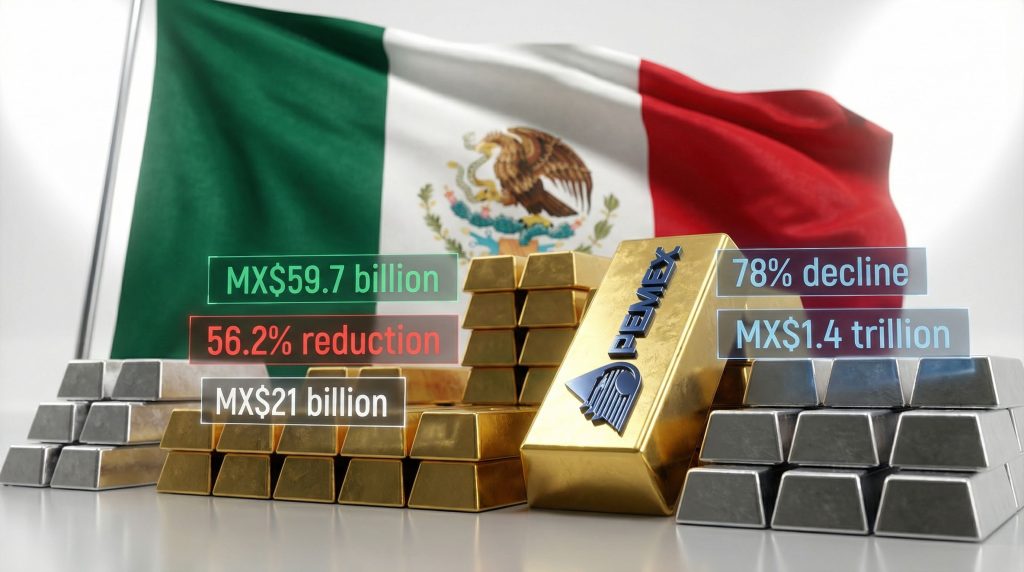
The magnitude of PEMEX spending cuts reduce deficit pressures through unprecedented operational constraint levels. Programmable expenditures have contracted to MX$59.7 billion during the first two months of 2026, representing a dramatic 56.2% year-over-year reduction in real terms. This figure marks the lowest spending level since 2007, creating an 19-year historical benchmark for operational constraint.
Critical Financial Metrics:
• Actual spending fell 32% below planned budget allocations
• Scheduled calendar allocation: MX$87.5 billion
• Monthly spending dropped below MX$100 billion for the first time in 14 years
• Real-terms adjustment accounts for inflationary effects, revealing genuine operational scale reduction
The deviation from planned spending schedules suggests either emergency fiscal pressure requiring unscheduled cuts or deliberate acceleration of constraint policies beyond original government intentions. México Evalúa's analysis indicates that following the original spending calendar would have generated only 13% deficit reduction rather than the achieved 37.5% improvement.
Investment Infrastructure Implications
Physical investment spending within PEMEX operations collapsed to MX$21 billion in February 2026, representing a 78% real-terms decline from the previous year's MX$95.5 billion. This reduction creates the lowest investment level since 2007, establishing an 18-year historical low for capital expenditure activity.
| Investment Category | February 2026 | February 2025 | Real Change |
|---|---|---|---|
| PEMEX Physical Investment | MX$21 billion | MX$95.5 billion | -78% |
| Total Government Investment | MX$87.1 billion | MX$158.4 billion | -44.9% |
| Investment Share of Budget | 6.2% | 11.3% | -45.1% |
Physical investment encompasses tangible capital expenditures including drilling operations, refinery maintenance, pipeline infrastructure, and processing facility modernisation. These investments form the foundation of PEMEX's productive capacity and future revenue-generation capability. Operating infrastructure beyond recommended maintenance intervals increases operational failure risk and reduces processing efficiency across Mexico's six major refineries.
How Are Deficit Reduction Strategies Affecting Long-Term Growth Prospects?
The "Golden Rule" Violation in Public Finance
Mexico's current fiscal approach contradicts fundamental public finance principles where debt financing should support productive investment rather than current expenditures. The Golden Rule of Public Finance emphasises that borrowed funds should finance capital investments generating future returns, while current revenues fund operating expenses.
Current Financial Configuration:
• Total government physical investment: MX$87.1 billion (down 44.9%)
• Debt servicing costs: MX$157.2 billion
• Debt service exceeds productive investment by 180%
This structure suggests debt is financing recurrent spending rather than productive capital formation, creating potential long-term economic vulnerabilities. The approach reduces future productive capacity while maintaining high debt service obligations, potentially creating a debt servicing trap where increasing revenue portions must fund obligations rather than growth initiatives.
Revenue Generation Challenges
Government revenue growth has decelerated to 2% year-over-year, representing the slowest expansion in four years. Total receipts reached MX$1.4 trillion during the first two months of 2026, reflecting broader economic momentum challenges and declining hydrocarbon sector contributions.
Revenue Performance Breakdown:
• Oil revenues: MX$136.4 billion (down 9.1% in real terms)
• Tax revenue growth: 2.6% (insufficient to offset petroleum decline)
• Combined performance: Weakest corresponding growth rates in four years
The asymmetry between declining petroleum revenues and insufficient tax revenue growth reveals structural limitations in Mexico's fiscal base. Furthermore, our oil price movements review demonstrates how international market volatility compounds domestic production challenges. Oil revenues have fallen to their lowest level since 2020, indicating both domestic production challenges and international market pressures beyond government policy control.
What Are the Structural Implications of Mexico's Energy-Dependent Fiscal Model?
Oil Revenue Dependency Risks
Petroleum-derived government revenues demonstrate persistent vulnerability to both production constraints and price volatility. The 9.1% real-terms decline in oil revenues during a period of relatively stable global energy prices suggests domestic production limitations rather than international market fluctuations drive the shortfall.
Production Context Analysis:
• Mexico's crude oil production declined from approximately 3.4 million barrels per day (2004 peak) to 1.7 million barrels per day (2023-2024 range)
• This 50% production decline over 20 years reflects natural field depletion and investment constraints
• Cantarell Field, Mexico's flagship production site, peaked at 2.1 million barrels per day in 2003 but has experienced systematic natural decline
• Recovery requires sustained capital investment in exploration, development drilling, and infrastructure
However, the broader context of US oil production decline shows similar challenges across North America. Additionally, detailed oil price stagnation insights reveal how geopolitical factors continue affecting regional energy markets.
The PEMEX-Government Financial Relationship Reversal
For the first time in recent history, Mexico's government provides net financial support to PEMEX rather than receiving net contributions from the national oil company. This fundamental relationship shift carries significant fiscal implications.
Financial Flow Analysis:
• PEMEX contributed MX$37 billion to federal coffers
• Government transfers to PEMEX: MX$43.3 billion
• Net fiscal cost: MX$6 billion (government subsidy to PEMEX)
This reversal indicates that Mexican citizens effectively subsidise the oil company operations, representing a structural shift from PEMEX as revenue generator to PEMEX as fiscal burden. The pattern challenges traditional assumptions about national oil company contributions to government finances.
How Does Mexico's Investment Performance Compare Internationally?
OECD Investment Benchmarking
Mexico's public investment levels remain among the lowest within OECD member countries as a percentage of GDP, limiting infrastructure development capacity and long-term competitiveness enhancement. The current fiscal strategy further constrains already-limited investment capabilities through the dramatic reduction to 18-year lows.
International Context:
México Evalúa emphasises that Mexico's public investment remains far below levels required to drive equitable, sustainable infrastructure development when compared to OECD benchmarks.
Infrastructure Development Constraints
The 44.9% reduction in total government physical investment to MX$87.1 billion creates potential bottlenecks across multiple sectors:
• Energy sector modernisation: Reduced investment limits refinery capacity and processing efficiency
• Transportation infrastructure: Deferred maintenance and expansion projects
• Digital connectivity: Limited broadband and telecommunications development
• Industrial capacity: Constrained manufacturing support infrastructure
What Are the Debt Servicing Implications of Current Fiscal Policy?
Positive Debt Management Signals
Debt servicing costs decreased 6.4% in real terms to MX$157.2 billion, providing one of the few encouraging indicators in Mexico's fiscal landscape. This improvement reflects effective debt management strategies and favourable refinancing conditions despite broader fiscal challenges.
Long-Term Debt Sustainability Concerns
While immediate debt servicing costs have declined, the strategy of reducing productive investment while maintaining current expenditures may compromise future debt sustainability by limiting economic growth potential. The concentration on expenditure cuts rather than structural reform creates risks for long-term fiscal stability. According to Capital Economics analysis, PEMEX's financial trajectory requires comprehensive structural reforms beyond simple spending reductions.
The next major ASX story will hit our subscribers first
How Might This Fiscal Strategy Impact Mexico's Economic Competitiveness?
Productivity Growth Constraints
The dramatic reduction in physical investment, particularly within energy infrastructure, may constrain Mexico's long-term productivity growth trajectory. Energy sector capacity limitations create bottlenecks across the broader economy, affecting manufacturing competitiveness and export potential.
Sector-Specific Impacts:
• Manufacturing: Energy supply constraints limit production capacity
• Export competitiveness: Infrastructure limitations affect logistics and transportation
• Foreign investment: Reduced infrastructure quality may deter international capital
• Regional development: Limited government investment exacerbates territorial disparities
Regional Development Implications
Reduced government investment may intensify regional development disparities, as infrastructure projects traditionally serve as catalysts for balanced territorial development. The concentration on deficit reduction over strategic investment limits Mexico's ability to leverage geographic advantages for economic development.
What Alternative Fiscal Strategies Could Mexico Consider?
Revenue Enhancement Opportunities
Rather than relying primarily on PEMEX spending cuts reduce deficit mechanisms, Mexico could explore comprehensive revenue diversification:
• Tax system modernisation: Enhanced collection efficiency and compliance rates
• Revenue source diversification: Reduced dependency on petroleum-derived income
• Strategic asset monetisation: Leveraging government assets for revenue generation
• Public-private partnerships: Infrastructure development through mixed financing models
Investment-Led Growth Models
Alternative approaches might emphasise strategic investment rather than constraint. Comprehensive investment strategy guide principles suggest that sustained economic growth requires balanced approaches between fiscal discipline and productivity-enhancing capital allocation:
• Selective high-return investments: Focus on productivity-enhancing infrastructure
• Energy sector modernisation: Long-term revenue generation through improved efficiency
• Regional development programmes: Measurable economic returns through territorial balance
• Digital infrastructure: Competitiveness enhancement through connectivity improvement
Research from Fitch Ratings demonstrates that Mexico's fiscal consolidation becomes increasingly challenging without addressing structural revenue and investment imbalances.
Conclusion: Balancing Immediate Fiscal Relief with Long-Term Growth
PEMEX spending cuts reduce deficit pressures in the short term, but Mexico's fiscal stabilisation through operational constraints represents a tactical approach that achieves immediate results while potentially compromising long-term economic growth potential. The reversal of traditional PEMEX-government financial relationships signals fundamental shifts in Mexico's energy sector economics, requiring careful evaluation of alternative strategies that balance fiscal responsibility with productivity-oriented investment.
Success in addressing these fiscal challenges will likely depend on developing more diversified revenue sources while maintaining strategic investments in infrastructure that enhances Mexico's international competitiveness. The current approach provides short-term fiscal breathing room but may create longer-term economic vulnerabilities that require comprehensive policy consideration.
Disclaimer: This analysis is based on fiscal data from México Evalúa and Mexico Business News reporting as of April 2026. Economic projections and policy implications involve inherent uncertainty and should not be considered as investment advice. Readers should consult independent financial advisors and official government sources for investment decisions.
Looking to Invest in Energy and Resource Companies?
Discovery Alert's proprietary Discovery IQ model delivers instant notifications on significant ASX mineral discoveries, empowering investors to identify actionable opportunities in the resources sector before broader markets respond. Access real-time insights into major energy and commodity discoveries, similar to those that have historically generated substantial returns, by exploring Discovery Alert's dedicated discoveries page and begin your 14-day free trial today to secure your market advantage.