May 22, 2026
The Long Cycle Problem: Why Mining Capital Is the First to Flee Regulatory Uncertainty
Capital allocation in the mining sector operates on timelines that most other industries would consider inconceivable. From the moment an exploration team stakes a claim to the day a mine ships its first tonne of ore, a decade or more of capital deployment, geological risk, permitting complexity, and community engagement must unfold in sequence. This structural reality means that mining investment decisions are uniquely sensitive to one variable above all others: the confidence that the rules governing a project today will remain materially intact tomorrow.
When that confidence erodes, the consequences are not immediate. They are delayed, compounding, and often invisible until the damage is irreversible. Mexico mining industry federal rules investor concern is precisely this kind of slow-burn problem, and understanding its full dimensions requires looking well beyond the headline legislative changes.
When big ASX news breaks, our subscribers know first
Mining's Foundational Role in the Mexican Economy
A Sector With Deep Historical and Economic Roots
Long before Spanish colonisation reshaped the country, the civilisations that preceded modern Mexico were already sophisticated miners. The Aztecs and their predecessors extracted gold, silver, jade, turquoise, garnets, emery, copper, and obsidian, deploying these materials across functions that ranged from ceremonial adornment to weapons manufacture and agricultural tooling. That relationship between Mexican territory and mineral wealth has never fundamentally changed.
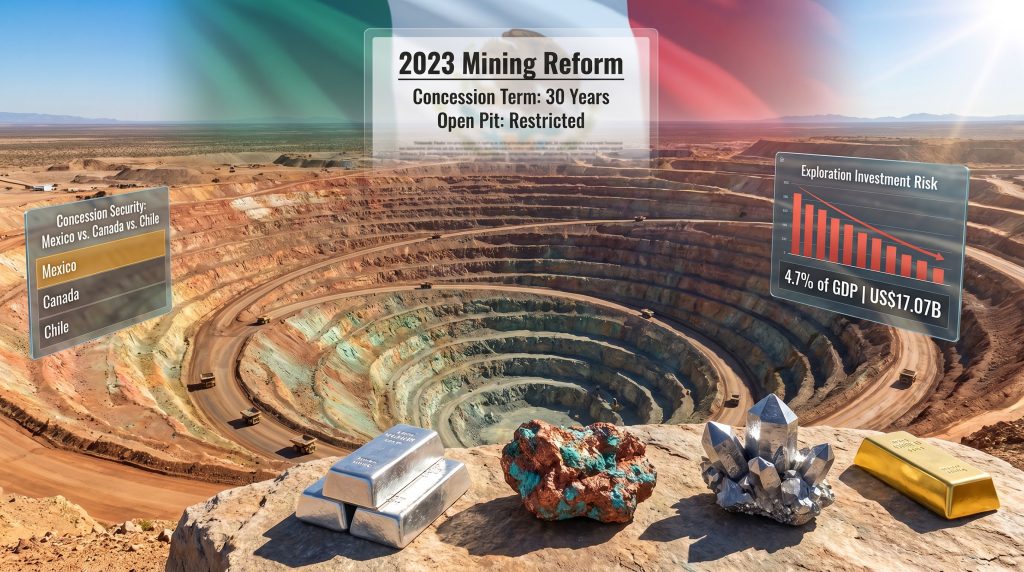
Today, the sector contributes approximately 4.7% of Mexico's GDP, representing roughly US$17.07 billion in annual production value. The primary commodities driving this output are silver, gold, copper, and zinc, all of which carry strong and durable global demand trajectories underpinned by industrial use, energy transition requirements, and monetary demand.
Direct employment in the sector stands at an estimated 400,000 workers, with a further 2 million jobs tied indirectly to mining activity across logistics, equipment supply, energy services, and professional services. The economic multiplier effect embedded in this figure is significant: base industries like mining consistently generate more than two additional roles in the broader economy for every direct position created. Consequently, the sector's true economic footprint is substantially larger than its headline employment figures suggest.
Why Remote Communities Depend on Mining
A dimension of mining's economic contribution that is frequently underweighted in policy discussions is its geographic concentration. Mining operations in Mexico are disproportionately located in remote and rural regions where alternative economic activity is limited. In these communities, a mine is not simply an employer — it is often the primary provider of:
- Formal employment and skills training in communities where subsistence farming would otherwise dominate
- Healthcare infrastructure, including on-site medical facilities and coverage for workers and dependents
- Physical infrastructure such as roads and utilities that serve the broader community beyond the mine boundary
- Tax revenue flowing to federal, state, and municipal governments that funds public services in regions that would otherwise generate minimal fiscal contributions
In states like Sonora, Zacatecas, Chihuahua, Durango, and Guerrero, mining is not a peripheral contributor to regional GDP. It is a structural pillar, and any policy that threatens the sector's viability in these states carries consequences that extend far beyond the balance sheets of mining companies.
Understanding Mexico's 2023 Mining Reform
The Mechanics of the Legislative Overhaul
Mexico's May 2023 Mining Reform represented the most sweeping restructuring of the country's concession framework in generations. The amendments touched the Mining Law alongside related environmental and water-use legislation, creating a materially different operating environment across multiple dimensions simultaneously. Furthermore, as noted by legal analysts examining these reforms, the breadth of these changes introduced significant uncertainty across the entire investment lifecycle.
| Reform Element | Previous Framework | Post-2023 Framework |
|---|---|---|
| Concession Term | Up to 50 years | Reduced to 30 years |
| Renewal Structure | Relatively straightforward | Limited and conditional |
| Concession Granting | Direct application process | Public auction-style competition |
| Transfer of Rights | Largely administrative | Requires explicit government approval |
| Indigenous Consultation | Inconsistently applied | Mandatory prior consultation |
| Water Access | Separate permitting | Conditional on availability assessment |
| Environmental Obligations | Operational compliance focus | Includes restoration, closure, post-closure |
What These Changes Mean for Capital Deployment
The practical consequences of these reforms are not abstract. They flow directly into project economics, investment timelines, and risk modelling in ways that affect every stage of the mining lifecycle:
- Shortened concession security compresses the viable investment horizon for capital-intensive projects that typically require 10 to 15 years from exploration to first production. A 30-year concession that begins at the exploration stage may expire before meaningful production is achieved on a complex deposit.
- Competitive concession granting introduces uncertainty into what was previously a more predictable application process, adding a layer of competitive risk to early-stage project planning.
- Transfer approval requirements create friction for project sales, joint ventures and asset sales, and corporate restructurings. For junior exploration companies whose primary capital recovery mechanism is asset sale, this represents a fundamental change to the business model.
- Water availability conditions carry particular weight in arid states like Sonora, where water access is already a binding constraint and where the majority of Mexico's most economically significant deposits are located.
- Post-closure obligations add long-term financial liabilities that must be modelled into project economics from the outset, increasing the minimum viable scale of a deposit and excluding smaller projects that might otherwise have been commercially attractive.
Five Dimensions of Investor Risk Under the New Framework
Why Regulatory Certainty Matters More in Mining Than Almost Any Other Sector
Mining investment decisions are made under conditions of extreme capital intensity and long time horizons. Once capital is deployed into exploration, drilling, and infrastructure development, it cannot be relocated. A software company facing an unfavourable policy environment can pivot markets. A mine cannot.
This structural immobility of mining capital is what makes regulatory uncertainty so disproportionately damaging to the sector. The five most consequential risk dimensions under the current Mexican framework are:
1. Retroactive Application Uncertainty
Legal advisers operating in the Mexican mining space have flagged meaningful ambiguity around whether new obligations under the 2023 reform apply to existing concessions granted under the prior framework. Uncertainty over retroactive impact creates a valuation problem that cannot be resolved through standard financial modelling. Investors cannot confidently project future cash flows if the regulatory baseline for their existing rights remains unclear.
2. Concession Renewal Risk
With concession terms shortened to 30 years and renewal pathways made more conditional, projects with longer development timelines face a scenario in which concession expiry precedes commercial production. This is especially acute for large, geologically complex deposits that require extended feasibility and permitting phases before construction can begin.
3. Transfer and Liquidity Constraints
The introduction of government approval requirements for concession transfers reduces the liquidity and exit optionality of Mexican mining assets. The junior exploration investment sector, which operates on the premise that exploration success will translate into a saleable asset, faces a structurally less liquid market under the new framework.
4. Indigenous Consultation Process Risk
While prior consultation with indigenous communities is a principle recognised under international frameworks including ILO Convention 169, Mexico's procedural framework for implementing these consultations in a mining context remains underdeveloped. Investors face genuine uncertainty around timelines, required outcomes, and the legal consequences of consultation processes that are contested or reach inconclusive results. Indeed, the mining claims framework adopted in other jurisdictions offers a useful contrast in how consultation processes can be more clearly codified.
5. International Treaty Exposure
Legal analysts have noted that the reforms may create grounds for international investment treaty claims if the new rules are found to impair vested rights held under bilateral investment treaties to which Mexico is a party. This creates a paradox: legislation designed to strengthen state control over mineral resources may simultaneously expose the federal government to costly international arbitration proceedings that undermine the very fiscal objectives the reforms were intended to serve.
The Exploration Investment Paradox
Why the Riskiest Capital Exits First
One of the least visible but most consequential dynamics in mining regulation is the relationship between policy uncertainty and exploration spending. Industry experience consistently points to the fact that only approximately 1 in every 1,000 mineral prospects will ever become a producing mine. The capital deployed into the other 999 prospects generates no direct return — it funds the geological knowledge base, the trained workforce, and the project pipeline from which the single successful mine will eventually emerge.
This means that the economics of exploration investment are fundamentally dependent on the expectation of a stable and predictable regulatory environment over a multi-decade horizon. When that expectation is disrupted, early-stage exploration capital — the most risk-sensitive component of the entire mining investment cycle — is the first to be redirected to more stable jurisdictions.
The consequences of this capital flight are not immediately visible in production statistics. They show up in the exploration pipeline 10 to 15 years later, when the absence of earlier-stage investment translates into a gap in the development-stage project inventory. Mexico risks engineering precisely this scenario, where near-term regulatory tightening produces a decade-long pipeline gap with production consequences that will not become apparent until the 2030s.
The Federal-State Fault Line: Open Pit Mining and Operational Contradictions
Sonora's Mining Economy vs. Federal Legislation
Among the most operationally significant tensions in Mexico's current policy landscape is the federal prohibition on open pit mining and its direct conflict with the economic realities of the country's most productive mining state. In Sonora, the majority of economically viable mineral deposits — particularly lower-grade mineral bodies that cannot be profitably processed through underground methods — are only commercially feasible as open pit operations.
Federal legislation does include exemption provisions for projects of national interest, however the criteria defining what constitutes national interest have not been clearly codified. This creates a planning problem that is arguably more damaging than an outright ban: investors cannot determine at the outset of an exploration programme whether their deposit will ultimately qualify for an exemption, making it impossible to construct a credible feasibility study or attract the capital needed to advance the project.
Possible criteria that might inform an exemption determination — including employment scale, strategic mineral classification, and export value — remain speculative rather than formally defined. The ambiguity around these criteria means that state governments, investors, and federal regulators may each apply different interpretations of what qualifies, creating conditions for extended legal disputes and project delays.
Critical Strategic Question: If a company cannot determine whether its deposit qualifies for an open pit exemption at the start of exploration, the economics of early-stage investment in Mexico become fundamentally unattractive relative to jurisdictions where the regulatory baseline is clear from day one.
Lithium Nationalisation and the Resource Nationalism Signal
The classification of lithium as a strategic mineral excluded from private ownership represents a separate but related dimension of Mexico's resource nationalism trajectory. While lithium's strategic classification reflects global trends toward securing critical minerals energy transition supply chains, the outright exclusion of private investment rather than a co-investment or royalty-based framework sends a signal to investors that extends beyond lithium itself.
The concern is not solely about lithium. It is about what the lithium precedent implies for the trajectory of Mexican mineral policy over the next decade, particularly in a world where the definition of strategic minerals is expanding as energy transition demand reshapes commodity markets.
The next major ASX story will hit our subscribers first
How Mexico Compares as a Mining Jurisdiction
Competitive Positioning Against Peer Jurisdictions
Mexico's mining policy reforms are occurring in the context of intense global competition for mining capital. Chile, Peru, Canada, and Australia are all actively competing for the same exploration and development dollars, and each offers a distinct risk-reward profile for investors evaluating portfolio allocation.
| Jurisdiction | Concession Security | Regulatory Predictability | Open Pit Policy | Strategic Mineral Control |
|---|---|---|---|---|
| Mexico | Reduced (30 years) | Declining | Restricted, undefined exemptions | Lithium nationalised |
| Chile | Stable | Moderate | Generally permitted | Copper oversight strengthened |
| Peru | Moderate | Variable | Generally permitted | Limited nationalisation |
| Canada | Strong | High | Generally permitted | Limited restrictions |
| Australia | Strong | High | Generally permitted | Incentive-based critical minerals strategy |
Mexico's combination of shortened concession terms, open pit restrictions, lithium nationalisation, and undefined exemption criteria places it at a competitive disadvantage relative to jurisdictions offering greater investment certainty. The counterbalancing factor is Mexico's exceptional geological endowment, particularly in silver, gold, copper, and zinc, which continues to attract investors with higher risk tolerance and longer capital horizons. However, geological richness alone cannot compensate indefinitely for policy uncertainty when alternative jurisdictions offer comparable mineralisation with a more stable operating environment. In addition, the broader mining permits overhaul occurring in North America more broadly is reshaping where capital chooses to flow.
The Case for Decentralised Mining Governance
Redistributing Decision-Making Authority to Mining-Dependent States
The five primary mining states collectively represent the majority of Mexico's mineral output and possess detailed, granular knowledge of local geology, community dynamics, water systems, and economic dependencies that federal regulators in Mexico City cannot replicate at the same level of specificity.
A governance model that grants states greater interpretive authority over federal mining legislation would reduce the policy contradictions currently undermining investment confidence while preserving the federal government's ability to set overarching standards.
| Governance Dimension | Current Centralised Model | Proposed Distributed Model |
|---|---|---|
| Decision-Making Centre | Centralised in Mexico City | Distributed to mining-dependent states |
| State Input on Federal Rules | Limited advisory role | Formal interpretive authority |
| Alignment with Local Economics | Inconsistent | Structurally embedded |
| Responsiveness to Regional Conditions | Low | High |
The historical precedent from other mining jurisdictions suggests that regulatory frameworks which incorporate meaningful state or provincial input consistently generate better investment outcomes than purely centralised models. Canada's provincial framework and Australia's state-based permitting systems are frequently cited by investors as positive models precisely because they allow policy to be calibrated to regional geological and economic realities rather than imposed uniformly from a national capital.
The Expropriation Spectrum and Long-Term Capital Risk
How Resource Nationalism Operates Without Formal Expropriation
Outright nationalisation represents only the most visible end of a broader spectrum of resource nationalism. More commonly, state assertion of control over mineral resources operates through incremental regulatory tightening that progressively erodes project economics without crossing the formal threshold of expropriation. Mechanisms include:
- Royalty increases applied retroactively or without adequate notice periods
- Permit delays engineered through bureaucratic complexity rather than explicit policy
- Forced renegotiation of concession terms at renewal
- Restrictions on capital repatriation that affect the return profile for foreign investors
- Environmental obligations applied selectively or expanded in scope post-investment
Historical precedent across Latin America demonstrates with considerable consistency that short-term fiscal gains from resource nationalisation are typically followed by sustained, long-term declines in exploration investment, production volumes, employment, and government revenue. The net present value of this trade-off is consistently negative for the nationalising state. As industry observers have widely noted, the political incentive structure that drives these decisions tends to favour short-term signalling over long-term resource development outcomes.
Frequently Asked Questions: Mexico Mining Industry Federal Rules Investor Concern
What did Mexico's 2023 Mining Reform change?
The reform shortened concession terms from 50 to 30 years, introduced competitive auction-style concession granting, required government approval for rights transfers, mandated indigenous consultation, added water availability conditions, and established post-closure environmental obligations.
Why are investors concerned about open pit mining restrictions in Mexico?
Federal legislation restricts open pit mining but includes exemptions for projects of national interest. The criteria for these exemptions remain undefined, making it impossible for investors to determine whether their deposit qualifies, which creates fundamental planning and financial risk at the exploration stage.
Is lithium available for private mining investment in Mexico?
No. Mexico has classified lithium as a strategic mineral and excluded it from private ownership. Private concessions for lithium deposits cannot be held or developed under the current framework.
How does Mexico's mining investment climate compare to Canada or Australia?
Mexico currently offers less concession security, declining regulatory predictability, open pit restrictions with undefined exemptions, and lithium nationalisation. Canada and Australia offer stronger concession security, more established consultation frameworks, and generally permit open pit operations, making them more competitive for risk-sensitive capital.
What is the multiplier effect of mining on Mexico's broader economy?
Each direct mining job is estimated to support more than two additional positions across the broader economy. With 400,000 direct employees and 2 million indirect workers, the sector's total economic footprint significantly exceeds its direct employment figures.
Could Mexico's reforms trigger international arbitration?
Legal analysts have noted that if the reforms are found to impair vested rights under bilateral investment treaties, affected investors may have grounds to pursue international arbitration claims against the Mexican federal government.
Key Takeaways for the Investment Community
The Mexico mining industry federal rules investor concern is not a single-event risk. It is a structural shift in the risk-reward calculus of Mexican mining investment that compounds across multiple regulatory dimensions simultaneously. The most important considerations for investors and policymakers to track are:
- Concession term reduction from 50 to 30 years materially compresses the viable investment window for large-scale, long-timeline projects
- Open pit exemption criteria remain undefined, creating planning risk for the majority of economically viable deposits in Sonora and other key states
- Lithium nationalisation signals a broader appetite for strategic mineral control that may extend to other commodities as energy transition demand reshapes what qualifies as strategic
- Federal-state policy divergence is creating operational contradictions that undermine confidence at the project level, particularly in Sonora
- Exploration capital is the most risk-sensitive segment of the mining investment cycle and will be the first to be redirected to more stable jurisdictions if the current trajectory continues
- Pipeline consequences of reduced exploration investment today will not become visible in production statistics until the 2030s, by which point the damage will be extremely difficult to reverse
- Governance decentralisation toward mining-dependent states represents the most structurally coherent path to restoring investor confidence without abandoning the reform agenda's stated policy objectives
This article contains forward-looking assessments and analytical projections based on publicly available information and industry frameworks. It does not constitute financial or investment advice. Readers should conduct independent due diligence before making any investment decisions related to the mining sector or specific jurisdictions discussed.
Want To Stay Ahead of Major Mineral Discoveries Before the Broader Market Reacts?
While Mexico's shifting regulatory landscape redirects risk-sensitive exploration capital toward more stable jurisdictions, Discovery Alert's proprietary Discovery IQ model continuously scans ASX announcements in real time, instantly identifying significant mineral discoveries across gold, silver, copper, and critical minerals — the very commodities central to this global capital reallocation. Explore how major discoveries have historically generated substantial returns on Discovery Alert's dedicated discoveries page, and begin your 14-day free trial today to position yourself ahead of the market.