June 21, 2026
Natural gas infrastructure development across Latin America increasingly relies on sophisticated public-private partnership models that distribute technical risk while optimizing capital deployment. Mexico's energy landscape exemplifies this trend, where state-owned enterprises collaborate with specialized international contractors to unlock domestic hydrocarbon resources and reduce import dependency through advanced processing technologies.
Understanding Mexico's Natural Gas Infrastructure Challenge
Mexico's natural gas sector faces a fundamental supply-demand imbalance that shapes national energy security policy. The country imported approximately 6.1 billion cubic feet per day (Bcf/d) in 2023, representing roughly 37% of total consumption, primarily through pipeline infrastructure from the United States. This dependency reflects a broader production decline, with domestic output falling from 7.4 Bcf/d in 2008 to approximately 3.8 Bcf/d by 2023, creating a strategic vulnerability in Mexico's energy supply chain.
The Ixachi Field emerges as a critical component of Mexico's domestic production strategy within this context. Located in the Veracruz basin, which contains approximately 40% of Mexico's remaining proven natural gas reserves, the field represents one of Mexico's largest onshore discoveries in recent decades. With gross gas production potential estimated at 900+ MMcf/d when fully developed, Ixachi could displace approximately 10-12% of current natural gas imports if operating at design capacity.
Technical Infrastructure Requirements
The Ixachi Field produces sour gas containing hydrogen sulfide (H₂S) and carbon dioxide (CO₂), requiring specialized sweetening technology to meet pipeline specifications. This technical complexity necessitates:
- H₂S Removal Systems: Design removal of hydrogen sulfide to meet pipeline specification of <4 ppm H₂S
- Three-Phase Separation: High-pressure vessels rated for H₂S/corrosive service environments
- Quality Control: Gas meeting TransCanyon Mexico natural gas pipeline specifications (CO₂ <2%, H₂S <4 ppm, water dew point <-10°C)
- Corrosion-Resistant Materials: NACE MR-01-75 standards for high-sulfur gas streams
PEMEX's Strategic Partnership Model
State-owned PEMEX faces significant capital constraints that limit independent infrastructure development. The company's debt-to-EBITDA ratios and capital budget limitations have necessitated innovative partnership structures with private sector entities possessing specialized technical capabilities. This approach reflects broader Latin American trends where state-owned energy companies utilize performance-based service agreements to develop production infrastructure without assuming full balance-sheet debt.
The partnership model addresses specific gaps in PEMEX's operational capacity:
- Technical Expertise: Advanced gas sweetening and processing methodologies
- Capital Allocation: Risk-sharing through specialized EPC contractors
- Operational Efficiency: Performance-linked service agreements
- Technology Transfer: Knowledge development for future field applications
When big ASX news breaks, our subscribers know first
Analyzing the $1.14 Billion Contract Structure
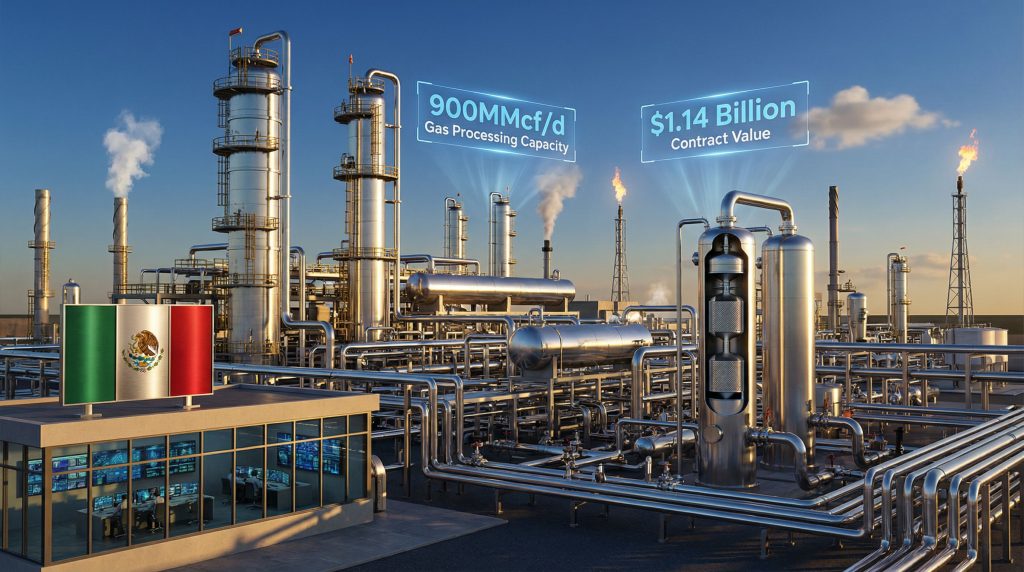
The Coastoil PEMEX Ixachi contract, signed December 19, 2025, represents a comprehensive infrastructure development initiative valued at US$1.14 billion. The agreement establishes a consortium led by Coastoil Dynamic, alongside Sistemas Integrales de Compresión and Nuvoil, creating an integrated approach to natural gas processing at the strategic Ixachi Field.
Processing Infrastructure Specifications
| Facility Component | Capacity Specification | Technical Requirements |
|---|---|---|
| Gas Sweetening Plant | 150 MMcf/d design capacity | H₂S removal, amine-based systems |
| Separation Facility | 900 MMcf/d gas + 56 Mb/d oil | Three-phase separator design |
| Pipeline Infrastructure | New condensate transportation | 4-6 inch diameter, 350-1500 psi |
| Construction Timeline | 300-517 days | Parallel engineering and procurement |
The engineering scope encompasses multiple integrated systems designed for high-throughput processing. The 150 MMcf/d sweetening plant requires sophisticated amine-based treatment systems capable of reducing hydrogen sulfide concentrations to pipeline specifications. The 900 MMcf/d separation facility represents advanced three-phase separator technology, processing raw wellhead production into dry natural gas, crude oil/condensate, and water phases.
Financial Framework Innovation
The contract introduces a hydrocarbon-backed trust account mechanism that aligns payment security with project performance. PEMEX must establish this trust within 30 business days of signing, funded directly from Ixachi Field production revenue rather than general treasury allocations. This structure provides several advantages:
PEMEX Benefits:
- Reduced upfront capital requirements
- Performance-linked payment obligations
- Production-based cash flow alignment
- Infrastructure development without immediate debt burden
Consortium Advantages:
- Secured revenue stream tied to field production
- Reduced payment default risk through trust mechanisms
- Long-term operational control extending through 2034
- Expansion opportunities within PEMEX's broader portfolio
Service Period and Revenue Projections
The 8 years and 10 months service period commences upon gas sweetening plant completion and formal acceptance, creating a revenue stream extending through 2034. Furthermore, Coastal Contracts, acting as consortium leader, assumes responsibility for contract administration, billing, and payment receipt, with all financial benefits attributable to the Mexican joint venture.
This represents a significant expansion from the original 2021 agreement, which covered single-facility operations with limited processing capacity. The current contract integrates multiple facilities, substantially larger processing volumes, and comprehensive midstream services, demonstrating PEMEX's confidence in the consortium's technical capabilities.
Strategic Implications for Mexico's Energy Sector
The Coastoil PEMEX Ixachi contract catalyses broader transformations within Mexico's energy infrastructure development strategy. Current natural gas market dynamics show total consumption reaching approximately 8.4-8.8 Bcf/d in 2023-2024, with import requirements representing 55% of total consumption. The Ixachi processing capacity, when fully operational, could contribute approximately 0.9 Bcf/d to domestic supply, potentially reducing import dependency by 10-11%.
However, this development must align with global energy transition challenges that reshape traditional hydrocarbon infrastructure investments. For instance, Mexico faces similar pressures to balance domestic energy security with international climate commitments, mirroring energy exports challenges experienced by other resource-rich nations navigating sustainable development pathways.
Production Optimisation Timeline
Strategic implementation follows a phased approach designed to maximise field output:
- Gas Sweetening Plant Operations (Late 2026/Early 2027): Initial processing capacity activation
- Full Separation Facility Integration (Mid-2027): Complete midstream infrastructure operational
- Ramp-up to Design Capacity (2027-2028): 90-180 day optimisation period
- Full Production Achievement (2028+): Maximum throughput and export potential
Regional Market Integration
Mexico's enhanced processing capacity creates opportunities for Central American market integration. Guatemala, Honduras, El Salvador, and Nicaragua represent emerging natural gas markets with combined demand estimated at 1.2-1.8 Bcf/d, growing 3-5% annually. Current regional supply relies heavily on LNG imports and limited pipeline infrastructure from Mexico.
Strategic Positioning: The Ixachi processing enhancement positions Mexico as a potential regional natural gas hub, capable of serving domestic industrial demand while exploring export opportunities to neighbouring Central American markets.
Technology Transfer and Workforce Development
The Malaysian consortium brings advanced gas processing expertise to Mexican operations, creating knowledge transfer opportunities for local technical personnel. This includes:
- Advanced Sweetening Technologies: Amine-based systems and sulphur recovery processes
- Operational Excellence: Performance optimisation and maintenance protocols
- Environmental Compliance: Best practices for onshore gas processing operations
- Project Management: Integration methodologies for complex midstream infrastructure
Market Positioning and Competitive Analysis
The enhanced Ixachi processing infrastructure fundamentally alters Mexico's competitive position within North American natural gas markets. Currently, Mexico imports approximately 4.6 Bcf/d primarily from U.S. suppliers via cross-border pipeline systems. The additional 0.9 Bcf/d domestic processing capacity could reduce this dependency while improving supply security for Mexican industrial consumers.
Consequently, the project addresses broader green transition insights by reducing transportation emissions associated with cross-border gas imports whilst enhancing domestic supply chain resilience.
Supply Chain Transformation
Processing Capacity Expansion creates multiple strategic advantages:
- Import Substitution: Direct displacement of 900 MMcf/d from current import volumes
- Industrial Supply Security: Reliable domestic source for Mexican manufacturers
- Price Stabilisation: Reduced exposure to volatile cross-border pricing
- Infrastructure Utilisation: Enhanced capacity for existing pipeline networks
Competitive Dynamics
Mexico's enhanced domestic processing capacity competes directly with U.S. LNG suppliers and pipeline imports. The Ixachi development provides several competitive advantages:
| Competitive Factor | Ixachi Domestic Supply | U.S. Import Alternatives |
|---|---|---|
| Transportation Costs | Minimal pipeline transport | Cross-border fees + transport |
| Supply Security | Domestic production control | External supplier dependency |
| Price Volatility | Local market pricing | International commodity exposure |
| Infrastructure Investment | Mexican job creation | External capital outflow |
Technology Leadership Development
The consortium's advanced processing capabilities establish Mexico as a regional centre for sophisticated gas treatment technologies. The 150 MMcf/d sweetening plant represents state-of-the-art H₂S removal systems, while the 900 MMcf/d separation facility demonstrates large-scale processing engineering suitable for replication across other Mexican fields.
Environmental compliance standards embedded within the project design create benchmarks for future onshore processing developments, potentially influencing regulatory frameworks across Latin American gas production operations.
Financial Performance Projections
The Coastoil PEMEX Ixachi contract generates predictable revenue streams through performance-linked service agreements extending through 2034. Financial projections indicate positive contributions to Coastal Contracts' earnings beginning in 2026, with revenue realisation tied directly to Ixachi Field production volumes and operational efficiency metrics.
Revenue Structure Analysis
Annual Service Fees derive from multiple components:
- Base Processing Fees: Fixed payments for sweetening plant operations (150 MMcf/d capacity)
- Separation Service Revenue: Variable income from 900 MMcf/d gas processing
- Performance Bonuses: Efficiency incentives tied to operational excellence metrics
- Maintenance Contracts: Long-term facility upkeep and optimisation services
The hydrocarbon-backed trust account mechanism ensures payment reliability by linking consortium compensation directly to field production revenue, reducing counterparty credit risk associated with PEMEX's capital constraints.
Investment Return Calculations
Project economics benefit from several structural advantages:
Risk Mitigation Factors:
- Production-linked payment schedules align revenue with field performance
- Trust account funding eliminates PEMEX treasury dependency
- Long-term service agreements provide revenue predictability
- Technical expertise creates barriers to competitive displacement
Return Enhancement Opportunities:
- Contract extension possibilities beyond 2034
- Additional facility expansions at other PEMEX fields
- Technology licensing to third-party Mexican operators
- Regional service expansion throughout Central America
Currency and Operational Considerations
The Malaysian parent company manages currency exposure through several mechanisms that reflect broader investment strategy insights for multinational energy projects:
- USD-Denominated Contracts: Payments in stable international currency
- Local Cost Management: Mexican peso expenses for construction and operations
- Hedging Strategies: Financial instruments to manage exchange rate volatility
- Revenue Diversification: Multiple project locations reducing single-country exposure
Future Development Scenarios
The successful implementation of the Coastoil PEMEX Ixachi contract establishes precedents for expanded private sector participation in Mexican energy infrastructure development. Multiple scenarios emerge for scaling this partnership model across PEMEX's broader asset portfolio and Mexico's evolving energy policy framework.
Expansion Pathway Analysis
Immediate Development Opportunities (2025-2028):
- Additional Ixachi Facilities: Secondary processing units for increased field output
- Regional Field Integration: Connecting nearby Veracruz basin discoveries to Ixachi infrastructure
- Pipeline Network Expansion: Enhanced transportation capacity to major Mexican markets
- Export Infrastructure Development: Cross-border pipeline connections for Central American markets
Medium-Term Strategic Options (2028-2032):
- Technology Replication: Deploying proven sweetening and separation systems at other PEMEX fields
- Joint Venture Expansion: Additional consortium partnerships for offshore gas development
- Midstream Integration: Downstream processing and petrochemical facility connections
- Regional Hub Development: Positioning Mexico as a Central American gas processing centre
Policy Framework Evolution
Mexico's energy policy direction increasingly favours private sector technical expertise while maintaining state ownership of hydrocarbon resources. The Ixachi partnership model demonstrates several policy trends:
Regulatory Development Patterns:
- Performance-based contracting for complex technical services
- Foreign investment frameworks emphasising technology transfer
- Environmental standards enforcement driving advanced processing requirements
- Regional energy integration supporting Central American market development
Investment Attraction Mechanisms:
- Risk-sharing structures reducing private sector exposure
- Hydrocarbon-backed payment systems enhancing project bankability
- Long-term service agreements providing revenue predictability
- Technology leadership opportunities creating competitive advantages
Integration with Renewable Energy Systems
Future scenarios include hybrid energy development where natural gas processing integrates with renewable energy integration and distribution systems. The Ixachi infrastructure could support:
- Grid Stability Services: Natural gas backup for intermittent renewable sources
- Industrial Heat Applications: Process gas for manufacturing requiring consistent thermal input
- Petrochemical Integration: Feedstock supply for sustainable chemical production
- Export Market Development: Clean-burning fuel for regional environmental compliance
The next major ASX story will hit our subscribers first
Key Success Metrics and Monitoring Framework
Evaluating the Coastoil PEMEX Ixachi contract requires comprehensive performance measurement across operational, financial, and strategic dimensions. Success metrics encompass both quantitative production targets and qualitative technology transfer achievements that establish benchmarks for future Mexican energy infrastructure development.
Operational Performance Indicators
Primary Production Metrics:
- Daily Processing Volumes: Target 900 MMcf/d gas separation vs. design capacity achievement
- Sweetening Plant Efficiency: 150 MMcf/d throughput with <4 ppm H₂S output specifications
- Uptime Performance: >95% operational availability excluding scheduled maintenance periods
- Product Quality Compliance: 100% adherence to Mexican pipeline transportation standards
Technical Excellence Standards:
- Environmental Impact Minimisation: Emissions reduction compared to industry baselines
- Safety Performance: Zero lost-time incidents and comprehensive H₂S exposure protection
- Energy Efficiency: Processing energy consumption per unit output optimisation
- Equipment Reliability: Mean time between failures for critical processing equipment
Financial Performance Tracking
Revenue Realisation Monitoring:
| Performance Metric | Target Achievement | Measurement Frequency |
|---|---|---|
| Monthly Service Fees | 100% of contracted amounts | Monthly billing cycles |
| Production Volume Bonuses | Tied to >90% capacity utilisation | Quarterly assessment |
| Operational Efficiency Incentives | Based on cost management targets | Annual performance review |
| Contract Extension Probability | Evaluated through performance scoring | Continuous monitoring |
Cost Management Framework:
- Capital Expenditure Control: EPC budget adherence within ±5% variance
- Operational Cost Optimisation: Annual efficiency improvements of 2-3%
- Maintenance Expense Management: Predictive maintenance reducing unplanned costs
- Currency Exposure Mitigation: Hedging effectiveness for peso-denominated expenses
Strategic Impact Assessment
PEMEX Organisational Benefits:
- Production Enhancement: Measurable increase in Ixachi Field output optimisation
- Technical Capability Development: Knowledge transfer to PEMEX engineering staff
- Capital Efficiency: Infrastructure development without balance sheet impact
- Market Positioning: Enhanced domestic gas supply reducing import dependency
National Energy Security Metrics:
- Import Reduction: Quantified decrease in U.S. natural gas imports (target: 0.9 Bcf/d)
- Supply Diversification: Reduced reliance on external suppliers for domestic consumption
- Industrial Competitiveness: Lower gas costs for Mexican manufacturing sectors
- Regional Integration: Export potential to Central American markets
Technology Transfer Evaluation
Knowledge Development Outcomes:
- Local Workforce Training: Number of Mexican technical personnel achieving advanced certifications
- Operational Excellence: Best practices adoption across PEMEX's broader operations
- Innovation Implementation: New technologies deployed at other Mexican gas fields
- Regulatory Compliance: Environmental and safety standard improvements
Long-Term Capacity Building:
The success framework extends beyond immediate operational metrics to encompass sustainable technology transfer that enhances Mexico's indigenous gas processing capabilities. This includes establishing Mexican engineering firms capable of replicating advanced sweetening technologies and developing local supply chains supporting sophisticated midstream infrastructure.
Critical Success Factor: The ultimate measure of project success lies in creating replicable models for private sector participation in Mexican energy infrastructure development while maintaining state ownership of hydrocarbon resources and building domestic technical capabilities.
Through comprehensive monitoring of these operational, financial, and strategic metrics, the Coastoil PEMEX Ixachi contract establishes benchmarks for evaluating future energy infrastructure partnerships and demonstrates the viability of innovative public-private collaboration models in Latin American energy sector development.
Looking to Capitalise on Latin America's Growing Energy Infrastructure Opportunities?
Discovery Alert's proprietary Discovery IQ model delivers real-time alerts on significant mineral discoveries, empowering subscribers to identify actionable opportunities ahead of the broader market as Latin American energy and infrastructure demand drives exploration across commodities. Explore how major mineral discoveries historically generate substantial returns and begin your 30-day free trial today to position yourself ahead of emerging market trends.