August 7, 2026
The Geology of Dependency: Why Mexico's Northern Shale Basins Are Back on the Table
When an energy-importing nation watches geopolitical conflict sever global shipping corridors and drive crude prices to multi-year highs, the conversation about domestic production urgency changes fundamentally. Conflict-driven disruptions through the Strait of Hormuz in 2026 pushed six of Europe's largest energy producers to collectively record US$22 billion in combined first-quarter profits, a figure that simultaneously illuminates the windfall available to producers and the compounding pain experienced by importers. For Mexico, a country structurally dependent on pipeline gas from a single northern neighbour, this global backdrop has accelerated a domestic policy conversation that was already building momentum: whether to move forward with Mexico pilot fracking in Tamaulipas and Coahuila.
The answer emerging from the Sheinbaum administration is cautious but directionally clear.
When big ASX news breaks, our subscribers know first
Mexico's Natural Gas Import Dependency: A Structural Vulnerability With Growing Costs
Mexico's domestic natural gas production has consistently fallen short of industrial and residential demand for years. The gap has been filled almost entirely by pipeline imports from the United States, creating a dependency that exposes the country to pricing volatility, potential supply interruptions, and a degree of geopolitical leverage that sits uncomfortably alongside Mexico's constitutional doctrine of resource nationalism.
This is not a new problem, but the urgency surrounding it is intensifying for several compounding reasons:
- U.S.-China trade war impacts on global supply chains have kept U.S.-Mexico trade relations under sustained pressure in 2026, making supply-chain reliance on a single foreign source a heightened strategic risk
- Global energy price inflation, driven in part by Strait of Hormuz disruptions, has raised the cost of import dependency in real fiscal terms, with current crude oil prices amplifying fiscal exposure for net importers
- PEMEX's financial deterioration has undermined the state-owned producer's capacity to maintain, let alone expand, conventional domestic output
- Mexico's industrial sector, which accounts for a substantial share of natural gas consumption, faces competitive disadvantage when input energy costs are exposed to cross-border pricing dynamics
The logical policy response to each of these pressures points in the same direction: develop domestic unconventional gas resources that are geologically accessible but have remained dormant under prior regulatory regimes.
How Hydraulic Fracturing Works in Tight Formation Geology
Understanding why Coahuila and Tamaulipas are the focus of Mexico's unconventional gas ambitions requires a basic grasp of formation geology and extraction mechanics.
Hydraulic fracturing, commonly called fracking, involves injecting high-pressure fluid mixtures into subsurface rock formations to create or widen fractures through which trapped natural gas can flow to the wellbore. Unlike conventional gas, which migrates naturally into porous reservoir rock and can be extracted through vertical wells, tight gas and shale gas are trapped within low-permeability formations that require artificial fracture networks to become economically producible.
The key geological characteristics that make a formation attractive for unconventional development include:
- Sufficient organic content to have generated hydrocarbons in place
- Low but workable matrix permeability that responds to fracture stimulation
- Formation thickness and lateral continuity that justifies horizontal drilling investment
- Manageable depth relative to water table zones to reduce contamination risk
- Structural integrity that limits induced seismicity risk from wastewater reinjection
Mexico's northern basins satisfy several of these criteria, which is precisely why they have attracted attention from both PEMEX geologists and independent analysts familiar with cross-border formation data.
The Scientific Committee's Basin-Specific Findings: A Differentiated Assessment
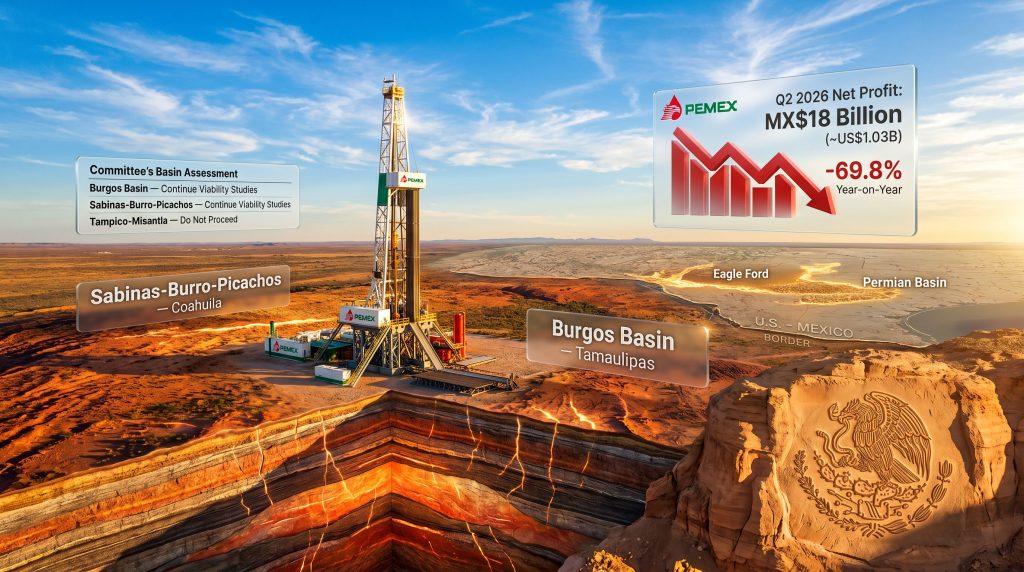
Mexico's Scientific Committee on Energy Sovereignty and Unconventional Natural Gas Deposits delivered findings that resist simple characterisation. Rather than issuing a blanket recommendation for or against fracking nationally, the committee conducted a basin-by-basin risk assessment across three distinct geological zones, producing meaningfully different outcomes for each.
| Basin | Location | Committee Recommendation | Primary Risk Factors |
|---|---|---|---|
| Tampico-Misantla | Tamaulipas / Veracruz | Do not proceed | Environmental and social risk |
| Sabinas-Burro-Picachos | Coahuila / Nuevo León | Continue viability studies | Further assessment required |
| Burgos | Tamaulipas | Continue viability studies | Further assessment required |
The committee structured its analytical work across four pillars: geology, water resource risk, engineering feasibility, and environmental impact. This multi-disciplinary approach reflects a level of methodological rigour that goes beyond simple resource estimation exercises, and the institutions represented on the committee, including UNAM, IPN, UAM, IMP, and IMTA, lend considerable technical credibility to the findings.
Critically, these recommendations are informed by real subsurface data. PEMEX has already drilled 25 exploratory wells across all three basins, providing formation pressure readings, water table interaction data, and geological characterisation that transforms the pilot fracking question from a speculative exercise into an evidence-based decision.
Why the Tampico-Misantla Basin Was Excluded
The committee's recommendation against proceeding in Tampico-Misantla carries important informational content about where the boundaries of the programme lie. This basin extends into Veracruz, a more densely populated and ecologically sensitive region than the arid northern frontier states. The combination of elevated community risk, more complex surface land use, and environmental sensitivity appears to have driven the exclusion.
The practical effect of this exclusion is to concentrate all pilot activity in the north, where proximity to existing U.S. shale infrastructure, lower population density, and greater industrial precedent provide a more defensible operational context.
Coahuila and Tamaulipas: Why These Two States Hold the Key
The case for Mexico pilot fracking in Tamaulipas and Coahuila rests on a convergence of geological, logistical, and economic factors that distinguish these northern states from other potential unconventional development zones.
The Sabinas-Burro-Picachos Basin (Coahuila)
Located in northeastern Coahuila along the U.S. border, the Sabinas-Burro-Picachos basin sits in geological continuity with productive formations on the American side. The basin has long been identified as prospective for tight gas, but a combination of regulatory uncertainty, PEMEX capital constraints, and the prior administration's anti-fracking stance prevented systematic development.
A less commonly discussed dimension of the Coahuila situation is the political architecture: the state is governed by opposition parties, introducing a federal-state coordination requirement that adds procedural complexity. Coahuila's state government has reportedly been actively promoting unconventional development and awaiting federal regulatory frameworks to define private-sector participation terms, suggesting political alignment at the state level even where federal-state institutional dynamics remain complex.
The Burgos Basin (Tamaulipas)
The Burgos basin represents Mexico's most advanced unconventional gas prospect from an exploration standpoint. It sits immediately adjacent to the Eagle Ford and Haynesville shale plays in Texas, two of the most productive tight-gas formations in North American history. This geological adjacency is not coincidental; the same Cretaceous-age source rocks that generate hydrocarbons on the U.S. side extend southward into Mexican territory.
A fracking initiative in Tamaulipas was specifically blocked during the López Obrador administration, meaning any new pilot programme carries clear policy reversal symbolism. That political weight cuts both ways: it signals genuine commitment from the Sheinbaum government, but it also invites organised opposition from the same environmental and community groups that succeeded in blocking the earlier programme.
Comparative Basin Snapshot
| Feature | Sabinas-Burro-Picachos | Burgos Basin |
|---|---|---|
| Primary State | Coahuila | Tamaulipas |
| U.S. Analog Formation | Permian Basin adjacency | Eagle Ford / Haynesville |
| Prior PEMEX Exploratory Wells | Yes | Yes |
| State Political Environment | Opposition-governed | Potentially lower resistance |
| Committee Status | Continued viability studies | Continued viability studies |
PEMEX's Financial Trajectory: The Corporate Urgency Behind the Policy Shift
Any analysis of Mexico's fracking evaluation that focuses exclusively on resource nationalism misses a critical financial dimension. PEMEX published its second-quarter 2026 results reporting a net profit of MX$18 billion (approximately US$1.03 billion), a figure that at first glance appears healthy but represents a 69.8% year-on-year decline from Q2 2025.
That trajectory is the more important data point. A company whose profitability has contracted by nearly 70% in a single year, while operating as the constitutionally mandated steward of Mexico's hydrocarbon resources, faces compounding pressure to identify new production streams. Unconventional gas development offers PEMEX a path to volume growth that conventional drilling in mature fields cannot realistically provide.
"The 69.8% profit decline at PEMEX in Q2 2026 is not merely a corporate earnings story. It is a fiscal pressure indicator that directly strengthens the institutional case for expanding domestic gas production through unconventional means, while simultaneously constraining the capital available to fund such expansion without private-sector co-investment."
This tension between strategic necessity and capital scarcity is likely to shape how any pilot programme is structured. Private-sector participation through service contracts, rather than production-sharing arrangements, is the constitutionally preferred model under Mexico's resource nationalism framework. However, the terms of those contracts will need to be attractive enough to draw technical expertise and risk capital. Furthermore, U.S. natural gas prices remain a direct benchmark against which any domestic Mexican production economics will be evaluated by potential investors.
The next major ASX story will hit our subscribers first
The Regulatory Landscape: Institutional Stakeholders and Their Roles
Mexico's fracking pilot evaluation involves a multi-agency institutional architecture that creates both procedural thoroughness and potential coordination friction:
- SENER (Secretaría de Energía): The federal energy ministry that oversees hydrocarbon policy and would issue any pilot authorisation
- Semarnat: The environmental regulatory body whose approval is required for surface disturbance, water use, and waste management associated with fracking operations
- SECIHTI: The science and technology council that convened the scientific committee producing the basin-specific recommendations
- UNAM, IPN, UAM, IMP, IMTA: Academic and technical institutions that provided the multi-disciplinary expertise underpinning the committee's findings
Reports indicate that initial pilot operations could potentially commence as early as September 2026, contingent on regulatory review completion and site-specific authorisation. Whether this timeline holds will depend substantially on the pace of Semarnat's environmental assessment processes and the publication of federal rules governing private-sector participation.
Environmental and Community Risks: The Social Licence Problem
The scientific committee's exclusion of Tampico-Misantla on environmental and social grounds is a useful signal: water resource risk is a genuine threshold constraint, not a secondary consideration, in Mexico's unconventional gas evaluation framework.
In the northern basins cleared for continued study, the primary environmental concerns include:
- Water availability and aquifer protection: Hydraulic fracturing requires significant fluid volumes in regions where water stress is already acute. Coahuila and Tamaulipas are predominantly arid or semi-arid, and agricultural communities competing for the same groundwater resources have historically opposed fracking projects on water security grounds
- Induced seismicity: Wastewater reinjection associated with fracking operations has been linked to low-level seismic events in U.S. shale plays. Mexican regulators will need to establish monitoring protocols and operational limits before pilot approval
- Surface and ecosystem disturbance: Drilling pad construction, road access, and pipeline installation create surface footprints that require careful siting in areas with ecological sensitivities
The López Obrador-era veto of the prior Tamaulipas fracking plan demonstrates that organised community and environmental opposition can override technical feasibility assessments in the Mexican political context. Consequently, any pilot programme under President Sheinbaum will need a credible community engagement framework and transparent environmental monitoring commitments to maintain social licence through the pilot phase.
"The gap between a scientific committee recommendation and operational social licence is where fracking programmes most commonly stall across Latin America. Geological viability and community acceptance are separate problems requiring separate solutions."
Regional Precedent: What Latin America's Unconventional Experience Reveals
Mexico is not entering unconventional territory without regional precedent to learn from. Argentina's resource development model in Neuquén province represents the most instructive Latin American case study, having moved from exploration to large-scale commercial production through a combination of regulatory clarity, fiscal incentives, and sustained private-sector investment. The Vaca Muerta experience demonstrates that geological prospectivity alone does not determine programme success; institutional consistency and community relations are equally determinative of production timelines.
Colombia and Brazil have both conducted fracking feasibility studies with more mixed results, where regulatory uncertainty and community opposition created extended permitting timelines that deterred capital deployment. Mexico's pilot-first approach, limiting initial activity to defined test zones with clear scientific justification for site selection, mirrors cautious entry strategies that have produced the most durable outcomes in comparable contexts globally.
The critical difference in Mexico's case is the constitutional constraint on PEMEX as the mandated operator, which limits the flexibility to attract international unconventional specialists through the partnership structures that accelerated Vaca Muerta's development. This structural constraint makes the terms of any service contract framework particularly important to programme momentum.
Gas as a Transition Fuel: The Decarbonisation Paradox
Mexico's fracking evaluation unfolds against a contested global debate about natural gas's role in energy transition pathways. Gas combustion produces substantially lower carbon dioxide emissions per unit of energy than coal, which has led many transition frameworks to classify it as a bridge fuel for economies moving away from heavy carbon dependence. However, methane leakage during unconventional extraction can significantly erode this climate advantage, and measurement of fugitive emissions from fracking operations remains technically challenging.
The Sheinbaum administration's simultaneous pursuit of renewable energy expansion and unconventional gas development reflects a pragmatic tension present in energy policy globally: long-term decarbonisation goals must coexist with near-term energy security imperatives. This is particularly relevant when geopolitical disruptions are driving energy price volatility to levels that create genuine economic and social pressure. Furthermore, government intervention in resources sectors globally has demonstrated that policy frameworks can either accelerate or severely constrain unconventional development timelines depending on how they are structured.
Elevated global shipping costs, with container freight costs rising sharply amid Mideast tensions, compound this pressure by raising the cost of any energy commodity with significant maritime transport exposure, further strengthening the relative economic case for domestic pipeline gas.
Key Milestones and Scenarios to Monitor
For analysts and observers tracking the progression of Mexico pilot fracking in Tamaulipas and Coahuila, the following indicators will signal whether the programme is advancing or stalling:
- Federal regulatory framework publication: Coahuila's state government is explicitly awaiting federal rules on private-sector participation alongside PEMEX. Publication would signal serious programme advancement
- Semarnat environmental authorisation: Site-specific environmental impact assessment approval is a mandatory prerequisite, making Semarnat's review pace a leading indicator
- PEMEX capital budget allocation: Inclusion of unconventional pilot expenditure in PEMEX's revised operational budget would confirm executive-level commitment beyond the evaluation phase
- September 2026 timeline: Reported as a potential start date for initial pilots; whether this holds or slips will reflect the depth of interagency alignment
| Scenario | Trigger Conditions | Likely Outcome |
|---|---|---|
| Pilots Proceed on Schedule | Federal framework published, Semarnat approval granted, PEMEX budget allocated | Limited pilot operations in Burgos and/or Sabinas-Burro-Picachos by late 2026 |
| Pilots Delayed | Coordination gaps, community opposition, extended Semarnat review | Programme pushed to 2027 with revised regulatory design |
| Programme Suspended | Environmental incident, political escalation, or federal-state conflict | Return to full import dependency with policy review |
| Expanded Programme | Successful pilots with manageable environmental footprint | Broader unconventional development with private-sector participation |
Frequently Asked Questions: Mexico Pilot Fracking in Tamaulipas and Coahuila
What is the current status of fracking in Mexico?
Fracking is under active evaluation by the Sheinbaum administration, with pilot projects potentially beginning in Coahuila and Tamaulipas as early as September 2026. No formal authorisation has been publicly confirmed as of the date of this article. The decision follows findings from a government-convened scientific committee that recommended continued viability studies for the Sabinas-Burro-Picachos and Burgos basins while advising against proceeding in Tampico-Misantla. For further context on how this fits within Mexico's broader energy landscape, independent reporting confirms the directional shift in policy.
Why are Coahuila and Tamaulipas the primary focus states?
Both states sit above geological formations structurally analogous to productive U.S. shale plays immediately across the border. PEMEX has already drilled 25 exploratory wells across these and adjacent basins, providing subsurface data to inform pilot design. The Burgos basin in Tamaulipas and the Sabinas-Burro-Picachos basin in Coahuila and Nuevo León are the two formations cleared for continued viability assessment.
Has fracking been attempted in Mexico before?
PEMEX conducted limited unconventional drilling activity in prior years, and a Tamaulipas-specific fracking initiative was vetoed during the López Obrador administration. The current evaluation represents a directional policy shift under President Sheinbaum, driven by energy sovereignty considerations and PEMEX's deteriorating financial performance.
What environmental risks are associated with the proposed pilots?
Primary concerns include water resource depletion and aquifer contamination in water-stressed northern Mexico, induced seismicity from wastewater injection, and surface disturbance in areas with ecological or agricultural sensitivities. Semarnat approval is required before any operations can commence, and environmental groups have indicated they intend to actively contest any pilot authorisations.
How does PEMEX's financial situation connect to this policy decision?
PEMEX reported a Q2 2026 net profit of MX$18 billion (approximately US$1.03 billion), representing a 69.8% decline from Q2 2025. This financial deterioration strengthens the institutional case for developing new domestic production streams, including unconventional gas, to stabilise the company's revenue base and reduce Mexico's structural exposure to U.S. import pricing.
Disclaimer: This article is intended for informational purposes only and does not constitute financial, investment, or legal advice. Statements regarding potential pilot timelines, regulatory outcomes, and production scenarios are based on publicly available information as of the date of publication and are subject to change. Readers should conduct independent due diligence before making any decisions based on the information presented here.
Want To Stay Ahead of Major Resource Discoveries Shaping Global Energy Markets?
As Mexico's unconventional gas ambitions highlight the growing strategic value of domestic resource development, Discovery Alert's proprietary Discovery IQ model delivers real-time alerts on significant ASX mineral discoveries — instantly translating complex geological data into actionable investment insights for traders and long-term investors alike. Explore historic examples of extraordinary discovery-driven returns and begin your 14-day free trial today to position yourself ahead of the market.