
August 21, 2026
The Geology of Reinvention: How Commodity Cycles Force Miners to Rebuild Their Identity
Every decade or so, the Australian resources sector experiences a structural rearrangement that forces smaller operators to confront a fundamental question: does the asset still justify the capital, or has the economic logic quietly disappeared beneath rising costs and falling margins?
Iron ore has long been a cornerstone of the ASX resources landscape, but the gap between how the commodity works for tier-one majors like BHP and Rio Tinto versus how it works for mid-sized operators has grown to a point where the comparison is almost meaningless. Scale economics, port access, integrated logistics, and sovereign hedging give the giants a structural cost advantage that junior producers simply cannot replicate. For smaller operators running lower-grade material from complex coastal or remote sites, the margin squeeze is not cyclical. It is structural.
This is the backdrop against which MGX Resources moves from iron ore to gold becomes not just a corporate decision, but a case study in rational capital allocation under pressure.
When big ASX news breaks, our subscribers know first
Why Iron Ore Economics Stopped Working for Mid-Tier Producers
The iron ore price decline story over the past several years has not been kind to lower-grade producers. The global seaborne iron ore market is increasingly bifurcated between high-grade material, which commands premium pricing from steel mills seeking to reduce carbon intensity, and lower-grade fines and lump, which attract significant discounts. Chinese steel mills, under increasing environmental pressure to reduce blast furnace emissions, have structurally tilted their purchasing toward higher iron content ore. This means the discount applied to sub-60% iron content material has widened and become more persistent.
For an operation like Koolan Island, which does produce high-grade material in parts but required increasingly complex logistics to sustain, the economics were not simply about the spot price. Site rehabilitation obligations, the capital-intensive nature of coastal island mining, and the eventual depletion of the highest-grade zones all compound the challenge.
There is also a less-discussed dynamic at play: rehabilitation liability. Junior and mid-tier iron ore producers frequently carry rehabilitation cost obligations that can run into the tens of millions of dollars. For a larger company, this is a manageable line item. For a smaller company with a more concentrated asset base, however, it can represent a significant drag on balance sheet optionality. Offloading that obligation as part of a divestment transaction is, in some ways, as strategically important as the headline sale price.
How China's Demand Shift Accelerated the Pressure
Furthermore, China steel and iron ore market dynamics have compounded the structural challenges for mid-tier producers. As Chinese mills pivot toward higher-grade feedstocks to meet tightening emissions standards, the commercial viability of lower-grade operations continues to erode. Consequently, smaller producers relying on discount-grade material face an increasingly unattractive long-term outlook.
Gold's Structural Appeal to Repositioning Australian Miners
The macro case for gold has been building across multiple dimensions simultaneously. Central bank gold demand hit multi-decade highs in 2022 and 2023, with institutions in emerging markets diversifying away from USD-denominated reserves at an accelerating pace. Sovereign debt levels across G7 economies remain at historically elevated levels, sustaining the structural narrative around currency debasement. These are not short-term trading catalysts. They represent a longer-duration shift in how capital allocators view the metal.
For Australian producers specifically, the local gold price dynamic has been particularly compelling. The AUD/USD exchange rate has historically provided a natural buffer for Australian gold miners: when global risk sentiment deteriorates and the Australian dollar weakens against the US dollar, the AUD gold price often rises even if the USD gold price is flat. This currency amplification effect is a structural feature of Australian gold economics that does not apply to iron ore.
Furthermore, with gold at record highs in both USD and AUD terms, the timing of MGX's pivot aligns with a particularly favourable window for repositioning capital into precious metals exposure. The result is a growing cohort of ASX-listed companies deliberately repositioning their commodity exposure from bulk materials toward precious metals, seeking more favourable capital market reception, better margin profiles, and longer asset lives.
MGX Resources' Iron Ore Legacy: A History Worth Understanding
MGX Resources built its operational identity over roughly two decades around the Koolan Island iron ore operation, situated off the Kimberley coast of Western Australia. The deposit is geologically distinctive: it hosts some of the highest-grade direct-shipping ore in Australia, with iron content that can exceed 65%, placing it at the premium end of the global quality spectrum. However, geological quality and operational complexity do not always align neatly.
The coastal island setting creates logistical challenges that add meaningfully to the per-tonne cost structure compared to Pilbara operations with direct rail access to port. The Koolan Island operation had already navigated significant adversity, including a seawall failure in 2014 that flooded the main pit and required a multi-year, capital-intensive remediation effort before production could resume. That history alone signals the operational complexity inherent to the asset.
By FY26, MGX had pivoted to running out the lower-grade inventory at Koolan Island through a dedicated low-grade sales programme. This programme sold 1.81 million tonnes of low-grade material as part of a total iron ore volume of 2.68 million tonnes for the year, generating $204.0 million in sales revenue. Critically, the cash generated from this final phase was sufficient to fully fund site rehabilitation and wind-down costs, a financially disciplined outcome that preserved balance sheet integrity.
The Koolan Island Divestment: More Than a Sale
The binding divestment agreement with Crestlink carries a floor value of $20.2 million, supplemented by a revenue-sharing arrangement and, crucially, the assumption of rehabilitation cost obligations by the acquirer. In the context of mining asset divestments, the transfer of rehabilitation liability is often underappreciated by generalist investors but is well understood by mining-sector specialists.
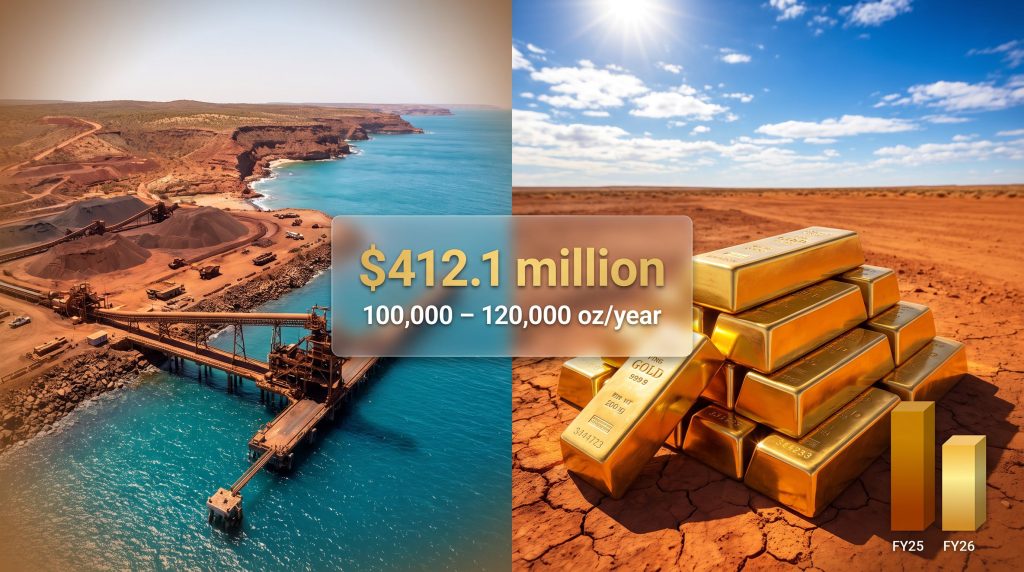
By structuring the transaction to include this cost transfer, MGX has achieved a cleaner balance sheet exit than a headline sale price alone would suggest. The company departs the iron ore chapter with approximately $412.1 million in cash and investments and no bank debt, a genuinely rare position of financial strength for a mid-tier miner executing a commodity pivot.
The FY26 financial outcomes tell a nuanced story when examined carefully:
| Financial Metric | FY26 | FY25 |
|---|---|---|
| Sales Revenue | $204.0 million | $330.5 million |
| Iron Ore Volume Sold | 2.68 million tonnes | N/A |
| Low-Grade Component | 1.81 million tonnes | N/A |
| Profit Before Tax and Impairments | $29.1 million | N/A |
| Net Loss After Tax | $30.2 million | $82.2 million |
| Cash and Investments | $412.1 million | N/A |
| Koolan Island Divestment Floor | $20.2 million + revenue share | N/A |
The year-on-year narrowing of the statutory net loss from $82.2 million to $30.2 million is a meaningful signal. The net loss itself is primarily attributable to non-cash impairment charges associated with the iron ore asset write-down, a technical accounting outcome rather than an operational failure. The underlying profitability figure, with profit before tax and impairments of $29.1 million, confirms the wind-down operations generated genuine economic value.
Investors who focus exclusively on the statutory net loss in a transitional year often miss the more important signal: whether the company is managing the transition in a financially disciplined way. In MGX's case, the combination of operational profitability during wind-down and a strengthened cash position suggests the transition has been executed with genuine rigour.
The Central Tanami Gold Project: Anatomy of the New Strategy
MGX Resources moves from iron ore to gold most concretely through its acquisition of a 50% interest in the Central Tanami Project Joint Venture from Northern Star Resources, announced in 2025 and completed in early 2026. This places the company into one of Australia's most geologically credible gold corridors. The Tanami region in the Northern Territory has been producing gold commercially since the 1980s, with the world-class Newmont Tanami operation demonstrating the region's capacity to support large-scale, long-life gold production.
Understanding the Tanami's Geological Credentials
The geological characteristics of the Tanami are worth understanding in detail. The region hosts gold mineralisation predominantly within greenstone belt sequences, where gold is associated with shear zones and structural controls. This style of mineralisation tends to produce relatively consistent, predictable ore bodies that are amenable to conventional processing. The ore is typically free-milling or moderately refractory, supporting straightforward processing flowsheets.
Scoping work for the Central Tanami Project suggests the following parameters:
| Project Parameter | Indicative Estimate |
|---|---|
| Throughput Capacity | ~1.5 million tonnes per year |
| Annual Gold Production Target | 100,000 to 120,000 ounces |
| Projected Mine Life | ~10 years |
| MGX JV Ownership | 50% |
At 50% attributable, MGX's annual gold production would be in the range of 50,000 to 60,000 ounces, positioning the company as a meaningful but not yet major producer upon reaching full output. However, a long mine life and a strong project balance sheet create a foundation from which further resource growth is possible.
What Gold Price Scenarios Mean for Project Economics
The illustrative revenue potential at various gold price assumptions provides a useful framework for understanding the upside case, while acknowledging the speculative nature of pre-production projections:
| Gold Price Assumption (AUD) | Attributable Revenue (50,000 oz) | Illustrative EBITDA (at 40% margin) |
|---|---|---|
| $4,000/oz | $200 million | $80 million |
| $4,500/oz | $225 million | $90 million |
| $5,000/oz | $250 million | $100 million |
These are illustrative scenarios only, based on publicly available scoping parameters. Actual outcomes will depend on capital costs, operating costs, gold price realised, and development timeline. This does not constitute financial advice.
The next major ASX story will hit our subscribers first
The Path from JV Acquisition to Operating Mine
One of the more commonly underappreciated aspects of gold project development is the gap between acquiring a JV interest and reaching a final investment decision. For a project of the Central Tanami's scale, the typical development sequence involves several distinct phases, each carrying its own technical and financial risks:
-
Resource definition drilling to upgrade the confidence classification of the existing resource and expand the known mineralisation footprint.
-
Prefeasibility and definitive feasibility studies to define capital costs, operating costs, processing flowsheet, and infrastructure requirements with engineering-grade precision.
-
Environmental and heritage approvals in a Northern Territory context, where engagement with Aboriginal land councils and compliance with the Aboriginal Land Rights (Northern Territory) Act is a critical and non-trivial step in the permitting process.
-
Infrastructure assessment covering water, power, accommodation, and access roads in a remote location where the cost of building and maintaining facilities can rival the processing plant itself.
-
Final investment decision and financing, which for a 50% JV interest may involve co-funding arrangements with the JV partner.
The Northern Territory regulatory context deserves specific attention. The Tanami is situated within Aboriginal freehold land, and any development requires ongoing engagement under the relevant land rights framework. Experienced operators in the region have demonstrated that these processes, while complex, are navigable. Newmont's long-running Tanami operation is clear evidence of this. However, timelines are non-trivial, and investors should not assume a linear path from feasibility to production.
Evaluating the Quality of MGX's Commodity Pivot
Not all commodity pivots are equal. The history of the ASX resources sector contains numerous examples of companies abandoning one underperforming commodity for another without the financial resources, technical capability, or asset quality to execute the transition successfully. MGX's situation differs from this pattern in several important respects.
A useful framework for evaluating pivot quality across four dimensions:
-
Balance sheet position at exit: MGX departs iron ore with $412.1 million in cash and no debt, a genuinely uncommon position of strength that provides multi-year development runway without requiring immediate equity dilution.
-
Incoming asset quality: The Central Tanami Project sits within a proven gold corridor with established regional infrastructure and a credible production-scale scoping profile, not a speculative grassroots exploration tenement.
-
Technical capability transfer: MGX's operational history at Koolan Island, including managing complex site logistics, remote operations, and large-scale rehabilitation programmes, provides transferable competencies relevant to a remote gold development context.
-
Commodity cycle timing: The transition occurs when iron ore margins for lower-grade material are structurally challenged and gold prices are at historically elevated levels in both USD and AUD terms.
Commodity pivots that occur from a position of financial strength, into high-quality assets, with demonstrable technical capability, at favourable points in relative commodity cycles, have a materially different probability profile than distressed pivots driven by necessity. MGX's transition more closely resembles the former category than the latter.
Key Risks Investors Should Weigh Carefully
The investment case for MGX's new direction carries genuine risks that deserve clear-eyed assessment rather than dismissal.
Development-stage execution risk is the most immediate concern. Scoping estimates are not bankable feasibility numbers. Capital cost estimates at the scoping stage typically carry accuracy ranges of plus or minus 35 to 40%, meaning the actual capital requirement for a 1.5 Mtpa processing operation could differ substantially from early projections. Remote NT projects have historically experienced cost overruns driven by labour, materials, and logistics.
JV dynamics introduce an additional layer of complexity. In a 50/50 JV structure, no single party holds unilateral decision-making authority. Development pace, capital allocation, and strategic priorities must be agreed between partners, which can slow decision-making relative to a wholly-owned project.
Revenue gap risk is real and present. MGX Resources moves from iron ore to gold as a cash-holding development company with no operating revenue from precious metals. The $412.1 million cash reserve is the bridge to production, and the rate at which that capital is deployed on development activities will determine how much financial buffer remains at the point of a final investment decision.
Rehabilitation counterparty risk also warrants monitoring. While Crestlink has assumed rehabilitation obligations for Koolan Island under the divestment agreement, this represents a counterparty commitment. If Crestlink were to encounter financial difficulty, the regulatory and liability position for the original site operator could become more complicated. This is a tail risk, not a base case, but it is worth monitoring.
What Near-Term Catalysts Should Investors Watch?
For investors evaluating MGX's trajectory, the following milestones represent the most significant near-term value inflection points:
-
Completion of the Koolan Island divestment with Crestlink, which removes the remaining operational overhang from the iron ore era and formally closes that chapter.
-
Resource definition drilling results at Central Tanami, which will determine whether the project's mineralisation footprint is sufficient to support a long-life operation at the scoped throughput rates.
-
Prefeasibility study release, which will provide the first engineering-grade view of capital costs and operating economics, substantially de-risking the development case.
-
Capital allocation communications from management, clarifying how the $412.1 million cash reserve will be deployed across development expenditure, potential additional acquisitions, and shareholder returns.
-
Gold price trajectory in both USD and AUD terms, which directly affects the economics of the development case and the urgency of the final investment decision.
The Bigger Picture: What This Pivot Reveals About the ASX Resources Sector
MGX's transition is not an isolated event. It sits within a broader structural shift across the ASX resources sector, where smaller and mid-sized operators are reassessing their commodity exposure in response to capital market preferences, ESG-driven commodity discrimination, and cycle positioning.
Gold continues to attract disproportionate institutional interest relative to bulk commodities among smaller ASX-listed producers. The reasons are multiple: gold is a more liquid market, gold equities tend to re-rate more dramatically in response to price movements than iron ore equities, and the ESG footprint of a gold operation is generally viewed more favourably than a large-scale bulk commodity mine. These are not geological or operational arguments. They are capital market dynamics that materially affect the cost of equity and the willingness of institutional investors to participate in funding rounds.
For a company with MGX's cash position and strategic ambition, the question now is not whether the pivot was the right strategic decision. The case for that decision is clearly articulated in both the operational outcomes and the balance sheet. The question is whether management can execute the development programme at Central Tanami with the same financial discipline that characterised the Koolan Island wind-down.
The answer to that question will unfold over the next several years, in drilling results, feasibility reports, and ultimately in the economics of the first gold pour from what management has described as a future high-quality Australian gold production business. The foundation has been laid with unusual care. The construction work is just beginning.
This article contains general information only and does not constitute financial advice. Investors should conduct their own research and consider their personal circumstances before making any investment decisions. Past performance is not indicative of future results. All financial projections and scenario analyses presented are illustrative only.
Ready to Identify the Next Major ASX Gold Discovery Before the Market Does?
Discovery Alert's proprietary Discovery IQ model scans ASX announcements in real time, instantly identifying significant mineral discoveries — including in high-potential gold corridors like the Tanami — and delivers actionable alerts to subscribers ahead of the broader market. Explore how major mineral discoveries have historically generated substantial returns for early investors, then begin your 14-day free trial at Discovery Alert to position yourself at the forefront of the next significant find.