August 6, 2026
Industrial-scale microwave technology has transformed numerous manufacturing sectors over the past two decades, from pharmaceutical synthesis to food processing. Within the critical minerals landscape, however, electromagnetic heating applications remain largely confined to laboratory settings, despite growing pressure to diversify rare earth element supply chains away from traditional mining operations. Recent advances in microwave extraction of rare earth elements from coal tailings demonstrate promising laboratory results, though significant scale-up challenges must be addressed before commercial deployment.
Understanding Microwave-Enhanced REE Recovery Technology
Core Process Chemistry and Mechanisms
The fundamental chemistry behind microwave extraction of rare earth elements from coal tailings relies on a sequential treatment approach that systematically breaks down mineral matrices. Sodium hydroxide pretreatment serves as the initial step, targeting aluminosilicate structures that typically encapsulate REE-bearing phases within coal waste materials.
During alkaline treatment, kaolinite minerals undergo structural transformation through two primary pathways: conversion to hydrosodalite intermediates or complete dissolution into aqueous phases. This restructuring process significantly increases surface area exposure and creates preferential leaching pathways for subsequent acid digestion steps.
Nitric acid digestion under microwave conditions operates through selective electromagnetic heating of polar molecules within the leach solution. Unlike conventional heating methods that rely on conductive heat transfer, microwave energy directly excites molecular bonds, creating more uniform temperature distribution and accelerated reaction kinetics.
Temperature-pressure relationships in microwave reactor systems require precise control to optimize REE liberation while preventing unwanted side reactions. Operating parameters typically range from 80-120°C under atmospheric pressure, with electromagnetic field strength calibrated to match the dielectric properties of the specific coal tailings feedstock.
Quantifying Performance Improvements
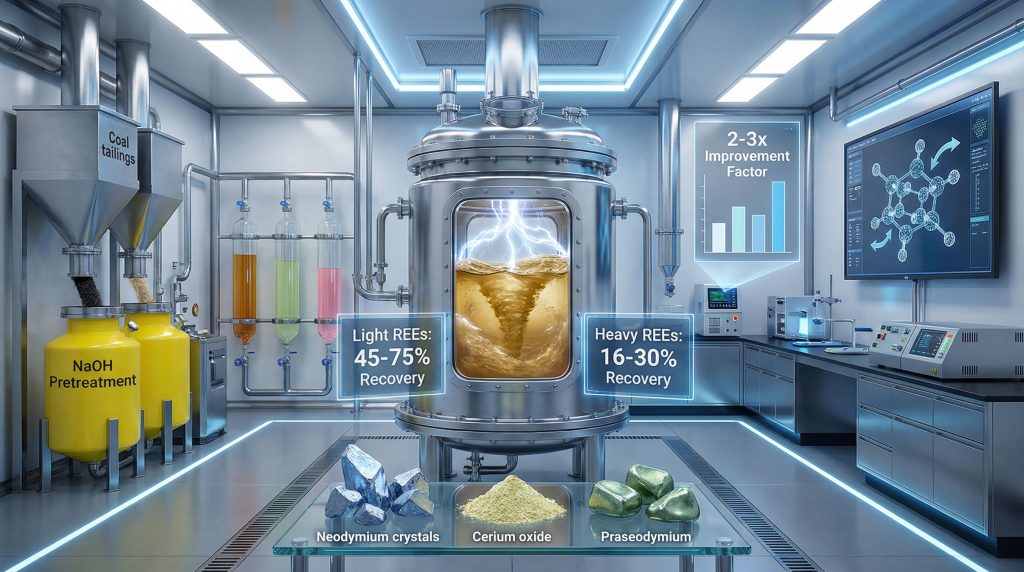
Laboratory studies demonstrate significant enhancement factors when comparing microwave-assisted extraction to conventional heating methods. Furthermore, research published in Environmental Science & Technology shows particularly notable improvements for light rare earth elements, with neodymium recovery rates increasing by factors of 2-3 times under optimized conditions.
REE Recovery Enhancement Comparison
| Element Category | Standard Extraction | Microwave-Enhanced | Improvement Factor |
|---|---|---|---|
| Light REEs (La, Ce, Pr, Nd) | 15-25% | 45-75% | 2-3x |
| Heavy REEs (Dy, Y, Er) | 8-15% | 16-30% | 2x |
| Critical Elements (Nd, Pr) | 12-20% | 36-60% | 3x |
The enhanced performance stems from improved mass transfer rates and more complete mineral dissolution under electromagnetic heating conditions. However, these laboratory results represent controlled conditions with standardised feedstock compositions, which may not reflect the variability encountered in industrial applications.
When big ASX news breaks, our subscribers know first
How Does Coal Tailings Mineralogy Affect Extraction Efficiency?
Geological Variability Across Coal Basins
Coal tailings composition varies dramatically depending on the geological formation, coal rank, and processing methods employed during beneficiation. Appalachian coal regions typically produce tailings with higher aluminosilicate content compared to Western US deposits, directly impacting REE hosting capacity and extraction complexity.
Pennsylvania and West Virginia tailings often contain elevated kaolinite concentrations ranging from 15-35% by weight, creating favourable conditions for alkaline pretreatment effectiveness. In contrast, Powder River Basin tailings exhibit lower clay mineral content but higher organic carbon residues, requiring modified processing parameters.
The impact of coal rank extends beyond simple mineral composition to include trace element distribution patterns. Bituminous coal tailings generally show more concentrated REE associations with clay minerals, while subbituminous waste streams display more dispersed element distributions across multiple mineral phases.
Processing history significantly influences tailings characteristics through particle size reduction, density separation effects, and chemical modification from flotation reagents. These factors create site-specific optimisation challenges that laboratory studies may not fully capture.
Mineral Phase Liberation Strategies
Effective REE liberation requires systematic breakdown of multiple mineral phases through carefully controlled solid-liquid ratio optimisation. Laboratory studies indicate optimal ratios typically range from 1:10 to 1:15 (solid:liquid) for maximum kaolinite dissolution, though this varies with specific mineralogical assemblages.
Multi-step alkaline treatment cycles can address complex mineral matrices containing mixed aluminosilicate phases. Sequential sodium hydroxide applications at progressively higher concentrations allow selective dissolution of different clay minerals while preserving REE-bearing phases for subsequent acid extraction.
An important co-benefit emerges during alkaline pretreatment phases: uranium removal from coal tailings. Alkaline conditions promote uranium dissolution and separation, potentially reducing radioactive waste management solutions requirements in downstream processing steps.
What Are the Industrial Scalability Challenges?
Microwave Reactor Engineering Limitations
Industrial microwave systems face fundamental physics constraints that limit scalability compared to laboratory applications. Electromagnetic penetration depth decreases with increasing material volume, creating non-uniform heating patterns in large-scale continuous processing systems.
High-throughput continuous systems require sophisticated waveguide design to maintain uniform electromagnetic field distribution across the entire reactor volume. Current industrial microwave technology struggles to achieve the precise temperature control demonstrated in bench-scale studies when scaled to multi-ton processing capacities.
Material handling complexities multiply in aggressive chemical environments combining sodium hydroxide, nitric acid, and microwave exposure. Specialised reactor materials capable of withstanding both chemical attack and electromagnetic heating represent significant capital investments compared to conventional processing equipment.
Process Economics and Waste Management
Industrial microwave systems require 3-5x higher capital investment than conventional heated reactors, while radioactive co-constituent management can add 15-25% to operational costs depending on regulatory requirements.
The economic challenge extends beyond equipment costs to include higher energy consumption patterns. Microwave heating typically consumes 2-4 times more electrical energy per unit of processed material compared to conventional heating methods, though this may be offset by reduced processing time and improved extraction efficiency.
Radioactive waste stream management creates additional cost centres that bench-scale studies often overlook. Coal tailings contain naturally occurring radioactive materials (NORM) including uranium, thorium, and radium isotopes that require specialised handling, treatment, and disposal protocols.
Reagent Recovery and Environmental Considerations
Sodium hydroxide regeneration from spent leach solutions presents both economic and environmental challenges. Caustic recovery typically requires energy-intensive evaporation and crystallisation processes that may offset some of the extraction efficiency gains achieved through microwave enhancement.
Nitric acid recovery and concentration management involves sophisticated distillation systems capable of handling high-temperature, corrosive solutions while maintaining acid purity specifications. These recovery systems represent substantial capital investments that scale non-linearly with processing capacity.
Environmental permitting for microwave extraction of rare earth elements from coal tailings involves multiple regulatory frameworks including air quality management, water discharge permitting, and radioactive materials handling licenses. This regulatory complexity can extend project development timelines by 18-36 months compared to conventional processing approaches.
Which Coal Waste Streams Offer the Best REE Potential?
Tailings vs. Fly Ash vs. Bottom Ash Comparison
Different coal waste streams exhibit varying REE concentrations and processing characteristics that directly impact extraction feasibility. Fly ash generally contains the highest REE concentrations due to volatilisation and concentration effects during combustion, while coal tailings offer advantages in terms of processing complexity and mineral phase accessibility.
REE Content by Coal Waste Type
| Waste Stream | Average REE Content (ppm) | Processing Complexity | Recovery Potential |
|---|---|---|---|
| Coal Tailings | 200-400 | High | Moderate-High |
| Fly Ash | 300-600 | Moderate | High |
| Bottom Ash | 150-300 | Low | Moderate |
Coal tailings require more intensive pretreatment due to clay mineral complexation but offer better control over feedstock composition and availability. Furthermore, fly ash provides higher grade material but involves more complex separation challenges due to glassy matrix phases formed during high-temperature combustion.
Regional Resource Assessment
Powder River Basin coal operations generate substantial tailings volumes with moderate REE concentrations, primarily hosted in kaolinite and illite clay minerals. The relatively consistent mineralogy across this region could support standardised processing approaches, though lower grade material requires higher processing volumes to achieve economic viability.
Illinois Basin coal waste streams exhibit higher sulfur content and more complex mineralogy, including pyrite and other sulfide phases that complicate extraction chemistry. However, these deposits often show elevated concentrations of critical minerals demand including dysprosium and terbium.
Eastern coal regions, particularly in Pennsylvania and West Virginia, produce tailings with favourable clay mineral assemblages but face additional challenges from acid mine drainage potential and complex regulatory environments surrounding coal waste processing.
How Does This Technology Compare to Alternative REE Sources?
Feedstock Benchmarking Analysis
Coal waste REE grades typically range from 200-600 parts per million total REE content, compared to 2,000-10,000 ppm in traditional bastnäsite ore deposits. This 5-20x grade differential creates inherent processing volume and cost challenges that microwave enhancement alone cannot fully overcome.
Processing cost comparisons reveal complex tradeoffs between feedstock acquisition costs and extraction expenses. Coal tailings offer essentially zero acquisition costs as waste materials, while traditional ore deposits involve mining, transportation, and beneficiation expenses that can represent 40-60% of total processing costs.
Supply chain security implications favour domestic coal waste utilisation over imported ore concentrates, particularly given geopolitical tensions surrounding critical mineral access. However, the distributed nature of coal waste resources creates logistics challenges compared to centralised mining operations.
Technology Maturity Assessment
Laboratory demonstration of microwave extraction of rare earth elements from coal tailings has progressed to bench-scale optimisation studies, but pilot-scale readiness remains 2-3 years away based on current development trajectories. Scale-up challenges include reactor design validation, process control optimisation, and waste management system integration.
Competing extraction technologies including bioleaching, ionic liquid extraction, and green solvent approaches offer different advantages and limitations. Bioleaching provides environmental benefits but requires extended processing times, while ionic liquids offer high selectivity at significantly higher reagent costs, particularly in the context of green transition in mining initiatives.
Timeline projections for commercial deployment suggest initial demonstration plants could operate by 2028-2030, with full-scale commercial operations potentially beginning in the early 2030s. These timelines assume successful resolution of scale-up challenges and favourable regulatory approval processes.
What Role Could Coal-Derived REEs Play in Supply Chain Diversification?
Market Impact Scenarios
Coal tailings could potentially supply 5-8% of US light REE demand by 2035, primarily serving as supplemental feedstock rather than replacing primary mining operations, based on current resource estimates and extraction efficiency projections.
This supplemental role reflects both resource limitations and processing challenges inherent in coal waste utilisation. Even with optimistic extraction efficiency improvements, the distributed nature and variable composition of coal tailings limit their ability to support large-scale, consistent REE supply chains.
Market impact analysis suggests coal-derived REEs would primarily serve niche applications requiring lower purity specifications or regional supply preferences. High-purity applications in defence electronics and medical devices would likely continue relying on traditional ore sources processed through established separation facilities.
Strategic Limitations and Downstream Bottlenecks
Separation and purification infrastructure represents the critical bottleneck in REE supply chains, regardless of feedstock source. Current US separation capacity handles less than 5% of domestic REE consumption, creating fundamental constraints on coal-derived REE utilisation.
Magnet manufacturing capability gaps compound supply chain vulnerabilities beyond raw material availability. Even with expanded domestic REE production from coal sources, the lack of integrated permanent magnet manufacturing facilities limits strategic supply chain benefits.
China maintains dominance in value-added processing steps that determine final product specifications and costs. Consequently, this downstream control means alternative feedstock sources provide limited strategic benefit without corresponding investments in separation, purification, and manufacturing infrastructure.
The next major ASX story will hit our subscribers first
Frequently Asked Questions About Microwave REE Extraction
What makes sodium hydroxide pretreatment so important for REE liberation?
Sodium hydroxide pretreatment proves essential for REE liberation because it systematically breaks down aluminosilicate mineral structures that encapsulate rare earth elements within coal tailings. This alkaline attack creates preferential leaching pathways that dramatically improve subsequent acid extraction effectiveness.
How do microwaves improve extraction kinetics compared to conventional heating?
Microwaves improve extraction kinetics through direct electromagnetic heating of polar molecules within the leach solution, creating more uniform temperature distribution compared to conductive heating methods. This direct heating approach accelerates reaction rates while reducing energy losses associated with heating reactor walls and external heat transfer.
What are the optimal solid-liquid ratios for processing?
Optimal solid-liquid ratios depend on specific tailings mineralogy and target extraction efficiency, but generally range from 1:10 to 1:15 (solid:liquid) for maximum effectiveness. Higher ratios provide better mass transfer but increase reagent consumption and waste volumes, while lower ratios may limit extraction completeness.
When might industrial-scale microwave REE extraction become economically viable?
Industrial-scale microwave REE extraction might become economically viable by 2030-2032, assuming successful resolution of scale-up challenges and favourable commodity price trends. Economic viability depends critically on achieving processing costs below $15-20 per pound of REE concentrate, including all operational and capital cost components.
What regulatory approvals are required for coal tailings processing?
Regulatory approvals for coal tailings processing involve multiple agencies including EPA, state environmental departments, and potentially Nuclear Regulatory Commission oversight for radioactive materials management. The approval process typically requires 18-36 months and comprehensive environmental impact assessments.
How does extraction efficiency vary between different coal basin tailings?
Extraction efficiency varies significantly between different coal basin tailings due to mineralogical differences, processing history, and trace element associations. Appalachian tailings generally show higher extraction rates due to favourable clay mineral assemblages, while Western basin materials may require modified processing parameters.
Future Research Directions and Development Priorities
Process Optimisation Opportunities
Hybrid extraction approaches combining microwave heating with ultrasonic treatment show promise for further improving REE liberation rates. Ultrasonic energy can enhance particle size reduction and surface area exposure, potentially creating synergistic effects with microwave heating.
Green chemistry alternatives to nitric acid digestion could reduce environmental impact and operating costs while maintaining extraction effectiveness. For instance, organic acid systems and bio-based leaching agents represent emerging research areas with potential commercial applications.
Selective extraction targeting high-value heavy REEs offers the most promising path to economic viability. Technologies that preferentially recover dysprosium, terbium, and yttrium could justify higher processing costs through improved revenue potential, particularly as data-driven mining operations advance.
Scale-Up Engineering Challenges
Continuous microwave reactor design for industrial throughput requires sophisticated electromagnetic field modelling and waveguide engineering. Current research focuses on multi-mode cavity designs that can maintain uniform heating across large process volumes.
Automated process control systems must accommodate variable feedstock compositions while maintaining consistent extraction performance. Advanced analytical instrumentation and feedback control algorithms represent critical development priorities for commercial deployment.
Integration with existing coal processing infrastructure could reduce capital costs and improve project economics through shared facilities and utilities. Co-location strategies require careful evaluation of compatibility between coal beneficiation and REE extraction operations, particularly as industry innovation trends evolve.
Investment and Policy Implications
Technology Development Funding Landscape
Federal research grants supporting coal waste REE recovery have increased substantially under critical minerals security initiatives. Department of Energy funding programmes specifically target technologies that can utilise domestic waste streams for critical mineral production.
Private sector investment in microwave extraction technologies remains limited but growing, with venture capital firms beginning to evaluate opportunities in the critical minerals space. Investment criteria typically emphasise technologies with clear paths to commercial scale and demonstrated technical advantages.
University-industry collaboration models provide essential bridges between laboratory research and commercial development. These partnerships often combine federal funding with industry expertise to accelerate technology maturation and de-risk private investment.
Regulatory Framework Considerations
Environmental permitting for coal tailings processing must address multiple regulatory frameworks including air quality standards, water discharge limitations, and waste management requirements. The complexity increases significantly when radioactive co-constituents require specialised handling protocols.
Radioactive material handling requirements vary by state and federal jurisdiction but generally involve licensing, monitoring, and disposal protocols that add substantial compliance costs. These requirements often prove more challenging than the technical extraction processes themselves.
Critical minerals policy support mechanisms including tax incentives, loan guarantees, and regulatory streamlining could significantly improve project economics for coal-derived REE operations. However, policy support must balance resource security objectives with environmental protection requirements.
This analysis reflects current technological and market conditions as of early 2026. Rare earth element markets and extraction technologies continue evolving rapidly, and readers should consult current technical literature and market reports for the most up-to-date information on commercial developments and investment opportunities.
Looking to Capitalise on Critical Minerals Opportunities?
Discovery Alert's proprietary Discovery IQ model delivers real-time alerts on significant ASX mineral discoveries, instantly empowering subscribers to identify actionable opportunities ahead of the broader market. Understand why major mineral discoveries can lead to substantial returns by exploring Discovery Alert's dedicated discoveries page, showcasing historic examples of exceptional outcomes, then begin your 30-day free trial today to position yourself ahead of the market.