June 20, 2026
Mid-Tier Gold Producer Evolution Through Underground Mine Development
Strategic positioning within Australia's gold mining landscape requires sophisticated operational frameworks that extend beyond traditional surface extraction methods. Companies operating in this space face persistent pressure to demonstrate sustainable growth trajectories while maintaining operational flexibility across volatile commodity cycles. The transition from exploration-focused entities to production-scale operations represents one of the most critical phases in mining company development, particularly when underground resources become economically viable and the Never Never ore Ramelius milestone demonstrates successful operational execution.
Underground mine development projects offer unique value propositions that fundamentally alter company risk profiles and operational characteristics. High-grade ore bodies accessible through underground methods typically provide superior grade consistency compared to open-pit operations, enabling more predictable cash flow generation and enhanced processing efficiency. These projects often represent the natural evolution of mining operations as surface resources become depleted or less economically attractive.
When big ASX news breaks, our subscribers know first
Financial Performance Indicators During Operational Transitions
Market Response Patterns to Development Milestone Achievements
Mid-tier mining companies experience distinct valuation adjustments when successfully achieving key development milestones. First ore delivery announcements typically generate immediate market attention as they represent the transition from capital deployment to revenue generation phases. Successful milestone achievement demonstrates management execution capability and validates technical assumptions underlying project economics.
Investor confidence indicators manifest through multiple channels during these transitional periods. Share price volatility patterns often normalise following successful milestone completion, reflecting reduced project execution risk. Trading volume increases typically accompany milestone announcements as institutional investors reassess company valuations based on demonstrated operational capability rather than projected performance.
Financial Performance Metrics During Transition Phases
Companies navigating development-to-production transitions exhibit characteristic financial patterns that distinguish successful operators from those experiencing execution difficulties. Revenue diversification through multiple asset integration becomes crucial for maintaining cash flow stability during individual project development phases.
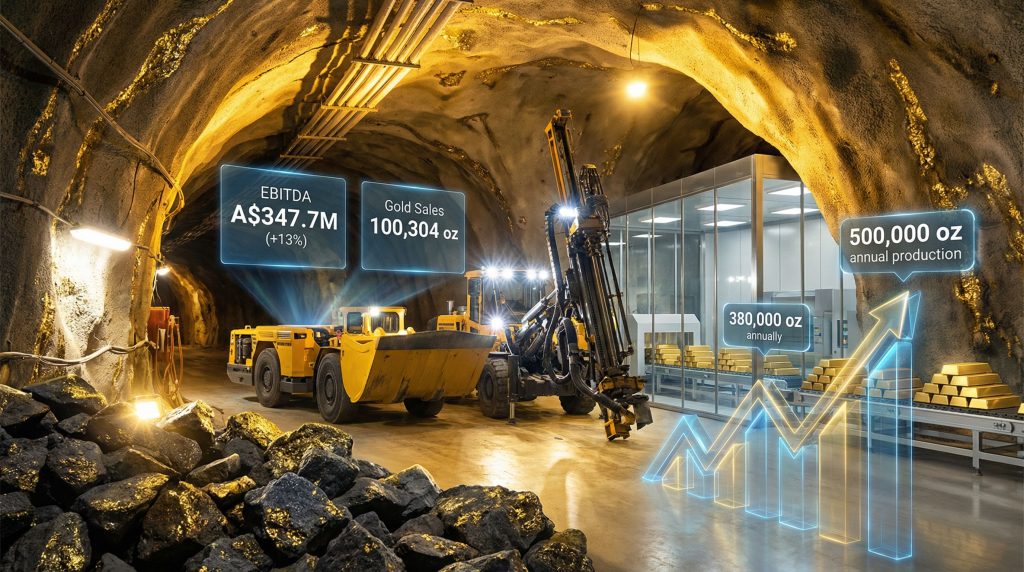
The Never Never ore Ramelius milestone demonstrates how strategic asset integration supports operational continuity. Companies achieving successful transitions typically maintain strong underlying earnings before interest, taxes, depreciation and amortisation (EBITDA) performance while managing development capital requirements. Record half-year EBITDA of A$347.7 million, representing a 13% increase despite transitional production profiles, illustrates effective financial management during growth phases.
Capital allocation efficiency becomes paramount during expansion periods. Companies must balance growth investment requirements with shareholder return expectations while maintaining balance sheet flexibility. The expansion of debt facilities from A$175 million to A$500 million while maintaining undrawn status demonstrates strategic financial positioning for future development requirements.
Strategic Value Creation Through Underground Development
High-Grade Ore Reserve Economics
Underground gold deposits typically contain significantly higher grade concentrations compared to surface operations, fundamentally altering project economics and operational characteristics. Grade differential analysis reveals that underground operations often achieve ore grades 2-4 times higher than equivalent open-pit operations, resulting in superior processing efficiency and reduced transportation costs per ounce of gold production.
Processing efficiency gains from concentrated ore bodies create multiple operational advantages:
• Reduced mill throughput requirements for equivalent gold production
• Lower energy consumption per ounce processed
• Enhanced metallurgical recovery rates from consistent feed characteristics
• Minimised waste rock handling compared to open-pit operations
Transportation cost optimisation through centralised processing becomes increasingly significant as companies develop multiple ore sources. Underground operations typically produce higher-grade ore requiring less material movement, reducing haulage costs and environmental impact compared to surface mining methods.
Mine Life Extension Through Underground Expansion
Resource conversion strategies from exploration to reserves represent critical value creation opportunities for mid-tier producers. Underground development enables access to ore bodies previously considered uneconomic due to stripping ratio limitations in open-pit scenarios. Companies successfully implementing underground expansion strategies often achieve mine life extensions of 5-10 years beyond original surface operation timelines.
Operational synergies between surface and underground operations create infrastructure utilisation advantages. Existing processing facilities, power infrastructure, and workforce capabilities can be leveraged for underground development, reducing capital requirements compared to greenfield project development.
Processing Hub Strategies and Regional Consolidation
Centralised Processing Model Benefits
Modern mid-tier gold producers increasingly adopt processing hub strategies that maximise infrastructure utilisation while providing operational flexibility through multiple ore sources. The Mt Magnet processing hub model demonstrates how centralised facilities can optimise operational efficiency across regional asset portfolios.
Economies of scale in metallurgical operations become apparent when processing facilities handle ore from multiple sources. Furthermore, blending optimisation capabilities enable consistent feed grades, improving metallurgical recovery rates and reducing processing variability. Companies operating centralised processing hubs typically achieve 5-15% lower processing costs per ounce compared to individual mine processing facilities.
Operational flexibility through multiple ore sources provides significant risk mitigation benefits. In addition, processing hubs can maintain production continuity despite individual mine maintenance requirements or operational disruptions. This flexibility becomes particularly valuable during equipment maintenance periods or unexpected operational challenges at individual mining sites.
Infrastructure Investment Return Analysis
Processing capacity expansion investments require careful analysis of return profiles across extended operational timelines. Companies investing in processing hub upgrades typically target internal rates of return exceeding 20% to justify capital deployment in established operations rather than greenfield development opportunities.
Regional consolidation competitive advantages emerge when companies control processing infrastructure within specific geographic regions. This positioning creates barriers to entry for competitors while providing acquisition opportunities for adjacent ore sources that lack processing capabilities.
Financial Performance Analysis During Growth Execution
Key Performance Metrics Analysis
| Financial Metric | H1 FY26 Performance | Strategic Significance |
|---|---|---|
| EBITDA | A$347.7M (+13%) | Strong operational cash generation |
| Gold Sales | 100,304 oz (-30%) | Transitional production profile |
| AISC | A$1,901/oz (+12%) | Cost management during expansion |
| Dividend | 3.0c/share | Capital return commitment maintenance |
The 30% decline in gold sales to 100,304 ounces reflects strategic asset portfolio optimisation rather than operational difficulties. Companies placing non-core assets into care and maintenance demonstrate disciplined capital allocation while focusing resources on higher-return development opportunities.
All-in sustaining cost increases to A$1,901 per ounce represent typical patterns during transitional periods when companies balance current production optimisation with future growth preparation. Cost management effectiveness becomes evident through maintained EBITDA growth despite production volume declines.
Balance Sheet Strength Indicators
Financial flexibility becomes crucial during growth phases when companies must balance development capital requirements with operational cash flow generation. The expansion of debt facilities to A$500 million while maintaining undrawn status demonstrates strategic positioning for future growth opportunities without immediate financial pressure.
Hedge position reduction strategies reflect management confidence in future gold price forecast environments while increasing company exposure to commodity price movements. The closure of forward contracts at A$28.4 million cost represents strategic repositioning for enhanced gold price exposure from March 2026 onward.
Dividend policy maintenance during growth phases signals management commitment to shareholder returns despite capital allocation toward development projects. The fully franked interim dividend of 3.0 cents per share exceeds minimum commitments while demonstrating financial stability during transitional periods.
Acquisition Integration and Operational Synergies
Post-Merger Operational Synergy Realisation
Successful mining company combinations require efficient integration timelines to realise projected synergies while maintaining operational continuity. The achievement of first ore delivery within 202 days of company combination demonstrates exceptional integration execution and operational coordination capabilities.
Asset portfolio optimisation strategies following acquisitions enable companies to focus resources on highest-return opportunities while placing non-core assets into care and maintenance. This disciplined approach maximises value creation from combined asset portfolios while reducing operational complexity.
Workforce integration challenges require careful management to maintain operational efficiency during transition periods. Companies achieving successful integrations typically implement structured communication protocols and retained key personnel from both organisations to ensure operational continuity.
Strategic Asset Rationalisation Decisions
The placement of Edna May into care and maintenance illustrates strategic asset portfolio management that prioritises capital allocation toward higher-return opportunities. Companies successfully executing portfolio optimisation typically achieve 15-25% improvements in return on invested capital through focused resource deployment.
Resource allocation prioritisation frameworks enable management teams to evaluate competing investment opportunities across multiple development projects. Successful mid-tier producers implement systematic evaluation criteria that consider project economics, technical risk, and strategic fit within overall company objectives.
The next major ASX story will hit our subscribers first
Production Scaling Pathways and Growth Trajectories
Staged Production Increase Strategy
Production Scaling Timeline:
- Current State: Transitional production following portfolio optimisation
- Phase 1 (2026): Underground mine development and ore delivery achievement
- Phase 2 (FY27-30): Processing hub optimisation targeting 380,000 oz annually
- Phase 3 (FY30+): Integrated operations achieving 500,000 oz annual production
Strategic production scaling requires careful coordination between underground development timelines and processing capacity expansion. Companies achieving successful scaling typically implement phased approaches that minimise operational disruption while progressively increasing production capability.
Technical development milestones provide measurable indicators of progress toward production targets. Underground mining methodology implementation requires specialised equipment and workforce capabilities that differentiate successful operators from those experiencing development delays.
Technical Development Milestones
Underground mining methodology implementation involves complex technical considerations including ventilation systems, ground support requirements, and ore haulage logistics. For instance, companies successfully developing underground operations typically achieve production rates of 1,000-3,000 tonnes per day depending on ore body characteristics and mining method selection.
Processing plant upgrade engineering progress becomes critical for accommodating increased ore throughput from underground sources. Upgrade projects targeting capacity increases often require 12-18 month implementation timelines including detailed engineering, equipment procurement, and installation coordination.
Ore reserve conversion and resource expansion activities support long-term production planning by defining mineable reserves and optimising extraction sequences. Successful underground developments typically achieve reserve conversion rates exceeding 70% of indicated resources through detailed mine planning and geotechnical studies.
Gold Price Exposure and Risk Management Strategies
Hedge Position Management Analysis
Strategic hedge position management enables companies to balance price protection with commodity price exposure based on operational requirements and market outlook assessments. The forward contract closure at A$28.4 million cost represents strategic repositioning for increased gold price sensitivity from March 2026.
Risk-reward balance considerations in volatile commodity markets require sophisticated analysis of potential price scenarios and their impact on operational cash flows. Companies reducing hedge positions typically demonstrate confidence in sustained record high gold prices while accepting increased price volatility exposure.
Price volatility management through operational flexibility becomes increasingly important as companies reduce financial hedging positions. Operational flexibility enables production optimisation during favourable price periods while maintaining cost control during price declines.
Currency and Commodity Price Sensitivity
Australian dollar gold price realisation benefits create natural currency hedging for Australian-based operations when gold prices strengthen in USD terms. The 36% increase in realised gold price to A$4,822 per ounce demonstrates how currency movements can enhance operational performance independent of operational improvements.
International market exposure considerations become relevant for companies operating across multiple jurisdictions or selling into international markets. Furthermore, gold market performance analysis reveals how currency exposure management strategies often involve natural hedging through operational cash flows or selective financial hedging instruments.
Investment Implications and Valuation Considerations
Investor Confidence Indicators
Dividend policy maintenance during growth phases provides strong signals regarding management confidence in operational cash flow sustainability. Companies maintaining dividend commitments while investing in growth projects typically demonstrate superior cash flow predictability and operational execution capability.
Capital allocation transparency through detailed project updates and milestone achievement reporting enhances investor confidence in management execution capability. The Never Never ore Ramelius milestone achievement within projected timelines validates management guidance and operational planning effectiveness.
Operational milestone achievement consistency creates predictable patterns that enable investor evaluation of management competency and project execution capability. However, companies achieving milestone targets consistently typically command valuation premiums compared to peers experiencing execution delays.
Comparative Valuation Considerations
Asset quality differentiation factors become increasingly important in competitive mid-tier gold producer markets. High-grade underground deposits typically command valuation premiums due to superior economics and extended mine life potential compared to surface operations.
Growth trajectory sustainability assessment requires analysis of resource pipeline, development capital requirements, and operational cash flow generation capability. Companies demonstrating sustainable growth through internal development and strategic acquisitions typically achieve enterprise value-to-EBITDA multiples 20-30% above industry averages.
Peer group performance benchmarking enables relative valuation assessment across similar-sized gold producers with comparable operational profiles. Gold miners' CEO insights suggest that companies achieving superior operational performance metrics typically outperform peer groups during favourable commodity price cycles while demonstrating greater resilience during price declines.
Strategic Investment Considerations and Future Outlook
Portfolio Optimisation Through Underground Development
The successful development and integration of underground resources represents a critical milestone in mid-tier mining company evolution. The Never Never ore Ramelius milestone exemplifies how strategic asset development can enhance operational flexibility and financial performance metrics.
Consequently, companies implementing gold investment strategies focused on underground resource development often achieve superior returns through concentrated ore processing and enhanced metallurgical recovery rates. This approach particularly benefits companies with existing processing infrastructure capable of handling multiple ore sources.
Market Integration and Operational Excellence
Underground mine development success requires comprehensive understanding of technical, financial, and operational factors that distinguish successful projects from those experiencing delays. The achievement of operational milestones within projected timelines demonstrates management competency while creating value through enhanced production capabilities.
Strategic asset management through portfolio optimisation enables focused capital allocation toward highest-return opportunities. This disciplined approach becomes particularly relevant during periods when companies must balance growth investment requirements with shareholder return commitments.
Frequently Asked Questions: Underground Development Strategic Impact
What makes underground gold deposits strategically significant for mid-tier producers?
Underground gold deposits provide access to high-grade ore reserves that significantly improve project economics compared to surface operations. These deposits typically offer grade advantages of 200-400% compared to open-pit alternatives, resulting in superior cash flow generation and extended mine life potential. The strategic significance emerges from reduced capital requirements per ounce of production capacity and enhanced operational flexibility through consistent ore characteristics.
How does centralised processing improve operational efficiency for regional mining operations?
Centralised processing creates economies of scale through infrastructure utilisation across multiple ore sources while enabling blending optimisation for consistent metallurgical performance. Companies operating processing hubs typically achieve 10-20% lower unit processing costs compared to individual mine processing facilities. The operational flexibility provided by multiple ore sources enables production continuity during maintenance periods and provides acquisition opportunities for additional regional deposits.
What financial metrics indicate successful mid-tier mining growth execution?
Key financial indicators include sustained EBITDA growth during transitional periods, maintained dividend policies despite growth capital requirements, and achievement of operational milestones within projected timelines. Companies demonstrating successful growth execution typically maintain debt facility headroom while achieving milestone targets, indicating effective capital allocation and operational planning. Balance sheet flexibility combined with operational cash flow growth provides the foundation for sustained development activity.
How do acquisition integrations affect production timelines and operational performance?
Successful acquisition integrations demonstrate management execution capability while creating operational synergies through asset portfolio optimisation. The achievement of operational milestones within 6-12 months of combination completion indicates effective integration planning and workforce coordination. Ramelius hauls maiden Never Never ore demonstrates how companies successfully integrating acquisitions typically achieve production synergies within 12-18 months while realising cost savings through operational consolidation and infrastructure utilisation optimisation. Ramelius delivers first Never Never ore showcases the successful integration of underground mining operations with existing processing facilities.
Disclaimer: This analysis contains forward-looking statements and projections that involve inherent risks and uncertainties. Mining operations face technical, environmental, and market risks that may affect actual results. Investors should conduct independent research and consider professional advice before making investment decisions. Past performance does not guarantee future results, and gold prices remain subject to significant volatility.
Looking for the Next Major Discovery Opportunity?
Discovery Alert's proprietary Discovery IQ model delivers real-time notifications on significant ASX mineral discoveries, instantly transforming complex mining announcements into actionable investment insights. Explore how major mineral discoveries have historically delivered exceptional returns and begin your 14-day free trial today to secure your market advantage.