July 30, 2026
The Trade Route That Could Rewrite the Global Financial Order
Few concepts in geopolitics are as misunderstood as the relationship between trade infrastructure and monetary power. Most investors and analysts focus on interest rate cycles, earnings multiples, or commodity demand curves. Yet the most consequential forces reshaping wealth and power in the 21st century are often physical: the roads, railways, and sea crossings that determine whose goods move, whose currency settles transactions, and ultimately whose rules govern commerce.
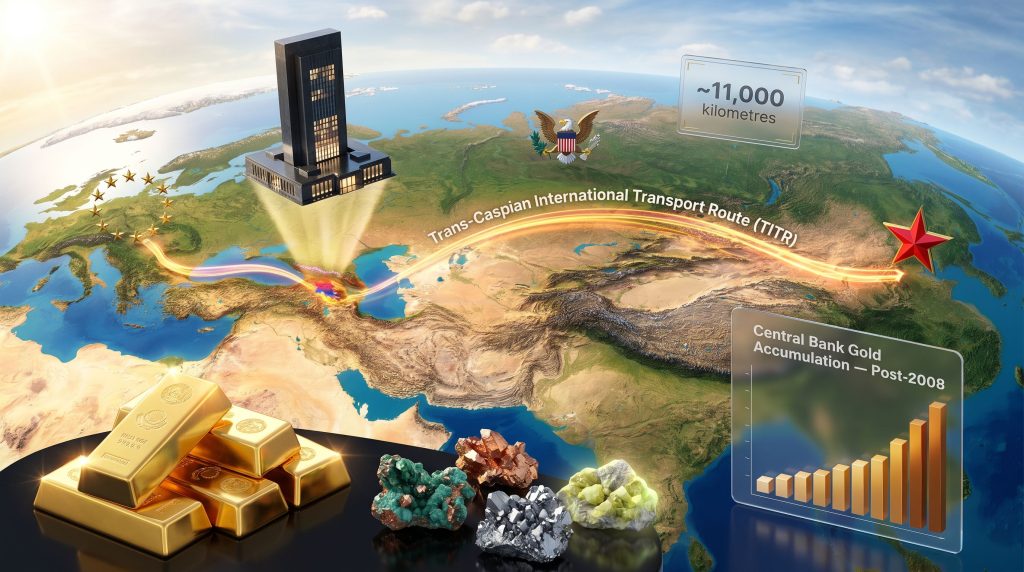
The Middle Corridor, formally designated the Trans-Caspian International Transport Route (TITR), sits at the intersection of all these forces. It is a multimodal freight artery connecting China to Europe via Kazakhstan, the Caspian Sea, Azerbaijan, Georgia, and Turkey. It bypasses both Russia and Iran. Furthermore, it has become the quiet centrepiece of a three-way competition between the United States, the European Union, and China — a contest that most conventional market commentary has completely missed. Understanding middle corridor and Armenia geopolitics is, consequently, essential for any serious investor tracking structural shifts in global trade.
When big ASX news breaks, our subscribers know first
A Geography Shaped by Millennia of Competition
The Caspian Basin's strategic importance did not begin with modern geopolitics. In the 1870s, the Nobel brothers, whose family name would later become synonymous with the Nobel Prize, identified oil reserves near Baku in present-day Azerbaijan. What followed was a three-way contest between European capital, American oil interests led by Rockefeller's Standard Oil, and the Russian state for control of what contemporaries called the "throne of oil."
The Bolshevik Revolution effectively ended that contest. From the early 1920s through the Soviet collapse in 1991, approximately seven decades of Caspian energy resources were locked behind Soviet control, inaccessible to Western capital markets or international trade frameworks. The region was not forgotten — it was simply frozen.
When the Soviet Union dissolved in 1991, those frozen assets became fifteen independent nations overnight. The geopolitical significance of that transformation, moreover, is still playing out today.
The Scale of What Was Unlocked
Assessments of Caspian basin resource endowments vary considerably, but the directional signal is clear. A 1998 US State Department document suggested the region's oil reserves could exceed those of Saudi Arabia — a figure that, if accurate, would represent one of the most consequential underdeveloped energy concentrations on Earth.
Beyond hydrocarbons, the broader corridor region contains substantial reserves of natural gas alongside critical minerals demand including uranium, copper, tungsten, and titanium. These are precisely the materials now central to defence manufacturing, energy transition infrastructure, and advanced electronics. The combination of hydrocarbon wealth and critical mineral endowment within a single contiguous geography makes the corridor uniquely valuable in any credible commodity supercycle scenario.
A 1998 New York Times analysis described the region as one where competing powers would contest trade routes with profound economic and geopolitical consequences. That characterisation has proven remarkably accurate across the three decades since.
How the Nixon Shock Set the Stage for Everything That Followed
Understanding the corridor requires stepping back to 1971, when the United States decoupled the dollar from gold. The structural consequence of that decision was a trajectory toward debt accumulation that, by 2008, had become systemic rather than cyclical. This global monetary shift continues to reverberate through sovereign wealth decisions and trade route competition to this day.
A declassified 1975 exchange between senior US officials contains a striking observation, attributed to the Secretary of State for Economic and Business Affairs, that European nations would be tempted to establish a new gold-based currency bloc, and that their capacity to do so would grow as their oil import deficits shrank. Read in the context of 2025, this note functions less as a historical curiosity and more as a remarkably accurate forecast of European institutional behaviour over the subsequent fifty years.
The sequence that followed is visible in central bank behaviour. From the post-World War II era through approximately 2008, Western central banks were consistent net sellers of gold. Following the Global Financial Crisis — the point at which US debt became structurally embedded rather than cyclically manageable — central banks globally reversed course and became net buyers. Simultaneously, foreign holdings of US Treasury securities peaked around 2008 and have since declined, suggesting a coordinated reassessment of dollar-denominated reserve assets among sovereign wealth managers worldwide.
"The visual representation of this shift is striking: decades of gold sales by central banks, then an abrupt reversal precisely at the moment US debt crossed from manageable to structural. It is difficult to interpret this as coincidence."
The Gold Accumulation Pattern Along the Corridor
One of the less widely discussed dynamics in this space involves identifying which sovereign entities have been accumulating gold most aggressively. The answer points directly at corridor-adjacent nations, and the data on central bank gold reserves underscores just how deliberate this accumulation has been.
The State Oil Fund of Azerbaijan (SOFAZ), distinct from the country's central bank, has reportedly purchased more gold than China over certain recent periods. Kazakhstan, Turkey, and Poland have also ranked among the most active sovereign gold accumulators globally. The geographic overlap between aggressive gold accumulation behaviour and Middle Corridor transit nations is, consequently, not coincidental within this analytical framework.
The EU dimension adds further weight. The Euro area, when member-state reserves are aggregated, holds significantly more gold than the United States. With each new EU accession, that collective position grows. Bulgaria's accession in January 2025 added approximately 43 tonnes to the Euro area's aggregate holdings. Armenia, which has formally applied for EU membership, and potentially Azerbaijan, both represent future accretion events for that collective gold position.
The European Union's Quiet 30-Year Strategy
The EU's involvement in the corridor is not a recent development. In 1993, Brussels established the Transport Corridor Europe-Caucasus-Asia (TRACECA) programme, financed by the EU and designed explicitly to develop a transport corridor through the South Caucasus and Central Asia. Ukraine and Moldova joined this framework by 1996 to 1998, expanding its geographic scope considerably.
This initiative predates China's Belt and Road by roughly two decades. It represents a largely overlooked chapter in EU strategic planning that contextualises much of what has followed.
The 2014 Inflection Point
By 2014, two parallel developments signalled that the EU-China partnership had moved from exploratory to operational. First, freight train volumes between China and Europe increased dramatically, with the first direct cargo service from China reaching Madrid in 2014, described at the time as the world's longest rail link. Second, European financial hubs began processing payments in Chinese renminbi at scale.
The scale of RMB adoption across European financial centres during this period was substantial:
- UK-based RMB transactions grew 123.6% in a single year
- France and Germany recorded comparable growth trajectories
- European payments exchanged directly with China and Hong Kong in RMB increased by approximately 105% from mid-2013
This financial infrastructure buildout ran precisely parallel to the physical trade route development, suggesting coordination rather than coincidence.
The Global Gateway and Critical Minerals
The EU's contemporary Global Gateway initiative explicitly targets Central Asian critical mineral supply chains as a strategic priority, positioning the Middle Corridor as the physical delivery mechanism for resources essential to European industrial decarbonisation. This strategy makes sense only if the corridor becomes operationally functional, which explains the EU's acute interest in corridor-adjacent geopolitics, including Armenian elections. The metals and mining geopolitics of this region are, in other words, inseparable from the corridor's long-term viability.
Comparing the Corridor's Competing Routes
Understanding the Middle Corridor's strategic value requires positioning it against the alternatives currently available for China-Europe freight.
| Route | Key Transit Nations | Bypasses | Primary Risk Factor |
|---|---|---|---|
| Northern Corridor (Trans-Siberian) | Russia | Iran | Sanctions exposure, geopolitical dependency |
| Southern Corridor (Suez/Red Sea) | Egypt, Djibouti | Russia, China overland | Maritime conflict, Houthi disruption |
| Middle Corridor (TITR) | Kazakhstan, Azerbaijan, Georgia | Russia, Iran | Infrastructure gaps, political instability |
| Belt and Road (China-Europe) | Central Asia, Russia | Western oversight | Chinese strategic dependency |
The Middle Corridor's theoretical advantage is clear: it bypasses both sanctioned Russia and Iran while maintaining a land-and-sea routing that avoids Red Sea chokepoints. The practical challenge is equally clear: infrastructure gaps, political dysfunction in Georgia, and unresolved territorial tensions between Armenia and Azerbaijan have prevented the corridor from scaling to commercially meaningful freight volumes.
Armenia: The World's Most Strategically Underestimated Country
Most discussions of global trade routes treat Armenia as a footnote. That assessment is almost certainly wrong. Indeed, middle corridor and Armenia geopolitics cannot be meaningfully separated, as Armenia's geographic position places it at the corridor's most contested junction.
Armenia, a landlocked nation of fewer than 3 million people, hosts what is reported to be the second-largest US embassy in the world by land area. The largest is in Baghdad; the third is in Beijing. The Armenian embassy, built in 2005, is estimated to house between 2,000 and 2,500 American diplomatic personnel. For comparison, the US mission in Russia, before diplomatic expulsions, housed approximately 455 staff.
"The arithmetic is stark: a country with fewer residents than many mid-sized cities hosts roughly five times the US diplomatic presence that Russia, one of the world's major nuclear powers, received before expulsions. This disparity demands explanation beyond routine consular operations."
Armenia occupies a position at the intersection of four competing power spheres simultaneously: Russia as historical security guarantor, the EU as economic integration partner, the United States as diplomatic and infrastructure investor, and Iran as southern border neighbour and trade partner. No other country in the corridor sits at this precise geopolitical crossroads.
The Zangezur Corridor Dispute and Sovereignty
The central tension in Armenian corridor politics involves two competing frameworks for transit access. According to analysts at the Atlantic Council, the corridor's future hinges significantly on how this dispute is resolved:
| Framework | Proposed By | Armenian Position | Key Strategic Concern |
|---|---|---|---|
| Zangezur Corridor | Azerbaijan, backed by Russia and Turkey | Rejected as legally incompatible | Extraterritorial control, potential Iran border severance |
| Crossroads of Peace | Armenia | Supported | Multi-route, full sovereign control |
| TRIPP Agreement | United States | Contested domestically | 99-year US operational rights |
Armenia's "Crossroads of Peace" initiative proposes opening multiple transit routes simultaneously under full Armenian sovereign control — a framework that directly conflicts with Azerbaijan's preferred arrangement and with the US TRIPP framework described below. For further context on the Zangezur corridor dispute, the competing sovereignty claims represent one of the region's most consequential unresolved tensions.
The TRIPP Agreement: What a 99-Year Concession Actually Represents
The Trump Route for International Peace and Prosperity (TRIPP) framework, announced in January 2026 following a peace agreement initialled between Armenia and Azerbaijan in August 2025, grants a US-backed consortium exclusive development and operating rights to the corridor for 99 years. The agreement encompasses physical infrastructure construction, fibre optic cable networks, and broader connectivity development.
Armenian critics have characterised the arrangement as constitutionally incompatible with Armenian sovereignty. A particular concern is that the agreement's routing would effectively sever Armenia's southern border with Iran — a border that functions as a critical economic and security lifeline for the country.
The agreement required a constitutional referendum in Armenia, which in turn required a parliamentary supermajority threshold of over two-thirds. This is where the June 2025 Armenian election became determinative.
The next major ASX story will hit our subscribers first
The June 2025 Armenian Election as Geopolitical Signal
The June 2025 Armenian parliamentary election was monitored by international observers from the European Parliament — an unusual level of scrutiny for a small country's domestic vote. The stakes were not merely domestic.
A supermajority outcome would have enabled a constitutional referendum allowing Armenia to formally accommodate the peace agreement's corridor provisions, effectively advancing the TRIPP framework toward ratification. The incumbent government, characterised as business-friendly and Western-oriented, won the election but fell short of the supermajority threshold required to trigger a constitutional referendum.
The implications of this outcome differed sharply depending on which actor's interests are considered:
| Actor | Preferred Election Outcome | Assessment of Actual Result |
|---|---|---|
| United States | Supermajority enabling TRIPP ratification | Setback: deal cannot proceed to referendum |
| European Union | Incumbent win, EU alignment maintained | Positive: sovereignty preserved, accession path intact |
| Russia | Opposition candidate victory | Negative: pro-Western government retained |
| Iran | Delay to Western corridor integration | Positive: TRIPP timeline disrupted |
| Azerbaijan | Peace deal finalisation pathway | Setback: constitutional mechanism blocked |
Notably, Canadian Prime Minister Mark Carney attended a European Union meeting held in Armenia in early May 2025, making him the first non-European leader to attend such a gathering — adding further signal to the corridor's growing prominence in Western strategic thinking.
Iran's Strategic Position Cannot Be Ignored
Iran signed a cooperation agreement with Central Asian corridor nations in May 2025, with operational changes scheduled for the second half of 2025. Following US military strikes on Iran in February 2026, Tehran responded by blocking food exports to multiple Central Asian countries, demonstrating both the willingness and capacity to weaponise corridor access as economic leverage.
Iran's fundamental opposition to the Middle Corridor's Western-aligned development stems from several compounding concerns:
- Strengthening Azerbaijan's connectivity would amplify separatist sentiment among Iranian Azerbaijanis
- A functional Western corridor bypassing Iran eliminates Tehran's transit monopoly and associated revenue
- Armenian integration into a US or EU-aligned framework would sever Iran's northern connectivity buffer
The Azerbaijan-Israel energy relationship adds another layer. Azerbaijan is Israel's largest single energy supplier. The corridor geopolitics therefore intersect with Middle Eastern energy security in ways that are rarely discussed in mainstream commentary.
The Petrodollar Endgame Scenario
The 1975 archival observation about European gold bloc formation maps with uncomfortable precision onto current conditions. The EU is actively securing Caspian energy access, accumulating gold through member-state expansion, and building trade infrastructure that bypasses dollar-denominated settlement systems.
The logical endpoint of this trajectory, if it proceeds: Europe secures Caspian energy supply via the Middle Corridor, establishes critical mineral supply chains from Central Asia, and maintains its gold accumulation trajectory through continued EU expansion. Under these conditions, the structural rationale for petrodollar dependency diminishes materially. The US dollar's reserve currency status has historically rested on oil being priced and settled in dollars. Remove that dependency, and the architecture changes fundamentally.
A report from the Dubai Commodity Commission described what it termed a "rupture" in global trade patterns — not a cyclical adjustment but a structural reorientation driven by demographic shifts, rising incomes across Africa, Asia, and the Middle East, and the gravitational movement of economic mass away from the North Atlantic. This framing suggests the middle corridor and Armenia geopolitics debate is a symptom of a broader civilisational trade reorientation rather than an isolated infrastructure dispute.
The Monetary Policy Bifurcation
The US executive prohibition on domestic central bank digital currency (CBDC) development, enacted upon the current administration's inauguration, and the parallel development of the Genius Act (stable coin legislation) and Clarity Act (broader crypto framework), represent a deliberate bifurcation from the BIS-coordinated CBDC rollout timeline targeting 2027.
CBDCs and stable coins are distinct instruments. CBDCs are government-backed digital money, while stable coins are backed by underlying assets such as gold or US Treasuries. The US position, prioritising stable coins over CBDCs, reflects a strategic calculation about monetary sovereignty distinct from the approach being advanced through BIS pilot programmes.
The UN-affiliated digital tax framework referenced in monetary policy circles represents a parallel monetary architecture that, if implemented, would extend taxing authority across borders — with significant implications for resource-producing jurisdictions including Canada and Australia. This is not a peripheral concern for resource investors; it is a direct threat to project economics in any jurisdiction where such frameworks gain traction.
Infrastructure Vulnerabilities That Could Derail the Corridor
The Middle Corridor's strategic logic is compelling. Its operational reality, however, is significantly more constrained. Three structural vulnerabilities stand out.
The Georgia Problem
Georgia functions as the corridor's only currently operational European gateway but faces significant political instability and chronic infrastructure underinvestment. Without a scalable Georgian transit node, corridor freight volumes cannot reach commercially meaningful levels regardless of development elsewhere along the route.
The Armenia-Azerbaijan Impasse
The corridor's optimal southern routing requires sustained cooperation between two countries that spent decades in active armed conflict over Nagorno-Karabakh. The peace agreement initialled in August 2025 remains unratified. The "get-along shirt" dynamic — where both nations must cooperate for the corridor to function effectively — remains unresolved. Georgia appears likely to be the next contested election geography in the regional power competition.
Iranian Escalation Risk
Iran has demonstrated willingness to deploy food export restrictions as economic leverage against Central Asian corridor nations. More extreme scenarios include Iranian targeting of Western-affiliated infrastructure. Corridor developers must price this risk into long-term project economics, and investors should factor it into exposure assessments accordingly.
Portfolio Positioning in a Fracturing Trade Order
For investors, the Middle Corridor thesis generates several actionable frameworks, alongside significant risks that require clear-eyed assessment.
Critical Minerals as the Structural Opportunity
Central Asian corridor nations collectively hold significant reserves of uranium, copper, tungsten, and titanium. The EU's Global Gateway strategy and the US TRIPP framework both explicitly target these mineral supply chains, creating a competitive dynamic that could accelerate development timelines. Furthermore, the global supply chain impacts of corridor competition are already reshaping how resource investors assess exposure in this region. The window for early-stage exposure to corridor-adjacent critical mineral assets may, consequently, be narrower than it appears.
Risk Management Frameworks for an Unstable Environment
Several risk dimensions warrant specific attention:
- Soft nationalisation risk: Government equity participation, escalating royalty regimes, and tax structure changes are accelerating across resource jurisdictions. Canada has been specifically flagged by analysts as a jurisdiction where this trend warrants close monitoring.
- Institutional concentration risk: The historical precedent of the 1934 US gold confiscation — where private holdings were compulsorily acquired at below-market prices — is increasingly cited as a template for thinking about digital asset tokenisation and potential future taxation. Spreading assets across multiple institutions and jurisdictions reduces exposure to scenarios where a single institution's data is compromised or a single jurisdiction imposes extraordinary measures.
- Physical precious metals: Given the documented gold accumulation behaviour of corridor-adjacent sovereign wealth funds and the broader monetary system restructuring thesis, physical gold and silver remain among the most direct hedges available to retail investors against monetary realignment.
- Jurisdictional diversification: Maintaining assets across multiple financial institutions, ideally across multiple jurisdictions, reduces exposure to the cyber attack and digital asset confiscation scenarios that monetary analysts are increasingly flagging as plausible rather than remote.
Disclaimer: Nothing in this article constitutes financial advice. The scenarios and frameworks described involve significant uncertainty. Investors should conduct independent due diligence and consult qualified financial advisors before making investment decisions. Forecasts and projections discussed herein are speculative and may not be realised.
The New Great Game: Why Most Investors Are Still Missing It
The competition over the Middle Corridor has been described by analysts at the Hudson Institute as a new great game, echoing the 19th century rivalry between the British and Russian Empires over Central Asian influence. The contemporary contest involves four major actors — Russia, the United States, China, and the EU — competing for influence and resources across a region that most Western investors cannot locate on a map.
Russia's surge in trade with Central Asian corridor nations from 2017 to 2022, documented in European Economic Review analysis, was followed by the 2022 Ukraine invasion. Whether the war in Ukraine is connected to corridor competition is a question that remains open and analytically contested, but the timing and geography are difficult to dismiss entirely.
What is less contested is the observation that geopolitical frameworks built around a simple US-China binary are fundamentally incomplete. The EU has been pursuing a coherent, decades-long strategy to secure energy access, trade route control, and monetary architecture through corridor development and gold accumulation. That strategy has largely operated below the radar of mainstream market commentary.
Understanding middle corridor and Armenia geopolitics is not an exercise in exotic area studies. It is, in fact, a prerequisite for understanding the structural forces that will determine which currencies, which supply chains, and which resource jurisdictions define the next era of global commerce.
Want to Position Yourself Ahead of the Next Major Resource Discovery?
The structural shifts reshaping global trade routes and critical mineral supply chains — from Central Asian uranium and copper to corridor-adjacent commodity plays — are already moving markets, and Discovery Alert's proprietary Discovery IQ model delivers real-time ASX mineral discovery alerts so investors can act on significant opportunities the moment they emerge. Explore historic discoveries and their returns to understand the scale of what early positioning can mean, then begin a 14-day free trial at Discovery Alert to ensure you're never the last to know when the next major find is announced.