August 7, 2026
The Middle East conflict threatens UAE polymer export port operations, creating significant disruptions across global petrochemical supply chains that have developed over decades of specialised regional production. Understanding these complex interdependencies requires examining how regional conflicts cascade through interconnected shipping routes, port facilities, and manufacturing ecosystems. Furthermore, the concentration of polymer production in politically sensitive regions demonstrates how localised events can trigger worldwide market adjustments affecting pricing, logistics, and strategic relationships.
Strategic Importance of Middle Eastern Polymer Production Capacity
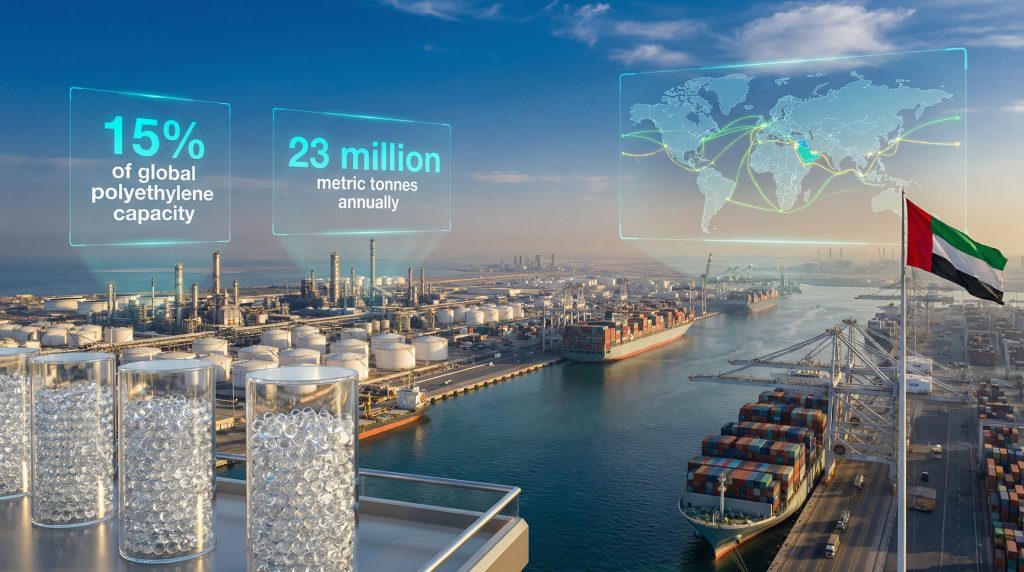
The concentration of polymer manufacturing in the Middle East represents a critical node in global supply chains, with the region controlling substantial portions of worldwide production capacity. Current data indicates Middle Eastern facilities produce over 23 million metric tonnes of polyethylene annually, representing approximately 15% of total global capacity. This production concentration creates both competitive advantages and systemic vulnerabilities.
Saudi Arabia dominates regional polyethylene output with 10.5 million tonnes of annual capacity, including 7.3 million tonnes from the strategically important Jubail petrochemical complex alone. Iran contributes an additional 5 million tonnes to regional capacity, creating a geographic concentration that influences global pricing mechanisms and supply reliability.
For polypropylene production, the Middle East accounts for 10 million tonnes yearly, representing roughly 9% of global manufacturing capacity. Saudi exploration licenses continue to expand regional capacity, while Iranian production contributes 1.2 million tonnes to regional output.
Production Infrastructure Vulnerabilities
The integration of production and export facilities at locations like Jubail demonstrates how operational efficiency creates strategic dependencies. When single facilities handle multiple polymer types while serving as primary export hubs, disruptions can simultaneously affect different product categories and multiple international markets.
Moreover, OPEC market influence on feedstock pricing creates additional vulnerability layers that affect production costs across the entire regional polymer industry.
Key Regional Capacity Distribution:
- Jubail Complex: 7.3 million tonnes polyethylene + 4 million tonnes polypropylene
- Iranian Facilities: 5+ million tonnes polyethylene + 1.2 million tonnes polypropylene
- Secondary Production Sites: Distributed across Kuwait, UAE, and Qatar
Feedstock Security and Competitive Positioning
Middle Eastern polymer producers maintain significant cost advantages through integrated petrochemical complexes that utilise locally sourced crude oil and natural gas feedstocks. This integration allows for optimised production scheduling and reduced transportation costs compared to facilities dependent on imported raw materials.
However, this geographic concentration also means that regional disruptions can simultaneously affect crude oil supply, natural gas availability, and finished polymer production across multiple product lines and export destinations. Additionally, oil price movements directly impact production economics throughout the region.
When big ASX news breaks, our subscribers know first
Port Infrastructure Dependencies in Global Polymer Trade
Maritime shipping bottlenecks represent critical vulnerability points where concentrated infrastructure creates systemic risks for global supply chains. The dominance of specific port facilities in regional export flows demonstrates how geographic advantages can become strategic liabilities during periods of instability.
Jebel Ali port in the UAE handles approximately 65% of Gulf Cooperation Council polymer exports and 33% of total GCC petrochemical exports, according to port operator DP World. This concentration reflects decades of infrastructure investment and logistical optimisation, but also creates single points of failure for substantial portions of global polymer trade.
Regional Port Infrastructure Analysis:
| Port Facility | Export Share | Strategic Advantages | Vulnerability Factors |
|---|---|---|---|
| Jebel Ali (UAE) | 65% of GCC polymer exports | Advanced container handling, Asian route proximity | Single facility concentration |
| Jubail (Saudi Arabia) | Major integrated complex | Production-export integration | Limited alternative capacity |
| Duqm (Oman) | Secondary regional hub | Geographic diversification | Smaller throughput capacity |
| Shuaiba (Kuwait) | Regional alternative | Established infrastructure | Limited expansion potential |
Recent Infrastructure Disruptions
Current events demonstrate how theoretical vulnerabilities can rapidly materialise into operational constraints. Middle East conflict threatens UAE polymer export port operations, validating concerns about correlated infrastructure risks across the Gulf region.
The concentration of polymer exports through Jebel Ali creates immediate logistical challenges when alternative routing becomes necessary. Secondary ports typically operate at higher utilisation rates and lack the specialised handling equipment optimised for large-volume polymer shipments.
Shipping Route Alternatives and Constraints
Alternative routing options face significant practical limitations during periods of primary route disruption. Red Sea routing via Saudi Arabian western ports adds substantial transit time and requires different port infrastructure capabilities. Overland transportation through Turkish networks involves complex customs procedures and increased handling requirements.
Transit Time Comparisons:
- Primary Gulf Routes: Direct shipping to Asian markets (7-10 days)
- Red Sea Alternatives: Additional 200+ nautical miles (12-15 days)
- Overland Turkish Routes: Customs and transloading delays (14-21 days)
Supply Chain Cascade Effects and Market Responses
Regional shipping disruptions trigger complex cascading effects throughout interconnected global supply networks. Understanding these relationships requires examining how initial infrastructure constraints amplify through inventory systems, logistics networks, and pricing mechanisms across multiple industries.
Immediate Logistics Impacts
When primary shipping routes face restrictions, the effects multiply exponentially through interconnected transportation networks:
- Container capacity constraints force cargo onto alternative routes with different scheduling patterns
- Port congestion develops at secondary facilities suddenly handling increased throughput volumes
- Inventory management disruptions affect just-in-time manufacturing systems across multiple industries
- Spot market volatility increases as buyers compete for available supplies through alternative channels
Secondary Market Adjustments
Supply chain professionals typically maintain strategic inventory buffers equivalent to 30-60 days of normal consumption to manage routine variations in shipping schedules. However, regional conflicts can extend disruption periods beyond normal buffer capacity, forcing market participants to access spot markets at premium pricing.
Historical Disruption Patterns:
Regional shipping disruptions typically require 4-8 weeks for alternative routes to fully absorb displaced cargo volumes, depending on existing infrastructure utilisation rates and available expansion capacity.
Price Discovery Mechanisms
Petrochemical futures markets amplify physical supply disruptions through speculative trading activity that anticipates potential shortages. This financial market activity can drive price increases that exceed the actual physical supply constraints, creating feedback loops that influence production planning and inventory decisions across the industry.
Regional conflicts affecting 12-15% of global polymer supply can trigger price responses affecting an additional 20-25% of global trade through supply chain interconnections and market psychology effects. Furthermore, how tariffs impact markets adds another layer of complexity to pricing mechanisms during disruption periods.
Alternative Export Route Analysis and Feasibility
Strategic alternatives for polymer exporters face significant practical constraints during regional disruptions. Understanding the realistic capacity and timeline limitations of alternative routes provides critical context for supply chain risk assessment and contingency planning.
Saudi Western Port Infrastructure
Red Sea routing through Jeddah and Yanbu ports offers geographic diversification but faces substantial capacity constraints. These facilities primarily handle crude oil exports through specialised terminal infrastructure that differs significantly from container and bulk polymer handling requirements.
Current utilisation estimates suggest limited spare capacity for large-volume polymer exports, with infrastructure expansion requiring 18-24 months for meaningful capacity increases. The additional transit distance to Asian markets adds 5-7 days to shipping schedules, impacting just-in-time supply chain relationships.
Omani Port Capabilities
Duqm port represents a strategic alternative with some existing polymer handling infrastructure. However, recent operational disruptions demonstrate that alternative facilities face similar regional risk factors affecting primary export routes.
Alternative Port Capacity Assessment:
| Alternative Route | Current Utilisation | Expansion Potential | Implementation Timeline |
|---|---|---|---|
| Saudi Western Ports | Limited polymer capacity | Significant investment required | 18-24 months |
| Omani Facilities | Moderate utilisation | Infrastructure dependent | 12-18 months |
| Kuwaiti Infrastructure | High baseline utilisation | Limited expansion space | 24-36 months |
Overland Transportation Networks
Turkish overland routes through European networks offer complete geographic diversification but involve substantial cost premiums and extended delivery timelines. Pipeline infrastructure exists for certain petroleum products but lacks capacity for solid polymer transportation.
Road and rail logistics require extensive customs coordination and multiple transloading operations, making these routes economically viable primarily during extended maritime disruptions exceeding several weeks duration.
Temporary Storage and Inventory Strategies
Regional storage facilities provide short-term buffering capacity during shipping route disruptions. However, storage costs and facility availability become constraining factors during extended disruption periods when multiple exporters simultaneously seek temporary inventory solutions.
Strategic storage planning requires coordinating with terminal operators, logistics providers, and end customers to optimise inventory positioning across multiple potential distribution scenarios.
Investment Decision Frameworks Under Geopolitical Uncertainty
Petrochemical investment decisions increasingly incorporate sophisticated risk modelling that accounts for geopolitical scenarios affecting production assets, supply chains, and market access. These frameworks balance cost optimisation against operational resilience across multiple potential disruption scenarios.
Geographic Diversification Strategies
Investment portfolios increasingly emphasise geographic distribution of production assets to minimise exposure to regional political risks. This strategy involves higher capital costs but provides operational flexibility during localised disruptions affecting specific regions or transportation corridors.
Modern investment frameworks typically model multiple scenario pathways:
- Regional conflict duration scenarios (30, 60, 180 days)
- Alternative route activation timelines and associated cost premiums
- Market share impacts from temporary supply disruptions
- Insurance and force majeure cost modelling for different risk levels
Supply Chain Redundancy Planning
Advanced supply chain design incorporates multiple sourcing options and logistics pathways to maintain operational continuity during regional disruptions. This approach typically involves 10-15% higher operational costs during normal periods but provides significant value preservation during disruption events.
Risk Management Best Practices:
- Multiple supplier relationships across different geographic regions
- Flexible logistics contracts allowing rapid route switching within 48-72 hours
- Strategic inventory positioning at multiple distribution points
- Political risk insurance covering both physical assets and business interruption
Technology Investment and Operational Flexibility
Investment in logistics technology and supply chain visibility systems enables rapid response to changing operational conditions. Companies maintaining sophisticated tracking and optimisation systems can typically reduce disruption response times from weeks to days compared to organisations relying on manual coordination processes.
Additionally, implementing comprehensive trade war strategies becomes essential for managing multiple geopolitical scenarios simultaneously.
Long-term Market Structure Evolution
Recurring regional disruptions drive fundamental changes in global petrochemical trade patterns and investment priorities. Understanding these structural shifts provides context for strategic planning across production, logistics, and market development activities.
Capacity Investment Patterns
Global capacity investment increasingly emphasises geographic diversification and supply chain resilience over pure cost optimisation. North American shale-based production and Asian capacity expansions provide alternatives to Middle Eastern production, though often at higher production costs.
This diversification trend accelerates during periods of regional instability as buyers prioritise supply security over marginal cost advantages. Long-term contracts increasingly include premium pricing for guaranteed supply availability during disruption periods.
Regional Competitive Dynamics
Middle Eastern polymer exports face intensifying competition from alternative production regions investing in expanded capacity and improved logistics infrastructure. Recent industrial restructuring in markets like South Korea, where government approval of major consolidation efforts addresses prolonged industry losses, demonstrates how global overcapacity pressures affect traditional competitive relationships.
Furthermore, Middle East conflict exporters fear rise in logistics insurance costs, adding another cost component that affects competitive positioning.
Competitive Pressure Sources:
- North American shale-based production offering feedstock cost advantages
- Asian capacity expansions providing regional supply alternatives
- European biochemical initiatives developing renewable feedstock pathways
- Strategic stockpiling programmes by major consuming nations
Market Adaptation Mechanisms
Forward-thinking market participants leverage regional instability as competitive differentiation opportunities through enhanced service offerings emphasising reliability over cost minimisation. This approach involves building excess capacity in politically stable jurisdictions and developing premium logistics services.
Strategic positioning during volatile periods typically involves:
- Excess capacity investment in stable regulatory environments
- Premium service development emphasising supply chain reliability
- Alternative supplier partnerships providing geographic diversification
- Logistics technology advancement enabling rapid route optimisation
The next major ASX story will hit our subscribers first
Risk Assessment and Future Preparedness
Market participants require sophisticated risk assessment frameworks incorporating multiple scenario planning approaches to navigate increasing geopolitical complexity affecting global polymer supply chains. These frameworks must balance probability estimation with impact severity across different disruption scenarios.
Disruption Duration Modelling
Historical analysis suggests regional conflicts affecting major shipping routes typically resolve within specific timeframes, though outlier events can extend significantly beyond normal patterns. Planning frameworks typically model three primary scenarios:
- Short-term disruptions (7-14 days): Inventory buffer management and alternative routing
- Medium-term disruptions (15-60 days): Alternative supplier activation and contract modifications
- Extended disruptions (60+ days): Market structure adjustments and strategic relationship changes
Supply Impact Calculations
Approximately 12-15% of global polymer supply originates from Middle Eastern production facilities, with potential cascading effects on an additional 20-25% through supply chain interconnections and market psychology impacts.
Regional disruptions affecting primary export routes can strand substantial shipping capacity while simultaneously increasing demand for alternative transportation options, creating compound logistics challenges that extend beyond simple route substitution.
Price Response Mechanisms
Historical pricing data indicates that major shipping route disruptions typically drive 15-40% price increases within 2-4 weeks, with volatility persistence extending 3-6 months beyond physical disruption resolution. These price movements reflect both actual supply constraints and speculative market activity anticipating potential shortages.
Market Response Timeline:
- Week 1-2: Initial inventory drawdown and spot market activation
- Week 3-6: Alternative route establishment and premium pricing
- Month 2-4: Market adaptation and contract renegotiation
- Month 4-6: Price normalisation and relationship stabilisation
Strategic Implications for Global Polymer Markets
Regional conflicts highlight fundamental interdependencies within global petrochemical supply networks, where localised disruptions trigger worldwide market adjustments affecting pricing, logistics, and strategic relationships across multiple industry sectors.
The concentration of production capacity and export infrastructure in geopolitically sensitive regions ensures continued market volatility as participants balance cost optimisation against operational resilience requirements. Success in this environment demands sophisticated risk management capabilities, diversified supply strategies, and adaptive operational systems capable of rapid response to changing conditions.
Future market development will likely emphasise supply chain redundancy and geographic diversification, driving investment toward politically stable regions despite potentially higher production costs. This structural evolution reflects learning from repeated disruption events and growing recognition that supply security provides strategic value beyond traditional cost considerations.
Understanding these complex relationships enables more effective strategic planning across production, logistics, and market development activities while providing context for investment decisions in an increasingly interconnected but geopolitically complex global economy. In addition, the Middle East conflict threatens UAE polymer export port operations, necessitating comprehensive contingency planning across all market participants to maintain operational continuity during extended disruption periods.
Ready to Navigate Volatile Commodity Markets?
Discovery Alert's proprietary Discovery IQ model provides real-time insights into mineral discoveries and market disruptions, helping investors identify opportunities in commodity-sensitive sectors including petrochemicals and materials. Start your 14-day free trial today at Discovery Alert and gain the market intelligence needed to make informed decisions during periods of supply chain uncertainty.