June 16, 2026
The Anatomy of an Energy Market Recovery: Why Reopening a Strait Is Not the Same as Restoring a Supply Chain
Energy markets have a well-documented tendency to price geopolitical resolution faster than physical infrastructure can deliver it. When shipping lanes reopen after conflict, when sanctions are lifted, or when production embargoes formally end, traders often respond as though supply will normalise within days. History consistently tells a different story. The mechanics of upstream oil production, downstream refining, and liquefied natural gas liquefaction operate on timelines that diplomacy cannot compress. Understanding the gap between a geopolitical agreement and genuine energy market normalisation is essential for investors, policymakers, and commodity traders trying to model what the Middle East oil and gas output recovery after the Strait of Hormuz reopening actually looks like in practice.
The Strait of Hormuz is the world's most consequential energy chokepoint. Approximately 20 million barrels per day of petroleum liquids transited the waterway as of 2024, representing roughly 20% of global petroleum consumption. Beyond crude oil, the strait also handles approximately one-fifth of all global LNG trade. When this passage is functionally closed, the consequences radiate across every major energy-consuming economy on the planet. The question that now confronts markets is not whether the strait will reopen, but how long the structural damage to Gulf energy production will take to unwind.
When big ASX news breaks, our subscribers know first
How Large Was the Supply Disruption? Understanding the Numbers
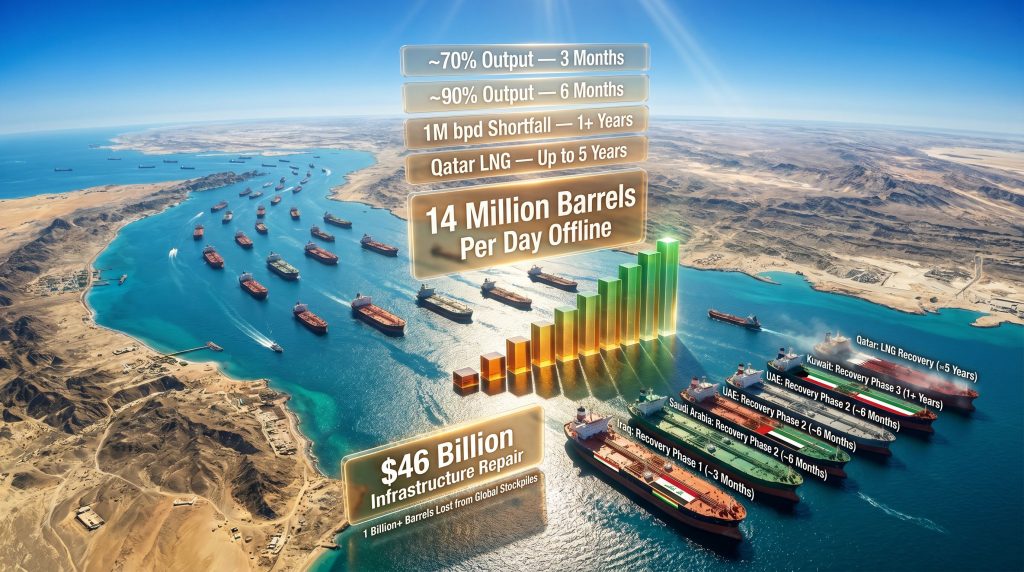
The scale of the production shutdown across the Gulf Cooperation Council was extraordinary by any historical measure. According to the International Energy Agency's most recent assessment, more than 14 million barrels per day of crude oil output was taken offline across the region, representing approximately 14% of total global demand. The affected producers include Iraq, Kuwait, Saudi Arabia, and the United Arab Emirates, representing a simultaneous multi-sovereign upstream shutdown with no direct precedent in the modern era of global oil markets.
The downstream consequences of that volume loss have been severe. Global oil stockpiles are estimated to have contracted by more than 1 billion barrels since the onset of the conflict, a drawdown that carries a market value in excess of $83 billion at prevailing prices. Data from the U.S. Energy Information Administration indicates that stockpiles in major consuming economies are now tracking toward their lowest levels since at least 2003, with the pace of depletion described as occurring at a record rate.
The inventory hole created by this disruption is so large that it cannot be filled simply by turning production back on. Markets face a structural rebalancing challenge that will play out across months and years, not days.
This inventory deficit functions as a persistent drag on price normalisation even after physical supply returns. The distinction between supply resumption and market rebalancing is critical and frequently misunderstood by participants reacting to headline diplomatic developments. Furthermore, understanding oil price volatility trends in this context helps investors appreciate why headline announcements rarely translate to immediate price stability.
Crude Oil Recovery: A Four-Phase Framework
Phase One: Precautionary Shutdowns Restart Within Days
Not all production shutdowns are equal. A meaningful portion of the lost output was idled as a precautionary measure rather than as a consequence of physical infrastructure damage. Fields in this category, particularly certain Iraqi southern oil assets, are operationally capable of resuming production within fewer than seven days of a formal restart decision, according to officials familiar with the matter. The prerequisites are largely logistical: operator authorisation, port and pipeline clearance, and the repositioning of tanker vessels that dispersed from the region during active conflict.
Phase Two: Controlled Ramp-Up to 70% Within Three Months
Industry analysis from Wood Mackenzie projects that a controlled, sequenced ramp-up across affected fields could restore approximately 70% of pre-disruption production within a three-month window from the point of a restart decision. The emphasis on a measured rather than aggressive restart reflects operational discipline specific to upstream petroleum management.
Simultaneously restarting multiple large-scale fields carries real engineering risks. Operators must manage reservoir pressure differentials, recertify surface equipment that has been idle under potentially adverse conditions, and sequence well interventions to avoid irreversible formation damage. A rushed restart that compromises reservoir integrity could permanently impair recoverable reserves, an outcome that would be far more damaging than a phased ramp-up.
An often-overlooked parallel constraint is the tanker fleet itself. Vessels that relocated away from Gulf waters during the conflict must physically reposition before normal loading cycles can resume at Arabian Gulf terminals. This fleet repositioning adds weeks to the effective supply normalisation timeline independent of what happens upstream. OPEC's market influence over production decisions will, consequently, remain a critical variable throughout this ramp-up period.
Phase Three: Approaching 90% Recovery Within Six Months
Further progress toward approximately 90% of prior production capacity is projected within a six-month horizon under a controlled restart scenario. The constraints at this stage shift from precautionary logistics to genuine infrastructure rehabilitation. Damaged wellheads, gathering systems, and export terminals require physical repair work, workforce redeployment, and equipment procurement cycles that cannot be accelerated through diplomatic agreements.
Phase Four: The Final 1 Million bpd Is a Multi-Year Problem
The last tranche of production recovery, estimated at approximately 1 million barrels per day, represents the most structurally complex challenge and is projected to require considerably longer than six months. This segment encompasses heavily damaged infrastructure where specialist repair requirements, extended procurement lead times for bespoke equipment, and capital allocation decisions by sovereign producers will all govern the pace of restoration. Wood Mackenzie analysts have explicitly flagged this final tranche as operating on a timeline that extends well beyond the six-month horizon applicable to the bulk of recovery.
| Recovery Phase | Estimated Timeline | Production Recovery Level |
|---|---|---|
| Precautionary shutdowns restart | Days to 1 week | Variable by field |
| Controlled ramp-up across affected fields | Up to 3 months | ~70% of prior output |
| Extended ramp with infrastructure repair | 3 to 6 months | ~90% of prior output |
| Full restoration including damaged assets | 1+ years | ~100% (aspirational) |
Why Refinery Recovery Is a Separate and More Complex Problem
The Downstream Shutdown: Scale and Categories
Upstream production is only part of the equation. As of early May, approximately 3.52 million barrels per day of regional refining capacity was offline, representing roughly 3.5% of global refining throughput, according to industry monitor IIR. Critically, affected facilities fall into two distinct categories that carry very different recovery timelines:
- Precautionary shutdowns: Plants idled without physical damage, capable of a restart cycle measured in approximately two weeks once the decision to resume is made.
- Physically damaged facilities: Sites that sustained structural or process equipment damage requiring extended repair, procurement, and recommissioning cycles.
Research from Vitol Bahrain suggests Gulf refining capacity as a whole could return to approximately 90% to 95% of operational throughput within a 40 to 60-day window for facilities that fall primarily into the precautionary shutdown category. However, this aggregate figure masks significant dispersion at the individual plant level. According to reporting on Gulf oil recovery, the rebound trajectory is likely to be uneven across different producing nations.
The $46 Billion Repair Bill
Rystad Energy estimates that total Middle East energy infrastructure repair expenditure will average approximately $46 billion, with refining and petrochemical assets accounting for the dominant share due to the operational complexity of process equipment and the extent of structural damage sustained. This figure represents one of the most significant regional infrastructure repair programmes in energy market history and carries important implications beyond oil price dynamics.
Investor Note: The $46 billion repair requirement creates a substantial near-term capital deployment opportunity for engineering, procurement, and construction contractors, specialist process equipment manufacturers, and project finance providers with established Gulf region relationships.
LNG Recovery: The Most Technically Constrained Restart of All
Why LNG Trains Cannot Simply Be Switched Back On
Liquefied natural gas production operates under physical constraints that have no direct parallel in crude oil restart dynamics. LNG liquefaction works by reducing gas temperature to approximately minus 162 degrees Celsius, transforming it into a liquid state that occupies roughly 1/600th of its gaseous volume for transport purposes. The cooldown phase of this process is the most operationally sensitive step: it must proceed slowly and deliberately to prevent thermal shock to cryogenic infrastructure, particularly the aluminium brazed heat exchangers and cold boxes at the core of each processing train.
A critical and frequently overlooked operational reality is that LNG production trains cannot be restarted simultaneously. Each train must be brought back online in a deliberate sequence, with the cooldown process for each taking approximately two weeks under ideal conditions. The total restart timeline for a multi-train facility therefore compounds across trains, meaning large-scale LNG plants require substantially more time to return to full capacity than the individual train cooldown duration might suggest.
Qatar's Structural Impairment: A Five-Year Recovery Horizon
Qatar's position represents the most severe long-term supply impairment in the regional recovery picture. QatarEnergy maintained three LNG processing trains in operation throughout the conflict period to continue supplying Kuwait and Bahrain with domestic energy requirements. However, its broader LNG export infrastructure sustained significant damage, with QatarEnergy's leadership acknowledging the loss of approximately 17% of Qatar's total LNG capacity for a period projected to extend up to five years.
This single data point fundamentally reshapes near-term global LNG supply forecasts. Qatar is the world's largest LNG exporter, and a five-year partial capacity impairment of this scale will create structural tightness in global markets that cannot be offset by other producing nations in the short to medium term. The broader LNG supply outlook for 2025 and beyond must therefore account for this sustained Qatari shortfall as a baseline assumption. European buyers who redirected procurement toward Qatari volumes following the Russia-Ukraine supply disruption now face a compounding supply availability challenge.
Country-by-Country Recovery Outlook
| Country | Upstream Recovery Speed | Key Constraint | Estimated Full Recovery |
|---|---|---|---|
| Iraq | Fastest (days to 1 week) | Tanker repositioning | 3 to 6 months |
| Saudi Arabia | Moderate | Volume scale, refinery repairs | 6 to 12+ months |
| UAE | Moderate | Downstream asset complexity | 6 to 12+ months |
| Kuwait | Moderate | Upstream field ramp-up | 3 to 6 months |
| Qatar (LNG) | Slowest | Structural capacity damage | Up to 5 years |
Saudi Arabia and the UAE maintain pipeline bypass infrastructure capable of routing approximately 2.6 million barrels per day around the Strait of Hormuz. While this provides meaningful near-term export optionality, it represents only a fraction of the total disrupted volume and cannot substitute for full strait transit capacity.
The next major ASX story will hit our subscribers first
The Inventory Rebuild Challenge and the Multi-Year Market Hangover
Paul Gooden, head of natural resources at investment manager Ninety One, has articulated the structural challenge clearly: normalising flows will take several months, and the estimated contraction of global oil inventories by more than 1 billion barrels since the conflict began cannot be unwound rapidly. His analysis further indicates that the Middle East oil and gas output recovery after the Strait of Hormuz reopening will impose a multi-year market hangover as sovereign governments undertake coordinated inventory rebuilding programmes to insulate themselves against future geopolitical supply shocks.
This observation captures a dynamic that markets frequently underweight. The demand for oil to refill strategic reserves competes directly with consumption demand in the near term, creating a structural price floor that persists even as Gulf supply volumes return. Governments that experienced the severity of this disruption will face domestic political pressure to expand strategic reserve capacity, extending the inventory rebuilding demand profile well beyond what standard supply-demand models would project.
Additionally, the 60-day ceasefire framework creates a negotiating window for potential Iranian sanctions relief. The evolving relationship between sanctions and oil trade globally provides a useful parallel for understanding how quickly — or slowly — Iranian volumes might realistically re-enter markets. Furthermore, the pace and scope of any sanctions adjustment will determine how these additional volumes interact with the Gulf producer recovery timeline, adding another layer of complexity to the oil market disruption analysis already confronting commodity strategists. However, analysts caution that sanctions negotiations rarely proceed on a predictable schedule. The IEA has also warned that Hormuz export recovery will take months, reinforcing the view that diplomatic agreements and physical market normalisation operate on fundamentally different timescales.
Frequently Asked Questions
How much oil was taken offline during the Strait of Hormuz closure?
More than 14 million barrels per day across Iraq, Kuwait, Saudi Arabia, and the UAE, representing approximately 14% of global demand.
How long will the Middle East oil and gas output recovery after the Strait of Hormuz reopening take?
Recovery will be staggered. Approximately 70% of affected production could return within three months, rising to around 90% within six months. The final tranche, including damaged assets, will take considerably longer. Qatar's LNG capacity impairment extends the full recovery horizon to potentially five years for that specific asset class.
Why can LNG trains not restart simultaneously?
Thermal shock risk to cryogenic infrastructure during the cooldown phase requires each train to be sequenced individually, with each cooldown taking approximately two weeks under optimal conditions.
What is the total estimated cost of regional infrastructure repairs?
Rystad Energy estimates approximately $46 billion, with refining and petrochemical facilities representing the largest share.
Will oil prices fall sharply once the Strait reopens?
Physical supply recovery is a multi-phase process spanning months to years. The inventory deficit of over 1 billion barrels acts as a structural price support mechanism that will limit the pace and depth of any sustained price decline regardless of near-term diplomatic developments. In addition, analysis from oilprice.com suggests Middle East output could take up to two years to recover fully, further underpinning this view.
Disclaimer: This article contains forward-looking projections, recovery timeline estimates, and financial analysis drawn from third-party industry sources including Wood Mackenzie, Rystad Energy, Vitol Bahrain, the U.S. Energy Information Administration, and Ninety One. These projections involve inherent uncertainty and should not be construed as investment advice. Actual recovery timelines and market outcomes may differ materially from the scenarios described.
Want to Position Yourself Ahead of the Next Major Commodity Discovery?
While energy markets navigate the prolonged recovery from Strait of Hormuz disruptions, Discovery Alert's proprietary Discovery IQ model scans ASX announcements in real time, instantly identifying significant mineral discoveries across more than 30 commodities and turning complex data into actionable investment insights — explore historic discoveries and their returns to understand the opportunity, then begin your 14-day free trial at Discovery Alert to secure a market-leading edge before the broader market moves.