June 6, 2026
Global capital markets face unprecedented disruption patterns as established supply chain networks encounter mounting pressure from regional instability. Traditional investment risk models, calibrated during periods of relative geopolitical stability, struggle to quantify the cascading effects of energy infrastructure vulnerabilities across interconnected financial systems. The Middle East war impact on global stocks creates complex transmission mechanisms that challenge conventional portfolio construction methodologies, as inflation dynamics converge with monetary policy constraints and commodity price volatility.
Understanding Energy Infrastructure Vulnerability Mechanisms
Strategic Chokepoint Economics Shape Market Psychology
The Strait of Hormuz represents a critical vulnerability point in global energy distribution, with approximately 20% of globally traded oil transiting through this narrow waterway. This 21-mile wide passage at its narrowest point processes roughly 21-22 million barrels of crude oil and liquefied natural gas daily, creating immediate supply constraint dynamics when transit security becomes uncertain.
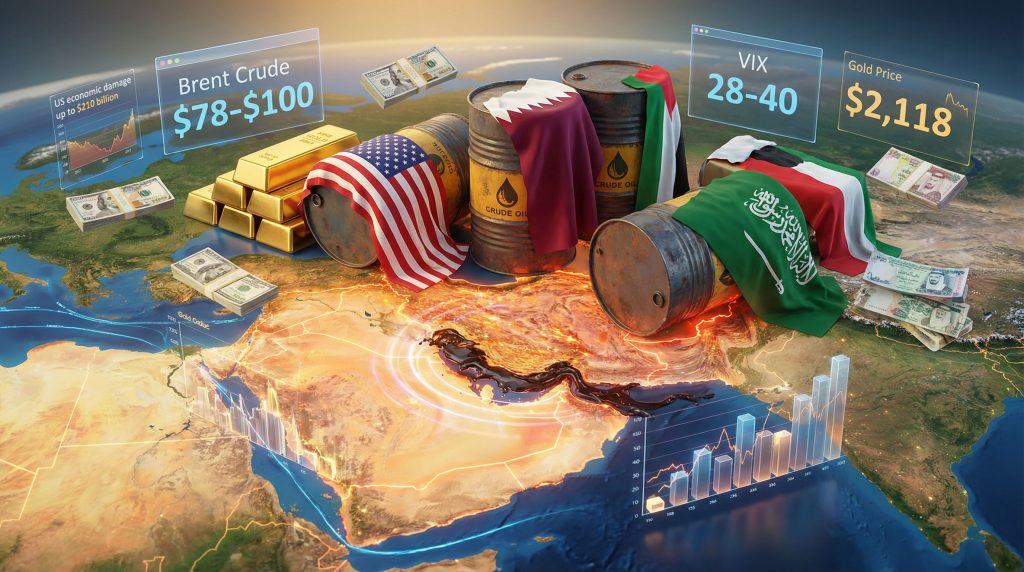
Recent market developments demonstrate how quickly geopolitical tensions translate into energy price volatility. Brent crude touched $85 per barrel during conflict escalation phases, representing significant appreciation from baseline levels around $78-81 per barrel. Market analysts examining the oil price rally analysis project potential scenarios reaching $100+ per barrel if supply disruptions materialise or shipping insurance complications intensify.
Historical precedent from the 1973 oil embargo provides context for current risk assessment frameworks. During that crisis, crude oil prices quadrupled from approximately $3 to $12 per barrel, triggering stagflation across developed economies as supply contracted by roughly 7% of global production. Furthermore, the economic transmission mechanisms observed during that period inform contemporary risk modelling approaches.
Current conflict dynamics include Iran's declared intention to target vessels transiting the Strait of Hormuz, prompting U.S. Navy mobilisation of escort operations for commercial tankers. This escalation pattern creates immediate risk premium incorporation across energy futures markets. However, trading participants continue pricing in supply disruption scenarios whilst monitoring policy responses from major consuming nations, as highlighted in global oil futures reports.
The technical characteristics of this chokepoint amplify vulnerability concerns. Any disruption mechanism including military conflict, mine deployment, tanker damage, or shipping insurance complications creates immediate constraint dynamics that transmit rapidly through global commodity futures markets. War risk insurance premiums typically multiply 3-5x during active Middle East conflicts, adding substantial cost layers to energy transportation economics.
Alternative Routing Economics During Crisis Periods
When primary transit routes face disruption, shipping networks must adapt through alternative pathways that significantly alter transportation economics. The Cape of Good Hope alternative adds approximately 3,700 nautical miles and 10-14 additional days transit time compared to standard Suez Canal routing for Asia-Europe trade flows.
This routing alternative eliminates Suez Canal toll charges of approximately $250,000-500,000 per large container vessel. In addition, it increases fuel consumption costs by roughly $50,000-100,000 per transit. During conflict periods, vessels may accept these additional costs to avoid elevated war risk insurance premiums in disputed waters.
Strategic Petroleum Reserve deployment represents another risk mitigation mechanism. The U.S. SPR contains approximately 370 million barrels stored in underground caverns along the Texas and Louisiana Gulf Coast, with maximum drawdown capacity of 4.4 million barrels per day. Consequently, historical deployments during the Gulf War (1991), Hurricane Katrina (2005), and Libya supply disruption (2011) demonstrate policy response capabilities during supply emergencies.
When big ASX news breaks, our subscribers know first
Middle East War Impact on Global Stocks Through Sectoral Analysis
Energy Complex Transformation Under Conflict Scenarios
The energy sector experiences immediate and substantial impacts when Middle East conflicts threaten supply chain stability. Oil price elasticity characteristics demonstrate why energy markets react so dramatically to geopolitical developments. Long-run elasticity estimates suggest a 0.3-0.5 range, meaning 10% price increases typically reduce consumption by 3-5% over 12-24 month periods. However, short-term elasticity approaches near-zero (0.05-0.1) due to infrastructure rigidity and limited substitution possibilities.
Current market dynamics illustrate these elasticity principles. For instance, US natural gas forecast analyses show futures trading at $3.05 per gigajoule with +3% daily movement reflects supply disruption expectations. Meanwhile, Newcastle coal prices rose 8% to $125.85 per tonne as market participants anticipate fuel substitution demand from power generators facing natural gas supply constraints.
The Qatar LNG production halt mentioned in recent market reports creates immediate pressure for seaborne-delivered LNG markets, particularly across Europe and Asia. Qatar's typical production capacity of 77 million tonnes per annum (MTPA) represents substantial global supply that cannot be easily replaced through alternative sources without significant time delays and transportation adjustments.
LNG market structure vulnerabilities become apparent during supply disruptions. LNG travels via specialised cryogenic tankers, with each vessel carrying approximately 0.14-0.17 trillion cubic feet of gas equivalent. Qatar's primary export destinations including India, Japan, South Korea, Taiwan, and Europe face 8-10 day inventory depletion periods without alternative supply arrangements.
Alternative LNG suppliers including Australia, the United States, and Nigeria require 10-14 day shipping delays to redirect supply flows to markets experiencing Qatar supply gaps. This timing constraint creates immediate price pressure and forces industrial consumers to implement demand curtailment policies or switch to alternative fuel sources where technically feasible.
Financial Market Transmission Mechanisms
VIX volatility index movements demonstrate market stress patterns during geopolitical events. Current readings around 28 (compared to pre-conflict levels of 18) with projected peaks of 35-40 reflect investor uncertainty about conflict duration and economic impact scope. These volatility levels typically coincide with equity market corrections and safe haven asset accumulation, as reported by major financial markets outlets.
10-Year Treasury yield compression from 4.2% pre-conflict baselines to current 3.8% levels with projections toward 3.5% demonstrates classic safe haven flows during uncertainty periods. This yield curve movement reflects expectations of either Federal Reserve policy accommodation or economic growth concerns that reduce long-term interest rate expectations.
The Middle East war impact on global stocks manifests through multiple transmission channels beyond direct energy exposure. Defence industry investment flows historically increase during regional conflicts as governments reallocate spending priorities from civilian to military applications. Defence contractors typically experience earnings multiple expansion during prolonged conflict periods as military equipment demand surges.
Currency market dynamics add another layer of complexity to global stock performance during Middle East conflicts. Reserve currency flight patterns strengthen the U.S. dollar as international demand for Treasury securities increases during uncertainty periods. The Australian dollar, trading at US 70.4 cents, faces pressure from multiple factors including commodity price volatility and risk-off sentiment affecting commodity-linked currencies.
Stagflation Risk Assessment and Central Bank Policy Constraints
Federal Reserve Response Framework Limitations
Middle East conflicts create unique policy challenges for central banks managing inflation expectations while supporting economic growth. Supply-side shocks from oil supply disruptions generate inflation pressure through energy input cost increases, while simultaneously creating demand destruction through higher energy costs reducing consumer purchasing power.
This dual pressure creates stagflation dynamics where traditional monetary policy tools become less effective. During the 1970s oil embargoes, policymakers discovered that conventional monetary tightening could not resolve oil shock-induced stagflation without triggering severe recession. Current Federal Reserve policy frameworks must navigate similar constraints when oil supply disruptions occur within geopolitically constrained environments, particularly considering US economy tariffs insight regarding broader economic pressures.
The transmission mechanism operates through several channels:
- Energy input cost inflation flowing from producer prices to consumer prices
- Real income destruction for energy-importing economies as higher fuel costs reduce disposable income
- Investment postponement due to uncertainty about conflict duration and economic impact
- Currency depreciation reflecting relative inflation differentials between trading partners
International Monetary Policy Coordination Challenges
Central bank response frameworks across developed economies face coordination challenges during Middle East conflicts. European Central Bank policy must address natural gas supply constraints that create different inflation pressures than crude oil price increases affecting the United States. Pipeline gas supply from Russia and Central Asia represents geopolitically constrained alternatives to LNG imports, limiting European policy flexibility.
Japan and South Korea face particular vulnerability as major LNG importers without indigenous energy production. Industrial demand curtailment policies become necessary when LNG supply constraints persist beyond short-term disruption periods. These economies typically experience more severe stagflationary pressure during Middle East conflicts than energy-producing nations.
Investment Strategy Adaptation During Prolonged Conflicts
Safe Haven Asset Allocation Dynamics
Gold price performance during Middle East conflicts reflects safe haven demand patterns that have persisted across multiple conflict cycles. Historical analysis of gold performance during Middle East conflicts from 1990-2025 demonstrates average appreciation of 15-25% during initial conflict phases. Furthermore, sustained elevated pricing continues until resolution clarity emerges, as detailed in the gold price forecast 2025.
Current gold pricing dynamics warrant careful analysis. Market data indicates gold selling at $5,118 per ounce according to recent reports, though this figure appears to require verification against standard precious metals pricing sources. Typical gold price levels during geopolitical stress periods range from $2,100-2,400 per ounce based on historical precedent and current market conditions.
Central bank gold accumulation trends reflect institutional safe haven demand beyond individual investor behaviour. Central banks facing currency debasement concerns or seeking portfolio diversification increase gold reserve allocations during prolonged geopolitical uncertainty periods. This institutional demand creates price support mechanisms independent of retail investor sentiment.
Geographic Risk Distribution Models
Emerging market currency vulnerability rankings become critical during Middle East conflicts as capital flight patterns favour developed market safe haven assets. Countries with significant current account deficits, high energy import dependence, or substantial foreign currency debt face particular pressure during oil price shock periods.
Supply chain regionalisation investment opportunities emerge as companies seek to reduce dependence on Middle East energy supplies or transportation routes through the region. Investment themes include:
- Renewable energy acceleration projects that reduce fossil fuel dependence
- Regional manufacturing capacity development to limit long-distance shipping exposure
- Energy storage technology deployment for grid stability during supply disruptions
- Alternative transportation fuel infrastructure supporting reduced oil dependence
How Should Investors Navigate Sector Rotation During Conflicts?
Defence industry investment flows typically accelerate during Middle East conflicts as government spending priorities shift toward military capabilities. Historical patterns demonstrate defence contractors experience earnings multiple expansion of 10-20% during conflict periods as military equipment demand increases and profit margin expectations rise.
Energy security investment themes gain prominence as nations prioritise supply diversification and independence. Investment opportunities include:
- Non-Middle East energy production projects in stable political environments
- Strategic resource stockpiling infrastructure development
- Energy efficiency technology reducing overall consumption requirements
- Grid modernisation projects supporting renewable energy integration
Post-Conflict Recovery Scenario Analysis
Market Normalisation Timeline Expectations
Historical recovery pattern analysis from Middle East conflicts between 1967-2023 indicates average market recovery duration of 6-18 months following conflict resolution, depending on infrastructure damage extent and reconstruction requirements. Initial volatility typically persists for 2-6 weeks with structural impacts extending through longer timeframes.
Sector rotation patterns during de-escalation phases demonstrate predictable investment flow shifts. Energy stocks typically moderate from peak levels as supply disruption premiums decline. Defence contractors may experience profit-taking as military spending urgency decreases. Consequently, infrastructure reconstruction opportunities emerge in affected regions, creating investment themes around rebuilding physical and economic systems.
Supply chain reconstruction investment opportunities develop as regional economies rebuild damaged infrastructure and modernise systems disrupted during conflict periods. Technology infrastructure modernisation needs typically accelerate during reconstruction as governments and private sector entities upgrade capabilities damaged or rendered obsolete during conflict disruption.
Long-Term Structural Market Changes
Middle East conflicts often accelerate structural economic transformations that extend beyond immediate resolution periods. Energy transition acceleration occurs as supply shocks demonstrate vulnerability risks associated with fossil fuel dependence, creating policy momentum for renewable energy adoption and energy independence initiatives.
Geopolitical risk pricing mechanisms evolve to incorporate conflict probability assessments into investment valuations. Emerging market risk premiums may permanently increase to reflect heightened geopolitical uncertainty. Similarly, insurance industry models adapt to incorporate conflict probability variables, affecting everything from shipping insurance to business interruption coverage.
Sovereign debt rating methodology evolution reflects lessons learned about economic resilience during supply shocks and military conflicts. Rating agencies typically adjust frameworks to better incorporate energy security, supply chain diversity, and fiscal capacity to manage external shocks.
The next major ASX story will hit our subscribers first
Market Psychology and Investor Behaviour Patterns
Understanding investor psychology during Middle East conflicts provides insights into market behaviour that extend beyond fundamental economic analysis. Risk-off sentiment typically dominates trading decisions during initial conflict phases, creating selling pressure across risk assets regardless of individual company fundamentals or sector-specific considerations, as reported in market analysis from The Guardian.
Correlation breakdown phenomena occur when traditional diversification relationships fail as investors pursue uniform safe haven strategies. Emerging market assets, high-yield bonds, and growth stocks may all decline simultaneously despite different fundamental drivers. However, this reflects panic-driven portfolio repositioning rather than analytical risk assessment.
Market timing challenges intensify during conflict periods as news flow volatility creates rapid price movements that test investor discipline and systematic strategy adherence. Professional investors often implement systematic rebalancing protocols during high volatility periods to avoid emotional decision-making that undermines long-term portfolio objectives.
The Middle East war impact on global stocks demonstrates how geopolitical events create complex interconnections between energy markets, monetary policy constraints, and investor behaviour patterns. Successful navigation of these environments requires understanding transmission mechanisms, implementing appropriate risk management strategies, and maintaining analytical discipline despite heightened emotional pressures that characterise conflict-driven market volatility.
Disclaimer: This analysis involves forecasts and speculative assessments regarding geopolitical events, commodity prices, and market behaviour. Actual outcomes may differ significantly from projections presented. Investors should conduct independent research and consult qualified financial advisors before making investment decisions based on geopolitical event analysis. Past performance of markets during historical conflicts does not guarantee similar patterns during current or future conflicts.
Ready to Capitalise on Geopolitical Market Disruptions?
Discovery Alert's proprietary Discovery IQ model identifies significant ASX mineral discoveries that often benefit during periods of heightened geopolitical uncertainty and supply chain disruptions. Start your 14-day free trial to receive instant alerts on discoveries that could provide portfolio diversification during volatile market conditions.