August 10, 2026
The Strategic Architecture of Middle Eastern Energy Security
Modern energy warfare has evolved beyond traditional production-focused conflicts into sophisticated infrastructure targeting campaigns. The vulnerability of transportation networks has become the defining characteristic of contemporary energy security transition, where diversified export routes now determine which nations maintain market access during regional conflicts. This transformation reflects a fundamental shift in how energy security is conceptualised and protected.
The recent escalation in Middle Eastern energy conflicts demonstrates how chokepoint control has replaced resource control as the primary weapon of energy warfare. Furthermore, nations with alternative export pathways possess strategic advantages that extend far beyond their production capacity, creating new hierarchies of energy security that reshape global market dynamics.
When big ASX news breaks, our subscribers know first
How Alternative Export Infrastructure Determines Market Winners
The Strait of Hormuz crisis has revealed the critical importance of pipeline infrastructure as strategic assets rather than mere economic conveniences. Countries with diversified export capabilities have demonstrated remarkable resilience compared to those dependent on single maritime routes.
Export Route Vulnerability Analysis:
| Producer | Primary Export Route | Alternative Capacity | Production Impact |
|---|---|---|---|
| Saudi Arabia | Strait of Hormuz | East-West Pipeline (7M bpd) | -25% production |
| UAE | Strait of Hormuz | Habshan-Fujairah (1.8M bpd) | Minimal impact |
| Iraq | Strait of Hormuz | Limited alternatives | -78% production |
| Kuwait | Strait of Hormuz | No major alternatives | -60% production |
| Bahrain | Strait of Hormuz | No alternatives | 100% suspension |
The dramatic production cuts experienced by Iraq, Kuwait, and Bahrain underscore how export route dependency creates existential vulnerabilities for petrostate economies. Moreover, Saudi Arabia's relatively modest 25% production reduction compared to Iraq's 78% cut illustrates the strategic value of the kingdom's East-West pipeline system.
The East-West Pipeline's Strategic Significance
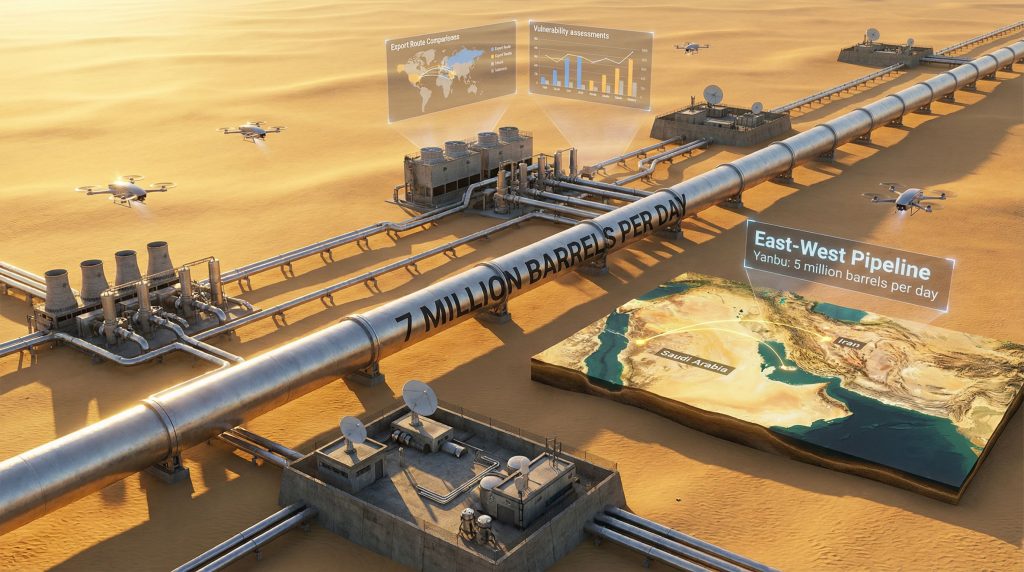
Saudi Arabia's East-West pipeline, constructed during the 1980s Iran-Iraq War, exemplifies strategic foresight in energy infrastructure planning. The system's 7 million barrels per day capacity has enabled the kingdom to redirect crude flows from eastern production centres to the Yanbu terminal on the Red Sea coast.
Recent operational data reveals the pipeline's crisis utilisation patterns:
- Normal operations: 5 million barrels per day to Yanbu
- Crisis capacity: Near-maximum 7 million barrels per day
- Current export levels: 4.6 million barrels per day from Yanbu
Consequently, this infrastructure has transformed Yanbu from a secondary export facility into Saudi Arabia's primary oil export terminal, demonstrating how alternative routes can reshape entire export strategies during crises.
Economic Impacts of Route Diversification Strategies
The crisis has created distinct economic outcomes based on infrastructure positioning, with dramatic variations in crude pricing and market access reflecting export route security. Additionally, the oil price rally tariffs have compounded these effects through trade policy complications.
Premium Pricing for Secure Supply
Oman crude prices surged above $150 per barrel during peak crisis periods, reflecting intense competition for supplies outside the Strait of Hormuz. This pricing differential illustrates how geographical positioning creates immediate market advantages during supply disruptions.
Regional Price Impacts:
- Oman crude: Premium exceeding $150/barrel
- Saudi export grades: Record premiums for Asian buyers
- Alternative sources: Increased demand pricing for non-Middle Eastern crude
The UAE's Habshan-Fujairah pipeline has maintained consistent throughput of approximately 1.5 million barrels per day, operating well within its 1.8 million barrels per day maximum capacity. This operational flexibility has enabled the UAE to avoid significant production cuts while capturing premium pricing for secure supply.
Storage Limitations and Production Constraints
Countries dependent solely on Hormuz transit faced immediate storage capacity limitations, forcing dramatic production cuts. Iraq's 78% production reduction and Bahrain's complete suspension reflect the physical impossibility of maintaining output without export capabilities.
The combined Middle Eastern production loss reached 11 million barrels per day according to industry estimates, with OPEC output falling to 22 million barrels per day in March, representing the most significant production decline in decades.
Infrastructure Vulnerability and Targeting Strategies
The shift toward infrastructure targeting represents a calculated evolution in energy warfare tactics, offering maximum disruption potential with minimal resource investment. However, this strategy also reflects broader patterns observed in US-China trade war impact scenarios, where critical infrastructure becomes a focal point of geopolitical tensions.
Strategic Advantages of Pipeline Attacks
Modern energy conflicts increasingly focus on transportation infrastructure due to several tactical considerations:
- Lower defensive requirements: Pipelines are difficult to protect across their entire length
- Reversible damage: Pipeline repairs versus permanent facility destruction
- Psychological impact: Creates long-term market uncertainty
- Escalation control: Allows measured response escalation
Iran attacks Saudi Arabia's East-West oil pipeline operations demonstrate how infrastructure targeting can achieve strategic objectives without permanently destroying production capacity. This approach enables crisis escalation while maintaining options for conflict de-escalation.
Geographic Vulnerabilities in Pipeline Networks
High-Risk Infrastructure Categories:
- Cross-border connections: Syria, Turkey, and Iraq transit routes
- Coastal terminal facilities: Yanbu, Fujairah, and Ras Tanura installations
- Processing infrastructure: Refineries and separation facilities
- Strategic storage: Tank farms and distribution networks
The targeting of Saudi Arabia's East-West pipeline highlighted vulnerabilities in even the most strategically important alternative routes, suggesting that no infrastructure remains completely secure from sophisticated attack capabilities.
Market Psychology and Risk Premium Evolution
The crisis has fundamentally altered how energy markets price infrastructure security, creating new risk assessment frameworks that extend beyond traditional supply-demand calculations. Furthermore, the tariff market impact has created additional complexity in energy pricing mechanisms.
Supply Chain Security Premiums
Energy buyers are implementing comprehensive supply source diversification strategies, including:
- Geographic diversification: Increased focus on non-Middle Eastern suppliers
- Route security evaluation: Premium pricing for transportation security
- Strategic reserve enhancement: Accelerated stockpiling policies
- Contract restructuring: Security clauses in supply agreements
These market adaptations suggest that infrastructure security has become a permanent component of energy pricing, with suppliers possessing secure export routes commanding sustained premiums.
Investment Reallocation Patterns
The crisis has accelerated investment flows toward infrastructure projects that enhance export route diversity. Priority areas include:
Pipeline Development Initiatives:
- Iraq alternatives: Northern and western route exploration projects
- Kuwait diversification: Potential Saudi Arabia transit agreements
- Regional integration: Shared infrastructure development frameworks
Security Enhancement Programs:
- Physical protection: Advanced pipeline monitoring systems
- Cyber security: Digital infrastructure protection protocols
- Emergency response: Rapid repair and rerouting capabilities
Long-Term Strategic Implications for Regional Powers
The crisis has established infrastructure diversity as a fundamental component of national energy security, with long-term implications for regional power dynamics and economic development strategies. Additionally, the Saudi exploration impact on global energy markets has become increasingly significant in this context.
Saudi Arabia's Strategic Model
The kingdom's East-West pipeline success has validated strategic infrastructure investment as a cornerstone of energy security planning. The system's ability to handle near-maximum capacity during the crisis demonstrates the value of over-engineering critical infrastructure.
Operational Success Metrics:
- Crisis utilisation: 95% of maximum capacity
- Market share maintenance: Sustained export levels to key markets
- Economic resilience: Minimal revenue impact compared to regional peers
UAE's Diversification Success
The UAE's Habshan-Fujairah pipeline represents a successful model of strategic infrastructure development, providing effective Strait of Hormuz bypass capability with operational flexibility for normal and crisis conditions.
The pipeline's consistent 1.5 million barrels per day throughput has enabled the UAE to maintain market access while benefiting from premium pricing during supply disruptions.
The next major ASX story will hit our subscribers first
Future Infrastructure Development Priorities
The crisis has highlighted critical gaps in regional export infrastructure, creating investment priorities for future energy security enhancement. In addition, lessons learned from Iran attacks Saudi Arabia's East-West oil pipeline incidents have informed new security protocols.
Emergency Response Capabilities
Immediate Enhancement Priorities:
- Surveillance systems: Advanced pipeline monitoring technology
- Rapid response protocols: Emergency repair capabilities
- Diplomatic frameworks: Regional security coordination mechanisms
- Market communication: Transparent damage assessment procedures
Strategic Infrastructure Planning
Long-term infrastructure development must address fundamental vulnerabilities exposed during the crisis:
- Route multiplication: Development of multiple export pathways
- Regional integration: Shared pipeline network development
- Technology advancement: Smart monitoring and control systems
- Security cooperation: Multilateral protection agreements
The experience has demonstrated that energy security requires not just production capacity, but diversified, secure export capabilities that can withstand targeted disruption attempts.
Investment Strategy Implications
The crisis has created new investment paradigms that prioritise infrastructure security alongside traditional production capacity considerations. Furthermore, pipeline security measures have become critical factors in investment analysis.
Infrastructure Security as Investment Criteria
Key Investment Considerations:
- Route diversity: Multiple export pathway availability
- Geographic positioning: Location relative to chokepoints
- Storage capacity: Ability to maintain operations during transit disruptions
- Security partnerships: Regional cooperation frameworks
Companies and countries with superior infrastructure positioning have demonstrated superior crisis performance, suggesting these factors will become permanent components of energy investment analysis.
Market Structure Evolution
The crisis has accelerated the evolution of energy markets toward infrastructure-centric risk assessment, where transportation security becomes as important as resource availability in determining supply reliability and pricing.
This transformation suggests that future energy security will depend increasingly on engineering solutions and strategic planning rather than purely geological advantages, fundamentally reshaping the competitive landscape of global energy markets. Consequently, Iran attacks Saudi Arabia's East-West oil pipeline incidents have become defining moments that illustrate the critical importance of infrastructure resilience in modern energy security frameworks.
Disclaimer: This analysis is based on publicly available information and industry reports. Energy market conditions are subject to rapid change based on geopolitical developments, and past performance does not guarantee future results. Readers should consult with qualified professionals before making investment decisions.
Looking to Capitalise on Global Energy Infrastructure Developments?
Discovery Alert's proprietary Discovery IQ model delivers real-time alerts on significant mineral discoveries across energy transition commodities, helping investors identify actionable opportunities in critical minerals essential for modern energy infrastructure. With historic discoveries potentially generating substantial returns, explore Discovery Alert's dedicated discoveries page to understand market opportunities, and begin your 14-day free trial today to position yourself ahead of energy transition developments.