
July 12, 2026
Military Deployment Economics and Regional Security Stability
Contemporary international security operations face unprecedented sustainability challenges as traditional funding models struggle to meet evolving operational requirements. Long-term military deployments in conflict zones demand comprehensive financial frameworks that extend beyond initial intervention costs to encompass sustained operational capacity, equipment maintenance cycles, and regional stability infrastructure. The recent troop withdrawal from Mozambique over funding crisis exemplifies these systemic challenges facing modern security partnerships.
The economics of military intervention reveal fundamental disconnects between donor nation commitments and actual deployment expenses. Recent analysis of African security operations demonstrates that traditional European funding mechanisms cover only fractional portions of real operational costs, creating unsustainable burden-sharing arrangements that threaten mission continuity. Furthermore, these energy security trends highlight the interconnected nature of military operations and strategic resource protection.
When big ASX news breaks, our subscribers know first
Understanding Military Deployment Financial Structures
Personnel and Operational Cost Components
Military deployments in complex security environments require substantial financial commitments across multiple operational categories. Personnel expenses encompass not merely soldier salaries but comprehensive deployment allowances, hazard pay differentials, and rotation logistics for sustained operations.
The Rwandan deployment to Mozambique's Cabo Delgado province, initiated in July 2021, exemplifies these cost structures. Beginning with approximately 1,000 troops and expanding to several thousand soldiers by 2026, the deployment demonstrates how operational requirements drive escalating financial commitments. Rwanda's government has indicated that mission costs reach hundreds of millions of dollars, representing substantial national budget allocation for regional security operations.
Equipment maintenance in operational theaters presents particularly challenging cost factors:
• Harsh environmental conditions accelerating equipment deterioration
• Extended supply lines increasing logistical expenses
• Specialized equipment requirements for counterinsurgency operations
• Emergency replacement needs for damaged or destroyed assets
Infrastructure development costs often receive insufficient attention in deployment planning. Forward operating bases, medical facilities, communication networks, and supply depots require substantial capital investment and ongoing maintenance. These infrastructure elements prove critical for sustained operations but represent hidden costs rarely captured in initial funding estimates.
Intelligence and Coordination Financial Requirements
Modern counterinsurgency operations demand sophisticated intelligence capabilities that extend far beyond traditional military expenses. Intelligence gathering requires specialized personnel, technological systems, and coordination mechanisms with local security forces and international partners.
The Mozambique deployment involves coordination between Rwandan forces, Mozambican Defense Forces, and potentially other regional security actors. This coordination necessitates investment in:
• Translation and cultural liaison capabilities
• Secure communication systems linking multiple command structures
• Intelligence sharing platforms enabling real-time information exchange
• Joint training programs ensuring operational compatibility
These coordination costs compound over time as operations extend beyond initial deployment periods, requiring sustained investment in relationship maintenance and capability development.
Analyzing International Funding Mechanisms
European Peace Facility Disbursement Patterns
The European Peace Facility represents a specific funding instrument designed to support European defense cooperation initiatives. Analysis of EPF disbursements reveals significant gaps between European commitments and actual operational requirements in African security missions.
In the Mozambique case, EPF disbursements of approximately 20 million euros (roughly $23 million) provided partial support for Rwandan operations. However, Rwandan officials indicate that actual mission costs exceed EPF support by at least ten times, suggesting a funding gap of $200-230 million annually. This disparity highlights fundamental structural problems in international security funding models.
| Funding Source | Amount (USD) | Percentage of Total Costs |
|---|---|---|
| European Peace Facility | $23 million | Approximately 10% |
| Rwandan National Budget | $207-230 million | Approximately 90% |
| Total Annual Costs | $230-253 million | 100% |
The EPF funding mechanism operates on time-limited disbursement cycles rather than open-ended commitments. Reports indicate that European Union funding for Rwandan troops was scheduled to expire in May 2026 with no renewal plans, creating immediate sustainability crises for ongoing operations. This situation directly led to the troop withdrawal from Mozambique over funding disputes.
Cost-Benefit Analysis for Donor Nations
European nations and other international donors face complex cost-benefit calculations when supporting African security operations. The immediate costs of military funding must be weighed against potential consequences of security deterioration, including economic disruption costs affecting European interests.
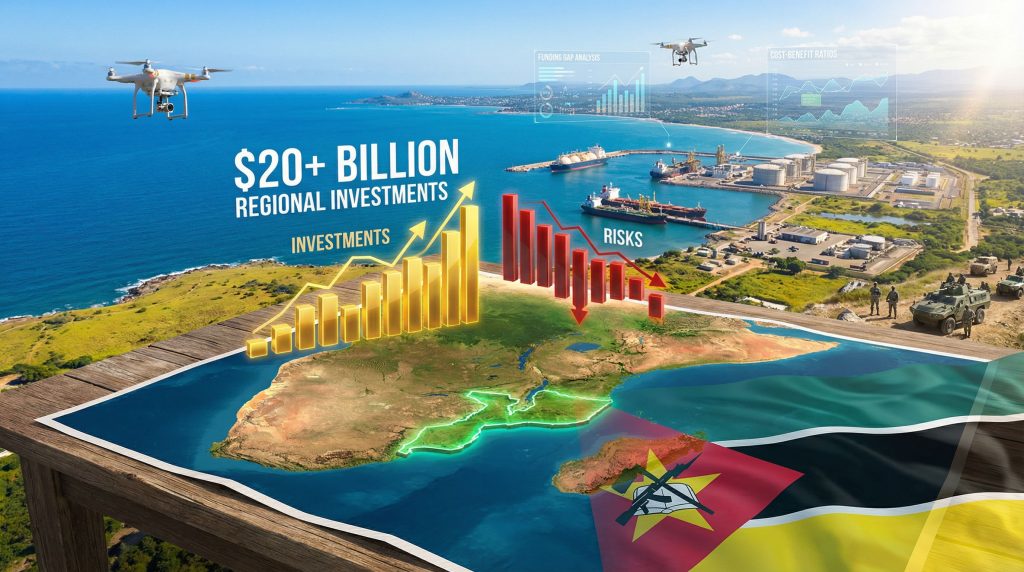
Economic disruption costs affecting European interests, particularly energy sector investments, remain substantial. The TotalEnergies liquefied natural gas project in Cabo Delgado represents a $20 billion investment directly dependent on regional security conditions. Additional LNG projects by ENI and ExxonMobil create additional European commercial interests requiring security infrastructure.
Humanitarian crisis prevention through sustained security operations costs significantly less than crisis response after security collapse. Displacement costs, refugee assistance, and humanitarian intervention expenses typically exceed prevention investment by substantial margins.
Regional contagion prevention represents another critical cost-benefit factor. Insurgency expansion across East African borders could threaten multiple European commercial interests and require much larger-scale international intervention.
Economic Impact Assessment of Security Operations
Energy Sector Investment Protection
The relationship between security operations and energy sector viability creates direct economic linkages between military deployment costs and commercial returns. Mozambique's natural gas reserves represent transformational economic potential for one of Africa's poorest nations, with implications extending across regional and international energy markets.
TotalEnergies' $20 billion LNG project in Cabo Delgado faced direct operational disruption from insurgent activity before improved security conditions enabled project resumption. The project timeline implications of security disruptions create cascading financial consequences:
• Extended development periods increasing capital costs
• Delayed revenue generation affecting investor returns
• Insurance premium increases reflecting higher risk assessments
• Workforce evacuation costs during security incidents
Energy sector vulnerability extends beyond individual project costs to broader regional development implications. Natural gas export infrastructure requires sustained security conditions for operational viability, creating long-term interdependence between military deployment effectiveness and economic development outcomes.
Displacement and Agricultural Productivity Impacts
Security operations enable displaced population return and agricultural productivity restoration in affected regions. Rwanda's intervention facilitated conditions allowing displaced people to return home, children to resume schooling, and businesses to reopen operations.
Agricultural communities in Cabo Delgado faced dual disruption from insurgent activity: immediate displacement disrupting farming cycles and longer-term productivity impacts from damaged infrastructure, depleted livestock, and disrupted market access.
Security improvement directly correlates with economic recovery indicators, including population return rates, school reopening statistics, and business resumption levels.
The economic multiplier effects of security improvement extend through local economies as returnee populations resume productive activities, local businesses reestablish operations, and regional trade networks reconnect previously isolated communities.
Alternative Security Financing Models
Multi-Stakeholder Funding Frameworks
Sustainable security financing requires diversified funding sources that align stakeholder interests with operational requirements. Traditional bilateral arrangements between deploying nations and recipient governments prove insufficient for long-term operational sustainability.
Private sector engagement in security financing offers potential solutions for operations protecting commercial interests. Energy companies with substantial regional investments could contribute to security operation funding through various mechanisms:
- Direct financial contributions to operational costs
- Infrastructure investment supporting military operations
- Logistical support reducing deployment expenses
- Technology provision enhancing operational effectiveness
Regional development bank participation could provide sustainable funding mechanisms tied to broader development objectives. Security operations supporting economic development goals align with development bank mandates, creating potential funding synergies.
Performance-based funding models tie financial support to measurable security outcomes, ensuring accountability and effectiveness while providing predictable funding streams for successful operations.
Risk-Sharing and Insurance Mechanisms
Financial instruments designed for complex security environments could provide alternative funding stability. Military deployment insurance products could protect contributing nations against cost overruns while ensuring operational continuity during funding transitions.
Contingency funding pools managed by regional organizations or international institutions could provide emergency support during funding crises, preventing abrupt operational termination with destabilizing consequences.
Geopolitical Complications and Funding Sustainability
International Sanctions Impact on Military Cooperation
Complex geopolitical relationships create complications for sustained security funding, particularly when contributing nations face international sanctions or diplomatic pressure related to separate regional conflicts. Moreover, trade war market impact considerations further complicate international financial flows.
The March 2026 troop withdrawal from Mozambique over funding crisis occurred alongside escalating international sanctions pressure on Rwanda related to allegations of supporting M23 rebels in eastern Democratic Republic of Congo. United States sanctions imposed on senior Rwandan military officers in early March 2026, followed by earlier European Union sanctions in March 2025, created diplomatic complications affecting all Rwanda-EU military cooperation.
These sanctions create potential transaction complications for international funding transfers, even when political willingness to support operations exists. Financial institutions face compliance requirements that may delay or complicate disbursement processes for sanctioned entities.
Diplomatic Balance Strategies
Nations contributing to regional security operations while facing sanctions pressure must navigate competing international pressures. Rwanda's assertive diplomatic communications regarding Mozambique funding reflect strategic choices to emphasise agency and resolve rather than accepting indefinite funding uncertainty.
The linkage between sanctions related to DRC conflicts and funding for Mozambique counterterrorism operations demonstrates how regional security issues become interconnected through diplomatic and financial mechanisms. Additionally, tariff economic implications add another layer of complexity to international cooperation funding structures.
Compartmentalisation strategies attempt to separate specific security cooperation from broader diplomatic disputes, but practical implementation faces significant challenges when sanctions affect military leadership directly involved in operations.
The next major ASX story will hit our subscribers first
Long-Term Regional Development Implications
Economic Development and Security Interdependence
Security operations in Cabo Delgado create conditions enabling broader economic transformation in Mozambique and the region. Natural gas revenue potential could transform Mozambique from one of Africa's poorest nations into a significant energy exporter, with implications for regional development patterns.
The interdependence between security conditions and development outcomes creates long-term justifications for sustained security investment. Economic returns from successful development could eventually provide domestic funding capacity for security operations, reducing dependence on international support.
Infrastructure development enabled by improved security extends beyond energy sector projects to transportation networks, telecommunications systems, and social infrastructure supporting broader economic growth. However, the US uranium ban impacts demonstrate how geopolitical tensions can affect resource security considerations.
Regional integration benefits from improved security conditions as cross-border trade networks, transportation corridors, and economic cooperation agreements become more viable with reduced conflict risk.
Humanitarian and Social Recovery Metrics
Security improvement enables measurable humanitarian recovery across multiple indicators. Population return rates, school reopening statistics, healthcare service restoration, and business resumption levels provide concrete metrics for assessing security operation effectiveness.
Long-term social recovery requires sustained security conditions that enable institutional development, community reconciliation processes, and economic opportunity restoration for affected populations.
Lessons for African Security Partnership Models
Replicable Funding Mechanisms
The Mozambique funding crisis reveals structural weaknesses in how international security partnerships are financed across Africa. Similar funding sustainability challenges affect multiple African security operations, suggesting systemic rather than exceptional problems.
Successful cost-sharing models from other regions provide templates for sustainable security funding. Operations with diversified funding sources, performance-based disbursement mechanisms, and long-term commitment frameworks demonstrate greater operational sustainability.
Early warning systems for funding sustainability crises could enable proactive intervention before operational effectiveness deteriorates. Predictable funding mechanisms reduce operational uncertainty and enable more effective long-term planning.
Policy Framework Recommendations
Effective security partnership models require institutional frameworks addressing funding predictability, performance accountability, and exit strategy planning. Regional organisations could play enhanced roles in coordinating security funding and ensuring operational continuity during political transitions.
Multi-stakeholder coordination mechanisms should align donor interests, operational requirements, and recipient nation priorities through formal institutional structures rather than ad-hoc arrangements. The critical minerals order demonstrates how strategic resource considerations increasingly influence security cooperation frameworks.
Contingency planning protocols should address funding transition periods, ensuring operational continuity while preventing abrupt security deterioration with destabilising regional consequences.
What Caused Rwanda's Ultimatum to Withdraw Troops?
Rwanda's decision to threaten troop withdrawal from Mozambique over funding resulted from multiple converging factors beyond simple financial considerations. The European Union's European Peace Facility provided only $23 million against estimated annual operational costs of $230-253 million, creating an unsustainable financial burden on Rwanda's national budget.
Reports from African news sources indicate that Rwanda warned European partners about funding shortfalls well before the March 2026 ultimatum, but received no concrete commitment for continued support beyond the May 2026 expiration of existing arrangements.
International sanctions pressure on Rwandan military leadership related to alleged DRC involvement further complicated funding discussions, creating diplomatic friction that affected all Rwanda-EU military cooperation channels.
Building Sustainable Security Investment Models
Contemporary security challenges in Africa require fundamental rethinking of international military cooperation financing. The Mozambique case demonstrates that traditional donor-recipient models prove inadequate for sustained counterinsurgency operations with regional development implications.
Effective solutions demand comprehensive approaches integrating security funding with broader development objectives, commercial interests, and regional stability requirements. The stakes extend beyond individual military deployments to encompass energy security, economic transformation, and humanitarian protection across East Africa.
Sustainable security financing requires predictable, diversified funding sources aligned with measurable outcomes and long-term regional development goals. Without addressing these structural challenges, similar funding crises will continue threatening regional stability across the continent.
This analysis is based on available public information and should not be considered investment or policy advice. Security situation developments and funding mechanisms may change rapidly, affecting the accuracy of projections and assessments presented herein.
Looking to Capitalise on African Resource Development Opportunities?
The complex interplay between regional security and resource development in Africa creates unique investment opportunities for those monitoring mineral discovery announcements and energy sector developments. Discovery Alert's proprietary Discovery IQ model provides instant notifications on significant ASX mineral discoveries, helping investors identify emerging opportunities in resource-rich regions before broader market recognition occurs.