
June 14, 2026
Military Precision Meets Market Psychology: Understanding Modern Conflict Impact Models
Global energy markets function as sophisticated early warning systems, registering geopolitical tensions through price mechanisms that often precede formal diplomatic or military announcements. When regional conflicts emerge near critical energy infrastructure, market psychology shifts from fundamental supply-demand calculations toward risk premium modeling that incorporates multiple scenario pathways. The current Middle Eastern conflict demonstrates how modern warfare's technological precision creates distinct market responses compared to historical conflict patterns, where broad infrastructure destruction generated predictable supply disruptions.
Contemporary military operations employ precision strike capabilities that target specific facilities while maintaining operational capacity in adjacent infrastructure, creating market uncertainty about actual versus perceived supply disruption. This technological evolution means that energy markets must evaluate not just immediate damage assessments, but also the strategic intent behind targeting decisions and the reconstitution timeline for damaged facilities. Furthermore, oil price movements reflect this complexity as traders attempt to price in various escalation scenarios.
When big ASX news breaks, our subscribers know first
Strategic Escalation Patterns and Nuclear Facility Targeting
The Iran airstrike campaigns represent a carefully calibrated operational approach designed to degrade specific capabilities without triggering broader international intervention. The targeting of Iran's Natanz uranium enrichment facility on March 22, 2026, marked the second confirmed strike on this installation during the ongoing conflict, with the facility located approximately 220 kilometres southeast of Tehran serving as Iran's primary uranium enrichment site.
The conflict's timeline reveals sustained operational commitment, with military operations beginning February 28, 2026, and continuing through the fourth week as of the latest reporting. The strategic significance of Natanz extends beyond immediate tactical gains, representing Iran's technological centre for isotope separation through advanced centrifuge technology. Previous strikes during a twelve-day conflict in June 2025 established this facility as a recurring priority target, suggesting systematic degradation rather than complete destruction as the operational objective.
Precision Strike Technology and Safety Protocols
The absence of radiological releases despite confirmed structural damage indicates sophisticated targeting methodologies that avoid fuel storage and processing areas. Iranian official news agency Mizan reported no radiation leakage following the March 22 strike, whilst the UN nuclear watchdog previously indicated that no radiological consequences were expected from earlier strikes.
This technical achievement suggests either advanced intelligence regarding facility operations at strike timing, or precision munitions capable of avoiding critical nuclear material storage areas. However, effective nuclear safety protocols remain crucial for preventing catastrophic accidents during such operations.
The facility's survival through multiple air campaigns, combined with Iran's continued assertions of operational capability, indicates that damage has not achieved complete incapacitation. This raises questions about distributed enrichment capacity elsewhere in Iran's nuclear infrastructure, or the technical challenges associated with completely destroying underground centrifuge installations.
Military Asset Deployment and Force Structure
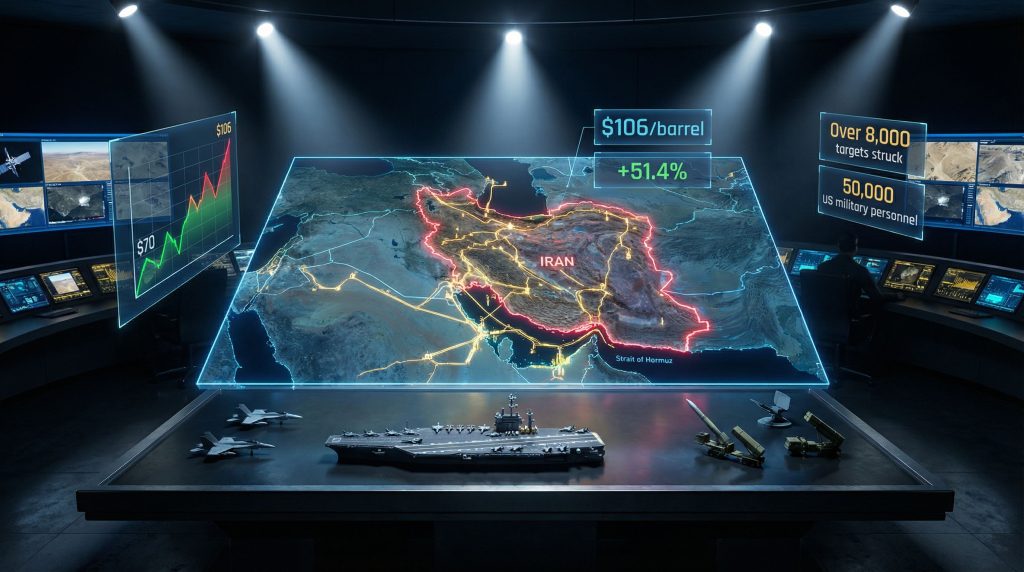
The United States has deployed over 50,000 military personnel across the Middle East, representing the largest regional deployment since the 2003 Iraq operations. This force commitment includes three additional amphibious assault ships and approximately 2,500 additional Marines redirected from Pacific theatre operations, demonstrating willingness to accept reduced presence in that strategic region.
The deployment magnitude suggests sustained conflict expectation rather than short-term operations. Amphibious assault ships carry multi-domain capability including helicopter squadrons, vertical launch systems for cruise missile delivery, and personnel transport capacity for approximately 2,000 Marines per ship.
Military casualties reported:
- At least 13 US military personnel killed
- Over 1,300 casualties in Iran
- 15 Israeli casualties from Iranian missile attacks
- 4 additional casualties in occupied West Bank
Energy Market Disruption and Price Volatility Mechanisms
Brent crude oil prices have increased from approximately $70 per barrel before conflict commencement to around $106 per barrel as of March 22, 2026, representing a 51.4 percent increase directly correlating with conflict escalation. This price volatility reflects both genuine supply disruption concerns and risk premium incorporation into pricing models, though the magnitude remains moderate compared to historical conflict scenarios.
| Energy Market Metrics | Pre-Conflict | Current Level | Percentage Change |
|---|---|---|---|
| Brent Crude | $70/barrel | $106/barrel | +51.4% |
| Regional Production Status | Normal Operations | Disrupted | Est. 15-20% reduction |
| Strategic Reserve Status | Stable | Activated | Variable release rates |
Sanctions Policy Recalibration and Market Intervention
The Trump administration announced a temporary suspension of sanctions on Iranian oil loaded on ships as of March 21, 2026, with the suspension explicitly set to end April 19, 2026. This 29-day window for sanction suspension represents a policy pivot aimed at moderating price pressures, though the mechanism operates through reduced enforcement of shipping documentation rather than increased Iranian production capacity.
Critical analysis reveals that this suspension does not increase actual production flow, as Iran has managed to evade US sanctions for years through various mechanisms. The policy's effectiveness remains questionable given that much of Iran's exportable oil already reaches international buyers through existing evasion networks. Additionally, tariffs impact on markets demonstrates how trade policy changes create complex market dynamics beyond their intended effects.
Strategic Reserve Utilisation and Supply Chain Adaptation
The Strait of Hormuz represents the critical chokepoint for global energy security, handling approximately 20-25 percent of global seaborne petroleum trade daily. Any direct disruption to tanker traffic through this waterway would create immediate supply shock distinct from production losses within Iran itself.
The strategic reserve activation referenced in market intervention protocols represents a proven mechanism for price moderation, though effectiveness depends on coordination with International Energy Agency member nations. According to reports from Iranian nuclear facility strikes, the absence of major Strait of Hormuz disruptions suggests current market volatility reflects risk premium pricing rather than actual supply constraint.
"The absence of major Strait of Hormuz disruptions suggests that current market volatility reflects risk premium pricing rather than actual supply constraint, though this calculation could change rapidly with escalated targeting of maritime infrastructure."
Iranian Response Capabilities and Retaliatory Strike Patterns
Iran has demonstrated significant missile capabilities in response to US and Israeli operations, with confirmed impacts including an Iranian missile that struck an empty kindergarten in Israel. Israeli army spokesman Nadav Shoshani posted video evidence of missile fragment damage, though no casualties were reported as the facility was empty at the time of impact.
This incident establishes that Iranian missiles have achieved targeting accuracy sufficient to impact Israeli territory whilst highlighting the operational challenges of precision targeting during conflict conditions. Iran's top military spokesperson, General Abolfazl Shekarchi, warned that parks, recreational areas and tourist destinations worldwide will not be safe for the country's enemies.
Leadership Transition and Command Structure Resilience
Supreme Leader Ayatollah Mojtaba Khamenei has not been seen in public since becoming supreme leader following Israeli strikes that reportedly killed his father, Ayatollah Ali Khamenei, and wounded him. The leadership transition under active conflict conditions tests Iran's command structure resilience and decision-making continuity during crisis periods.
Khamenei praised Iranian steadfastness in a written statement read on television to mark Nowruz, though his absence from public appearances raises questions about the extent of injuries sustained and the actual decision-making authority structure within Iran's government during ongoing military operations.
Regional Expansion and Proxy Force Activation
Lebanon-Hezbollah Theatre Escalation
Israeli operations have expanded to include systematic targeting of Iran-backed Hezbollah militants in Beirut's southern suburbs. The Israeli military announced waves of strikes with evacuation warnings for seven neighbourhoods, resulting in smoke rising, fires breaking out, and loud explosions across central Beirut.
Israeli strikes targeting Hezbollah in Lebanon have killed more than 1,000 people and displaced more than 1 million, according to Lebanese government reporting. This expansion demonstrates the multi-front nature of current operations, with proxy force engagement representing a significant escalation beyond direct Iran-Israel confrontation.
Iraqi Territory Involvement and Sovereignty Implications
A drone strike targeted the intelligence service headquarters in Baghdad, killing an officer, though no group immediately claimed responsibility for the attack. This incident illustrates how regional conflicts generate spillover effects affecting neighbouring countries' sovereignty and internal security, even when those nations attempt to maintain neutrality.
Furthermore, the involvement of Iraqi territory, either through direct targeting or proxy operations, complicates regional diplomatic calculations and potentially draws additional actors into the conflict framework beyond primary combatants.
Economic Cascade Effects Beyond Energy Markets
Financial Market Integration and Systemic Risk
Oil price increases have generated broader financial market stress, with reporting indicating that energy price volatility has negatively impacted US stock market performance. This demonstrates the systemic integration between energy markets and broader financial systems, where geopolitical risk premium in energy pricing translates into equity market uncertainty and potential economic slowdown concerns.
The administration's request for an additional $200 billion from Congress to fund ongoing military operations indicates sustained financial commitment despite public messaging about potentially winding down efforts. This funding request magnitude suggests either significant operational costs or expectation of prolonged engagement timeline. Moreover, uranium market volatility adds another layer of complexity to energy market dynamics during periods of nuclear facility targeting.
Inflation Pressure and Consumer Impact
Energy price volatility creates cascading effects throughout economic systems, particularly affecting transportation costs and food security through fuel price increases. Consumer price index projections must incorporate not just direct energy costs, but secondary effects through supply chain disruption and logistics cost increases affecting broad categories of goods and services.
The timing of conflict during global economic recovery periods amplifies inflationary pressure, as energy price shocks interact with existing supply chain constraints and monetary policy frameworks designed for different economic conditions.
The next major ASX story will hit our subscribers first
International Institutional Response and Oversight Mechanisms
Nuclear Safety and Monitoring Protocols
The International Atomic Energy Agency faces unprecedented challenges maintaining inspection access and safety monitoring during active military conflict. The agency's previous statement that no radiological consequences were expected from strikes on nuclear facilities establishes important precedent for nuclear safety during warfare, though the long-term implications for international nuclear oversight remain uncertain.
Radiation monitoring network activation and international safety standard enforcement during conflict represent critical precedents for future scenarios where nuclear facilities become military targets. The successful prevention of radiological releases thus far suggests that both attacking and defending forces recognise the catastrophic consequences of nuclear accidents during conflict.
United Nations Security Council Dynamics
Resolution attempts and veto patterns within the UN Security Council reflect broader geopolitical alignments rather than conflict-specific considerations. The institutional framework for ceasefire negotiation faces structural limitations when permanent Security Council members have strategic interests in conflict outcomes, limiting the UN's effectiveness as a neutral mediating body.
Humanitarian corridor establishment efforts represent practical cooperation mechanisms that may function even when broader diplomatic frameworks remain deadlocked, suggesting that functional cooperation on specific issues may continue despite overall political confrontation. Reports from Iranian strikes on nuclear facilities highlight the international community's concerns about escalation.
Long-Term Strategic Implications and Scenario Modelling
Regional Power Balance Recalibration
The current conflict accelerates existing regional power competition, particularly Saudi-Iranian proxy confrontation and Turkish positioning for influence expansion. Israeli security doctrine evolution reflects adaptation to multi-domain threat environments where traditional air superiority may not guarantee strategic objective achievement against dispersed nuclear and missile infrastructure.
The redirection of US forces from Pacific to Middle East theatre creates opportunities for other powers to advance interests in regions with reduced American military presence, particularly regarding China's strategic calculations in the South China Sea and Taiwan Strait scenarios.
Energy Infrastructure Vulnerability Assessment
Critical facility hardening requirements and backup system activation protocols represent long-term adaptations to demonstrated vulnerability of energy infrastructure during conflict. The successful targeting of multiple facilities without complete operational shutdown suggests that distributed infrastructure design and rapid reconstitution capability become essential for strategic resilience.
International protection mechanism development for critical energy infrastructure may require new frameworks beyond traditional diplomatic immunity or neutrality concepts, particularly for facilities that serve multiple countries or global market functions.
Risk Assessment and Investment Strategy Implications
Portfolio Hedging and Commodity Exposure
Current conflict dynamics demonstrate the importance of energy sector exposure in portfolio diversification strategies, though the relationship between geopolitical risk and energy investment returns becomes more complex when conflicts involve precision targeting rather than broad infrastructure destruction. Defence sector equity performance during conflict periods provides insights into market expectations regarding conflict duration and intensity.
Commodity futures volatility patterns extend beyond oil to include food security commodities affected by transportation cost increases, suggesting that geopolitical risk hedging requires broader commodity exposure than traditional energy-focused strategies. Consequently, effective diversification and risk strategies become crucial for navigating these complex market conditions.
Market Psychology and Sentiment Analysis
The moderate nature of energy price increases relative to supply disruption magnitude suggests that markets currently anticipate contained conflict scope rather than regional war escalation. This assessment could change rapidly if targeting expands to include major oil production facilities or transportation infrastructure, requiring continuous recalibration of risk models.
Investor sentiment indicators currently reflect uncertainty rather than panic, suggesting that systematic risk assessment rather than emotional reaction drives current pricing mechanisms, though this stability depends on continued precision in military operations and avoidance of civilian infrastructure targeting.
Investment decisions should consider geopolitical risk as a permanent feature of modern markets rather than temporary disruption, requiring portfolio strategies that maintain flexibility across multiple scenario pathways whilst recognising that technological precision in modern warfare creates different risk profiles than historical conflict patterns.
Looking to Diversify Your Portfolio During Geopolitical Uncertainty?
Discovery Alert provides instant notifications on significant ASX mineral discoveries, powered by its proprietary Discovery IQ model, helping investors identify actionable opportunities whilst broader markets react to global events like Middle Eastern conflicts. Explore how historic mineral discoveries can provide portfolio diversification beyond traditional energy and defence sectors, and begin your 14-day free trial today to gain a market-leading edge during volatile periods.