May 20, 2026
Understanding Mine Overflow Incidents: Technical Analysis and Industry Impact
Water management failures in mining operations represent one of the most technically complex challenges facing the extractive industries today. Unlike catastrophic dam collapses that dominate headlines, vale mine overflow incidents involve nuanced hydraulic engineering principles and operational dynamics that require specialized understanding. These events occur when active mining pits exceed their designed water retention capacity, creating cascading effects that can impact adjacent operations and surrounding infrastructure.
Defining Overflow Events vs. Catastrophic Dam Failures
The fundamental distinction between overflow incidents and dam failures lies in their structural origins and scale of impact. Overflow events typically involve operational water management systems reaching capacity limitations during active mining processes, whereas dam failures represent complete structural collapse of engineered containment barriers. The vale mine overflow incident at Fabrica mine in Minas Gerais demonstrates this distinction clearly, as the company explicitly confirmed that no dam structure was involved in the January 2026 event.
Mine overflow incidents generally affect smaller geographic areas and involve ongoing operational sites, while dam collapses can release massive volumes of stored materials across extensive regions. The Brumadinho dam collapse seven years prior, which resulted in 270 fatalities and caused Vale to lose its position as the world's largest iron ore producer, exemplifies the catastrophic potential of structural dam failures compared to operational overflow events.
Operational Causes Behind Water Management Failures
Active mining operations face multiple operational factors that contribute to water management failures. Equipment malfunction represents a critical vulnerability, particularly when primary pumping systems experience unexpected downtime during periods of high water accumulation. Furthermore, inadequate drainage capacity design often becomes apparent during seasonal precipitation peaks when engineering specifications prove insufficient for actual hydrological conditions.
Mining pit geometry creates unique hydraulic challenges, as open-pit operations naturally collect surface water and groundwater inflows. The interaction between excavation depth, slope stability, and water table fluctuations requires continuous monitoring and adaptive management strategies. In addition, sediment accumulation within drainage systems can progressively reduce effective capacity, creating conditions where previously adequate infrastructure becomes insufficient.
Sediment Transport Mechanisms in Active Mining Operations
Sediment-laden water transport during overflow events follows predictable physical principles but creates complex environmental pathways. Particle size distribution affects settling rates and transport distances, with fine clay particles remaining suspended longer than coarse materials. However, flow velocity determines sediment carrying capacity, while surface topography influences dispersion patterns across affected areas.
The recent vale mine overflow involved water with sediment reaching competitor CSN Mineração's Pires unit, affecting warehouse facilities, internal access areas, mechanical workshops, and loading zones. This demonstrates how sediment transport can create operational disruptions beyond the originating site, requiring coordinated response efforts between competing companies.
When big ASX news breaks, our subscribers know first
What Triggers Water Overflow in Open-Pit Mining Operations?
Hydrological factors contributing to water overflow in mining operations involve complex interactions between natural precipitation patterns, groundwater infiltration, and artificial drainage systems. Understanding these triggers requires analysis of both predictable seasonal patterns and unexpected extreme weather events that can overwhelm existing water management infrastructure.
Hydrological Factors Contributing to Pit Water Accumulation
Groundwater infiltration represents a continuous challenge in below-grade mining operations, as excavation activities often intersect natural aquifers and water-bearing geological formations. The rate of groundwater influx depends on local hydrogeology, including rock permeability, fracture networks, and regional water table elevations. Moreover, seasonal variations in groundwater levels can create periods of increased influx that strain pumping capacity.
Surface water collection occurs naturally in open-pit operations due to their bowl-like geometry. Rainfall accumulation rates depend on pit surface area, slope configurations, and the effectiveness of perimeter drainage systems. Consequently, direct precipitation into active mining areas can overwhelm drainage infrastructure during intense storm events, particularly when combined with runoff from surrounding terrain.
Drainage System Design Limitations and Capacity Thresholds
Engineering specifications for mining drainage systems must balance operational costs with risk mitigation across varying hydrological scenarios. Design capacity calculations typically incorporate historical precipitation data, but climate change patterns may render these assumptions inadequate. Furthermore, pump system redundancy becomes critical when primary equipment experiences mechanical failure during high-demand periods.
Pipeline capacity limitations often become apparent during peak flow conditions when theoretical design specifications meet real-world operational constraints. In addition, sediment accumulation within drainage infrastructure can progressively reduce effective capacity, creating bottlenecks that contribute to overflow conditions even during moderate precipitation events.
Seasonal Precipitation Patterns and Mining Site Vulnerability
Brazil's Minas Gerais region experiences distinct wet and dry seasons that create predictable patterns of water management stress. The summer rainy season typically extends from October through March, coinciding with periods of maximum operational vulnerability. Furthermore, historical precipitation data indicates increasing variability in storm intensity, creating challenges for traditional infrastructure design approaches.
Mining operations must adapt their water management strategies to accommodate seasonal variations while maintaining continuous production schedules. The timing of the January 2026 vale mine overflow occurred during the region's wet season, highlighting the increased risk potential during periods of elevated precipitation.
| Common Overflow Triggers in Mining Operations |
|---|
| Factor |
| Excessive Rainfall |
| Inadequate Pumping Capacity |
| Blocked Drainage Channels |
| Equipment Failure |
How Do Mining Overflow Events Affect Adjacent Operations?
The impact radius of mining overflow events extends significantly beyond the originating site boundaries, creating operational disruptions and environmental consequences for neighboring facilities. Cross-contamination pathways follow predictable flow patterns influenced by topography, soil permeability, and existing infrastructure configurations. Moreover, adjacent mining operations face unique vulnerabilities due to their shared geological environments and interconnected surface water systems.
Cross-Site Contamination Pathways and Environmental Vectors
Sediment-laden overflow water follows surface topography and existing drainage patterns, often impacting downstream facilities regardless of property boundaries. The recent mine overflow demonstrated this phenomenon when water from Fabrica mine reached CSN Mineração's Pires unit, affecting multiple operational areas including warehouses, workshops, and loading facilities.
Contamination vectors include direct surface flow, subsurface seepage through permeable soils, and accumulation in low-lying areas where sediments can settle and concentrate. However, the composition of overflow water typically includes suspended solids, dissolved minerals, and potentially chemical additives used in mining processes, creating complex environmental remediation challenges.
Infrastructure Damage Assessment Protocols
Immediate infrastructure impact assessment requires systematic evaluation of affected facilities to determine operational continuity and safety risks. Critical infrastructure categories include:
- Warehouse facilities – Storage areas vulnerable to flooding and sediment accumulation
- Mechanical workshops – Equipment maintenance areas sensitive to water intrusion
- Loading zones – Material handling areas requiring operational surfaces
- Internal access roads – Transportation infrastructure essential for site mobility
- Electrical systems – Power distribution networks requiring immediate safety evaluation
Damage assessment protocols must prioritize safety evaluation before operational impact analysis. Furthermore, structural integrity evaluation becomes essential for buildings and equipment exposed to sediment-laden water, as particle accumulation can create unexpected loading conditions.
Operational Disruption Quantification Methods
Measuring the operational impact of overflow events requires comprehensive analysis of production interruptions, cleanup costs, and recovery timelines. Direct costs include immediate response activities, cleanup operations, and infrastructure repairs. In addition, indirect costs encompass production delays, alternative material sourcing, and potential contractual penalties.
The competitive dynamics between mining companies add complexity to impact quantification, as demonstrated by the interaction between Vale and CSN Mineração during the January 2026 overflow event. Vale reported that its own output would remain unaffected, while CSN Mineração faced operational disruptions at affected facilities.
Typical Infrastructure Impact Areas
Mining overflow events commonly affect warehouse facilities, mechanical workshops, loading zones, and internal access roads. The extent of damage depends on water volume, sediment concentration, and containment response time.
Why Are Brazilian Mining Sites Particularly Vulnerable to Water Management Issues?
Brazil's mining sector faces unique geological, climatic, and regulatory challenges that create elevated vulnerability to water management failures. The concentration of iron ore operations in Minas Gerais state creates a regional cluster of mining activities operating under similar environmental conditions, amplifying both individual site risks and potential for cascading impacts across multiple operations.
Geological Characteristics of Minas Gerais Mining Region
The geological foundation of Minas Gerais creates inherent challenges for mining water management due to the region's iron ore formations and associated rock structures. Iron-bearing formations often occur in geological settings that include complex groundwater systems, fractured rock networks, and variable permeability zones that complicate water control efforts.
Moreover, regional topography features steep terrain and natural drainage patterns that concentrate surface water flow toward mining areas. The interaction between engineered mining operations and natural hydrological systems creates potential conflict zones where traditional water management approaches may prove inadequate during extreme precipitation events.
Regulatory Framework Evolution Following Historical Incidents
The regulatory environment for Brazilian mining operations underwent significant transformation following the Brumadinho dam collapse, which killed 270 people and fundamentally altered industry oversight approaches. Enhanced safety requirements, increased inspection frequencies, and stricter operational protocols now govern mining water management systems throughout the region.
Post-Brumadinho regulatory changes emphasize prevention-focused approaches rather than reactive compliance measures. Consequently, mining companies now face heightened scrutiny regarding their water management infrastructure, emergency response capabilities, and environmental impact mitigation strategies. These regulatory pressures create additional operational complexity while potentially improving overall safety outcomes.
Climate Pattern Analysis and Seasonal Risk Assessment
Minas Gerais experiences tropical climate patterns with distinct wet and dry seasons that create predictable periods of elevated water management risk. The January timing of the recent vale mine overflow corresponds with the region's peak wet season, when precipitation volumes typically reach annual maximums.
Climate variability analysis indicates increasing frequency of extreme precipitation events, potentially exceeding historical design parameters for mining drainage infrastructure. Furthermore, long-term climate trends suggest that traditional water management approaches may require substantial upgrades to accommodate changing precipitation patterns and intensity variations.
What Distinguishes Overflow Events from Dam Collapse Disasters?
The technical and operational distinctions between mine overflow events and dam collapse disasters involve fundamental differences in structural engineering, risk scales, and emergency response requirements. Understanding these distinctions becomes essential for appropriate risk assessment, regulatory compliance, and emergency preparedness planning across different types of mining operations.
Structural Engineering Differences Between Containment Systems
Mine overflow events typically involve operational water management systems designed for active mining processes, including pumping networks, drainage channels, and temporary containment structures. These systems operate under dynamic conditions with variable water volumes and continuous operational adjustments based on mining progress and environmental conditions.
However, dam structures represent permanent engineered barriers designed to contain large volumes of materials over extended periods. These systems incorporate complex geotechnical engineering principles, including foundation design, structural stability analysis, and long-term material containment strategies. Furthermore, the engineering standards for dam construction significantly exceed those required for operational water management systems.
Scale Comparison: Localized Overflow vs. Catastrophic Release
The scale differential between overflow events and dam collapses creates vastly different impact scenarios. The recent Vale spillage affected specific operational areas within competitor facilities, representing localized impacts that could be addressed through targeted cleanup and remediation efforts.
Dam collapse events can release massive volumes of stored materials across extensive geographic areas, creating environmental disasters with regional impacts. The Brumadinho collapse demonstrated this scale differential, causing 270 fatalities and environmental damage across a broad area, fundamentally different from the localized operational impacts of overflow events.
Emergency Response Protocol Variations
Emergency response protocols for overflow events focus on immediate containment, affected area isolation, and operational continuity measures. Response teams prioritize source control, flow diversion, and infrastructure protection while maintaining safety for personnel in active operational areas.
In contrast, dam failure emergency response requires large-scale evacuation procedures, multi-agency coordination, and long-term disaster recovery planning. These protocols involve community evacuation, emergency services mobilization, and comprehensive environmental remediation efforts that extend far beyond individual mining operations.
Featured Insight: Mine overflow events involve water escaping from operational pits due to capacity limitations, while dam failures represent structural collapses of engineered barriers. Overflow incidents typically affect smaller areas and involve active mining operations, whereas dam collapses can release massive volumes stored behind permanent structures.
How Do Companies Assess and Manage Overflow Risk?
Modern mining operations employ sophisticated risk assessment methodologies combining real-time monitoring systems, predictive modeling capabilities, and collaborative risk management approaches. These integrated systems must balance operational efficiency with safety requirements while accommodating the dynamic nature of active mining environments and changing environmental conditions.
Predictive Modeling Systems for Water Level Monitoring
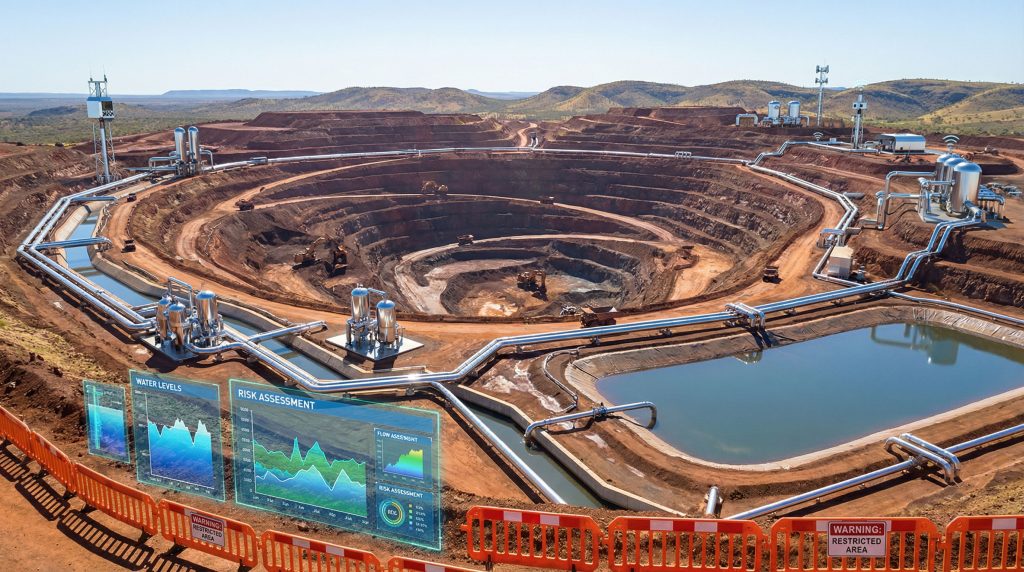
Advanced hydrological modeling systems integrate multiple data sources including precipitation forecasts, groundwater monitoring, and operational water production rates to predict potential overflow conditions. Furthermore, these systems incorporate data‐driven operations that adapt to site-specific conditions and improve prediction accuracy over time through continuous data integration.
Predictive systems must account for complex interactions between natural hydrological processes and mining activities, including the effects of excavation on local groundwater patterns, changes in surface drainage due to ongoing operations, and seasonal variations in precipitation intensity and frequency.
Real-Time Sensor Networks and Alert Mechanisms
Contemporary mining operations deploy extensive sensor networks that monitor water levels, flow rates, and precipitation in real-time across operational areas. These systems provide automated alerts when predetermined thresholds are approached, enabling proactive response measures before overflow conditions develop.
Sensor integration with operational control systems allows for automated responses including pump activation, valve adjustments, and flow diversions that can prevent or minimize overflow events. However, the effectiveness of these systems depends on proper calibration, regular maintenance, and integration with broader operational management protocols.
Inter-Company Communication Protocols for Adjacent Sites
The vale mine overflow incident highlighted the importance of communication protocols between adjacent mining operations, as water management failures at one site can directly impact neighboring facilities. Effective inter-company protocols establish information sharing procedures, joint response capabilities, and coordinated risk management strategies.
Regional mining clusters require collaborative approaches to water management that recognize the interconnected nature of hydrological systems across property boundaries. Furthermore, these protocols must balance competitive business relationships with shared environmental responsibilities and mutual risk exposure.
The next major ASX story will hit our subscribers first
What Are the Immediate Response Procedures for Mining Overflow Events?
Effective emergency response to mining overflow events requires coordinated implementation of standardized procedures designed to minimize safety risks, limit environmental impact, and restore operational capability. These procedures must be executed rapidly while maintaining safety protocols and ensuring appropriate documentation for regulatory compliance and insurance purposes.
Emergency Containment Strategies and Equipment Deployment
Immediate containment efforts focus on source control through emergency pumping systems, temporary diversion structures, and flow restriction measures. Mobile pumping equipment provides rapid response capability when permanent systems become overwhelmed or malfunction. Moreover, portable barriers and diversion channels can redirect overflow away from critical infrastructure areas.
Equipment deployment strategies must consider access limitations during overflow conditions, as affected areas may become inaccessible to standard vehicles and equipment. Consequently, pre-positioned emergency supplies and specialized response equipment improve response times and effectiveness during critical initial response periods.
Affected Area Isolation and Safety Perimeter Establishment
Safety perimeter establishment represents the highest priority during initial response phases, ensuring personnel safety while enabling effective response operations. Isolation procedures must account for potential electrical hazards, structural stability risks, and contamination exposure that may result from overflow conditions.
Access control procedures balance safety requirements with operational necessity, enabling essential response activities while preventing unnecessary exposure risks. Furthermore, communication protocols ensure that all personnel understand restricted areas and alternative access routes during emergency conditions.
Environmental Impact Assessment Rapid Response Teams
Specialized response teams conduct immediate environmental impact assessments to document conditions, collect samples, and establish baseline measurements for subsequent remediation efforts. These assessments provide essential information for regulatory reporting requirements and insurance claim documentation.
Rapid response protocols prioritize identification of sensitive environmental receptors, assessment of contamination extent, and implementation of immediate protective measures. In addition, early environmental assessment enables more effective long-term remediation planning and regulatory compliance.
Standard Overflow Response Steps:
- Immediate site evacuation and safety zone establishment – Personnel safety priority and secure perimeter creation
- Source isolation and flow diversion implementation – Containment measures and alternative flow routing
- Affected infrastructure damage assessment – Structural evaluation and operational impact analysis
- Environmental monitoring and sampling initiation – Baseline establishment and contamination assessment
- Regulatory notification and compliance reporting – Authority communication and documentation requirements
- Cleanup and remediation planning – Recovery strategy development and resource mobilization
How Do Overflow Incidents Impact Iron Ore Production and Market Dynamics?
Mining overflow events create both immediate operational disruptions and broader market implications that extend beyond the directly affected facilities. The interconnected nature of iron ore supply chains means that localized incidents can influence regional production capacity, competitive positioning, and market pricing dynamics across the broader minerals sector.
Production Continuity Assessment and Recovery Timelines
Production impact assessment requires comprehensive evaluation of affected infrastructure, equipment damage, and operational capacity reduction. The vale mine overflow incident demonstrates how events at one operation can affect competitor facilities, creating complex production continuity challenges that extend beyond the originating company.
Recovery timelines depend on multiple factors including cleanup complexity, infrastructure repair requirements, and regulatory approval processes for resumed operations. Furthermore, environmental remediation requirements can extend recovery periods significantly, particularly when overflow events affect sensitive environmental areas or require extensive soil and water treatment.
Supply Chain Disruption Analysis for Regional Markets
Regional iron ore markets face potential supply disruptions when major producers experience operational interruptions, even if the direct production impact appears limited initially. The concentration of mining operations in Minas Gerais creates potential for cascading effects when infrastructure damage affects transportation networks or processing facilities shared between multiple operations.
Market analysis must consider both direct production losses and indirect effects including transportation delays, processing capacity reductions, and contractual delivery complications. In addition, the global nature of iron ore markets means that regional disruptions can influence international pricing and supply allocation decisions.
Competitor Advantage Scenarios During Operational Shutdowns
Overflow events create temporary competitive advantages for unaffected producers who can increase market share during competitor recovery periods. Vale's statement that its output would remain unaffected by the January 2026 overflow, while competitor CSN Mineração faced operational disruptions, illustrates how these events can alter competitive dynamics.
Strategic market positioning during competitor difficulties requires careful balance between short-term opportunity exploitation and long-term industry relationship management. However, companies must consider reputational risks associated with capitalizing on competitor misfortunes, particularly in regions where collaborative relationships support overall industry stability.
What Long-Term Prevention Strategies Are Mining Companies Implementing?
Contemporary mining operations increasingly emphasize proactive prevention strategies that integrate advanced technologies, collaborative risk management approaches, and enhanced regulatory compliance frameworks. These comprehensive strategies recognize that effective water management requires long-term investment in infrastructure, technology, and organisational capabilities rather than reactive problem-solving approaches.
Advanced Water Management Technology Integration
Mining companies invest heavily in sophisticated water management technologies that provide enhanced monitoring, prediction, and response capabilities. These systems integrate multiple technology platforms including satellite monitoring, automated sensor networks, and artificial intelligence-driven analysis systems that can predict potential overflow conditions days or weeks in advance.
Technology integration strategies focus on creating comprehensive situational awareness that enables proactive decision-making rather than reactive emergency response. Furthermore, advanced systems can automatically adjust pumping rates, modify drainage configurations, and implement flow diversions based on real-time conditions and predictive algorithms.
Collaborative Risk Sharing Between Adjacent Operations
The interconnected nature of mining water management challenges drives increased collaboration between adjacent operations, including shared infrastructure development, joint emergency response capabilities, and coordinated risk management strategies. These collaborative approaches recognise that water management failures at one operation can impact neighbouring facilities regardless of corporate boundaries, as evidenced by the onslow iron project halt which highlighted similar operational interdependencies.
Risk sharing agreements enable more effective resource utilisation during emergency conditions while providing mutual insurance against operational disruptions. Moreover, enhanced collaboration supports the broader industry evolution trends toward integrated risk management approaches.
Regulatory Compliance Enhancement Programs
Enhanced regulatory frameworks implemented following major incidents require mining companies to invest significantly in compliance programs that exceed traditional operational requirements. These programs emphasise prevention-focused approaches, comprehensive risk assessment methodologies, and enhanced emergency response capabilities.
Compliance enhancement initiatives include regular third-party audits, advanced staff training programs, and investment in infrastructure upgrades that exceed minimum regulatory requirements. Furthermore, companies recognise that proactive compliance investment reduces long-term operational risks while improving stakeholder confidence and supporting sustainability initiatives.
| Water Management Technology Comparison |
|---|
| Technology |
| Automated Pumping Systems |
| Real-Time Monitoring Networks |
| Predictive Analytics Platforms |
| Emergency Diversion Channels |
What Lessons Can the Industry Learn from Recent Overflow Events?
Recent overflow incidents provide valuable learning opportunities for the broader mining industry, highlighting both successful response strategies and areas requiring improvement. These lessons inform best practice development, technology advancement priorities, and regulatory framework evolution across the global minerals sector.
Best Practice Development from Incident Analysis
Comprehensive incident analysis reveals critical factors that contribute to both overflow occurrence and effective response implementation. The vale mine overflow demonstrates the importance of clear communication protocols between competing companies when overflow events create cross-property impacts.
Best practice development focuses on prevention-oriented approaches that address root causes rather than symptoms of water management failures. These practices emphasise system redundancy, predictive monitoring, and rapid response capabilities that can minimise impact severity when overflow conditions develop. Furthermore, integration with mine reclamation innovation supports comprehensive environmental protection strategies.
Technology Transfer Opportunities Between Mining Regions
Successful water management technologies and operational procedures developed in one region can often be adapted for implementation in other mining areas facing similar challenges. International technology transfer accelerates industry-wide improvement while reducing development costs for individual companies.
Regional mining associations facilitate technology sharing through industry conferences, technical publications, and collaborative research programmes. These initiatives help standardise effective practices while accommodating local geological and regulatory variations.
Regulatory Evolution and Industry Standard Updates
Regulatory frameworks continue evolving based on lessons learned from overflow incidents and changing environmental conditions. The Brazilian mining sector's post-Brumadinho regulatory transformation demonstrates how major incidents drive comprehensive regulatory reform that affects industry-wide operational practices.
Industry standard organisations incorporate incident lessons into updated technical specifications, operational guidelines, and safety protocols. Consequently, these standards provide frameworks for consistent risk management approaches while enabling technological innovation and operational efficiency improvements.
How Do Environmental Monitoring Systems Track Post-Overflow Recovery?
Environmental recovery monitoring requires comprehensive assessment protocols that track both immediate cleanup effectiveness and long-term ecosystem restoration progress. These monitoring systems must provide accurate data for regulatory compliance while supporting adaptive management strategies that optimise recovery outcomes across affected areas.
Water Quality Assessment Protocols and Testing Frequencies
Post-overflow water quality monitoring involves systematic sampling and analysis programmes that assess contamination extent, cleanup effectiveness, and ecosystem recovery progress. Monitoring protocols typically include immediate baseline establishment, regular progress assessment, and long-term trend analysis to verify complete environmental restoration.
Testing frequencies depend on contamination severity, environmental sensitivity, and regulatory requirements. Initial phases may require daily sampling, gradually transitioning to weekly, monthly, and eventually quarterly monitoring as conditions stabilise and approach pre-incident baselines.
Sediment Dispersion Modelling and Cleanup Verification
Sediment transport modelling predicts contamination dispersion patterns and guides cleanup prioritisation efforts. These models incorporate topographical data, soil characteristics, and hydrological conditions to forecast sediment movement and accumulation patterns across affected areas.
Cleanup verification requires comprehensive sampling that demonstrates successful sediment removal and environmental restoration. Furthermore, verification protocols must satisfy regulatory requirements while providing confidence that cleanup efforts have achieved intended environmental protection objectives.
Ecosystem Recovery Indicators and Long-Term Monitoring
Biological monitoring systems track ecosystem recovery using indicator species, vegetation reestablishment, and overall ecological function assessment. These systems provide early warning of recovery problems while documenting successful restoration outcomes for regulatory and stakeholder communication purposes.
Long-term monitoring programmes may continue for years following overflow events to ensure complete ecosystem recovery and identify any delayed environmental impacts. These programmes provide valuable data for improving future incident response and prevention strategies.
Frequently Asked Questions:
How long does it typically take to clean up after a mine overflow?
Recovery timelines vary significantly based on overflow volume, affected area size, and environmental sensitivity, typically ranging from several weeks for minor incidents to several months for major events.
What environmental permits are required for overflow remediation?
Remediation activities typically require environmental permits for cleanup activities, waste disposal, and restoration work, with specific requirements varying by jurisdiction and incident severity.
How do insurance policies cover overflow-related damages?
Insurance coverage depends on policy terms, incident cause determination, and damage extent, with environmental liability and business interruption coverage providing primary protection.
What role do government agencies play in overflow investigation?
Regulatory agencies conduct independent investigations, enforce compliance requirements, and oversee remediation efforts to ensure environmental protection and public safety.
Building Resilient Water Management Systems in Modern Mining
The evolution toward resilient water management systems represents a fundamental transformation in mining operational philosophy, emphasising prevention-focused approaches that integrate advanced technology, collaborative risk management, and adaptive operational strategies. This transformation recognises that effective water management requires comprehensive system thinking rather than isolated technical solutions.
Industry-Wide Risk Mitigation Trend Analysis
Mining industry trends indicate increasing investment in comprehensive risk mitigation strategies that address water management challenges through integrated technology platforms, enhanced operational procedures, and collaborative industry initiatives. These trends reflect recognition that traditional reactive approaches prove inadequate for contemporary operational and environmental requirements.
Risk mitigation evolution incorporates lessons learned from incidents like the vale mine overflow, driving development of more sophisticated prediction systems, enhanced response capabilities, and improved inter-company coordination protocols. Industry-wide adoption of these enhanced approaches improves overall sector resilience while reducing individual company risk exposure.
Future Technology Integration Roadmap
Technology roadmaps for mining water management emphasise artificial intelligence integration, automated response systems, and predictive analytics capabilities that can anticipate overflow conditions well in advance of actual occurrence. These systems promise to transform water management from reactive problem-solving to proactive risk prevention.
Integration roadmaps recognise the importance of interoperability between different technology platforms, enabling comprehensive situational awareness and coordinated response capabilities. Furthermore, future systems will likely incorporate satellite monitoring, ground-based sensors, and predictive algorithms into integrated platforms that provide decision support for complex water management decisions.
Stakeholder Collaboration Framework Development
Effective water management increasingly requires collaboration between multiple stakeholders including mining companies, regulatory agencies, environmental organisations, and local communities. Framework development emphasises shared responsibility approaches that recognise the interconnected nature of water management challenges and the benefits of coordinated response strategies.
Collaboration frameworks must balance competitive business relationships with shared environmental responsibilities, as demonstrated by the interaction between Vale and CSN Mineração during the January 2026 overflow event. Consequently, these frameworks enable more effective resource utilisation while reducing overall industry risk exposure through shared knowledge and coordinated response capabilities.
Disclaimer: This analysis is based on publicly available information and industry best practices. Specific technical recommendations should be validated through site-specific engineering analysis and regulatory consultation. Investment and operational decisions should consider multiple factors beyond water management considerations.
Further Exploration:
Readers interested in learning more about mining water management and overflow prevention can explore additional educational resources about industrial water treatment systems and mining safety protocols available through various industry publications and technical journals.
Want to Stay Ahead of Mining Market Developments?
Discovery Alert's proprietary Discovery IQ model delivers real-time alerts on significant ASX mineral discoveries, instantly empowering subscribers to identify actionable opportunities ahead of the broader market. Understand why historic discoveries can generate substantial returns by visiting Discovery Alert's dedicated discoveries page to see exceptional market outcomes.