July 14, 2026
The Regulatory Architecture Behind Mine Reclamation in the United States
Across the American West, landscapes that once bore the scars of open-pit extraction are slowly reassembling themselves. Grasses take root in graded soils. Deer trails reappear through restored shrublands. Streams run cleaner. This is not accidental recovery — it is the product of one of the most layered environmental governance systems in the industrialised world. Mine reclamation in the United States sits at the intersection of ecological science, financial engineering, and federal-state law, and understanding how it actually functions reveals far more complexity than its outcomes suggest.
When big ASX news breaks, our subscribers know first
What Mine Reclamation Actually Involves and Why It Became Legally Mandatory
Mine reclamation refers to the structured, regulated process of returning land disturbed by mineral extraction to a condition that is either ecologically functional or economically productive. In practice, this spans everything from recontouring blasted terrain to reestablishing native plant communities, managing water quality in former pit lakes, and stabilising waste rock structures that may have been piled decades ago.
The scale of the problem that forced reclamation into law is difficult to overstate. Before modern standards existed, mining operations across Appalachia, the Rocky Mountain West, and the Great Plains routinely left behind shattered highwalls, acidic drainage channels, barren waste dumps, and open shafts with no obligation to restore anything. By the 1970s, tens of thousands of abandoned sites had accumulated across the country, many posing direct hazards to nearby communities.
The transformation from voluntary stewardship to legally enforceable obligation came not from industry initiative but from legislative pressure, driven by documented public health impacts and environmental degradation that voluntary codes had failed to prevent.
The Surface Mining Control and Reclamation Act of 1977, commonly known as SMCRA, established the first comprehensive federal framework for this obligation. Its passage marked a structural shift: mine reclamation ceased to be an optional goodwill gesture and became a legally binding condition of operating. Furthermore, understanding the mine reclamation evolution helps contextualise just how dramatically expectations have shifted over the past five decades.
How SMCRA Transformed the Legal Landscape for U.S. Coal Mining
The Core Requirements Built into the Statute
SMCRA's requirements are operationally demanding. Before any extraction begins, an operator must submit a detailed reclamation plan to regulators specifying exactly how the disturbed land will be restored, what post-mining land use is proposed, and how that use will equal or exceed the productivity or ecological value of the pre-mining condition.
The law's approximate original contour (AOC) standard requires that surface contours, drainage patterns, and slope gradients be restored to broadly match pre-disturbance conditions. Exceptions are permitted where an alternative post-mining land use — such as commercial development, recreation, or wildlife habitat — is approved in advance by regulators and supported by local land use plans.
Federal Oversight Versus State Primacy: How the System Divides Authority
SMCRA created a dual-track governance model. The Office of Surface Mining Reclamation and Enforcement (OSMRE) within the U.S. Department of the Interior sets the minimum national standards that all programmes must meet. States can apply for primacy — the authority to run their own approved regulatory programmes — provided those programmes are at least as stringent as federal requirements.
Table: Federal vs. State Reclamation Authority Under SMCRA
| Governance Level | Responsible Body | Scope of Authority | Key Mechanism |
|---|---|---|---|
| Federal (Primary) | OSMRE | Sets minimum national standards | SMCRA Title V |
| State (Primacy) | State Mining Agencies | Enforce approved state programmes | State-level permits |
| Federal (Backstop) | OSMRE | Intervenes where states lack primacy | Federal programme oversight |
| Tribal Lands | OSMRE + Tribal Governments | Co-managed reclamation oversight | Government-to-government consultation |
By the mid-1970s, 38 states already had some form of surface mine reclamation law on their books, which meant SMCRA was built on an existing patchwork of state-level activity rather than a blank regulatory canvas. Today, the majority of coal-producing states hold primacy, with OSMRE retaining direct oversight where state programmes do not exist or have not been approved.
The Technical Mechanics of Reclaiming a Surface Mine
A Step-by-Step View of How Reclamation Actually Unfolds
The reclamation process is sequential, technically precise, and monitored at each stage. Understanding the mechanics clarifies why high-quality outcomes require planning that begins before the first shovel moves, not after the last truckload leaves.
-
Pre-mining baseline documentation — Soil horizons, plant community composition, hydrological flow paths, and topographic profiles are mapped and recorded before disturbance begins.
-
Topsoil salvage and segregated stockpiling — The biologically active upper soil layers are stripped and stored separately from subsoils and overburden to preserve the microbial communities and organic matter that enable revegetation.
-
Concurrent mining and reclamation panels — Modern practice sequences extraction in defined sections, allowing earlier-mined areas to begin reclamation while active extraction continues in adjacent panels.
-
Backfilling and recontouring — Overburden removed during mining is returned to the void and graded to restore natural drainage patterns, with particular attention to preventing the formation of impoundments that could generate acid mine drainage.
-
Topsoil replacement and soil amendments — Salvaged topsoil is respread across graded surfaces. Where stockpiling has degraded soil biology, amendments may be required to restore fertility before seeding.
-
Revegetation with appropriate species — Native grasses, shrubs, or tree species are established based on the approved post-mining land use. Species selection is highly site-specific, reflecting regional climate, soil characteristics, and ecological context.
-
Monitoring, performance verification, and bond release — Regulators conduct multi-year inspections to confirm that vegetation density, species diversity, and land productivity meet the standards specified in the reclamation plan before financial bonds are returned to the operator.
The Forestry Reclamation Approach and Why Loose Grading Matters
One of the most significant advances in reclamation science over recent decades is the Forestry Reclamation Approach (FRA), a set of best-management practices developed specifically for coal-mined land being returned to native forest. Traditional reclamation methods relied on heavy compaction of replaced soils to control erosion — a technique that inadvertently created conditions hostile to tree root development.
The FRA reverses this logic. By grading reclaimed surfaces loosely, using appropriate native tree species, and minimising post-seeding ground disturbance, operators can achieve forest regeneration rates that dramatically outperform legacy methods. Research conducted on Appalachian reclamation sites has documented substantially better crown closure, root depth, and above-ground biomass on FRA-managed sites compared to traditionally compacted reclamations.
The insight that compacted soils were actively preventing successful reforestation took decades to translate into standard practice, illustrating how reclamation science evolves through applied field research rather than regulatory mandate alone.
Concurrent Versus End-of-Mine Reclamation: A Critical Strategic Distinction
The timing of reclamation carries significant financial and ecological consequences. End-of-mine closure models defer all restoration activity until production ceases, concentrating costs and environmental risk at the point when an operator may have the least financial capacity to deliver. Concurrent reclamation distributes these activities across the operating life of the mine, reducing peak liability, improving ecological outcomes, and demonstrating ongoing compliance to regulators.
Newmont, one of the world's largest gold producers, has formalised this principle across its global portfolio. In 2025, the company completed concurrent reclamation across more than 130 hectares while maintaining full compliance with its internal Closure and Reclamation Management Standard at every operating site. This approach also supports the company's biodiversity commitments, including a stated objective of achieving no net loss of key biodiversity values wherever operationally practicable.
How Reclamation Is Financed: Bonds, Fees, and the AML Fund
The Financial Assurance System That Underpins Regulatory Credibility
Regulatory requirements alone cannot guarantee reclamation outcomes if operators become insolvent or abandon sites. The financial assurance system addresses this by requiring operators to post bonds, obtain surety coverage, or qualify for self-bonding arrangements before receiving permits. These instruments are sized to cover the estimated cost of completing reclamation if the operator defaults, ensuring that the public does not absorb cleanup costs.
Bond amount calculations are site-specific. Regulators assess the total acreage proposed for disturbance, the complexity of the reclamation plan, the vegetation establishment challenges specific to the site's climate and soils, and the cost of managing any water treatment obligations that may extend beyond mine closure. The result is a per-acre bond figure that varies significantly across regions and mine types.
Self-Bonding and Its Risks
Self-bonding — where financially qualified operators use their own balance sheet rather than a third-party instrument to guarantee reclamation obligations — has attracted increasing regulatory scrutiny. Critics argue that self-bonds are contingent liabilities that can evaporate rapidly if an operator's financial condition deteriorates, leaving regulators with unrecoverable cleanup costs. Several high-profile coal company bankruptcies in the 2010s exposed billions of dollars in self-bonded reclamation obligations that were either inadequately secured or impaired by insolvency proceedings.
The Abandoned Mine Land Fund: Addressing Legacy Sites Through Current Production
The second major financial mechanism established by SMCRA is the Abandoned Mine Land (AML) Fund, governed by Title IV of the statute. Rather than targeting active operations, the AML programme addresses the enormous backlog of sites abandoned before 1977, when no reclamation obligation existed.
Table: AML Reclamation Fund — Key Financial Metrics
| Metric | Data Point |
|---|---|
| Total AML Fund collections (as of September 2025) | $14.233 billion |
| Current surface coal fee rate | 22 cents per ton |
| Current underground coal fee rate | ~9 cents per ton |
| Legislative authority | SMCRA Title IV |
| Primary beneficiaries | States and tribes with certified AML programmes |
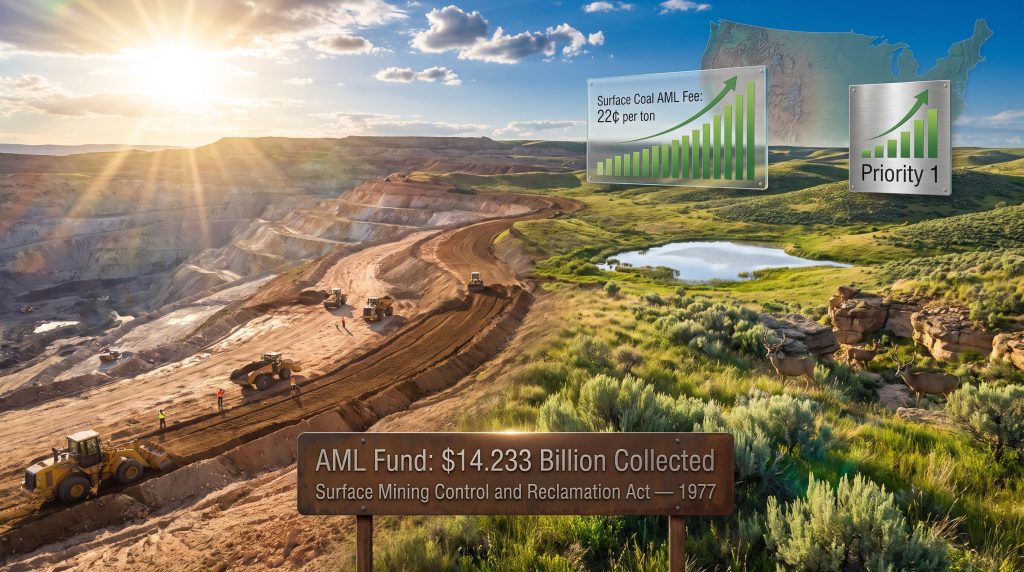
The fund is capitalised through per-ton fees levied on all active coal production. Surface operations pay 22 cents per ton, while underground mines pay approximately 9 cents per ton, reflecting the smaller surface disturbance footprint of subsurface extraction. As of September 2025, total collections have reached $14.233 billion since the programme's inception.
States and tribes with federally certified AML programmes receive priority access to fund disbursements and retain greater flexibility in how allocations are spent. Non-certified jurisdictions receive grants under more constrained conditions. This certification structure creates a tangible incentive for states to maintain strong reclamation governance frameworks.
The Priority Classification System for Abandoned Mine Sites
Not all abandoned sites present equal hazards, and the AML programme uses a priority classification system to sequence remediation funding toward the most urgent cases first.
Table: AML Priority Classification System
| Priority Level | Type of Hazard | Examples |
|---|---|---|
| Priority 1 | Threat to public health and safety | Open shafts, unstable highwalls, toxic water discharge |
| Priority 2 | Threat to property | Subsidence, erosion, structural instability |
| Priority 3 | Environmental degradation without direct safety risk | Acid mine drainage, habitat loss, aesthetic degradation |
Priority 3 classification does not imply low importance. Acid mine drainage from pre-1977 sites remains one of the most persistent and expensive reclamation challenges in the country. Drainage from abandoned coal and metal mines acidifies streams, mobilises heavy metals, and can persist for decades or centuries without active treatment. The chemistry involved is essentially self-sustaining: once sulfide minerals in exposed waste rock begin oxidising, they generate sulphuric acid that accelerates further oxidation in an ongoing cycle that passive revegetation cannot arrest.
The next major ASX story will hit our subscribers first
The Regulatory Gap Between Coal and Hardrock Mining
Why Gold, Copper, and Silver Mines Operate Under Different Rules
One of the least well-understood aspects of mine reclamation in the United States is the fundamental regulatory divide between coal and hardrock minerals. SMCRA applies exclusively to coal surface mining. Gold, copper, silver, molybdenum, lithium, and all other non-coal metals and minerals are not subject to any equivalent federal reclamation statute for active operations. They are governed primarily by state law, and the stringency of those requirements varies considerably across jurisdictions.
This gap has historical roots. The General Mining Law of 1872 — which still governs hardrock mineral claims on federal lands — contains no reclamation provisions. It was designed to encourage settlement and resource exploitation, not environmental stewardship. For over a century, this framework left hardrock mine reclamation entirely to state discretion. In addition, the broader challenges around natural capital in mining highlight why environmental accountability must extend beyond coal to all extractive industries.
The absence of a unified federal reclamation standard for hardrock mining represents one of the longest-standing structural gaps in American environmental law, and its consequences are visible in the thousands of abandoned metal mine sites that continue to generate contamination across the western United States.
The 2021 Infrastructure Act and the New Hardrock Reclamation Programme
The Infrastructure Investment and Jobs Act of 2021 introduced the Abandoned Hardrock Mine Reclamation (AHMR) Program, the first federal initiative specifically designed to address legacy contamination from abandoned hardrock mines on federal and tribal lands. This is an important legislative step, though it is narrowly targeted at pre-existing abandoned sites rather than establishing new reclamation requirements for active hardrock operations.
The AHMR programme does not extend SMCRA-equivalent standards to new hardrock projects. Active hardrock mine reclamation on federal lands remains governed primarily through state programmes and, where applicable, conditions attached to surface use permits under the Federal Land Policy and Management Act (FLPMA). The regulatory architecture for hardrock mining thus remains fundamentally fragmented compared to the unified federal framework that governs coal.
Nevada's Excellence in Mine Reclamation Awards as a State-Level Benchmark
Nevada has developed one of the more rigorous state-level frameworks for hardrock mine reclamation, and its Excellence in Mine Reclamation Awards programme has become a meaningful industry benchmark. Recognition under this programme reflects performance that exceeds minimum regulatory requirements, creating reputational incentives for operators to invest in higher-quality restoration.
Kinross Gold's Bald Mountain operation in Nevada has received recognition through this programme. The reclamation work at Bald Mountain combined revegetation with habitat restoration specifically designed to support mule deer migration corridors and native ecosystem connectivity — outcomes that go considerably beyond stabilising disturbed ground. Nevada Gold Mines earned similar recognition for its Butte Canyon Historic Waste Rock Facility project, which tackled the complex challenge of stabilising pre-regulation waste dumps and establishing vegetation capable of persisting in Nevada's arid, low-rainfall environment.
What Award-Winning Reclamation Reveals About Industry Best Practice
From Grazing Land Restoration to Wetland Recovery
OSMRE's National Excellence in Surface Coal Mining Reclamation Awards programme provides an annual survey of the highest-performing reclamation projects in the country. Winning projects have included restorations to wetlands, native forests, productive agricultural land, and wildlife habitat, often with measurable improvements in water quality and biodiversity compared to pre-mining conditions.
Peabody Western Coal Company's reclamation work at the former Kayenta Mine in Arizona exemplifies what collaborative post-mining land use planning can achieve. Working in partnership with the Navajo Nation, the company established native grasses, shrubs, and other vegetation that have created productive grazing land for livestock. The project earned OSMRE's national recognition, with the agency noting that restored areas now integrate naturally into the surrounding landscape while delivering practical economic benefits to local communities.
OSMRE's position is that the highest-quality reclamation projects return land to a condition of equal or better beneficial use compared to its pre-mining state. This standard, when genuinely achieved, reframes reclamation not as environmental mitigation but as land improvement. The broader pursuit of mining sustainability transformation reflects this same philosophy at an industry-wide level.
Reclaiming Legacy Waste Facilities in Arid Environments
Arid-region reclamation presents specific technical challenges that do not apply in wetter climates. Low annual rainfall limits plant establishment, high evaporation rates stress newly seeded vegetation, and the absence of natural seed banks in heavily disturbed soils means that revegetation must often be actively engineered rather than passively encouraged.
Nevada Gold Mines' Butte Canyon project addressed exactly these constraints through targeted species selection, erosion-resistant cover materials, and slope stabilisation designed for the geotechnical characteristics of legacy waste rock rather than engineered fill. Achieving vegetation persistence on such structures requires understanding both the physical stability of the substrate and the water-holding characteristics that determine whether plant roots can access moisture during dry periods.
Mine Reclamation and the U.S. Energy Transition
Why Critical Mineral Demand Is Intensifying Reclamation Scrutiny
The accelerating demand for copper, lithium, cobalt, and rare earth elements to support electric vehicle manufacturing, grid-scale battery storage, and renewable energy infrastructure is creating a paradox for the mining sector. The very materials needed to decarbonise the energy system must be extracted from the ground, and the environmental credibility of that extraction increasingly depends on demonstrated reclamation performance. Consequently, the relationship between critical minerals and energy transition is placing reclamation credibility at the very centre of project approval debates.
For investors, regulators, and the communities hosting new mineral projects, the question of what a mine site will look like in 30 years is no longer hypothetical. Social licence — the informal acceptance by affected communities that a project can proceed — is increasingly conditional on operators demonstrating credible post-mining land use plans and financial assurance structures that are genuinely proportionate to the reclamation obligations they cover.
Former Mine Sites as Candidates for Renewable Energy Development
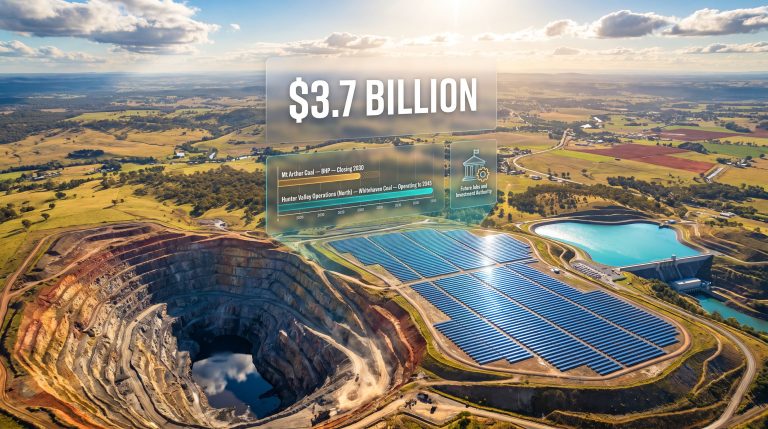
One emerging strategy that aligns reclamation objectives with energy transition goals is the conversion of post-mining land to solar or wind energy facilities. Flat, graded reclaimed surfaces with existing grid connections and industrial zoning represent potentially attractive sites for renewable energy infrastructure. Several federal agencies have identified brownfield and post-industrial sites as priority candidates for clean energy development, and former mine lands fit this category in many respects. Furthermore, renewable energy in mining is increasingly being seen as both an operational strategy and a post-closure land use opportunity.
This pathway does not eliminate reclamation obligations, but it can create a commercial rationale for investing in post-mining land improvements beyond the minimum regulatory standard, since renewable energy developers require stable, well-characterised surface conditions rather than raw disturbed ground.
Key Challenges Facing Mine Reclamation Today
The AML Fund has collected over $14 billion since 1977, but the total cost of reclaiming all priority abandoned mine sites in the United States substantially exceeds current fund balances. The gap between collections and cleanup costs reflects both the sheer scale of pre-1977 legacy contamination and the long time horizons involved in ecological restoration.
Climate variability adds a further layer of uncertainty. Revegetation success rates on reclaimed sites depend heavily on precipitation patterns during establishment years. In regions experiencing increasing drought frequency or altered seasonal rainfall distribution, vegetation communities that once established reliably are now showing higher failure rates, requiring operators and regulators to revisit species selection and planting protocols.
Workforce capacity is also a constraint that receives less attention than financial or ecological factors. High-quality reclamation planning requires expertise in soils science, hydrology, ecology, and geotechnical engineering simultaneously. As the reclamation workload grows — both from new mine closures and the expanding AML programme — the pipeline of qualified practitioners has not kept pace with demand in all regions.
Frequently Asked Questions: Mine Reclamation in the United States
What Law Governs Mine Reclamation in the United States?
The primary federal statute is the Surface Mining Control and Reclamation Act (SMCRA) of 1977, which applies to coal surface mining. Hardrock mineral reclamation is regulated primarily at the state level, with the Infrastructure Investment and Jobs Act of 2021 introducing the first federal programme specifically targeting abandoned hardrock sites on federal and tribal lands.
What Is the Abandoned Mine Land Fund?
The AML Fund is a federal account established under SMCRA Title IV, financed through per-ton fees on active coal production. It funds the reclamation of hazardous sites abandoned before 1977. As of September 2025, cumulative collections have reached $14.233 billion.
What Is Concurrent Reclamation?
Concurrent reclamation is the practice of restoring previously mined sections of a site while extraction continues elsewhere. It is widely regarded as best practice because it reduces the peak environmental liability associated with mine closure, accelerates ecosystem recovery, and distributes reclamation costs across the operational life of the mine rather than concentrating them at closure.
How Are Reclamation Bonds Calculated?
Bonds are sized to cover the estimated cost of completing all reclamation obligations if an operator defaults. Regulators assess site-specific variables including total disturbed acreage, complexity of the restoration plan, site hydrology, vegetation establishment challenges, and any long-term water treatment requirements. Bond amounts therefore vary considerably across sites and regions.
What Is the Forestry Reclamation Approach?
The FRA is a set of evidence-based best-management practices for restoring coal-mined land to native forest. Its core principle is that loose grading, appropriate native species selection, and minimal post-planting compaction produce substantially better reforestation outcomes than the traditional heavily compacted reclamation methods that preceded it.
Do Hardrock Mines Face the Same Reclamation Requirements as Coal Mines?
No. SMCRA does not apply to hardrock mining. Active hardrock operations are regulated under state law, with significant variation in reclamation standards across jurisdictions. The 2021 Infrastructure Act created a new federal programme for abandoned hardrock sites on federal and tribal lands, but this does not impose SMCRA-equivalent standards on new hardrock projects.
Key Takeaways: The State of Mine Reclamation in the United States
Summary Statistics Table
| Indicator | Data Point |
|---|---|
| Year SMCRA enacted | 1977 |
| AML Fund total collections (to September 2025) | $14.233 billion |
| Surface coal AML fee rate | 22 cents per ton |
| Underground coal AML fee rate | ~9 cents per ton |
| States with primacy under SMCRA | Majority of coal-producing states |
| States with pre-existing reclamation programmes (mid-1970s) | 38 states |
| New federal hardrock programme established | 2021 (Infrastructure Investment and Jobs Act) |
-
Mine reclamation in the United States operates under a fundamentally split regulatory structure: federal SMCRA authority for coal and a state-dominant framework for hardrock minerals, with the 2021 Infrastructure Act beginning to close the hardrock legacy gap on federal lands.
-
Financial assurance through bonding is the primary mechanism that gives regulatory requirements genuine teeth, ensuring reclamation proceeds even when operators become insolvent.
-
The AML Fund, financed by fees on active coal production, represents one of the most ambitious legacy site remediation programmes in global mining governance, though the scale of unreclaimed sites continues to exceed available funding.
-
Concurrent reclamation is emerging as the defining standard that separates leading operators from minimum-compliance performers, with measurable benefits for both ecological outcomes and long-term financial liability management.
-
The energy transition is raising the stakes for reclamation performance: as new critical mineral projects advance, demonstrated reclamation credibility is becoming an increasingly important factor in securing both regulatory approvals and community acceptance.
Readers interested in ongoing coverage of environmental mining practices and reclamation case studies across the United States can explore related industry reporting at Mining and Minerals Today (m-mtoday.com), which publishes regular analysis on sustainability and land stewardship across the U.S. mining sector.
Want to Stay Ahead of the Next Major Mineral Discovery on the ASX?
Discovery Alert's proprietary Discovery IQ model delivers real-time alerts the moment significant ASX mineral discoveries are announced, transforming complex geological data into actionable investment insights for both short-term traders and long-term investors. Explore historic examples of major discoveries and the returns they generated, then begin your 14-day free trial at Discovery Alert to position yourself ahead of the broader market.