May 21, 2026
Understanding Mine Rehabilitation Financial Frameworks in Western Australia
Mining companies operating across Australia face complex financial obligations that extend decades beyond active extraction. These responsibilities encompass comprehensive site restoration, environmental monitoring, and long-term stewardship commitments that can fundamentally reshape corporate balance sheets and regional economic planning. Understanding how these frameworks operate becomes particularly crucial when examining high-profile cases where griffin coal mine rehabilitation costs may exceed initial estimates by substantial margins.
Legislative Requirements for Coal Mine Closure Costs
Western Australia's regulatory environment establishes rehabilitation obligations through individually negotiated mining agreements rather than standardised formulas. Under the Mining Act 1978 (Amended), operators must demonstrate financial capacity for site restoration before receiving operational approval, though specific bonding percentages vary significantly across different projects.
The Department of Energy, Mines, Industry Regulation and Safety (DEMIRS) oversees these agreements, which typically specify rehabilitation timelines, environmental standards, and monitoring requirements. However, enforcement mechanisms and adequacy reviews occur at intervals determined by original agreement terms rather than standardised regulatory schedules.
Griffin coal mine rehabilitation costs present a particularly complex case study within this framework, as the Collie operation operates under mining agreements that predate current best practices for rehabilitation bonding. Industry analysis suggests that legacy agreements often contain provisions that may prove inadequate when measured against contemporary environmental restoration standards.
The Role of Mining Rehabilitation Bonds in Risk Management
Australian mining bonds typically range from 15-50% of estimated rehabilitation costs, though no uniform national standard exists. These financial instruments serve as insurance policies for taxpayers, theoretically ensuring that site restoration proceeds regardless of operator financial stability.
Traditional bonding mechanisms include:
- Direct cash bonds held in escrow accounts
- Irrevocable parent company guarantees
- Dedicated rehabilitation trust funds
- Insurance instruments (less common due to perpetuity concerns)
However, fixed-amount bonds often become inadequate due to inflation over 20-50+ year monitoring periods. The challenge intensifies when considering that rehabilitation cost estimates frequently prove conservative compared to actual remediation expenses encountered during implementation.
How Insolvency Affects Environmental Liability Transfer
Australian insolvency law creates a problematic hierarchy where environmental liabilities rank below secured creditors, employee entitlements, and general creditors under the Corporations Act 2001. This statutory priority structure means that when mining companies enter administration, rehabilitation obligations often receive minimal recovery from available assets.
When operators become insolvent and bonds prove insufficient, environmental restoration becomes a de facto public sector liability with no clear funding mechanism. This legal framework effectively transfers long-term environmental risks from private entities to taxpayers, creating what environmental economists term "socialised cleanup costs."
When big ASX news breaks, our subscribers know first
What Are the True Costs of Coal Mine Site Restoration?
Environmental remediation expenses vary dramatically based on geological conditions, mining depth, contamination extent, and regulatory requirements. Accurate cost estimation requires sophisticated lifecycle analysis rather than simplified fixed-term projections, as many restoration obligations continue for decades after active operations cease.
Environmental Remediation Components and Pricing
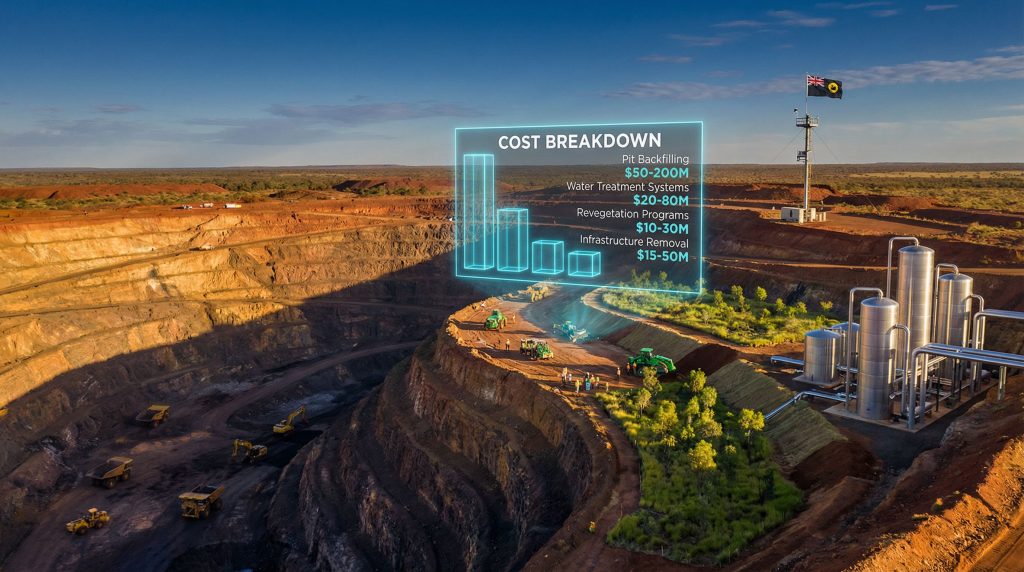
Coal mine rehabilitation encompasses multiple technical and financial components, each presenting unique challenges and cost variations. Understanding these elements becomes essential when evaluating whether existing bonds adequately protect public interests.
| Component | Cost Factors | Timeline Considerations |
|---|---|---|
| Pit Backfilling | Volume, depth, material transport costs | 5-15 years depending on pit size |
| Water Treatment Systems | Acid mine drainage severity, treatment technology | 20-50+ years of operational costs |
| Revegetation Programs | Climate conditions, species selection, soil preparation | 3-7 years establishment period |
| Infrastructure Removal | Equipment complexity, access limitations | 2-4 years for complete dismantling |
Griffin coal mine rehabilitation costs illustrate the complexity of accurate estimation, as the Collie site presents unique hydrological challenges due to its proximity to water table systems and historical mining practices. Independent analysis suggests that water treatment obligations alone could require decades of ongoing operational expenditure.
Revegetation costs typically range from AUD $5,000-$50,000 per hectare, varying significantly based on climate conditions and species selection requirements. However, these figures represent establishment costs only, excluding long-term maintenance and replacement obligations.
Contamination Remediation in Legacy Mining Sites
Australia maintains an estimated 50,000+ abandoned or legacy mining sites, though accurate figures vary depending on size thresholds and contamination definitions. Legacy coal mining operations frequently generate acid mine drainage, heavy metal soil contamination, and groundwater pollution requiring perpetual management systems.
Sulfide-bearing waste rock generates sulfuric acid when exposed to oxygen and water, mobilising heavy metals including zinc, copper, and arsenic into surrounding environmental systems. This process continues for decades or centuries without active management, making the concept of "completed" rehabilitation increasingly questionable in environmental science.
Remedial technologies available include:
- Neutralisation systems: Chemical treatment of acidic drainage
- Soil excavation and containment: Physical removal of contaminated materials
- Groundwater pump-and-treat systems: Continuous water quality management
- Bioremediation approaches: Biological treatment of contaminated media
Each approach presents different cost profiles and effectiveness limitations, with many sites requiring multiple technologies operating simultaneously over extended periods.
Long-term Monitoring and Maintenance Obligations
Monitoring requirements typically extend 20-50+ years post-closure for coal mines with acid mine drainage risk, creating ongoing operational expenses often underestimated in initial cost projections. Industry cost modelling suggests that annual monitoring expenses range from 5-15% of initial remediation capital costs, though site-specific variations prove substantial.
Environmental monitoring protocols encompass:
- Water quality sampling: Heavy metals, pH, conductivity analysis
- Groundwater level measurements: Hydrological system assessment
- Surface subsidence surveys: Structural stability monitoring
- Vegetation health assessment: Ecosystem recovery evaluation
Modern monitoring increasingly incorporates automated sensor networks and remote sensing technologies, reducing field visit costs while requiring significant capital investment in monitoring infrastructure.
How Do Mining Companies Secure Rehabilitation Funding?
Mining companies employ various financial instruments to demonstrate rehabilitation capacity, though these mechanisms often prove inadequate when tested against actual restoration costs or operator insolvency scenarios. Furthermore, companies looking to expand operations may explore various capital raising methods to fund both operational expansion and rehabilitation obligations.
Traditional Bonding Mechanisms and Their Limitations
Traditional bonding approaches assume that rehabilitation costs remain stable over time and that bonds will be available when needed. However, these assumptions frequently prove incorrect when examined against real-world implementation challenges.
Key limitations include:
- Inflation erosion: Fixed bonds lose purchasing power over decades
- Scope underestimation: Initial assessments often miss contamination extent
- Technology changes: New environmental standards require upgraded remediation
- Operator insolvency: Bonds may be insufficient when companies fail
Griffin coal mine rehabilitation costs exemplify these challenges, as the operation's mining agreement predates current rehabilitation cost estimation methodologies and may not account for contemporary environmental restoration standards.
Corporate Guarantee Structures in the Resources Sector
Parent company guarantees create apparent financial security while depending entirely on continued corporate solvency. ASX Listing Rules require disclosure of material contingent liabilities, including mining rehabilitation obligations, though specific financial thresholds vary across different operations.
Corporate guarantee structures prove vulnerable because they depend on parent company financial stability. Australian insolvency law prioritises secured creditors and employee entitlements above environmental obligations, meaning that guarantees may provide minimal recovery when most needed.
Government-Backed Rehabilitation Programs
Western Australia lacks comprehensive government rehabilitation programs comparable to structured systems operating in some Canadian provinces. Instead, the state relies on case-by-case negotiation through individual mining agreements, creating inconsistency and potential vulnerability when operators encounter financial difficulties. The broader wa resource sector impact on the state economy creates complex policy considerations when developing rehabilitation frameworks.
Mining regulation falls primarily under state jurisdiction, with limited Commonwealth involvement in rehabilitation funding mechanisms. This division of responsibility can create coordination challenges when rehabilitation costs exceed state budgetary planning.
Why Do Taxpayers Bear Coal Mine Cleanup Costs?
Australian legal and regulatory frameworks create conditions where environmental restoration costs ultimately transfer to public sector balance sheets when private operators fail to fulfil obligations. In addition, these frameworks significantly influence the broader mining industry innovation landscape.
Insolvency Protection Laws and Environmental Liabilities
Environmental liabilities rank below secured creditors, employee entitlements, and general creditors under the Corporations Act 2001, creating a statutory framework that effectively prioritises financial obligations over environmental restoration.
When mining companies enter administration, environmental obligations often rank below secured creditors, leaving governments as the ultimate guarantor of site restoration.
This legal priority structure means that rehabilitation bonds and corporate guarantees may provide minimal recovery during insolvency proceedings, transferring restoration costs to taxpayers by default rather than design.
The Economics of Stranded Coal Assets
Energy transition policies create market conditions where coal mining operations may become economically unviable before rehabilitation obligations are fulfilled. Stranded asset scenarios intensify rehabilitation cost concerns because operators may lack financial incentives to complete restoration work when future revenue streams disappear.
Griffin coal mine rehabilitation costs become particularly relevant in this context, as changing energy markets may affect the long-term viability of Collie coal operations and associated rehabilitation funding capacity.
Political Considerations in Energy Transition Planning
Government policy makers face complex trade-offs between supporting economic transition and managing environmental liability transfer. Rehabilitation cost obligations can influence political decisions about mine closure timelines and transition support programs.
Regional economic considerations often compete with environmental restoration priorities, creating political pressure to minimise immediate rehabilitation expenditure while potentially increasing long-term costs.
What Factors Drive Rehabilitation Cost Variations?
Site-specific factors create substantial variations in rehabilitation cost estimates, making standardised bonding approaches problematic for ensuring adequate funding coverage. Moreover, these variations significantly impact comprehensive mine reclamation insights across different operational contexts.
Site-Specific Geological and Hydrological Challenges
Geological conditions fundamentally determine rehabilitation complexity and associated costs. Factors including groundwater proximity, acid mine drainage potential, slope stability, and contamination extent vary dramatically across different sites.
Critical geological factors include:
- Sulfide mineral content: Determines acid generation potential
- Groundwater interaction: Affects long-term treatment requirements
- Slope stability conditions: Influences pit wall management needs
- Soil contamination extent: Determines remediation scope requirements
Griffin coal mine rehabilitation costs reflect the unique challenges presented by Collie's geological environment, including its proximity to significant water systems and historical mining practices that may complicate restoration efforts.
Historical Mining Practices and Modern Standards
Legacy mining operations often employed practices that increase rehabilitation complexity when measured against contemporary environmental standards. Historical waste disposal, chemical usage, and land management approaches can create contamination challenges not anticipated in original cost estimates.
Modern rehabilitation standards require comprehensive ecosystem restoration rather than simple site stabilisation, increasing both technical complexity and financial requirements compared to historical approaches. Consequently, operators must integrate comprehensive waste management solutions throughout their operational lifecycles.
Scale and Duration of Operations Impact on Final Costs
Larger mining operations typically generate greater rehabilitation obligations, though economies of scale may reduce per-unit restoration costs. Operation duration affects contamination accumulation and infrastructure complexity, influencing final restoration requirements.
Long-term operations often create legacy challenges including extensive subsurface workings, accumulated waste materials, and infrastructure systems requiring specialised removal techniques.
How Do International Models Handle Mining Closure Costs?
International rehabilitation frameworks provide alternative approaches to managing mining closure costs, offering potential models for strengthening Australian systems.
Canadian Progressive Reclamation Requirements
Canadian mining jurisdictions typically require progressive reclamation during active operations, reducing final closure costs and demonstrating rehabilitation feasibility throughout mine life. This approach spreads rehabilitation expenses across operational periods rather than concentrating costs at closure.
Progressive reclamation systems also provide opportunities to test restoration techniques and adjust approaches based on observed outcomes, potentially improving final rehabilitation effectiveness.
United States SMCRA Bonding Systems
The Surface Mining Control and Reclamation Act (SMCRA) establishes comprehensive bonding requirements for coal mining operations, including standardised bond calculation methodologies and regular adequacy reviews.
SMCRA systems require bonds sufficient to complete rehabilitation using third-party contractors, providing more robust cost estimation than operator-generated estimates common in Australian practice.
European Union Extractive Waste Directive Compliance
EU frameworks emphasise prevention of environmental damage through comprehensive planning and financial assurance requirements that address long-term liability management.
European approaches typically require detailed closure planning before operational approval, with regular updates based on changing environmental standards and operational experience.
The next major ASX story will hit our subscribers first
What Are the Long-term Fiscal Implications for State Governments?
State governments must develop budget planning frameworks that account for potential environmental liabilities when mining operators fail to fulfil rehabilitation obligations.
Budget Planning for Unfunded Environmental Liabilities
State governments must allocate significant contingency funds for coal mine rehabilitation, with costs potentially exceeding $1 billion across multiple sites requiring decades-long restoration programs.
Griffin coal mine rehabilitation costs represent one component of broader state-level environmental liability planning, requiring Western Australia to maintain budgetary capacity for potential rehabilitation assumption.
Budget planning challenges include:
- Long-term liability estimation: Difficulty projecting costs decades into the future
- Multiple site coordination: Managing simultaneous rehabilitation projects
- Technology cost uncertainty: Changing remediation standards and techniques
- Political priority competition: Balancing environmental spending against other needs
Resource Sector Transition and Legacy Obligation Management
Energy transition policies may accelerate mine closure timelines while leaving rehabilitation obligations intact, intensifying state government financial responsibilities during transition periods.
Transition planning requires coordination between economic development policies and environmental liability management to prevent creating unfunded mandates for future governments.
Intergenerational Equity in Environmental Restoration Funding
Current policy frameworks may transfer environmental restoration costs to future generations through inadequate present-day bonding and monitoring systems.
Intergenerational equity considerations suggest that rehabilitation costs should be fully internalised by mining operations rather than transferred to future taxpayers through inadequate funding mechanisms.
How Can Mining Rehabilitation Frameworks Be Strengthened?
Policy reforms could reduce public sector rehabilitation cost exposure while maintaining resource sector economic contributions.
Enhanced Bonding Requirements and Regular Reviews
Bonding adequacy reviews could occur at regular intervals with adjustments for inflation, changing environmental standards, and operational experience rather than relying on original estimates throughout mine life.
Enhanced bonding systems might include:
- Inflation-indexed bond amounts: Maintaining purchasing power over time
- Regular cost estimate updates: Reflecting changing conditions and standards
- Independent verification requirements: Third-party cost assessment
- Technology upgrade provisions: Accounting for evolving remediation techniques
Progressive Rehabilitation During Active Operations
Progressive rehabilitation requirements could reduce final closure costs while demonstrating restoration feasibility throughout operations, similar to Canadian provincial models.
Progressive approaches provide opportunities to test rehabilitation techniques and adjust methodologies based on observed outcomes, potentially improving overall restoration effectiveness.
Industry-Wide Rehabilitation Insurance Mechanisms
Industry-wide insurance or mutual fund systems could spread rehabilitation risks across multiple operators rather than concentrating exposure with individual companies.
Collective insurance mechanisms could provide more stable funding sources while reducing individual operator cost burdens through risk pooling approaches.
What Role Do Environmental Consultants Play in Cost Estimation?
Environmental consulting firms provide technical assessments that form the basis for rehabilitation cost estimates, though these assessments may face inherent conflicts of interest when consultants are retained by mining operators.
Technical Assessment Methodologies
Environmental consultants employ various assessment methodologies including site characterisation studies, contamination analysis, and restoration feasibility assessments to generate cost estimates.
Assessment quality depends on available data, site access, and investigation scope, with limited assessments potentially underestimating rehabilitation requirements and associated costs.
Risk-Based Costing Models for Complex Sites
Risk-based assessment approaches attempt to account for uncertainty in rehabilitation cost estimation through scenario modelling and probabilistic analysis.
Griffin coal mine rehabilitation costs would benefit from risk-based modelling that accounts for geological uncertainty, regulatory change potential, and technology evolution over extended time horizons.
Independent Verification of Company Estimates
Independent cost verification provides regulatory assurance that operator-generated estimates adequately protect public interests, though independent verification requirements vary across jurisdictions.
Third-party verification systems could reduce conflicts of interest while providing more robust cost estimates for bonding and budget planning purposes.
Frequently Asked Questions About Coal Mine Rehabilitation Costs
Understanding common rehabilitation cost questions helps clarify public policy implications and individual taxpayer exposure scenarios.
Who ultimately pays when mining companies become insolvent?
When mining companies enter insolvency, environmental rehabilitation obligations typically rank below secured creditors and employee entitlements, meaning that government agencies often assume restoration responsibilities using taxpayer funding.
How accurate are company-provided rehabilitation cost estimates?
Company-provided estimates frequently prove conservative compared to actual restoration costs due to scope underestimation, inflation effects, and changing environmental standards over multi-decade timeframes.
What happens to mining sites that remain unremediated?
Unremediated mining sites can generate ongoing environmental damage including acid mine drainage, groundwater contamination, and ecosystem degradation that may require eventual government intervention.
Can rehabilitation costs be recovered from parent companies?
Parent company guarantee enforcement depends on corporate structure and solvency status, with recovery potential limited when parent companies also enter insolvency proceedings.
Future Policy Directions for Mining Site Restoration
Policy development trends suggest increasing emphasis on prevention rather than remediation, with enhanced bonding requirements and progressive rehabilitation becoming more common.
Renewable Energy Transition and Closure Planning
Energy transition policies may accelerate coal mine closure timelines, requiring coordination between economic transition support and environmental restoration obligation management.
Griffin coal mine rehabilitation costs become particularly relevant in transition planning scenarios where changing energy markets affect long-term operational viability and associated restoration funding capacity.
Enhanced Corporate Accountability Measures
Enhanced accountability measures might include personal director liability for environmental obligations, strengthened parent company guarantee requirements, and extended corporate liability periods.
Regional Economic Diversification Strategies
Regional economic diversification planning could reduce community dependence on mining operations while ensuring adequate financial capacity for rehabilitation obligation fulfilment.
Economic diversification strategies require coordination between industrial development policies and environmental liability management to support transition while protecting taxpayer interests.
This analysis is intended for educational purposes and does not constitute financial, legal, or investment advice. Readers should consult qualified professionals for guidance specific to their circumstances. The mining industry involves inherent risks, and rehabilitation cost estimates contain significant uncertainty that may affect actual outcomes.
Looking for Opportunities in ASX Mining Stocks?
Discovery Alert's proprietary Discovery IQ model delivers real-time notifications on significant ASX mineral discoveries, empowering subscribers to identify actionable opportunities ahead of the broader market. With mining rehabilitation frameworks evolving and creating new investment considerations, stay informed about major discoveries that have generated substantial returns and begin your 14-day free trial today to secure your market-leading advantage.