May 17, 2026
The Invisible Infrastructure Holding Commodity Trade Together
Physical commodity markets operate on a foundation most outsiders never see. Long before a payment clears or a shipment is confirmed, a quiet but commercially decisive process unfolds in spreadsheets, email chains, and disconnected laboratory portals. This process is assay management, and for decades it has sat at the intersection of scientific measurement and financial settlement, shaping the monetary value of every tonne of metal concentrate that changes hands.
In base metal concentrate trading, the price a buyer pays is rarely fixed at the point of contract. It adjusts based on the precise elemental composition of the material delivered, verified independently by buyers, sellers, and third-party umpire laboratories. When those three sets of assay results agree, settlement flows smoothly. When they diverge, the consequences are immediate and financial: disputed invoices, delayed payments, and protracted reconciliation cycles that consume operational resources and introduce cash flow risk.
What makes this dynamic particularly striking is that, despite enormous technology investment across commodity supply chains over the past two decades, assay management remained stubbornly anchored to manual methods. The workflow resisted digitisation not because solutions were impossible to imagine, but because the multi-party nature of the process created a coordination problem. Furthermore, any digital tool that required buyers, sellers, and laboratories to all participate simultaneously faced an adoption ceiling that few technology providers could break through.
Key Insight: In physical commodity markets, assay data functions as the commercial record of truth. The elemental grade of a copper, zinc, or lead concentrate shipment directly determines the invoice value. Errors or delays in assay reconciliation are not administrative inconveniences. They translate directly into monetary discrepancies and settlement friction.
When big ASX news breaks, our subscribers know first
How MineHub Assay Manager Evolved From Network Tool to Standalone System
Understanding what MineHub Assay Manager is today requires understanding what it grew out of. TSX-V listed MineHub Technologies has spent several years building toward a fully integrated digital infrastructure for physical commodity supply chains, and its approach to assay management reflects a deliberate architectural evolution rather than a single product launch.
2021: Building the Digital Exchange Foundation
The earliest iteration of MineHub's assay capability was designed as a multi-party exchange platform. The core objective was to replace email and phone-based assay communications with a structured digital environment where buyers, sellers, and laboratories could exchange verified data. The blockchain-secured architecture provided an immutable audit trail, reducing manual re-entry errors and shortening settlement timelines for participants who adopted the system together.
The limitation of this model was inherent in its design. Value depended on ecosystem participation. If a seller's buyer was unwilling or unable to join the platform, the seller could not realise the efficiency gains, regardless of how compelling the technology was.
2024: Adding Intelligence to the Exchange Layer
The Assay Exchange Dashboard expanded the platform's analytical capabilities, introducing real-time shipment tracking, laboratory performance monitoring, and third-party data integration. This release achieved something measurable: users reported reductions of up to 10 days in assay exchange turnaround times, a substantial improvement in an industry where delayed assay receipt directly delays payment processing.
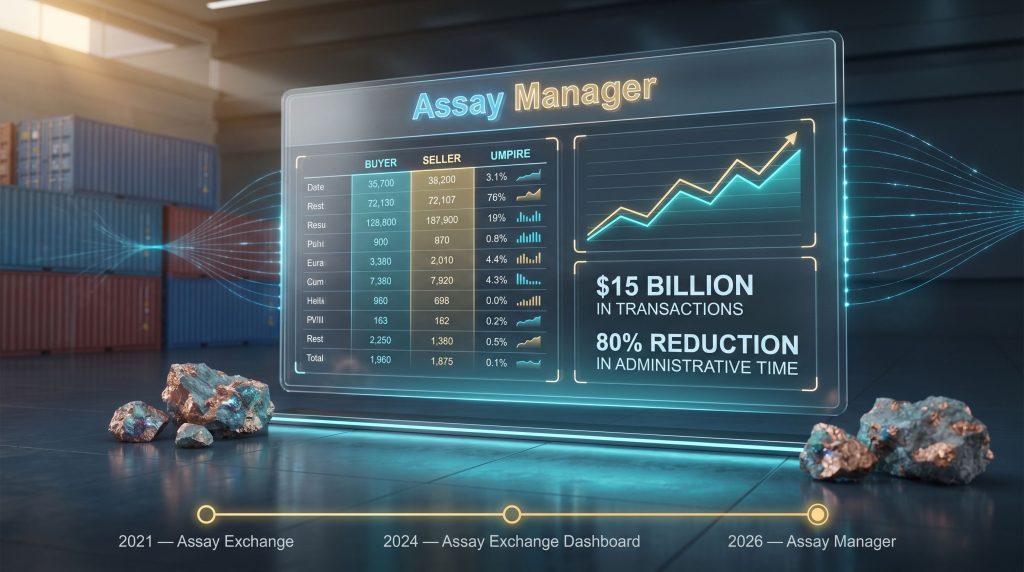
By this stage, MineHub had processed over $15 billion in transactions across its platform, with users documenting up to 80% reductions in administrative time, equating to approximately $1.2 million per year in operational savings per organisation. These figures established the scale of value the platform could deliver, but the counterparty dependency constraint remained.
2026: The Architectural Shift That Changes the Market
On May 6, 2026, MineHub Technologies launched MineHub Assay Manager, and the distinction from everything that preceded it is structural rather than incremental. The counterparty participation requirement, which had been the primary constraint on adoption since the platform's inception, was removed entirely.
| Platform Stage | Year | Core Capability | Counterparty Dependency |
|---|---|---|---|
| Assay Exchange | 2021 | Multi-party digital exchange, blockchain-secured | Required |
| Assay Exchange Dashboard | 2024 | Real-time analytics, lab performance tracking, 10-day turnaround reduction | Required |
| Assay Manager | 2026 | Standalone workflow, invoice reconciliation, live dashboards, umpire win rate tracking | Not required |
This shift transforms MineHub's commercial proposition from a network platform requiring bilateral buy-in to a productivity tool that any commodity producer, trader, or buyer can deploy unilaterally as an internal system.
What MineHub Assay Manager Actually Does: A Functional Breakdown
MineHub Assay Manager is a purpose-built digital module that covers the complete assay management lifecycle within a single integrated environment. It does not require counterparties to hold MineHub accounts, making it deployable as a fully internal workflow system regardless of what technology a buyer or seller uses on their side of the transaction.
The platform's CEO Andrea Aranguren has described the tool as giving customers full control of their assay workflows, from initial data upload through to invoice reconciliation and end-of-month reporting, entirely within the MineHub platform. The emphasis on end-to-end coverage within a single system is deliberate. The fragmentation of existing workflows across multiple tools and communication channels is precisely what creates both errors and delays.
Multi-Party Assay Comparison and Commercial Modelling
The comparison engine allows users to upload and review buyer, seller, and umpire assay results side by side within a single structured digital environment. This eliminates the current practice of manually reconciling data from separate email threads, laboratory portals, and spreadsheet files maintained by different teams across different systems.
Beyond simple comparison, the modelling capability enables scenario analysis. Users can assess the commercial impact of assay variances before settlement is finalised, providing decision-makers with financial visibility at the point where it can still influence outcomes rather than after discrepancies have already generated disputed invoices.
Live Analytics and Umpire Win Rate Tracking
One of the less-discussed but strategically significant features of MineHub Assay Manager is umpire win rate tracking. In commodity concentrate trading, when buyer and seller assay results diverge beyond a contractually defined tolerance, a third-party umpire laboratory is engaged to provide a binding determination. The umpire's result typically dictates which value applies to the final settlement.
Industry-Specific Insight: Umpire laboratory selection is rarely discussed publicly, but it carries substantial financial consequences. Over a portfolio of shipments, systematic differences in how laboratories measure certain elements can produce biased outcomes that favour one counterparty. Tracking umpire win rates over time gives a trader or producer an evidence base for selecting laboratories that produce genuinely independent results, rather than relying on habit or relationship.
The live analytics module creates a structured historical repository of all assay data, making this longitudinal performance analysis possible in a systematic way for the first time. Previously, any such analysis would have required manual aggregation of records scattered across email archives and spreadsheets spanning multiple years.
Automated Reporting and Invoice Reconciliation
The reporting function eliminates manual compilation of end-of-month assay summaries, generating structured, audit-ready outputs suitable for internal review, counterparty communication, and compliance documentation. For operations processing high volumes of shipments, the time savings from automating this single function are material.
Invoice reconciliation directly connects assay outcomes to financial settlement workflows. This integration addresses one of the most consequential failure points in traditional processes: the manual handoff between the assay team and the finance team, where discrepancies can be carried uncorrected into invoice generation and only discovered after payment obligations have been formalised.
The Five Workflow Failures Assay Manager Directly Targets
Traditional assay management fails in predictable ways. MineHub Assay Manager is designed with each of these failure modes explicitly in scope:
-
Manual data re-entry across disconnected systems creates error propagation at every transfer point, from laboratory result to internal spreadsheet to counterparty communication.
-
Fragmented communication channels mean assay data lives across email threads, phone records, and individual files with no centralised version control or audit trail.
-
Sequential processing delays between assay receipt, multi-party comparison, dispute resolution, and invoice generation add days or weeks to settlement cycles, creating cash flow uncertainty.
-
Absence of structured umpire performance records means laboratory selection relies on anecdote rather than data, leaving systematic performance differences undetected over time.
-
Disconnected reporting workflows require manual compilation of end-of-month summaries, consuming operational resources and introducing human error into compliance-sensitive documentation.
How Traditional and Digital Approaches Compare
The performance gap between spreadsheet-based assay management and a purpose-built digital system like MineHub Assay Manager is not subtle. The following comparison illustrates the structural differences across the workflows most affected:
| Workflow Dimension | Traditional Spreadsheet Approach | MineHub Assay Manager |
|---|---|---|
| Data entry | Manual re-entry across multiple systems | Centralised upload and structured comparison |
| Assay comparison | Side-by-side spreadsheet review | Integrated digital comparison engine |
| Umpire performance tracking | Ad hoc or non-existent | Automated win rate tracking over full history |
| Reporting | Manual compilation per cycle | Fully automated, audit-ready outputs |
| Invoice reconciliation | Disconnected from assay data | Directly integrated into settlement workflow |
| Counterparty requirement | Not applicable | None, fully standalone operation |
| Historical data access | Fragmented across files and email archives | Unified, structured, searchable repository |
| Settlement cycle speed | Multiple manual handoffs introduce delays | Automated workflow compresses timeline |
The 80% reduction in administrative time documented by MineHub platform users, producing approximately $1.2 million per year in operational savings per organisation, indicates the order of magnitude of efficiency gain available when these manual processes are replaced with structured automation. Consequently, the commodity pricing impact of faster, more accurate settlement cycles extends well beyond individual operational savings.
Who Gains the Most From Deploying MineHub Assay Manager
The tool's standalone architecture means the relevant question is no longer whether counterparties are willing to adopt a shared platform. It is simply whether an organisation's own assay management workflow would benefit from centralisation, automation, and analytics. For most commodity market participants handling assay-dependent transactions at volume, the answer is clear.
Commodity producers operating mines that sell base metal concentrates gain end-to-end control of assay data from laboratory receipt through to settlement, without depending on their buyers to use compatible technology. This is particularly valuable for producers selling to multiple buyers simultaneously, where managing separate assay processes across different counterparty systems creates compounding administrative complexity. In addition, a thorough metals and mining analysis consistently highlights assay reconciliation as one of the most resource-intensive pain points across the sector.
Physical commodity traders managing multiple concurrent shipments across different buyer-seller relationships gain centralised comparison, historical benchmarking, and automated reporting across an entire trading book. The ability to model commercial scenarios before settlement is especially valuable for traders whose profitability is sensitive to small differences in elemental grades across large volumes. Furthermore, commodity trading giants have long recognised that marginal improvements in settlement efficiency at scale produce disproportionately large financial returns.
Commodity buyers, smelters, and refiners gain independent verification capability and structured dispute documentation without requiring their sellers to participate in the same platform. In industries where assay disputes are common and their resolution is commercially consequential, the ability to maintain a structured independent record strengthens a buyer's position in negotiations.
Strategic Note: The removal of counterparty dependency fundamentally changes MineHub's sales motion. Instead of requiring bilateral platform adoption, a historically slow process in conservative commodity markets, Assay Manager can be sold as a unilateral internal efficiency tool to a single decision-maker within one organisation. This compresses the sales cycle significantly and expands the addressable market beyond existing platform participants.
The next major ASX story will hit our subscribers first
The Broader Strategic Picture for Physical Commodity Digitisation
MineHub Assay Manager does not exist as a standalone product in the company's long-term vision. It is designed as the commercial settlement layer within a broader platform architecture that spans logistics management, compliance workflows, financial reconciliation, and the full trade lifecycle from first shipment documentation to final payment.
The settlement layer has historically been the last major segment of physical commodity trade to attract structured digital investment. Logistics tracking, compliance documentation, and trade finance platforms received earlier and heavier technology investment. The assay management workflow, despite its direct and measurable financial consequences, persisted as a manual process because the multi-party coordination challenge made single-vendor solutions commercially difficult to sell.
However, by solving the coordination problem through standalone operation, MineHub has effectively removed the category's primary structural barrier to digitisation. The implications for the broader market are significant: operators who previously could not justify adopting a platform their counterparties would not join can now deploy a productivity tool that delivers value entirely within their own organisation. Commodity trade volatility further amplifies this value proposition, as faster and more accurate settlement reduces financial exposure during periods of rapid price movement.
Aranguren has framed the company's broader ambition as building the most comprehensive digital infrastructure for commodity supply chains, covering the complete trade lifecycle from logistics and compliance through to commercial settlement and financial reconciliation. The launch of MineHub Assay Manager represents the company's most direct step yet into the settlement layer that sits at the financial core of every physical commodity transaction. Moreover, periods of commodity market turmoil have historically demonstrated just how costly manual settlement inefficiencies can become when price volatility accelerates dispute frequency.
As Yahoo Finance has noted in its coverage of the Assay Manager launch, the platform's evolution reflects a broader industry shift toward purpose-built digital infrastructure for commodity trade settlement. Additionally, MineHub's SAP partner integration further extends the platform's reach into enterprise environments where ERP connectivity is a prerequisite for adoption.
Disclaimer: This article is intended for informational purposes only and does not constitute financial or investment advice. References to platform metrics, operational savings, and transaction volumes are drawn from MineHub Technologies' official announcements as reported by Mining Weekly (May 7, 2026). Forward-looking statements about market expansion and commercial outcomes involve assumptions that may not be realised. Readers should conduct their own due diligence before making any investment or commercial decisions.
Want To Spot The Next Major ASX Mineral Discovery Before The Market Does?
Discovery Alert's proprietary Discovery IQ model scans ASX announcements in real time, instantly converting complex mineral data across 30-plus commodities into clear, actionable insights for both traders and long-term investors — the same kind of infrastructure efficiency gains reshaping commodity markets are also compressing the window between discovery and price movement. Explore how historic mineral discoveries have generated substantial returns and begin your 14-day free trial today to position yourself ahead of the broader market.