June 29, 2026
Understanding the Mineral Carbonation Revolution
Industrial processes worldwide contribute billions of tons of carbon dioxide to the atmosphere annually, driving urgent demand for scalable removal technologies. Traditional carbon capture approaches focus on post-combustion solutions, yet a fundamentally different pathway exists within the geological foundations of mining operations themselves.
Ultramafic rocks, formed deep within Earth's mantle and exposed through tectonic processes, contain reactive minerals that naturally consume atmospheric CO2 when weathered. These same geological formations host many of the world's most important nickel, platinum, and cobalt deposits, creating unique opportunities to integrate carbon removal with critical mineral production.
The convergence of mining operations with permanent carbon storage represents a paradigm shift from viewing waste rock as liability to recognizing it as climate solution infrastructure. Understanding the technical mechanisms, implementation strategies, and economic frameworks driving this transformation reveals how carbon sequestration in mining operations could scale to gigatonne levels of atmospheric CO2 removal.
When big ASX news breaks, our subscribers know first
Geological Foundations for Industrial Carbon Capture
Mining operations expose vast quantities of ultramafic rocks containing 35-45% magnesium oxide (MgO), creating natural reaction sites for atmospheric carbon dioxide conversion. These formations originated in Earth's mantle under extreme pressure and temperature conditions, developing mineral compositions that become highly reactive when exposed to surface environments.
The crushing and grinding processes essential to mineral extraction create exponentially greater surface areas compared to natural weathering. A single mining operation can expose 1-2 billion metric tonnes of ultramafic material over its operational lifetime, with particle sizes optimized for maximum chemical reactivity.
Key reactive minerals include:
- Serpentine minerals containing hydrated magnesium silicates
- Brucite (Mg(OH)₂) with loosely-bound hydroxyl groups
- Olivine compositions rich in forsterite (Mg₂SiO₄)
- Pyroxene minerals containing calcium-magnesium chains
Infrastructure advantages emerge naturally from mining operations. Material handling systems, crushing circuits, and waste management solutions provide existing platforms for carbonation enhancement. Co-location with industrial emission sources reduces transport costs and energy requirements for captured CO2 delivery to reaction sites.
Temperature and moisture conditions in mining environments often optimize carbonation kinetics. Arid climates with high solar irradiance enable thermal activation of mineral surfaces, while humid conditions promote aqueous reaction pathways. Furthermore, mining operations in regions like northern British Columbia leverage both seasonal moisture and industrial-scale electricity access to enhance natural weathering processes.
The Turnagain Project exemplifies these geological advantages. Located in British Columbia's Golden Triangle, the deposit contains 1.57 million metric tons of measured and indicated nickel-cobalt resources within ultramafic host rocks enriched with brucite. Mining operations will expose approximately 1.3 billion metric tons of this reactive material over a projected 30-year operational period.
Optimizing Waste Materials for Maximum CO2 Absorption
Different mining waste streams demonstrate varying carbonation potential based on mineral composition, surface characteristics, and chemical reactivity. Understanding these material properties enables targeted optimization of sequestration systems across diverse mining operations.
Ultramafic Rock Tailings Performance
Serpentine-rich tailings represent the highest-volume carbonation feedstock in many operations. These materials contain 40-45% magnesium oxide and demonstrate natural weathering rates of 10-50 kg CO2/tonne/year under ambient conditions. However, enhanced processing techniques can accelerate these rates by factors of 100-1000x through controlled temperature, pressure, and chemical environment optimization.
The carbonation mechanism proceeds through dissolution-precipitation reactions:
- Mineral dissolution: Mg₂SiO₄ + 4H⁺ → 2Mg²⁺ + SiO₂ + 2H₂O
- CO2 hydration: CO₂ + H₂O → H₂CO₃ → H⁺ + HCO₃⁻
- Carbonate formation: Mg²⁺ + HCO₃⁻ + OH⁻ → MgCO₃ + H₂O
Optimal sequestration capacity reaches 0.3-0.6 tonnes CO2 per tonne of processed tailings under controlled reactor conditions, with passive heap systems achieving 200-500 kg CO2/tonne over extended timeframes.
Brucite-Enriched Material Advantages
Brucite minerals demonstrate superior carbonation characteristics due to their chemical structure and dissolution behavior. The Mg(OH)₂ composition provides readily available magnesium ions while maintaining alkaline pH conditions that favor carbonate precipitation.
Technical specifications for brucite carbonation:
| Parameter | Value Range | Optimal Conditions |
|---|---|---|
| pH | 7.0-10.5 | 8.5-9.5 |
| Temperature | 15-85°C | 45-65°C |
| CO2 partial pressure | 0.1-20 bar | 2-5 bar |
| Residence time | 1-72 hours | 4-12 hours |
| Conversion efficiency | 60-95% | 80-90% |
Research partnerships at facilities like Turnagain estimate ultimate sequestration potential of 220 million metric tons of atmospheric CO2 through brucite-enriched waste rock processing. This represents permanent storage lasting geological timescales through formation of chemically stable magnesite (MgCO₃) and dolomite (CaMg(CO₃)₂) minerals.
Alternative Waste Stream Integration
Kimberlite tailings from diamond mining operations contain high olivine concentrations enabling rapid carbonation kinetics. Typical volumes range from 10-50 million tonnes per operation, with alkaline pH naturally maintained through calcium-magnesium mineral dissolution.
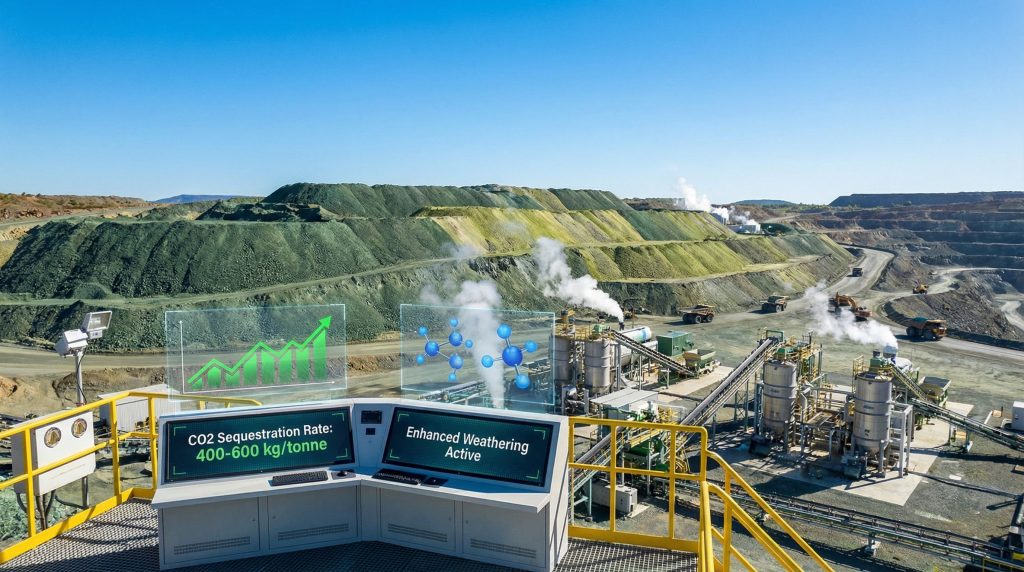
Wollastonite-bearing iron ore waste demonstrates exceptional reactivity for ambient-temperature carbonation. Calcium silicate compositions achieve sequestration rates of 400-600 kg CO2/tonne while producing marketable precipitated calcium carbonate for industrial applications.
Consequently, basic oxygen furnace slag from steelmaking provides concentrated calcium oxide sources for rapid CO2 uptake. Direct carbonation in aging ponds achieves both waste treatment objectives and atmospheric carbon removal, with potential for construction aggregate production from carbonated materials.
Implementation Methodologies Across Operational Scales
Carbon sequestration in mining operations employs diverse technical approaches optimized for specific geological conditions, operational constraints, and economic objectives. Understanding these methodologies enables strategic selection and integration across different mining environments.
Passive In-Situ Carbonation Systems
Natural weathering enhancement represents the lowest-cost approach to atmospheric CO2 capture in mining operations. This methodology leverages ambient conditions while optimizing physical and chemical parameters for maximum reaction efficiency.
Design principles include:
- Tailings pile configuration for maximum surface area exposure
- Moisture management systems maintaining optimal hydration levels
- pH buffering through controlled alkaline mineral distribution
- Aeration enhancement via engineered porosity and convection channels
Carbonate precipitation occurs over months to years without external energy input, making this approach suitable for operations with extended mine life and large waste volumes. No external CO2 capture infrastructure is required, as atmospheric concentrations drive the carbonation reactions.
Implementation at the Turnagain Project involves optimized waste rock placement to maximize exposure of brucite-enriched materials to atmospheric conditions. Engineering studies evaluate pile geometry, moisture retention, and seasonal weathering patterns to enhance natural carbonation rates across the 30-year operational timeline.
Active Ex-Situ Reactor Processing
Controlled reactor environments enable accelerated carbonation through precise optimization of temperature, pressure, and chemical conditions. These systems achieve 60-90% CO2 conversion efficiency with residence times of 30 minutes to 4 hours.
Operational parameters for reactor systems:
- Temperature range: 50-200°C for enhanced reaction kinetics
- Pressure envelope: 1-20 bar CO2 partial pressure
- Particle size: <100 microns for maximum surface area
- Slurry concentration: 20-40% solids by weight
Feed preparation involves grinding mineral materials to optimal particle size distributions, creating slurries with controlled pH and ionic strength. Concentrated CO2 streams from point sources or direct air capture systems are injected through high-efficiency diffusion systems.
Product recovery separates solid carbonate minerals through filtration or centrifugation, with aqueous phases recycled to maintain system efficiency. Solid products can be utilised for construction aggregates, chemical feedstocks, or permanent geological storage.
Thermal Activation Through Solar Integration
Concentrated solar power systems enable thermal activation of serpentine minerals at 300-650°C, achieving 100x faster CO2 uptake compared to ambient temperature processing. This approach proves particularly effective in arid mining regions with high solar irradiance.
System components include:
- Heliostat arrays for concentrated solar energy collection
- Thermal reactors with precise temperature control
- Heat recovery systems for energy efficiency optimization
- Automated material handling for continuous processing
Hybrid thermal systems combine solar heating with waste heat recovery from existing mineral processing operations, reducing overall energy footprints while maintaining enhanced carbonation rates. Integration with low-carbon electricity grids further optimises environmental performance.
Sector-Specific Carbon Integration Strategies
Different mining sectors present unique opportunities and challenges for carbon sequestration in mining implementation based on geological settings, operational scales, and mineral processing requirements. Mining innovation trends continue to drive technological advancement in this space.
Nickel and Platinum Group Metal Operations
Ultramafic-hosted nickel deposits provide optimal conditions for large-scale carbon sequestration through abundant reactive mineral availability and existing processing infrastructure.
Technical advantages include:
- High MgO content (35-45%) in host rock formations
- Large tailings volumes (50-200 tonnes per tonne metal produced)
- Extended mine life enabling long-term carbonation programs
- Co-product recovery potential for value-added minerals
The Turnagain Project demonstrates commercial-scale integration potential. Planned production of 982,500 metric tons of nickel and 58,000 metric tons of cobalt over 30 years will generate massive volumes of brucite-enriched waste suitable for carbonation.
Enhanced processing approaches under development through technology partnerships focus on optimising emerging technologies for permanent atmospheric CO2 storage in ultramafic waste streams. Natural carbonation potential of 200-500 kg CO2/tonne of tailings provides baseline performance, with active enhancement targeting higher sequestration rates.
Iron Ore and Steel Industry Integration
Iron ore mining operations generate calcium-rich waste materials suitable for ambient temperature carbonation, while steelmaking slag provides concentrated reactive compounds for rapid CO2 uptake.
Wollastonite utilisation pathways:
- Direct carbonation in tailings facilities achieving 400-600 kg CO2/tonne sequestration
- Construction material production through controlled carbonation processes
- Chemical industry feedstocks from precipitated calcium carbonate formation
Basic oxygen furnace slag processing enables dual benefits of waste treatment and carbon removal through engineered aging pond systems. Reactive calcium compounds achieve rapid atmospheric CO2 uptake while producing valuable construction aggregates.
Diamond Mining Kimberlite Systems
Kimberlite pipes contain high olivine concentrations enabling rapid mineral carbonation kinetics across 10-50 million tonnes of tailings per operation.
Implementation approaches include:
- Heap leaching adaptation for continuous CO2 circulation through waste piles
- Integrated diamond recovery with simultaneous carbonation processing
- Alkaline pH management through natural calcium-magnesium mineral buffering
Natural weathering rates in kimberlite tailings can be enhanced through pile management, moisture optimisation, and aeration systems without requiring external energy input for basic carbonation processes.
Advanced Technologies for Sequestration Optimization
Emerging technological approaches enhance carbon sequestration in mining efficiency through process intensification, monitoring optimisation, and system integration strategies.
Direct Air Capture System Integration
Co-location of modular direct air capture (DAC) systems with mining operations enables cost-effective CO2 concentration for enhanced mineral carbonation while sharing electrical infrastructure and operational resources.
Integration benefits include:
- Reduced transport costs through on-site CO2 capture and utilisation
- Shared infrastructure for electrical systems and maintenance
- Scalable deployment based on mine production rates and waste volumes
- Grid stabilisation through flexible electrical load management
Modular DAC systems can be sized to match mineral carbonation capacity, with captured CO2 directed to reactor systems or enhanced weathering facilities for permanent storage in carbonate minerals.
Real-Time Monitoring and Verification
Advanced monitoring technologies enable precise quantification of CO2 uptake rates and long-term storage verification across diverse mining environments.
Monitoring system components:
| Technology | Application | Measurement Range | Accuracy |
|---|---|---|---|
| pH sensors | Aqueous carbonation tracking | 4.0-12.0 units | ±0.1 units |
| IR spectroscopy | Carbonate mineral identification | 400-4000 cm⁻¹ | ±2 cm⁻¹ |
| Mass spectrometry | CO2 flux quantification | 0.1-1000 ppm | ±0.05 ppm |
| Automated sampling | Continuous composition analysis | 24/7 operation | ±5% precision |
Geochemical modelling software integrates real-time data with predictive algorithms for long-term sequestration assessment and operational parameter optimisation. In addition, machine learning approaches identify optimal processing conditions across varying mineral compositions and environmental conditions.
Process Intensification Innovations
Microreactor technologies achieve enhanced mass transfer rates through high surface area-to-volume ratios and precise environmental control. Modular designs enable scalable deployment across different operational scales.
Performance characteristics:
- Residence times reduced to minutes versus hours in conventional systems
- Temperature control within ±1°C across reactor volumes
- Pressure management enabling optimal CO2 solubility conditions
- Automated operation reducing labour requirements and operational complexity
Ultrasonic enhancement utilises acoustic energy to increase dissolution rates and mass transfer efficiency. Integration with existing grinding circuits provides synergistic benefits for both mineral liberation and carbonation preparation.
The next major ASX story will hit our subscribers first
Economic Models and Revenue Generation
Carbon sequestration in mining operations creates multiple revenue streams while potentially reducing operational costs through optimised waste management and value-added product recovery. Understanding decarbonisation mining benefits is crucial for economic assessment.
Carbon Credit Monetization Strategies
Verified carbon removal credits represent the primary revenue source for permanent geological CO2 storage, with pricing premiums for long-term permanence and additionality criteria.
Market pricing dynamics:
- Current pricing range: $100-600 per tonne CO2 for verified removal credits
- Permanence premiums: 20-50% above temporary storage solutions
- Additionality requirements: Demonstration that sequestration would not occur without project implementation
- Corporate offtake agreements: Long-term contracts providing revenue certainty
The Turnagain Project's estimated 220 million metric tons of sequestration potential represents substantial monetisation opportunity across the 30-year mine life. At conservative pricing assumptions, carbon credit revenues could significantly enhance project economics while supporting broader decarbonisation objectives.
Value-Added Product Recovery
Mineral carbonation processes generate marketable byproducts beyond permanent CO2 storage, creating additional revenue streams and reducing overall process costs.
Product applications include:
- Precipitated calcium carbonate for paper, plastics, and pharmaceutical industries
- Magnesium compounds for chemical processing and agricultural applications
- Construction aggregates from carbonated tailings with enhanced durability
- Specialty minerals for electronics and advanced materials manufacturing
Reduced waste disposal costs provide additional economic benefits through optimised tailings management and environmental compliance. Permanent stabilisation of reactive waste materials reduces long-term monitoring and remediation requirements.
Capital and Operating Cost Analysis
Investment requirements vary significantly based on processing approach, operational scale, and integration with existing infrastructure.
Capital cost estimates:
- Passive systems: $10-50 per tonne CO2/year capacity for pile optimisation and monitoring
- Active reactors: $50-200 per tonne CO2/year capacity including processing equipment
- Thermal systems: $100-500 per tonne CO2/year capacity with solar concentration and heat recovery
Operating expenses depend on energy requirements, chemical additives, and labour for system operation. Integration with existing mine processing reduces marginal costs while leveraging shared infrastructure and operational expertise.
Payback periods typically range from 5-15 years depending on carbon pricing, byproduct revenues, and operational efficiency optimisation. Economic sensitivity to carbon credit prices drives investment decision-making across different geological and operational contexts.
Implementation Challenges and Mitigation Strategies
Large-scale deployment of carbon sequestration in mining faces technical, regulatory, and economic barriers that require systematic approaches for successful implementation. Government intervention in mining continues to shape policy frameworks.
Technical Performance Optimization
Reaction kinetics limitations represent primary technical challenges, as natural weathering rates often prove insufficient for commercial-scale sequestration without enhancement.
Mitigation approaches include:
- Thermal activation through solar heating or waste heat recovery
- Chemical enhancement via pH optimisation and catalyst addition
- Physical preparation through particle size reduction and surface area maximisation
- Process integration with existing mineral processing circuits
Scale-up considerations require careful translation of laboratory results to field conditions, accounting for heterogeneous mineral compositions, seasonal variations, and long-term stability requirements.
Mass transfer limitations in heap systems can be addressed through engineered aeration, moisture management, and pile geometry optimisation. However, controlled reactor environments provide more predictable performance but require higher capital investment and energy input.
Regulatory Framework Development
Measurement and reporting protocols need standardisation across jurisdictions to enable carbon credit verification and national carbon accounting integration.
Key requirements include:
- Quantification methodologies for CO2 uptake across different mineral systems
- Long-term monitoring standards for permanent storage verification
- Quality assurance protocols for measurement accuracy and precision
- Reporting frameworks compatible with international carbon accounting systems
Environmental permitting processes must address modified tailings management practices, air quality impacts from enhanced weathering, and water quality considerations for leaching systems. Stakeholder engagement becomes critical for maintaining social licence and community support.
Economic Risk Management
Carbon price volatility creates investment uncertainty that can be mitigated through long-term offtake agreements and diversified revenue streams including byproduct recovery.
Risk mitigation strategies:
- Portfolio diversification across multiple carbon removal technologies
- Flexible system design enabling operational optimisation as market conditions change
- Insurance products for performance guarantees and long-term storage verification
- Government policy support through tax incentives and research funding programmes
Technology risk can be reduced through phased implementation, pilot project validation, and partnerships with established technology providers. Integration with existing mining operations leverages proven infrastructure and operational expertise.
Future Technological Developments
Emerging innovations in carbon sequestration in mining focus on enhanced efficiency, reduced costs, and broader applicability across different geological and operational contexts.
Biomineralization and Biological Enhancement
Microbially-induced carbonate precipitation utilises biological catalysts to accelerate carbonation reactions while reducing energy requirements compared to thermal or chemical enhancement methods.
Biological approaches include:
- Bacterial catalysis through CO2-concentrating microorganisms
- Enzyme enhancement using carbonic anhydrase for accelerated CO2 hydration
- Biofilm systems for continuous processing in heap leach applications
- Integrated biohydrometallurgy combining metal recovery with carbon sequestration
Research focuses on optimising microbial communities for different mineral compositions and environmental conditions while maintaining long-term biological system stability. For instance, mineral carbonation studies demonstrate promising results across various geological settings.
Advanced Materials and Nanotechnology
Engineered mineral surfaces demonstrate enhanced CO2 reactivity through nanostructured catalysts and modified surface chemistry.
Material innovations include:
- Nanostructured catalysts for enhanced dissolution and precipitation kinetics
- Smart materials responsive to environmental conditions for autonomous optimisation
- Hybrid organic-inorganic systems combining biological and mineral carbonation pathways
- Advanced composites enabling controlled release of reactive components
Development focuses on cost-effective manufacturing and deployment while maintaining performance advantages over conventional mineral carbonation approaches.
Industry Integration and Circular Economy
Mine planning software integration incorporates carbon sequestration considerations into feasibility studies, life-of-mine planning, and optimisation algorithms. The role of green transition materials becomes increasingly important in this context.
Integration trends include:
- ESG reporting systems for comprehensive environmental impact assessment
- Supply chain decarbonisation through low-carbon metal certification programmes
- Circular economy approaches maximising material utilisation across multiple value streams
- Digital twin modelling for real-time optimisation and predictive maintenance
Policy and market drivers continue evolving through government research funding, tax incentives for carbon sequestration projects, and corporate sustainability commitments requiring net-zero emissions across supply chains.
Furthermore, investment trends favour long-term partnerships between mining companies, technology developers, and carbon credit buyers, creating stable revenue streams for project development and operational optimisation.
This analysis provides educational information about carbon sequestration technologies in mining operations. Specific investment decisions should consider individual project circumstances, regulatory requirements, and technical feasibility assessments. Projected sequestration volumes and economic returns involve uncertainties related to technology performance, market conditions, and regulatory frameworks.
Looking to Invest in Next-Generation Carbon Solutions?
Discovery Alert's proprietary Discovery IQ model delivers real-time alerts on significant mineral discoveries that could revolutionise carbon sequestration technology, instantly empowering subscribers to identify actionable opportunities in sustainable mining ahead of the broader market. Begin your 14-day free trial today to position yourself at the forefront of the mining industry's transformation towards carbon-negative operations.