June 27, 2026
The evolution of geochemical exploration methodologies has transformed how mining companies identify and evaluate potential ore deposits. Modern exploration success hinges on systematic soil sampling techniques, statistical analysis of elemental distributions, and understanding complex multi-element signatures that indicate subsurface mineralization. Furthermore, recognising the mineral exploration importance has become critical for establishing successful mining operations.
Understanding Polymetallic Geochemical Systems in Modern Mineral Exploration
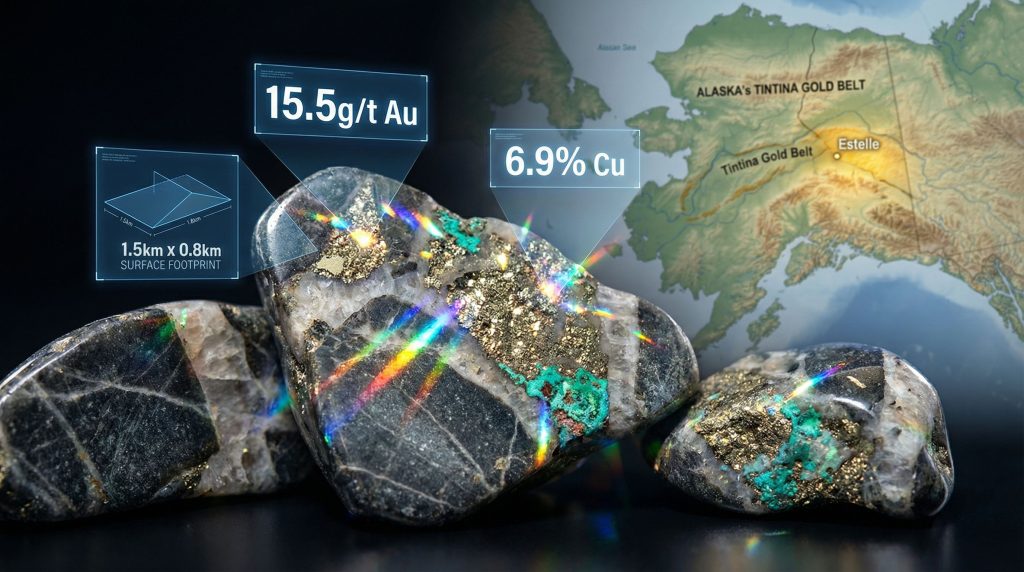
Contemporary geochemical anomaly detection employs sophisticated statistical frameworks that distinguish meaningful mineral signatures from background geological noise. At the West Wing prospect within Nova Minerals' Estelle project in Alaska, recent exploration has defined a significant 1.5 kilometre by 0.8 kilometre surface footprint containing elevated gold and copper concentrations that exceed industry-standard threshold values.
The technical parameters defining this anomaly demonstrate classic polymetallic signatures through systematic sampling methodologies. Analysis of 626 total samples collected during the 2025 field season revealed 16 soil samples exceeding 1.0 g/t Au and an equivalent number surpassing 0.2% Cu, establishing statistical significance across multiple elements.
Critical Threshold Analysis:
| Element | Background Range | Threshold Significance | West Wing Peak Values |
|---|---|---|---|
| Gold (soil) | 0.01-0.1 g/t | >1.0 g/t | 3.8 g/t |
| Gold (rock) | 0.1-0.5 g/t | >2.0 g/t | 15.5 g/t |
| Copper (soil) | 10-50 ppm | >0.2% (2,000 ppm) | >0.2% |
| Copper (rock) | 50-200 ppm | >1.0% | 6.9% |
Statistical Framework for Anomaly Classification
Geochemical anomalies require rigorous statistical validation to distinguish exploration targets from geological background variations. The sample density of 8.3 samples per line kilometre across 75 line kilometres provides sufficient data points for robust statistical modelling.
Multi-element associations indicate polymetallic mineralisation systems where the gold copper anomaly at Estelle demonstrates coincident enrichment patterns. This spatial clustering suggests primary mineralisation rather than residual or transported metal concentrations. Moreover, effective drilling results analysis will be essential for interpreting these geochemical signatures.
Quality Control Protocols:
- Standard QAQC procedures with certified reference materials
- Field duplicate sampling at 5% frequency
- Laboratory blank insertion protocols
- Multi-laboratory check assaying for grade validation
The progression from geochemical indication (detecting presence) to economic interest (indicating potential ore grades) requires understanding threshold distinctions. West Wing's copper results demonstrate this transition, with average concentrations of 0.2% Cu progressing to peaks of 6.9% Cu in outcrop samples.
When big ASX news breaks, our subscribers know first
Geological Context: Contact Metamorphism and Mineralisation Controls
The West Wing discovery exhibits distinctive geological characteristics within hornfels-hosted mineralisation adjacent to plutonic contacts. This represents a departure from typical intrusion-related gold systems (IRGS) commonly associated with Alaskan deposits, suggesting alternative deposit models within the broader Estelle district framework.
Hans Hoffman, Nova Minerals' General Manager and Geologist, identified that whilst most samples originated from hornfels adjacent to the Estelle pluton, select soil samples collected above quartz-feldspar porphyry indicate West Wing could represent a different deposit style than typical for the district.
Contact Metamorphic Processes and Ore Formation
The formation of hornfels-hosted mineralisation involves complex thermal and hydrothermal processes. The Estelle pluton's emplacement into sedimentary sequences creates metamorphic aureoles where original rock compositions transform under elevated temperature conditions.
Metamorphic Transformation Sequence:
- Initial Intrusion: Granodioritic-tonalitic pluton emplacement
- Thermal Aureole Development: 200-500 metre contact zone formation
- Mineralogical Changes: Clay minerals convert to cordierite, biotite assemblages
- Structural Enhancement: Fracture network development and permeability increase
- Hydrothermal Activity: Ore-bearing fluid circulation and deposition
The statistical distribution of anomalous samples provides insight into mineralisation controls. Of 46 soil samples collected at West Wing:
- 21 samples (45.7%) exceeded 0.5 g/t Au
- 16 samples (34.8%) exceeded 1.0 g/t Au
- 5 samples (10.9%) exceeded 2.0 g/t Au
This grade distribution suggests structural control rather than disseminated mineralisation, with higher-grade zones potentially related to specific geological features within the hornfels sequence. Consequently, implementing 3D geological modelling will be crucial for understanding these structural relationships.
What Makes Hornfels-Hosted Deposits Different?
Deposit Style Characteristics:
| Feature | Porphyry-Related | Hornfels-Hosted | West Wing Profile |
|---|---|---|---|
| Host Rock | Intrusive | Contact metamorphic | Mixed hornfels/porphyry |
| Grade Range | 0.5-3.0 g/t Au | 2.0-15 g/t Au | 15.5 g/t Au peak |
| Geometry | Concentric shells | Structurally controlled | Under evaluation |
| Tonnage | Large (>10 Moz) | Moderate | Assessment pending |
| Development Cost | Lower per ounce | Higher per ounce | Economic study required |
The presence of quartz-feldspar porphyry samples indicates potential telescoped mineralisation where multiple deposit styles overlap. This geological complexity creates exploration upside through diverse mineralisation mechanisms operating at various depths and structural positions.
Advanced Exploration Methodology and Target Generation
The 2025 surface reconnaissance programme employed systematic geochemical sampling across multiple prospect areas, representing industry-standard exploration protocols designed to identify and prioritise drill targets.
Programme Statistics and Coverage:
- Total samples: 626 (430 soil, 170 rock, 26 stream sediment)
- Geographic scope: Three main project areas
- Traverse coverage: 75 line kilometres across 30+ traverses
- Sample distribution: 68.7% soil, 27.2% rock, 4.2% stream sediment
This sampling methodology provides comprehensive geochemical coverage whilst maintaining cost-effective exploration budgets. The emphasis on soil sampling (68.7% of total) reflects industry best practices for regional target generation in glaciated terrains typical of Alaska.
Multi-Element Pathfinder Analysis
Beyond primary gold and copper values, pathfinder element associations support deposit model interpretations. Expected pathfinder signatures include:
- Arsenic: Associated with gold mineralisation in epithermal systems
- Antimony: Regional signature element for the Tintina Gold Belt
- Silver: Polymetallic system indicator
- Molybdenum: Porphyry-style alteration signature
Rock Sample Performance Metrics:
Of 30 rock samples collected around the prospect:
- 8 samples (26.7%) graded above 2.0 g/t Au
- 3 samples (10%) exceeded 5.0 g/t Au
- 3 samples (10%) contained >1% Cu
This hit rate demonstrates systematic anomaly definition rather than isolated high-grade results, supporting the interpretation of a coherent mineralised system requiring drill testing. In addition, understanding polymetallic nodules benefits provides context for the broader significance of multi-element systems.
Technical Risk Assessment and Development Implications
Exploration success in hornfels-hosted systems requires understanding geological controls and potential development constraints that influence economic viability. The West Wing discovery presents both opportunities and challenges typical of contact metamorphic environments.
Geological Risk Factors
Primary Technical Risks:
- Structural Complexity: Hornfels zones often exhibit complex fracture patterns
- Grade Continuity: High-grade samples may not represent continuous ore shoots
- Metallurgical Recovery: Contact metamorphic minerals can impact processing
- Dilution Control: Structural boundaries may complicate mining selectivity
Mitigation Strategies:
- Systematic Structural Mapping: Define fracture orientations and competency contrasts
- Early Metallurgical Testing: Assess processing characteristics of mineralised hornfels
- Integrated Geophysical Surveys: Ground magnetic and IP surveys for subsurface targeting
- Environmental Baseline Studies: Establish pre-development environmental conditions
Exploration Targeting Methodology
Future exploration phases require integrated approaches combining geological, geochemical, and geophysical methodologies to define optimal drill targets.
Recommended Technical Sequence:
| Phase | Method | Objective | Expected Timeline |
|---|---|---|---|
| Phase 1 | Detailed geological mapping | Structure/alteration definition | Q2 2026 |
| Phase 2 | Ground geophysics (IP/Mag) | Subsurface targeting | Q3 2026 |
| Phase 3 | Diamond drilling programme | Resource definition | Q4 2026 |
| Phase 4 | Metallurgical characterisation | Processing assessment | Q1 2027 |
The systematic approach ensures technical de-risking whilst maintaining exploration momentum toward resource definition objectives.
Regional Context: Alaska's Tintina Gold Belt Framework
The Estelle project operates within Alaska's Tintina Gold Belt, a world-class metallogenic province hosting multiple large-scale gold deposits. This regional context provides geological analogues and infrastructure advantages supporting mineral development.
Established District Resources:
- RPM Valley: Intrusion-related gold system with defined resources
- Muddy Creek: Vein-hosted gold mineralisation
- Discovery Zone: Bulk tonnage exploration target
- West Wing: Newly defined hornfels-hosted polymetallic system
The 35-kilometre mineralised corridor demonstrates district-scale potential extending beyond individual prospects. Regional geological mapping indicates similar pluton-sediment contact zones throughout the district, suggesting additional hornfels-hosted targets remain untested.
Infrastructure and Development Context
Alaska's established mining jurisdiction provides regulatory clarity and infrastructure access supporting exploration and development activities. The Tintina Gold Belt benefits from:
- Established Mining Law: Clear permitting frameworks
- Regional Infrastructure: Transportation corridors and power access
- Skilled Workforce: Experienced mining professionals
- Government Support: Policy framework supporting critical minerals development
Comparative Regional Deposits:
- Fort Knox: 11+ million ounce hornfels-hosted gold producer
- Livengood: Advanced exploration in contact metamorphic setting
- Donlin Creek: Large-scale gold-copper porphyry development
These regional analogues demonstrate successful development of similar geological settings, providing technical and economic benchmarks for West Wing evaluation. Furthermore, recent developments in the region highlight the growing importance of these discoveries.
Investment Implications and Development Timeline
The West Wing discovery adds to Estelle's overall resource potential whilst requiring additional technical evaluation before economic assessment. The hornfels-hosted mineralisation style presents both opportunities and challenges distinct from typical Alaskan gold deposits.
Development Sequence and Milestones
Technical Advancement Pathway:
2026 Objectives:
- Detailed geological mapping and structural analysis
- Ground geophysical surveys (IP, magnetic)
- Environmental baseline data collection
- Metallurgical sample collection and initial testing
2027 Targets:
- Systematic drilling programme (5,000-10,000 metres)
- Resource estimation modelling
- Metallurgical process development
- Environmental impact assessment initiation
2028+ Goals:
- Economic evaluation integration with district resources
- Feasibility study advancement
- Permitting process initiation
- Infrastructure planning and development
Economic Considerations
Hornfels-hosted deposits often exhibit characteristics favouring economic development:
Positive Factors:
- Higher grade potential (demonstrated 15.5 g/t Au peak)
- Better ore dilution control than vein systems
- Predictable geological boundaries
- Established regional infrastructure
Challenge Areas:
- Moderate tonnage relative to porphyry systems
- Potential metallurgical complexity
- Structural targeting requirements
- Capital intensity for development
The gold copper anomaly at Estelle represents significant exploration value within Nova Minerals' broader district development strategy. Integration with existing resources could enhance overall project economics through shared infrastructure and processing facilities.
The next major ASX story will hit our subscribers first
Future Exploration Strategy and Target Prioritisation
The West Wing discovery demonstrates continued exploration potential within the broader Estelle district, supporting systematic prospect evaluation across the 35-kilometre mineralised trend. Future programmes should focus on identifying additional hornfels-hosted targets whilst advancing known prospects toward resource definition.
Priority Target Categories
Immediate Priorities:
- West Wing drill target definition and testing
- Similar contact zones district-wide
- Structural extensions of known mineralisation
- Integration opportunities with existing resources
Medium-Term Objectives:
- Regional geophysical target generation
- Systematic evaluation of pluton-sediment contacts
- Stream sediment geochemistry expansion
- Environmental permitting advancement
Long-Term Strategic Goals:
- District-wide resource integration
- Infrastructure development planning
- Processing facility optimisation
- Market positioning for critical minerals
The systematic approach ensures optimal resource allocation whilst maintaining exploration momentum across multiple prospects. The hornfels-hosted discovery adds geological diversity to the district, potentially supporting larger-scale development scenarios through multiple deposit types within a single project framework.
However, the gold copper anomaly at Estelle requires careful evaluation of its economic potential relative to established deposits in the region. Consequently, Nova Minerals must balance aggressive exploration with prudent resource allocation to maximise shareholder value.
Disclaimer: This analysis is based on publicly available information and should not be considered investment advice. Mineral exploration involves significant risks, and readers should conduct their own due diligence before making investment decisions. Forward-looking statements regarding exploration results, development timelines, and economic potential are subject to numerous variables and uncertainties that may cause actual results to differ materially from those projected.
Want to Stay Ahead of the Next Major Mineral Discovery?
Discovery Alert's proprietary Discovery IQ model provides instant notifications when significant ASX mineral discoveries like Nova Minerals' West Wing prospect are announced, delivering actionable insights that help investors capitalise on exploration breakthroughs before the broader market responds. Explore how major mineral discoveries have generated exceptional returns by visiting Discovery Alert's dedicated discoveries page and begin your 14-day free trial today to secure your competitive advantage in mineral exploration investing.