May 17, 2026
The mining sector operates through complex geological systems where subsurface mineral deposits remain hidden beneath layers of rock, soil, and vegetation. These concealed resources represent potential economic value measured in billions of dollars globally, yet their discovery requires sophisticated technical methodologies that have evolved dramatically over the past two decades. Traditional prospecting methods, while foundational, cannot address the scale and precision demanded by modern resource extraction economics where exploration budgets often exceed $50 million for major projects.
Contemporary mineral exploration techniques integrate multiple data streams through digital platforms that process geological, geophysical, and geochemical information simultaneously. This systematic integration transforms raw field data into actionable intelligence, enabling exploration teams to identify mineralization patterns across vast territories while minimizing environmental disruption and operational costs. Furthermore, the mineral exploration importance has grown exponentially as global demand for critical minerals continues to rise.
What Performance Metrics Define Successful Exploration Programs?
Modern exploration success depends on measurable outcomes that demonstrate both technical effectiveness and economic viability. Industry analysis reveals distinct performance patterns across different exploration phases, with success rates varying significantly based on geological complexity and methodological approaches.
Exploration Efficiency Benchmarks:
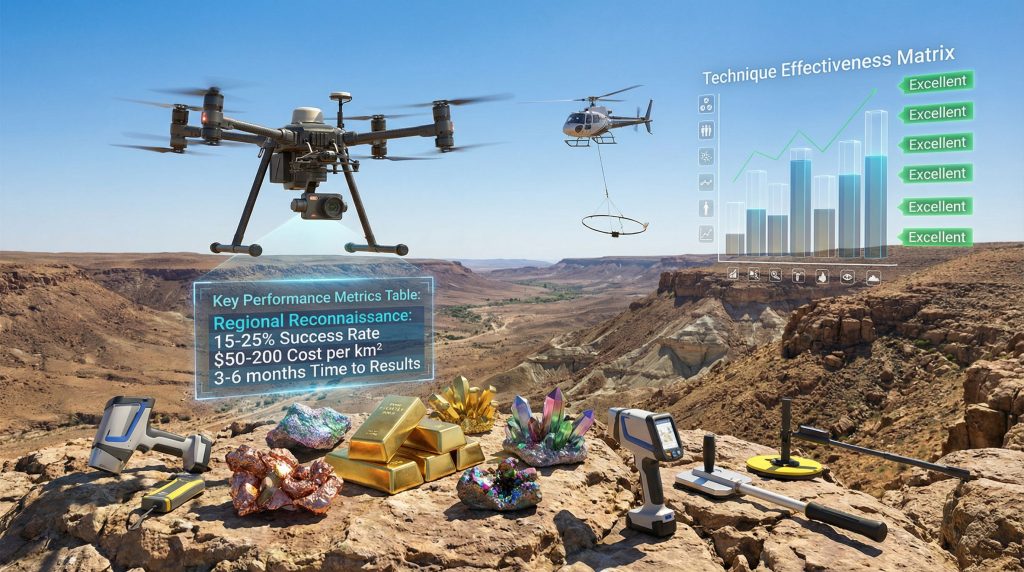
- Regional reconnaissance programs typically achieve target identification rates of 15-25% while covering areas exceeding 1,000 square kilometres
- Detailed target evaluation increases success probability to 35-45% through focused geophysical surveys and systematic sampling
- Resource delineation drilling reaches 60-75% success rates when supported by comprehensive geological modelling
Cost management remains critical throughout exploration phases, with expenditures ranging from hundreds to thousands of dollars per square kilometre depending on survey intensity. Effective programs allocate budgets according to geological confidence levels, investing minimally in early-stage reconnaissance while concentrating resources on validated targets.
Risk Assessment Framework:
- Geological risk varies by deposit type, structural complexity, and alteration signatures
- Technical risk depends on survey method selection and data integration capabilities
- Economic risk fluctuates with commodity prices, infrastructure costs, and regulatory requirements
- Environmental risk encompasses permitting timelines, community relations, and ecological impact
Successful exploration companies implement stage-gate decision processes that evaluate progress against predetermined criteria before advancing to subsequent phases. This systematic approach prevents over-investment in low-probability targets while ensuring adequate funding for promising discoveries. Additionally, drilling interpretation insights play a crucial role in optimising resource allocation decisions.
When big ASX news breaks, our subscribers know first
How Do Advanced Remote Sensing Technologies Transform Resource Detection?
Satellite-based exploration systems have revolutionised mineral detection by providing high-resolution imagery and spectral data across global territories. Hyperspectral imaging technologies detect mineral signatures through electromagnetic radiation analysis, identifying alteration zones associated with subsurface mineralisation.
Modern satellite constellations deliver spatial resolution approaching 30 centimetres with temporal coverage enabling weekly monitoring of exploration areas. This capability allows teams to track surface changes, monitor competitor activities, and identify previously unrecognised geological features.
Advanced Imaging Applications:
- Thermal infrared mapping detects hydrothermal alteration signatures invisible to standard photography
- Radar interferometry measures ground displacement indicating subsurface structural changes
- Multispectral analysis differentiates rock types and vegetation stress patterns over mineralised zones
Unmanned aerial systems complement satellite coverage by providing sub-metre resolution imagery and real-time data processing capabilities. Drone-mounted sensors collect magnetic, electromagnetic, and photographic data while maintaining operational flexibility impossible with traditional aircraft.
Drone System Advantages:
- Weather independence enables operations during conditions that ground traditional aircraft
- Rapid deployment allows same-day survey initiation following target identification
- Cost efficiency reduces survey expenses by eliminating aircraft charter and crew requirements
- Safety enhancement removes personnel exposure risks in hazardous or remote terrain
Integration platforms process satellite and drone data through machine learning algorithms that identify subtle anomalies missed by conventional interpretation methods. These systems analyse thousands of spectral bands simultaneously, detecting mineral signatures below human visual detection thresholds. For more comprehensive guidance on exploration methods, refer to the New South Wales exploration techniques overview.
Which Geophysical Methods Optimise Detection for Specific Mineral Systems?
Geophysical survey selection depends critically on target mineral characteristics, geological environment, and operational constraints. Different deposit types exhibit distinct physical properties that determine optimal detection methodologies.
Method Selection Matrix:
| Survey Type | Massive Sulfides | Gold Deposits | Iron Formations | Rare Earth Elements |
|---|---|---|---|---|
| Electromagnetic | Excellent | Good | Limited | Fair |
| Magnetic | Good | Fair | Excellent | Good |
| Gravity | Fair | Poor | Good | Excellent |
| Induced Polarisation | Excellent | Excellent | Poor | Fair |
Electromagnetic Survey Applications
Time-domain electromagnetic systems penetrate depths exceeding 500 metres while detecting conductive mineralisation associated with base metal deposits. Frequency-domain methods excel in environments with conductive overburden where time-domain systems experience interference.
Helicopter-borne surveys achieve line coverage rates surpassing 200 kilometres daily while maintaining survey elevation consistency impossible with ground-based methods. Modern systems integrate GPS positioning with real-time data quality monitoring, ensuring survey specifications throughout challenging terrain.
Magnetic Survey Innovations
- Caesium vapour magnetometers achieve sensitivity levels of 0.01 nanotesla, detecting subtle magnetic anomalies
- Gradiometry systems measure magnetic field gradients, reducing regional field corrections by 90%
- Autonomous platforms enable continuous 24-hour operations with automated flight planning and obstacle avoidance
Induced Polarisation Advantages
This technique detects disseminated sulfide mineralisation through electrochemical responses that remain invisible to other geophysical methods. Modern IP systems measure both resistivity and chargeability parameters, providing dual constraints on subsurface electrical properties.
Ground-based surveys achieve electrode spacing precision enabling detailed imaging of mineralisation geometry. Three-dimensional inversion algorithms process complex datasets, generating subsurface models that guide drill targeting with unprecedented accuracy.
What Role Does Artificial Intelligence Play in Modern Exploration?
Machine learning applications have transformed geological data interpretation by identifying complex patterns within multidimensional datasets that exceed human cognitive processing capabilities. AI systems analyse geological, geophysical, and geochemical information simultaneously, detecting subtle correlations that traditional statistical methods cannot recognise.
Pattern Recognition Applications:
- Geochemical anomaly detection identifies element associations indicating specific mineralisation styles
- Structural interpretation recognises fault and fracture patterns controlling ore distribution
- Alteration mapping classifies mineral assemblages through spectral signature analysis
Predictive modelling integrates diverse exploration datasets through neural networks trained on successful discovery examples. These systems rank exploration targets based on geological similarity to known deposits, optimising resource allocation across large tenement portfolios. Furthermore, AI-driven drill efficiency improvements have demonstrated measurable cost reductions.
Data Integration Benefits:
Cloud-based platforms process terabytes of exploration data while providing real-time visualisation capabilities that enable field teams to adjust survey parameters instantly. Blockchain technology ensures data integrity across multi-partner exploration ventures where information security remains critical.
Industry Insight: AI implementation has reduced exploration costs by 25-40% through improved targeting efficiency while decreasing false positive rates from 60% to 15% through machine learning validation protocols.
Automated Interpretation Systems
Modern algorithms process geophysical surveys within hours compared to traditional interpretation requiring weeks of expert analysis. These systems identify drilling targets automatically while flagging data quality issues that could compromise interpretation accuracy.
Real-time processing enables adaptive survey design where subsequent measurements focus on areas identified as anomalous during initial data collection. This approach maximises information content while minimising survey costs through intelligent sampling strategies.
How Do Systematic Sampling Strategies Maximise Resource Discovery?
Geochemical sampling provides direct evidence of mineralisation through systematic collection and analysis of soil, sediment, and rock samples. Sampling design must balance spatial coverage with analytical costs while ensuring statistical validity across diverse geological environments.
Grid-Based Sampling Frameworks:
- Reconnaissance grids employ 100-500 metre spacing for regional anomaly identification
- Detailed grids utilise 25-100 metre spacing for target definition and grade continuity assessment
- Infill sampling provides sub-25 metre resolution for resource delineation and metallurgical testing
Stream Sediment Analysis
This technique leverages natural erosion processes that concentrate heavy minerals in drainage systems. Single samples can represent upstream catchments covering 10-50 square kilometres, making stream sediment surveys extremely cost-effective for regional reconnaissance.
Modern analytical methods provide multi-element analysis from single samples, generating comprehensive geochemical signatures that indicate specific deposit types. Portable XRF analysers deliver 30+ element results within 60 seconds, enabling real-time decision making during field programs.
Advanced Analytical Techniques:
| Method | Elements Analysed | Detection Limits | Sample Turnaround |
|---|---|---|---|
| Portable XRF | 30+ elements | ppm to percent | Real-time |
| ICP-MS | 70+ elements | ppb to ppm | 24-48 hours |
| Fire Assay | Precious metals | ppb levels | 48-72 hours |
Quality Control Protocols
Certified reference materials inserted at 5% frequency validate analytical accuracy while duplicate samples verify precision. Blank samples detect cross-contamination issues that could generate false anomalies leading to wasted drilling expenditures.
Hyperspectral Core Scanning maps mineral distribution at millimetre resolution, identifying ore textures and alteration patterns invisible to conventional logging methods. This technology enables detailed mineralogical studies without destructive sample preparation.
Which Drilling Techniques Provide Optimal Resource Definition?
Drilling represents the most expensive component of exploration programs, with costs often exceeding 60% of total project budgets. Drilling method selection significantly impacts both data quality and project economics, making technique optimisation critical for programme success.
Drilling Method Comparison:
| Technique | Cost per Metre | Optimal Depth | Recovery Rate | Applications |
|---|---|---|---|---|
| Reverse Circulation | $80-150 | 0-300m | 85-90% | Bulk sampling, grade assessment |
| Diamond Core | $150-400 | 50-1,500m | 95-99% | Geological logging, metallurgy |
| Sonic Drilling | $200-500 | 0-100m | 95-99% | Unconsolidated sediments |
Diamond Core Advantages
This technique provides continuous rock samples enabling detailed geological interpretation, structural analysis, and metallurgical testing. Core recovery rates approaching 99% ensure representative sampling across mineralised intervals, critical for resource estimation accuracy.
Advanced logging systems measure magnetic susceptibility, density, and electrical conductivity continuously along drill core, generating high-resolution geological data that supplements visual logging observations.
Reverse Circulation Benefits
This method excels in weathered or unconsolidated geology where diamond drilling experiences poor recovery. RC drilling produces large sample volumes suitable for metallurgical testing while maintaining cost advantages for reconnaissance programmes.
Innovative Drilling Technologies
- Directional drilling accesses targets beneath infrastructure or environmentally sensitive areas
- In-situ logging provides real-time geological and geochemical measurements during drilling
- Automated core photography enables remote geological consultation and digital core libraries
Core Analysis Innovations:
CT scanning reveals internal ore textures and structural relationships without destructive testing, preserving samples for subsequent metallurgical studies. Digital documentation systems create permanent records enabling future reinterpretation as geological understanding evolves.
The next major ASX story will hit our subscribers first
How Do Environmental Factors Shape Contemporary Exploration Practices?
Environmental stewardship has become integral to exploration planning, with regulatory frameworks requiring comprehensive impact assessments before major programmes commence. Sustainable practices minimise ecological disruption while maintaining exploration effectiveness through technological innovations.
Low-Impact Exploration Methods:
- Minimal footprint drilling reduces surface disturbance by 70% through advanced rig design and access planning
- Helicopter-supported operations eliminate road construction requirements in sensitive ecosystems
- Seasonal restrictions protect wildlife during critical breeding or migration periods
Water Management Systems
Exploration activities in water-scarce environments implement closed-loop systems that recycle drilling fluids and prevent contamination. Water treatment technologies enable multiple reuse cycles while meeting discharge standards for excess water.
Rehabilitation Protocols
Progressive rehabilitation restores exploration sites to pre-disturbance conditions through systematic soil replacement, vegetation re-establishment, and erosion control. Monitoring programmes track recovery success over multi-year timeframes. In addition, sustainable exploration practices have become essential for maintaining social licence to operate.
Regulatory Compliance Requirements:
- Environmental impact assessments evaluate potential ecosystem effects before programme approval
- Cultural heritage surveys identify and protect indigenous archaeological sites
- Biodiversity monitoring ensures ecosystem preservation throughout exploration phases
- Community consultation incorporates stakeholder input into programme design
Adaptive Management Strategies
Modern exploration employs adaptive frameworks that modify operations based on environmental monitoring results. This approach enables programme continuation while addressing emerging environmental concerns through operational adjustments.
What Emerging Technologies Will Transform Future Exploration?
Next-generation exploration technologies promise dramatic improvements in detection capabilities, operational efficiency, and environmental performance. Quantum sensors represent revolutionary advances in gravitational anomaly detection, offering sensitivity levels surpassing conventional gravimeters by orders of magnitude.
Quantum Sensing Applications
These devices detect minute gravitational variations associated with density contrasts between ore bodies and host rocks. Quantum gravimeters operate without moving parts, eliminating mechanical drift while achieving measurement stability impossible with spring-based instruments.
Robotic Exploration Systems
Autonomous platforms operate in hazardous environments where human access remains dangerous or impossible. Robotic sampling systems collect geological specimens from mine workings, steep terrain, or radioactive areas while transmitting data in real-time.
Satellite Constellation Networks
Advanced satellite systems provide daily global coverage with spatial resolution approaching aircraft-quality imagery. Change detection algorithms identify surface modifications indicating exploration activity, infrastructure development, or environmental disturbance. Moreover, comprehensive exploration methods documentation provides valuable reference for implementation strategies.
Integration Platform Innovations
- Digital twin technology creates virtual exploration environments enabling scenario testing without field operations
- Augmented reality systems overlay geological models on field terrain, guiding sampling and drilling activities
- Autonomous survey platforms reduce human exposure in remote locations while maintaining operational efficiency
Investment Implications:
Technology adoption cycles favour organisations implementing advanced systems early, with efficiency gains reaching 200-300% over traditional methods. Capital requirements shift from field operations toward technology infrastructure, fundamentally altering exploration economics.
Data Ownership Considerations:
Intellectual property protection becomes critical as exploration datasets gain strategic value through AI processing and predictive modelling. Competitive advantages derive from data quality, processing algorithms, and integration capabilities rather than traditional geological expertise alone. Consequently, data integration platforms have become essential infrastructure investments.
How Should Organisations Structure Exploration Programs for Maximum Effectiveness?
Systematic programme design maximises discovery probability while optimising resource allocation across multiple exploration phases. Stage-gate frameworks prevent over-investment in low-probability targets through objective evaluation criteria at predetermined decision points.
Phased Development Strategy:
- Desktop Integration combines public geological databases, satellite imagery, and historical exploration results
- Regional Reconnaissance employs airborne surveys and systematic sampling across large areas
- Target Definition focuses detailed studies on highest-probability anomalies
- Resource Delineation quantifies deposit geometry, grade distribution, and economic potential
Budget Allocation Guidelines
Effective programmes distribute expenditures according to exploration phase requirements and geological confidence levels:
- 20-30% allocated to regional reconnaissance and database compilation
- 40-50% invested in target definition through detailed surveys
- 30-40% concentrated on drilling and resource evaluation
Portfolio Risk Management
Diversified target portfolios spread geological risk across multiple deposit types, geological environments, and development stages. Joint venture partnerships share costs and technical expertise while reducing individual company exposure to exploration failures.
Performance Monitoring Systems
Regular programme reviews evaluate progress against geological and economic milestones, enabling timely course corrections when results diverge from expectations. Key performance indicators include target identification rates, drilling success percentages, and cost per ounce or ton of resource identified.
Technology Integration Benefits
Organisations implementing advanced exploration technologies demonstrate measurably superior performance through improved targeting accuracy, reduced cycle times, and enhanced data integration capabilities. Competitive advantages compound over time as technological proficiency enables increasingly sophisticated exploration strategies.
This analysis reflects current industry practices and emerging trends in mineral exploration techniques. Exploration outcomes involve inherent geological risks, and technological capabilities continue evolving rapidly. Readers should consult with qualified professionals before making exploration or investment decisions.
Want to Stay Ahead of Major Mineral Discovery Announcements?
Discovery Alert provides instant notifications on significant ASX mineral discoveries, powered by its proprietary Discovery IQ model, enabling investors to identify actionable opportunities ahead of the broader market. Explore historic examples of exceptional discovery outcomes and begin your 14-day free trial today to gain a competitive advantage in mineral exploration investments.