July 28, 2026
Revolutionary Approaches to Mineral Recovery Enhancement
Advanced flotation technology for phosphate and potash recovery has emerged as a transformative approach to mineral processing efficiency in an era where operational margins depend increasingly on extracting maximum value from each tonne processed. The fundamental challenge facing modern mineral processors lies not in identifying profitable deposits, but in optimising recovery rates from complex ore bodies while simultaneously reducing environmental impact and operational costs.
Traditional mechanical flotation systems, developed decades ago for simpler ore compositions, struggle with the fine particle dynamics that characterise contemporary phosphate and potash deposits. This technological limitation creates a cascading series of operational challenges that extend far beyond simple recovery percentages, affecting everything from waste management solutions to water recycling efficiency.
When big ASX news breaks, our subscribers know first
Understanding the Physics of Enhanced Bubble-Particle Interactions
The core mechanism driving flotation efficiency centres on the complex hydrodynamic interactions between air bubbles and mineral particles suspended in aqueous solutions. Modern systems have evolved beyond simple air injection to incorporate sophisticated engineering principles that manipulate these fundamental physics.
Surface chemistry modifications through selective reagent application create hydrophobic conditions on target minerals while maintaining hydrophilic characteristics on unwanted gangue materials. This chemical differentiation enables precise separation, but only when bubble-particle collision dynamics are optimised through proper equipment design.
Key Performance Drivers:
- Bubble size distribution control for enhanced collision probability
- Particle conditioning intensity to maximise surface activation
- Residence time optimisation across separation zones
- Hydrodynamic flow patterns that minimise particle re-entrainment
Column flotation systems address many limitations inherent in conventional mechanical cells by providing controlled environments where gravity assists in particle separation whilst countercurrent flow patterns enhance grade selectivity. The integration of cavitation tube technology represents a significant advancement in particle conditioning intensity.
According to industry testing documented by equipment manufacturers, advanced flotation systems demonstrate recovery improvements of 15% compared to conventional mechanical flotation cells, primarily through enhanced capture of ultrafine mineral fractions that traditional systems typically lose to tailings streams.
Addressing Mineralogical Complexity in Phosphate Processing
Phosphate ore deposits present unique processing challenges due to their complex mineralogical associations and varying gangue compositions across different geological formations. Sedimentary phosphate deposits, which comprise the majority of global production, contain intricate mixtures of phosphate minerals intergrown with silica, carbonate, and clay components.
Silicate contamination represents the most persistent challenge in phosphate beneficiation, as quartz and feldspar particles often exhibit similar flotation behaviour to phosphate minerals under certain chemical conditions. This similarity necessitates precise reagent chemistry and equipment design to achieve adequate separation selectivity.
Typical Phosphate Ore Classifications and Recovery Targets:
| Ore Type | Primary Gangue | Processing Approach | Recovery Range |
|---|---|---|---|
| Siliceous | Quartz, feldspar | Reverse flotation + columns | 85-92% |
| Carbonate | Dolomite, calcite | Sequential flotation stages | 80-88% |
| Weathered | Clay minerals | Desliming + direct flotation | 75-85% |
| Complex | Mixed gangue | Hybrid circuit design | 70-82% |
Clay mineral interactions create additional complications through slimes coating effects, where ultrafine clay particles adhere to phosphate surfaces and interfere with reagent adsorption. Modern flotation circuits address this challenge through high-intensity conditioning systems that mechanically remove clay coatings while simultaneously activating phosphate mineral surfaces.
Iron oxide associations, particularly common in weathered phosphate deposits, require integrated magnetic separation prior to flotation to prevent interference with flotation chemistry. The sequential application of magnetic separation followed by optimised flotation has become standard practice in many phosphate operations.
Revolutionary Advances in Column Flotation Engineering
Column flotation technology has undergone substantial evolution from its original conceptual design to current high-performance configurations that integrate multiple separation mechanisms within single vessels. The fundamental advantage of column systems lies in their ability to provide distinct zones for particle conditioning, separation, and cleaning within a controlled hydrodynamic environment.
Cavitation tube conditioning represents one of the most significant recent advances in flotation technology. This system combines high-shear mechanical conditioning with column flotation principles to enhance bubble-particle collision kinetics for fine and ultrafine particles. Industry testing indicates that cavitation-assisted flotation can recover mineral fractions previously considered uneconomical to process.
Modern cavitation tube systems achieve 15% higher recovery rates than conventional flotation whilst simultaneously reducing tailings volumes and improving water recovery efficiency, addressing both economic and environmental operational constraints.
The engineering principles underlying cavitation tube performance centre on controlled bubble generation through rapid pressure fluctuations that create micro-cavitation events. These cavitation bubbles collapse with sufficient energy to disrupt particle surface films and enhance reagent adsorption while simultaneously generating optimal-sized bubbles for fine particle attachment.
Advanced Gas Sparging Design Considerations:
- Porous media selection for uniform bubble distribution
- Gas flow rate optimisation across column height
- Pressure management for consistent bubble size
- Coalescence prevention through proper hydrodynamics
Furthermore, froth management systems in modern column flotation incorporate automated controls that maintain optimal froth depth while managing wash water addition rates to balance grade and recovery objectives. These systems typically achieve superior concentrate quality compared to mechanical flotation through enhanced particle retention time and improved drainage characteristics.
Potash Processing Optimisation Through Selective Flotation
Potash flotation operates under fundamentally different principles compared to other mineral systems due to the high-salinity brine environment and the unique physical properties of sylvite and halite crystals. The density differential between potassium chloride (2.0 g/cm³) and sodium chloride (2.2 g/cm³) provides an additional separation mechanism that flotation systems can exploit.
Temperature control represents a critical parameter in potash flotation, as reagent effectiveness and brine chemistry both exhibit strong temperature dependencies. Most commercial potash flotation circuits operate at elevated temperatures (60-80°C) to optimise collector adsorption whilst maintaining proper brine saturation levels.
Modern Potash Flotation Performance Benchmarks:
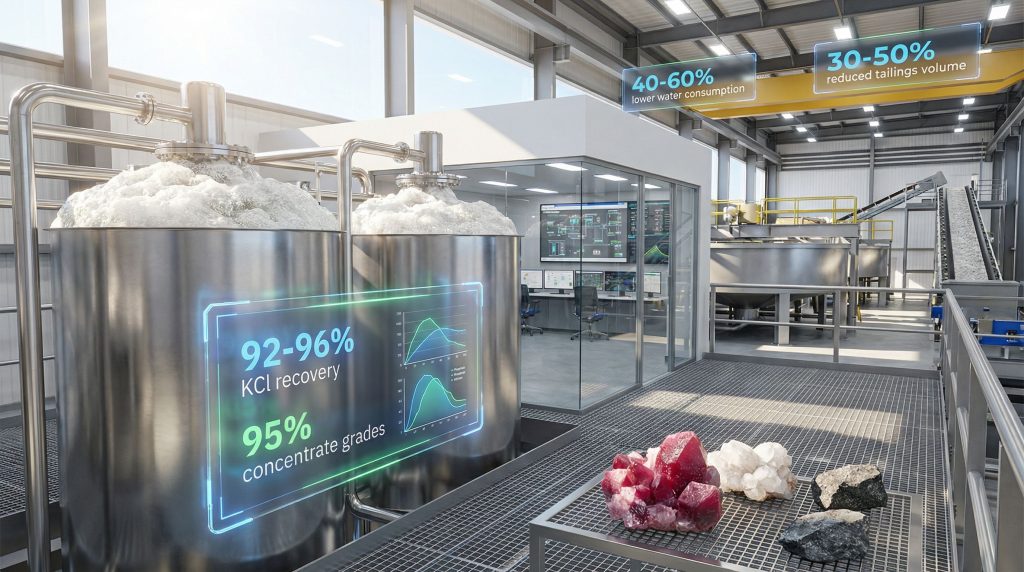
- KCl recovery rates: 92-96%
- Final concentrate grades: >95% KCl
- Performance improvement: 15-20% over mechanical cells
- Water recovery efficiency: 85-90%
Collector chemistry in potash systems relies primarily on amine-based reagents that selectively adsorb on sylvite crystal faces while exhibiting minimal affinity for halite surfaces. The pH control of flotation pulp, typically maintained between 9.5-10.5, ensures optimal collector performance whilst preventing unwanted side reactions.
Consequently, fluidized bed flotation systems have gained acceptance in potash processing for their ability to handle coarse particle feeds whilst maintaining high recovery efficiency. These systems combine the benefits of gravity separation with flotation selectivity, enabling processing of feeds that would be difficult to handle in conventional flotation equipment.
Reagent Chemistry and Process Optimisation Strategies
Flotation reagent selection and dosing optimisation represent critical factors in achieving maximum separation efficiency whilst minimising operating costs. Modern reagent systems are designed for specific ore mineralogy and water chemistry conditions, with customised formulations often required for optimal performance.
Collector reagent chemistry has evolved significantly beyond traditional fatty acid and amine systems to include specialised surfactants designed for specific mineral-gangue combinations. These advanced collectors often exhibit superior selectivity and lower dosage requirements compared to conventional reagents.
Primary Flotation Reagent Categories:
- Collectors: Surface-active agents for mineral hydrophobicity
- Frothers: Bubble stabilisation and froth characteristics
- Depressants: Selective gangue mineral suppression
- Activators: Mineral surface conditioning agents
- pH Modifiers: Chemical environment optimisation
Frother selection significantly impacts bubble characteristics and froth stability, with modern frother systems designed to maintain consistent performance across varying water chemistry conditions. Methyl isobutyl carbinol (MIBC) remains the industry standard, but specialised frother blends are increasingly common in complex ore systems.
In addition, depressant chemistry has become increasingly sophisticated, with multi-component systems designed to selectively suppress different gangue minerals whilst maintaining target mineral floatability. Starch-based depressants for carbonate minerals and dispersants for clay suppression represent established technologies, whilst newer bio-based depressants offer improved environmental profiles.
The next major ASX story will hit our subscribers first
Waste Stream Valorisation and Secondary Recovery
Historical tailings represent significant untapped resources in many phosphate and potash operations, with accumulated tailings often containing substantial quantities of recoverable minerals. Modern assessment techniques enable detailed characterisation of these legacy waste streams to identify economic recovery opportunities.
Slimes beneficiation has emerged as a particularly promising area for advanced flotation technology for phosphate and potash recovery application. These ultrafine waste fractions, previously considered unprocessable, can now be economically treated using column flotation systems specifically designed for fine particle recovery.
Waste Stream Recovery Potential Analysis:
| Waste Type | Typical Grade | Processing Method | Recovery Efficiency |
|---|---|---|---|
| Phosphate tailings | 8-15% P₂O₅ | Column flotation | 60-75% |
| Potash brines | 2-8% KCl | Evaporation + flotation | 85-92% |
| Slimes fraction | 5-12% valuable minerals | Cavitation tube flotation | 45-65% |
| Clay overburden | 3-7% phosphate | Scrubbing + flotation | 35-55% |
Water recovery integration with mineral processing creates synergistic benefits in waste stream processing applications. Closed-loop water systems not only reduce environmental impact but also maintain optimal chemical conditions for flotation performance across both primary and secondary recovery circuits.
However, the economic drivers for waste stream processing continue to strengthen as mineral grades decline and environmental regulations become more stringent. Operations that successfully implement secondary recovery systems often achieve 10-20% increases in overall plant recovery whilst simultaneously reducing long-term environmental liabilities.
Automation and Process Control Integration
Modern flotation operations increasingly rely on automated control systems to maintain optimal performance across varying feed conditions and operational requirements. Real-time monitoring technologies enable continuous adjustment of critical process parameters to maximise recovery efficiency through data-driven mining operations approaches.
Online analytical instruments provide continuous feedback on feed composition, intermediate product grades, and final concentrate quality. X-ray fluorescence (XRF) analysers, particle size distribution monitors, and froth imaging systems generate data streams that automated control algorithms use for process optimisation.
Key Process Control Parameters:
- Feed rate and composition variability management
- Reagent addition rate optimisation
- pH and temperature control across circuits
- Froth level and characteristics monitoring
- Water recovery and recirculation management
Machine learning applications in flotation control represent an emerging area of significant potential. Neural network algorithms can identify complex patterns in operational data that traditional control systems cannot detect, enabling predictive adjustments that improve both recovery and equipment reliability.
For instance, digital twin modelling allows operations to test process modifications and optimisation strategies in virtual environments before implementing changes on actual equipment. This capability reduces operational risk whilst accelerating the adoption of performance improvement initiatives.
Environmental Impact Mitigation Through Technology Advancement
Advanced flotation technology for phosphate and potash recovery delivers substantial environmental benefits through improved resource efficiency and reduced waste generation. Modern systems typically achieve 40-60% reductions in water consumption compared to conventional processing methods whilst simultaneously reducing tailings volumes through enhanced recovery.
Energy efficiency improvements represent another significant environmental benefit, with modern flotation systems consuming 25-35% less energy per tonne of concentrate produced. These efficiency gains result from optimised equipment design, improved process control, and integration with plant-wide energy management systems.
Environmental Performance Improvements:
- Water consumption reduction: 40-60%
- Tailings volume decrease: 30-50%
- Energy usage reduction: 25-35%
- Reagent consumption optimisation: 20-40%
Closed-loop water systems integration enables near-zero discharge operations in many applications, particularly important in arid regions where water resources are limited. Advanced flotation systems are specifically designed to operate effectively with high levels of water recycling whilst maintaining separation performance.
Furthermore, carbon footprint reduction through process intensification allows operations to achieve higher throughput and recovery in smaller equipment footprints, reducing both capital and operating costs whilst minimising environmental impact. This approach aligns with broader industry innovation trends toward sustainable mineral processing.
Economic Analysis and Investment Considerations
The economic justification for advanced flotation technology implementation depends on multiple factors including ore characteristics, existing plant configuration, environmental constraints, and long-term operational objectives. Most operations can justify investment in advanced flotation systems through improved recovery rates alone, without considering environmental and operational benefits.
Retrofit applications typically offer faster payback periods compared to greenfield installations, as existing infrastructure can often accommodate advanced flotation equipment with minimal modifications. The modular design of modern column flotation systems enables phased implementation that reduces capital requirements and operational risk.
Investment Decision Factors:
- Current recovery rates and improvement potential
- Feed ore characteristics and processing challenges
- Environmental compliance requirements
- Water availability and management costs
- Long-term resource sustainability objectives
Operational cost improvements extend beyond direct processing benefits to include reduced tailings management costs, lower water treatment requirements, and decreased reagent consumption. These indirect benefits often represent 20-30% of total project value and should be included in economic evaluations.
Consequently, technology risk mitigation strategies typically include pilot testing programmes, phased implementation approaches, and performance guarantees from equipment suppliers. These risk management measures ensure that investment objectives are achieved whilst minimising operational disruption.
Future Technology Developments and Industry Trends
Emerging technologies in flotation processing focus on further improvements in fine particle recovery, environmental impact reduction, and automation integration. Nano-bubble flotation, electroflotation, and microwave-assisted liberation represent areas of active research and development that align with AI in mining operations capabilities.
Artificial intelligence applications continue to expand beyond basic process control to include predictive maintenance, optimisation algorithm development, and autonomous operation capabilities. These advanced systems enable operation at performance levels that exceed human operator capabilities whilst reducing labour requirements.
Technology Development Priorities:
- Enhanced fine particle recovery systems
- Reduced reagent consumption and environmental impact
- Increased automation and autonomous operation
- Integration with renewable energy systems
- Advanced materials for equipment durability
Moreover, sustainability transformation considerations increasingly drive technology development priorities, with bio-based reagents, renewable energy integration, and circular economy principles shaping equipment design and process development. Operations that proactively adopt these technologies often achieve competitive advantages in increasingly environmentally conscious markets.
The convergence of mineral processing technology with digital transformation creates opportunities for performance improvements that were previously impossible to achieve. Internet of Things (IoT) sensor networks, cloud-based optimisation platforms, and blockchain applications for supply chain tracking represent emerging areas of significant potential.
This analysis of advanced flotation technology for phosphate and potash recovery demonstrates the significant potential for operational improvement through modern processing approaches. The integration of enhanced equipment design, optimised process control, and environmental stewardship creates sustainable competitive advantages in increasingly challenging market conditions. Investment in these technologies represents a strategic imperative for operators seeking to maximise resource recovery whilst meeting evolving environmental and economic requirements.
Want to Discover the Next Major Mineral Processing Breakthrough?
Discovery Alert's proprietary Discovery IQ model delivers real-time alerts on significant ASX mineral discoveries, instantly empowering subscribers to identify actionable opportunities in advanced processing technologies and innovative mining companies ahead of the broader market. Begin your 14-day free trial today and secure your market-leading advantage in the rapidly evolving mineral processing sector.