July 31, 2026
When Earnings Do the Talking: Understanding the Mineral Resources Re-Rating
Few events in equity markets are as instructive as watching a heavily indebted, sentiment-beaten stock undergo a fundamental earnings inflection. The mechanics are well understood in theory: balance sheet stress creates depressed valuations, operational improvement triggers a re-rating, and capital flows back in as risk premiums compress. What is far less common is seeing this cycle play out as rapidly and as dramatically as it has with Mineral Resources Ltd (ASX: MIN) over the past twelve months.
For investors now asking whether Mineral Resources shares buy hold or sell is the right question at current levels, the answer depends almost entirely on which part of the cycle you believe the company occupies today. Is the re-rating complete, or is the market still catching up to a fundamentally transformed business?
When big ASX news breaks, our subscribers know first
The Earnings Inflection That Explains the 106% Rally
Why the Share Price Move Was Not Speculative
A doubling in share price over twelve months invites scepticism. In many cases, such moves are driven by sentiment, momentum, or macro tailwinds disconnected from underlying business performance. The Mineral Resources re-rating, however, was grounded in one of the more striking earnings recoveries seen in the ASX resources sector in recent years.
At its half-year results for the six months to 31 December 2025 (H1 FY2026), released in February 2026, the company delivered a set of numbers that fundamentally changed the investment conversation:
| Metric | H1 FY2025 | H1 FY2026 | Change |
|---|---|---|---|
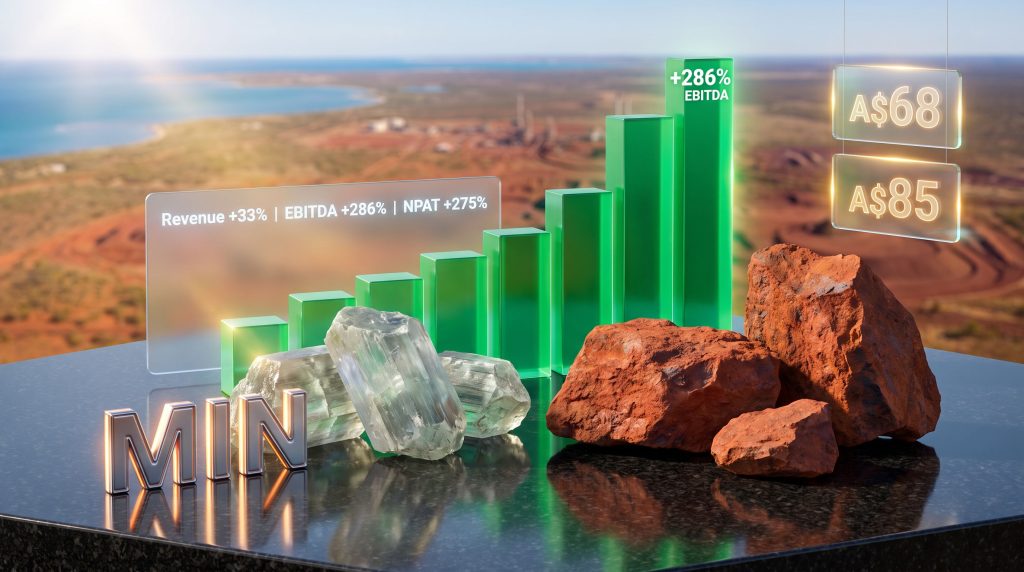
| Revenue | ~$2.33B | $3.1B | +33% YoY |
| Underlying EBITDA | ~$310M | $1.2B | +286% YoY |
| Net Profit After Tax | ~$91M | $343M | +275% YoY |
| Net Debt | $4.5B (Mar 2026) | $4.3B (Jun 2026) | Declining |
| Liquidity | $1.8B (Mar 2026) | $2.4B (Jun 2026) | Improving |
A near-tripling of underlying EBITDA in a single half-year reporting period is a rare occurrence. The revenue increase of 33% year-on-year was meaningful, but it was the dramatic operating leverage flowing through to EBITDA and NPAT that signalled a genuine structural shift in the company's earnings power rather than a cyclical blip.
What the June 2026 Quarterly Update Confirmed
If the February half-year results provided the catalyst, the June quarter operating update released in late July 2026 provided the validation. The update confirmed that Mineral Resources had achieved or exceeded its FY2026 volume and cost guidance across every single business segment, a result that even the most optimistic forecasters had not fully anticipated.
Several metrics from the quarterly update stand out:
- Net debt fell to $4.3 billion as at 30 June 2026, down from $4.5 billion just three months earlier at 31 March 2026
- The net debt-to-EBITDA ratio declined to below the 2x threshold, a deleveraging milestone that materially reduces balance sheet risk perceptions
- Liquidity strengthened by $600 million in a single quarter, rising from $1.8 billion to $2.4 billion
- An undrawn revolving credit facility of $800 million provides additional financial headroom beyond reported liquidity
"The speed of the liquidity improvement, $600 million in one quarter, signals that operating cash generation has reached a level where debt reduction is now self-funding from operations rather than dependent on asset sales or capital raisings."
What Is the Current Broker Consensus on Mineral Resources Shares?
A Divided Analyst Community
As of mid-2026, broker consensus on Mineral Resources (ASX: MIN) is genuinely mixed rather than uniformly bullish. Across approximately 14 analysts tracked on major platforms, roughly 7 carry Buy ratings, 5 Hold ratings, and 2 Sell ratings, with a consensus average 12-month price target near A$69.23, implying meaningful upside from recent trading levels around A$59 to A$61.
A separate aggregator tracking 12 analysts produces a more cautious composite, with a Hold-leaning average and minimal implied upside, reflecting divergent modelling assumptions around commodity prices and debt trajectory.
| Broker | Rating | Price Target | Implied Upside (from ~$59) |
|---|---|---|---|
| Morgans | Buy (upgraded from Accumulate) | A$68 | ~+15% |
| Macquarie | Outperform | A$85 | ~+44% |
| Consensus Average (14 analysts) | Buy | A$69.23 | ~+17% |
| Alternative Aggregator (12 analysts) | Hold | Mixed | Minimal |
Morgans' Upgrade: What Changed and Why
Following the June quarter operating update, Morgans upgraded its rating from Accumulate to Buy, a meaningful shift reflecting increased conviction rather than a routine adjustment. The broker's reasoning centred on several interconnected positives:
- Production and cost outcomes exceeded internal forecasts across the mining services, iron ore, and lithium divisions simultaneously
- Net debt came in approximately 8% below prior expectations, a positive surprise that accelerated the deleveraging timeline
- The sub-2x net debt to EBITDA ratio represents a tangible reduction in financial risk, a threshold that institutional investors often use as a trigger for increasing position sizes
- Morgans maintained its price target at A$68 per share, representing approximately 15% upside from current trading levels
Macquarie's Thesis: Three Catalysts, One Price Target
Macquarie's analysts described the quarterly result as exceeding even their most optimistic internal scenario, a notable admission given that Macquarie already carried a constructive view heading into the update. Their ongoing investment thesis for Mineral Resources shares buy hold or sell assessment is built around three distinct value drivers:
- Onslow iron ore growth execution — the ramp-up of production volumes at the Onslow iron project, which remains in relatively early stages
- Continued deleveraging — further net debt reduction toward and ultimately below A$4 billion
- Potential capital returns — the prospect of dividend reinstatement or a buyback program as the balance sheet strengthens
Macquarie's price target of A$85 per share is the highest published target among major brokers and implies upside of more than 44% from current levels near A$59 to A$61.
Is the Rally Already Priced In? Bull and Bear Perspectives
The Bull Case for Continued Upside
The argument for further appreciation rests on several interconnected pillars that go beyond simple momentum:
- Macquarie's A$85 target implies 44% additional upside from current levels, a significant margin that is difficult to dismiss even after the sharp re-rating
- The debt reduction trajectory is ahead of most consensus forecasts, meaning analyst models may need to be revised upward
- The Onslow transhipper expansion is still in the early stages of its production ramp, meaning the iron ore earnings contribution has not yet peaked
- Lithium prices remain subdued but have not deteriorated to zero, and any recovery toward mid-cycle pricing would provide substantial earnings leverage given Mineral Resources' production exposure
It is also worth understanding the structural reason Mineral Resources can benefit so dramatically from an earnings recovery. The company operates with a high degree of operating leverage, meaning that revenue increases flow through to EBITDA at an amplified rate once fixed costs are covered. This explains why a 33% revenue increase produced a 286% EBITDA expansion.
The Bear Case: Caution After a 100% Run
The risks are equally real and should not be minimised by the excitement of recent performance:
- A stock that doubles in twelve months has absorbed a substantial amount of forward good news into its price; new buyers are paying a meaningfully higher multiple than investors who entered a year ago
- Technical analysis indicators on several platforms have flagged short-term sell signals, suggesting that near-term momentum may be stretched even if the medium-term thesis remains intact
- One broker aggregator shows a notably bearish split of 7 Sell ratings versus 4 Buy ratings, a stark contrast to the more constructive consensus tracked elsewhere and a reminder that analyst opinion is genuinely divided
- Net debt of A$4.3 billion remains substantial; if iron ore or spodumene prices deteriorate materially from current levels, the deleveraging timeline would extend and re-introduce balance sheet anxiety
- Furthermore, the lithium market downturn has shown limited recovery despite broadly supportive demand narratives, and MIN's earnings remain partially exposed to this volatile market
Risk Matrix: Key Variables to Monitor
| Risk Factor | Current Status | Trajectory |
|---|---|---|
| Net Debt | A$4.3B | Declining ✅ |
| Lithium Prices | Subdued | Uncertain ⚠️ |
| Iron Ore Prices | Moderate | Stable ➡️ |
| Onslow Ramp-Up | On Track | Improving ✅ |
| Capital Returns | Not Yet Announced | Potential Catalyst ✅ |
| Macro Conditions | Mixed | Monitoring ⚠️ |
Understanding What Makes Mineral Resources Structurally Distinct
The Mining Services Dimension That Many Investors Overlook
A meaningful but often underappreciated aspect of the investment case is the mining services division. Unlike pure-play commodity producers, whose revenue rises and falls almost entirely with commodity prices, Mineral Resources generates a portion of its revenue from fee-based contract mining services provided to third parties. This creates a degree of earnings diversification that partially insulates the business during commodity price troughs.
The mining services business also operates as an internal cost controller for MIN's own operations. By owning its crushing and processing infrastructure rather than contracting it externally, the company retains more of the value chain and achieves cost structures that would be impossible for smaller competitors. This vertical integration is a structural competitive advantage that compounds over time.
The Onslow Iron Ore Project: A Long-Duration Growth Asset
The Onslow iron ore project in Western Australia represents a genuinely long-duration growth asset, a characteristic that distinguishes Mineral Resources from many ASX mid-cap mining peers who lack similar pipeline depth. The latest Onslow haul road update indicates the ramp-up of production volumes is expected to compound over multiple years rather than peak quickly.
Critically, Onslow was constructed with significant upfront infrastructure investment, meaning that as production volumes scale, the marginal cost of additional tonnes declines — a dynamic that amplifies EBITDA margins during the ramp phase. This is precisely the type of operating leverage inflection that long-term investors seek to identify before it becomes universally apparent in reported numbers.
Lithium Exposure: Risk and Optionality in Equal Measure
Mineral Resources holds production exposure to lithium through its spodumene operations, primarily in Western Australia. Spodumene is the hard-rock lithium-bearing mineral processed into lithium concentrate and ultimately refined into battery-grade lithium chemicals used in electric vehicle batteries and stationary storage systems.
The lithium market has experienced severe price compression since its 2022 peak, with spodumene concentrate prices falling from above US$8,000 per tonne to levels that pressure the economics of many producers. However, the structural demand case for lithium remains intact over a multi-year horizon. For investors willing to hold a multi-year view, MIN's lithium exposure represents genuine earnings optionality not fully captured in current commodity price assumptions.
How Does Mineral Resources Compare to ASX 200 Mining Peers?
The twelve-month performance context is striking. While the ASX 200 Index delivered approximately 3.5% total return over the same period, Mineral Resources generated returns exceeding 106%, outperforming the broader market benchmark by a factor of roughly 30 times. This is not typical mid-cycle mining sector performance; it reflects the specific dynamics of an earnings recovery from a distressed base.
| Company | Risk Profile | Lithium Exposure | Iron Ore | Mining Services | Onslow-style Growth Asset |
|---|---|---|---|---|---|
| BHP Group (ASX: BHP) | Lower | Minimal | Significant | No | No |
| Rio Tinto (ASX: RIO) | Lower-Moderate | Emerging | Dominant | No | No |
| Mineral Resources (ASX: MIN) | Higher | Significant | Growing | Yes | Yes (Onslow) |
The key differentiator is that BHP and Rio Tinto offer diversification, lower volatility, and more predictable dividend streams but limited leverage to either lithium recovery or the specific Onslow growth story. Mineral Resources occupies a higher-risk, higher-reward position in the mining sector landscape, with multiple potential re-rating catalysts that the mega-caps simply do not possess.
The next major ASX story will hit our subscribers first
Investment Outlook Across Different Time Horizons
Short-Term View (0 to 6 Months)
The near-term price picture is complicated by the sheer scale of the preceding rally. Most of the readily identifiable positive catalysts — the strong H1 FY2026 results, the June quarter beat, the sub-2x net debt milestone — have already been absorbed by the market. Technical signals are mixed, and some momentum indicators suggest a period of consolidation is plausible before the next leg higher.
This does not mean the stock is overvalued in absolute terms, but it does mean that short-term price volatility could be significant in either direction, particularly if commodity prices shift or macro conditions change.
Medium-Term View (6 to 18 Months)
The medium-term case is arguably where the most compelling risk-reward balance exists. Analyst price targets in the range of A$68 to A$85 suggest that analysts with detailed financial models see meaningful upside over a twelve to eighteen month horizon. The key drivers include:
- Continued debt reduction, with the next meaningful milestone being net debt falling below A$4 billion
- Onslow production ramp generating an ascending earnings contribution
- A potential capital return announcement (dividend reinstatement or buyback), which would signal balance sheet confidence and attract income-oriented institutional buyers
Long-Term View (2 or More Years)
For patient investors with a genuine multi-year horizon, the long-term thesis is arguably the most straightforward. Lithium demand fundamentals tied to EV adoption and battery storage remain structurally compelling, even if the near-term pricing environment is challenging. If spodumene prices recover to mid-cycle levels over a two to four year period, the earnings leverage available through MIN's production base could be substantial and is not reflected in current consensus forecasts.
A Framework for Deciding: Buy, Hold or Sell Mineral Resources Shares?
Step-by-Step Decision Process for ASX: MIN
Rather than applying a single blanket recommendation, the Mineral Resources shares buy hold or sell question is best evaluated through a structured personal framework. In addition, ongoing attention to Mineral Resources governance issues is warranted given recent legal developments that could influence institutional sentiment:
- Assess your current exposure and cost base — Investors already holding MIN at prices well below current levels have a strong hold case supported by ongoing earnings momentum and broker consensus
- Apply entry price discipline — New buyers entering around A$59 to A$61 are paying a substantially higher multiple than was available twelve months ago; appropriate position sizing is important
- Stress-test the debt scenario — Model what happens to the balance sheet if iron ore prices fall 20% for an extended period; if the deleveraging thesis survives, the conviction case strengthens
- Identify your primary catalyst — Clarity on whether you are buying for Onslow growth, lithium recovery, debt reduction, or capital returns will help establish realistic timelines
- Set review triggers in advance — Establish price levels or fundamental milestones, such as net debt falling below A$4 billion or a capital return announcement, that would prompt reassessment
Summary by Investor Profile
| Investor Type | Suggested Stance | Core Rationale |
|---|---|---|
| Existing holder (low cost base) | Hold / Accumulate | Earnings momentum intact; further upside in broker targets |
| New buyer (entering ~$59 to $61) | Selective Buy | Upside exists but requires conviction on debt and commodities |
| Income-focused investor | Hold / Monitor | No confirmed capital return program yet |
| Risk-averse investor | Avoid / Underweight | A$4.3B net debt and commodity volatility remain material |
| High-conviction growth investor | Buy | Macquarie's A$85 target implies significant upside if execution continues |
Frequently Asked Questions: Mineral Resources Shares (ASX: MIN)
What is the current broker price target for Mineral Resources?
Price targets among major brokers range from approximately A$68 (Morgans) to A$85 (Macquarie), with a consensus average near A$69.23 across 14 analysts, implying upside of between 15% and 44% from recent trading levels near A$59 to A$61.
Why did Mineral Resources shares rise more than 106% in one year?
The re-rating was driven by a fundamental earnings recovery, including a 286% expansion in underlying EBITDA and a 275% increase in net profit in H1 FY2026, combined with consistent delivery against guidance across all operating segments and a faster-than-expected deleveraging trajectory.
What is Mineral Resources' current debt position?
As at 30 June 2026, net debt stood at A$4.3 billion, down from A$4.5 billion at 31 March 2026. The company holds A$2.4 billion in liquidity and has a fully undrawn A$800 million revolving credit facility.
Is Mineral Resources primarily a lithium or iron ore company?
Neither exclusively. Mineral Resources operates across three primary segments: lithium production, iron ore (including the Onslow growth project), and mining services. This multi-segment structure differentiates it from pure-play producers in either commodity.
What is the single biggest risk for MIN shareholders?
The A$4.3 billion net debt balance combined with commodity price exposure, particularly to volatile lithium prices, represents the most significant ongoing risk. A deterioration in either iron ore or spodumene prices could slow the deleveraging cycle and reintroduce balance sheet pressure.
What to Watch Over the Next 12 Months
For investors monitoring Mineral Resources shares buy hold or sell decisions through the remainder of FY2026 and into FY2027, the following milestones represent the most important signposts:
- Onslow production volumes — acceleration in iron ore output will be the primary earnings driver for the next reporting cycle
- Net debt trajectory — a decline below A$4 billion would be a significant positive signal for institutional investors
- Lithium price movements — any sustained recovery in spodumene concentrate pricing would provide substantial earnings upside not currently modelled in consensus forecasts
- Capital return announcement — a dividend reinstatement or on-market buyback program would signal management confidence in cash generation and attract income-oriented capital
- FY2026 full-year results — confirmation of the earnings trajectory established in the first half will be closely scrutinised for evidence that the recovery is durable rather than episodic
Macquarie's publicly stated focus on Onslow's execution, the ongoing deleveraging cycle, and the potential for capital returns provides investors with a clear three-point checklist for evaluating the MIN investment case through the coming financial year. If all three catalysts materialise on schedule, the gap between current prices and the A$85 price target becomes increasingly difficult for the broader market to ignore.
This article contains general financial information only and does not constitute personalised investment advice. Past performance is not indicative of future returns. All financial figures and broker targets referenced are based on publicly available information current at the time of writing. Investors should consider their own financial circumstances and consult a licensed financial adviser before making investment decisions. Commodity price forecasts and broker price targets are subject to change and carry inherent uncertainty.
Want to Spot the Next Major ASX Mineral Discovery Before the Market Does?
Discovery Alert's proprietary Discovery IQ model scans ASX announcements in real time, instantly identifying high-potential mineral discoveries across more than 30 commodities — from iron ore to lithium — and delivering actionable insights to subscribers ahead of the broader market. Explore historic discoveries and their returns to understand the potential scale of early-mover advantage, then begin your 14-day free trial to position yourself at the forefront of the next major ASX resource re-rating.