July 31, 2026
The Quiet Crisis in Australia's Industrial Energy Economy
Energy-intensive industries have always operated at the intersection of economic necessity and political inconvenience. When electricity markets function predictably, aluminium smelters are profitable industrial workhorses. When they don't, those same facilities transform into fiscal and political emergencies requiring urgent government attention. Australia is navigating exactly this dynamic in 2025 and 2026, as policymakers wrestle with what to do when the commercial logic of keeping a major smelter running no longer adds up without public intervention.
The Tomago aluminium smelter rescue funding talks represent far more than a single facility's survival story. They are a live stress test of how Australia's federal system handles nationally significant industrial assets that sit within state borders, how energy transition costs are distributed between governments and industry, and whether the country possesses the policy architecture to make coherent decisions about its sovereign industrial future.
When big ASX news breaks, our subscribers know first
Understanding What Makes Tomago Aluminium So Difficult to Replace
Situated in New South Wales' Hunter Valley near Newcastle, the Tomago aluminium smelter is among the most electricity-hungry single facilities on Australia's eastern seaboard. It consumes roughly 12% of New South Wales' total grid demand, a figure that immediately communicates the scale of the operation and the complexity of any attempt to replace or replicate it elsewhere.
The facility directly employs around 1,000 workers, but this number significantly understates its economic footprint. Aluminium smelters sit at the centre of dense supply chain networks spanning logistics, maintenance, chemical supply, and downstream manufacturing. When economists describe such facilities as anchor industries, they mean that a smelter's closure triggers contraction effects far beyond the facility perimeter, affecting regional labour markets and dependent businesses over timescales measured in years, not months.
Rio Tinto (ASX: RIO) holds a controlling interest in Tomago, giving the world's second-largest mining company significant negotiating leverage in current discussions with both federal and state governments.
Why Aluminium Smelters Cannot Simply Be Restarted
One of the least-understood aspects of primary aluminium smelting is its technical irreversibility. Unlike many industrial facilities that can be mothballed and recommissioned, aluminium smelters rely on electrolytic reduction cells that must remain continuously energised. Shutting these cells down causes the molten aluminium and cryolite bath to solidify in ways that typically render the cell liners permanently damaged.
Recommissioning a closed smelter is not a matter of flicking a switch. It requires extensive cell relining, equipment replacement, and capital expenditure that can approach or exceed the cost of building a new facility. This technical reality underpins the urgency behind the Tomago aluminium smelter rescue funding talks: once the smelter closes, Australia does not simply wait a few years and reopen it. The capacity is effectively gone.
"The irreversibility of primary smelting capacity is a critical factor that distinguishes aluminium from most other industrial products. A country that loses smelting infrastructure cannot recover it quickly, regardless of how favourable future market conditions become."
The 2028 Electricity Contract Cliff and What It Actually Means
Tomago's current power purchase agreement is set to expire in 2028. This deadline is the structural driver behind the urgency of current negotiations. Under its existing contract, the smelter receives electricity at rates that allow it to operate commercially. Once that agreement lapses, it would be exposed to prevailing National Electricity Market (NEM) wholesale prices.
The problem is that those wholesale prices have fundamentally changed in character. Australia's accelerated retirement of coal-fired baseload generation has removed the price-stabilising anchor that historically kept electricity affordable for industrial consumers. What has replaced it is a market characterised by greater price volatility, higher average costs, and a growing gap between what intermittent renewable generation can offer and what 24/7 high-voltage aluminium smelting actually requires.
How Australia's Energy Transition Created an Industrial Cost Crisis
Renewable energy solutions are increasingly cost-competitive on a levelised cost basis, but aluminium smelting cannot be powered by intermittent generation alone. The electrolytic reduction process demands uninterrupted power delivery at consistent voltage levels. Fluctuations that might be acceptable for other industrial consumers can catastrophically damage smelter cells.
This means that even as solar and wind generation costs fall, aluminium smelters require firming infrastructure, including pumped hydro investment, battery storage, and grid backup, that adds significant cost above the raw generation price. The economic math is harsh: market-rate electricity with full firming costs in today's NEM would, according to industry and government modelling, render Tomago commercially unviable.
| Cost Driver | Pre-Transition Baseline | Post-Transition Exposure |
|---|---|---|
| Wholesale electricity price | Stable, coal-anchored | Elevated and volatile |
| Firming and backup costs | Minimal | Significant and growing |
| Long-term contract availability | Readily structured | Limited without intermediary |
| Price certainty for planning | High | Low without government backing |
Breaking Down the Proposed Rescue Package
The financial architecture of the proposed Tomago support package involves multiple layers, each designed to achieve the same fundamental outcome: delivering below-market electricity to the smelter on a long-term contracted basis.
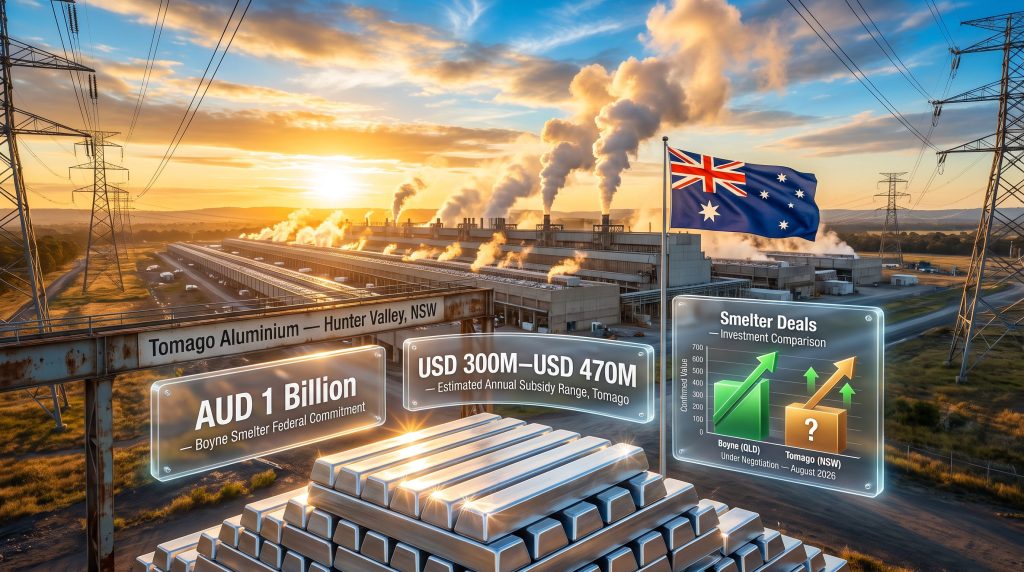
Industry and government source estimates place the annual electricity subsidy component at between USD 300 million and USD 470 million per year. Projected across a ten-year agreement term, the total public commitment could reach several billion dollars. Tomago's owners are expected to contribute at least AUD 1 billion in capital expenditure and plant maintenance investment across the agreement period, providing a commercial counterweight to public outlays.
The Federal-NSW Cost-Sharing Dispute Explained
The central unresolved tension in the Tomago aluminium smelter rescue funding talks is not whether to support the facility but how the bill gets divided between Canberra and Sydney. Both governments have publicly affirmed commitment to the smelter's future. The disagreement is arithmetical and political.
The Federal Government has pushed for a 50/50 cost-sharing arrangement. NSW has reportedly sought to contribute only 10 to 20 percent of the package cost, arguing that it already directs substantial support to the facility through existing state-level programs. NSW allocated funding for Tomago in its June 2026 budget, but that allocation is understood to fall short of what the federal government considers an equitable share.
This impasse reflects something deeper than a budget negotiation. It exposes a structural fault line in Australian federalism: nationally significant industrial assets that sit within a single state's jurisdiction create inherently misaligned incentive structures. The federal government captures the political and strategic benefit of preserving sovereign industrial capacity, while the state faces the more visible fiscal burden of funding a subsidy for a private operator within its borders.
The Mechanisms Proposed to Deliver the Package
| Mechanism | Role in Package |
|---|---|
| Snowy Hydro long-term power purchase agreement | Delivers below-market electricity without direct cash transfer |
| Clean Energy Finance Corporation (CEFC) | Concessional financing for renewable generation and storage assets |
| New generation and transmission infrastructure | Supports long-term renewable energy supply to the facility |
| Rio Tinto capital commitment | AUD 1 billion+ in plant capex and maintenance over agreement term |
Snowy Hydro's involvement is particularly significant from a policy design perspective. As a government-owned renewable energy generator, it can structure a power purchase agreement that delivers the subsidy through a commercial electricity contract rather than a direct budget appropriation. This matters because direct cash subsidies to private industrial operators attract intense public and political scrutiny, whereas a discounted PPA can be characterised as an infrastructure investment. The fiscal outcome is similar, but the political optics differ substantially.
The Boyne Smelter Precedent and What It Tells Us About Tomago
To understand where the Tomago negotiations are heading, it is instructive to examine what happened with Rio Tinto's Boyne smelter in Queensland. That facility secured a concluded support agreement with a confirmed federal commitment of AUD 1 billion (approximately USD 702.58 million), establishing a financial reference point that Tomago's owners can reasonably cite in their own negotiations.
Federal Industry Minister Tim Ayres acknowledged Queensland's faster progress, noting that if the process were treated as a competition, Queensland had crossed the finish line first. The comment was intended humorously but carried a pointed message: NSW's slower progress in agreeing its cost-sharing position had delayed an outcome that was broadly accepted as inevitable.
| Dimension | Boyne Smelter (QLD) | Tomago Smelter (NSW) |
|---|---|---|
| Federal commitment confirmed | AUD 1 billion (USD ~702.58M) | Under negotiation |
| State government contribution | Agreed | Disputed (10-20% vs. 50% sought) |
| Deal status as of July 2026 | Concluded | Announcement expected August 2026 |
| Power supply mechanism | Renewable-backed | Snowy Hydro + potential CEFC |
| Operator | Rio Tinto | Rio Tinto |
If the Tomago agreement is finalised in August 2026 as anticipated, it would represent Australia's second major aluminium smelter rescue package within a single calendar year. That pattern is not coincidental. It reflects a deliberate policy orientation toward preserving primary aluminium smelting capacity as a strategic national asset, even when commercial logic alone cannot justify it.
Green Aluminium and Why the Framing Matters
Both the Boyne and Tomago support packages are being presented not as legacy industry bailouts but as investments in green aluminium production. This framing is deliberate and consequential. Furthermore, it connects directly to broader discussions around mining electrification trends that are reshaping how industrial facilities across Australia approach their energy strategies.
Australia's aluminium sector, if successfully transitioned to renewable energy supply, would be positioned to supply low-carbon primary aluminium to global supply chains increasingly demanding emissions-certified material. Electric vehicle manufacturers, renewable energy infrastructure builders, and defence procurement agencies are all moving toward requiring documented carbon intensity data from their metal suppliers.
Australian aluminium smelted on renewable power could command a market premium in these segments, transforming what is currently a cost problem into a potential competitive advantage. The CEFC's involvement in the proposed Tomago package is specifically oriented toward accelerating this transition by financing the generation and storage assets that would underpin a genuinely low-carbon electricity supply to the smelter.
The Sovereign Capability Argument and Its Long-Term Implications
Beyond the green aluminium narrative, policymakers have increasingly framed aluminium smelting retention as a sovereign industrial capability question. The argument is that certain industrial capacities are so strategically important to defence supply chains, construction materials security, and transport infrastructure that their preservation justifies above-market public support, regardless of short-term economic efficiency calculations.
This is a significant conceptual departure from conventional industry policy frameworks, which typically require demonstrated market failure before public intervention is warranted. Applying a sovereign capability lens instead treats the potential loss of smelting capacity as a form of strategic national risk, similar in character to the rationale used to justify strategic petroleum reserves or domestic defence manufacturing. In addition, Australia's green metals leadership ambitions make the case for retention even more compelling at a global level.
"When industrial capacity is defined as sovereign rather than merely commercial, the cost-benefit calculus shifts fundamentally. The question is no longer whether the subsidy is economically efficient but whether the cost of losing the capability permanently is acceptable. For aluminium smelting, Australia has evidently concluded that it is not."
The next major ASX story will hit our subscribers first
What Happens If No Deal Is Reached
The consequences of a failed negotiation are asymmetric and severe. Without a subsidised long-term power agreement in place before 2028, Tomago's owners would face electricity costs at market rates that multiple analyses suggest would render the facility commercially unviable. The smelter would face closure, eliminating more than 1,000 direct jobs, removing a major economic anchor from the Hunter Valley region, and permanently extinguishing Australia's largest single-site aluminium smelting capacity.
The downstream effects would extend well beyond the facility itself, affecting:
- Aluminium fabricators and processors dependent on domestic primary metal supply
- Logistics and transport companies serving the smelter
- Chemical and materials suppliers including carbon anode producers
- Regional retail and service economies in the Hunter Valley
- Australia's capacity to supply domestic aluminium to defence and construction supply chains
The Broader Policy Question: Who Comes Next?
The Tomago and Boyne rescue packages have resolved an immediate crisis, but they have also opened a wider policy question that remains unanswered. Other energy-intensive Australian industries, including chemicals, glass manufacturing, and steel production, face structurally similar electricity cost pressures as the NEM transitions away from coal-fired baseload. Consequently, discussions around green metals pricing are becoming increasingly central to how policymakers assess which industries might qualify for similar arrangements.
If aluminium smelters qualify for subsidised long-term power arrangements, the logical question from those industries is: why not us? Australia currently lacks a published, criteria-based industrial support framework that would allow policymakers to answer that question consistently. The absence of such a framework creates policy uncertainty for existing energy-intensive industries, potential investors in new industrial capacity, and energy market participants trying to model future demand patterns.
The Tomago aluminium smelter rescue funding talks, when concluded, will inevitably be studied as a template. Whether that template is documented and generalised into a broader industrial energy policy framework, or remains an ad-hoc precedent applied inconsistently, may prove to be the most consequential policy decision to emerge from this entire episode.
Frequently Asked Questions
When is an announcement on the Tomago rescue package expected?
An announcement has been anticipated for August 2026, following Prime Minister Albanese's direct involvement in final-stage negotiations with NSW Premier Minns. As of the most recent reporting in late July 2026, negotiations were still described as ongoing.
How much will the Tomago aluminium rescue package cost taxpayers?
Estimates suggest the electricity subsidy component alone could range from USD 300 million to USD 470 million annually. Over a ten-year agreement, total public commitment could reach several billion dollars. Tomago's owners are separately expected to contribute at least AUD 1 billion in capital and maintenance investment.
What happens to Tomago if no deal is reached?
Without a subsidised long-term power agreement in place before 2028, the smelter would be exposed to market-rate electricity costs that industry and government modelling suggests would make it commercially unviable, placing over 1,000 direct jobs at risk and permanently eliminating the facility's smelting capacity.
Why is Snowy Hydro central to the proposed deal structure?
As a government-owned renewable energy generator, Snowy Hydro can deliver below-market electricity through a long-term power purchase agreement rather than a direct budget transfer, providing both governments with greater fiscal and political flexibility in structuring the support package.
How does Tomago compare to the Boyne smelter agreement?
The Boyne smelter in Queensland was secured with a confirmed AUD 1 billion federal commitment and was concluded ahead of the Tomago negotiations. Both facilities are operated by Rio Tinto and both involve renewable energy supply structures, however the Tomago package involves larger estimated annual subsidy costs and a more complex federal-state cost-sharing dispute.
Disclaimer: This article contains forward-looking estimates, financial projections, and policy analysis sourced from publicly available industry and government reporting. Figures related to subsidy ranges, cost-sharing arrangements, and deal timelines reflect estimates current as of July 2026 and are subject to change as negotiations progress. This article does not constitute financial or investment advice.
Want To Know Which ASX Mining Companies Could Benefit From Australia's Shifting Industrial Energy Landscape?
Discovery Alert's proprietary Discovery IQ model delivers real-time alerts on significant ASX mineral discoveries, instantly empowering subscribers to identify actionable opportunities as Australia's energy transition reshapes the resources sector. Explore historic examples of exceptional discovery returns and begin your 14-day free trial at Discovery Alert to position yourself ahead of the broader market.