June 27, 2026
Saudi Arabia's mineral wealth discovery has emerged as one of the most significant resource assessments in modern mining history, fundamentally reshaping global expectations for critical materials supply and economic diversification potential. The convergence of artificial intelligence-enabled geological mapping, satellite-based mineral detection, and comprehensive geophysical databases now enables resource-rich nations to reassess their mineral endowments with extraordinary precision. Furthermore, this technological revolution has fundamentally altered how countries value their subsurface assets, moving beyond speculative assessments toward data-driven mineral wealth calculations.
Understanding the $2.5 Trillion Valuation Framework
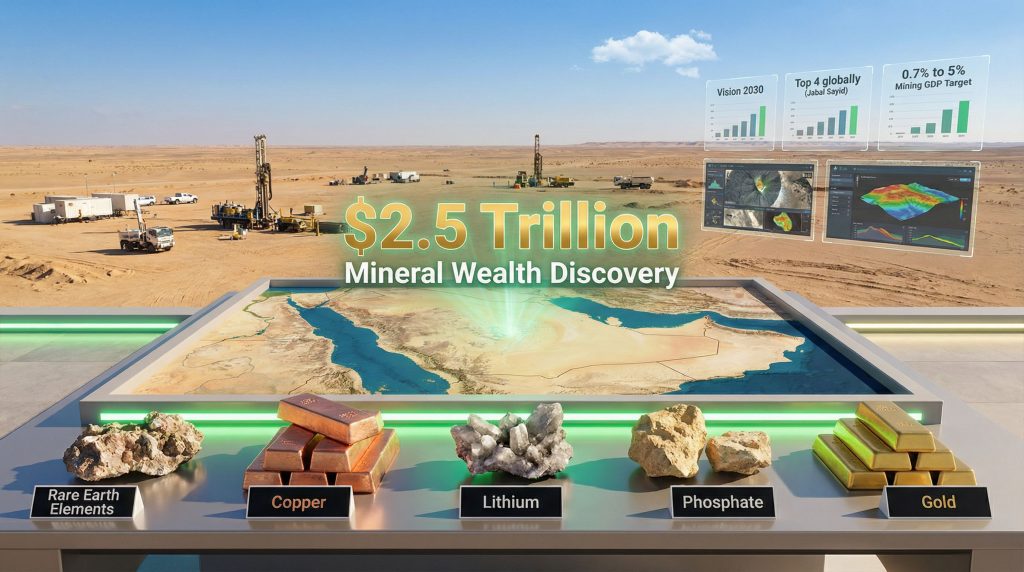
Saudi Arabia's remarkable mineral wealth discovery in Saudi Arabia demonstrates the sophisticated methodologies now employed in national resource assessment. The Kingdom's mineral wealth valuation has surged from SR5 trillion in 2016 to SR9.375 trillion ($2.5 trillion) by 2026, representing a 90% increase that reflects both newly discovered quantities and fair market value reassessments.
This valuation methodology incorporates multiple analytical frameworks:
- Geological certainty classifications distinguishing proven resources from speculative reserves
- Current commodity pricing integration reflecting post-2020 critical minerals premium
- Comprehensive geophysical mapping covering 1.3 million square kilometers across the Arabian Shield and sedimentary basins
- Technology-enhanced precision achieving globally recognized survey standards through SR1 billion in investment
The distinction between in-situ mineral resources and economically recoverable reserves represents a critical component of modern valuation frameworks. However, Saudi Arabia's approach emphasizes geological certainty through what officials describe as surveys completed at precision levels considered among the most accurate globally, establishing baseline data for ongoing reassessment cycles planned every three to five years.
Market Dynamics Influencing Arabian Peninsula Resource Assessment
The dramatic revaluation of Saudi Arabia's mineral assets reflects broader market dynamics reshaping global resource economics. Critical minerals transition demand has intensified significantly since 2020, driven by energy transition requirements and supply chain resilience concerns. This demand shift has created pricing premiums for strategic materials, particularly rare earth elements, copper, and lithium essential for renewable energy infrastructure.
Geopolitical risk factors substantially influence Middle Eastern resource valuations. The region's political stability, established infrastructure networks, and strategic geographic positioning between major consuming markets in Asia, Europe, and Africa create valuation premiums compared to resources in politically unstable regions. In addition, Saudi Arabia's positioning as a reliable supplier with strong international partnerships enhances the economic viability of its mineral discoveries.
Market concentration risks in critical mineral supply chains have elevated the strategic value of diversified resource bases. China's dominance in rare earth element processing (controlling approximately 60-70% of global processing capacity) has incentivized consuming nations to develop alternative supply relationships, creating favorable conditions for new entrants like Saudi Arabia with significant rare earth discoveries.
When big ASX news breaks, our subscribers know first
Why Are Unexpected Geological Discoveries Economically Significant?
Traditional mining regions worldwide face increasing extraction costs as easily accessible, high-grade deposits become depleted. Consequently, the economic significance of discovering minerals outside conventional geological belts lies in accessing untapped resource bases without competing for over-exploited deposits. These discoveries enable nations to capture first-mover advantages in emerging mineral provinces while established mining regions face rising operational costs and declining ore grades.
The Economics of Exploration Beyond Traditional Mining Belts
Saudi Arabia's mineral wealth discovery in Saudi Arabia demonstrates the transformative economics of expanding exploration boundaries beyond traditional mineralized zones. Companies revealed significant discoveries in areas not previously expected, outside the scope of conventional mineralized belts, fundamentally altering the economic geography of Middle Eastern mining.
The cost-benefit analysis of non-conventional exploration zones reveals several economic advantages:
- Reduced competition for specific geological targets compared to established mining districts
- Lower land acquisition costs in areas without existing mining infrastructure
- Phased development opportunities enabling capital deployment over extended timeframes
- Infrastructure integration potential with existing energy and transportation networks
Technology-enabled sedimentary cover exploration has made previously inaccessible deposits economically viable. Advanced geophysical techniques now penetrate sedimentary sequences to identify basement-hosted deposits and stratiform mineralisation within sedimentary formations. For instance, Saudi Arabia's discovery of important minerals such as phosphate and bauxite in sedimentary strata exemplifies this technological capability expansion.
Supply Chain Implications of Diversified Mineral Geography
The geographic distribution of newly discovered mineral sites creates strategic advantages for supply chain diversification. Unlike concentrated mining districts where single geological events or operational disruptions can affect multiple operations, dispersed discoveries across different geological provinces provide inherent supply security through geographic risk distribution.
Transportation economics for newly discovered deposits benefit from Saudi Arabia's existing infrastructure networks developed for petroleum operations. The Kingdom's established port facilities, rail connections, and logistics capabilities reduce the infrastructure investment requirements typically associated with greenfield mining development in remote locations.
Processing facility optimization becomes economically advantageous when multiple mineral types are discovered across different regions. The combination of rare earth elements in the Arabian Shield, phosphate in sedimentary sequences, and various transition metals enables integrated processing approaches that capture economies of scale and reduce per-unit processing costs.
Which Critical Minerals Are Driving Saudi Arabia's Resource Strategy?
Strategic mineral selection reflects the intersection of geological endowment, market demand dynamics, and industrial policy objectives. Saudi Arabia's focus on rare earth elements, copper, phosphate, and gold represents a portfolio approach balancing immediate revenue generation with long-term strategic positioning in critical supply chains.
Rare Earth Elements and Strategic Metal Economics
| Mineral Category | Saudi Arabia's Position | Global Market Dynamics | Strategic Applications |
|---|---|---|---|
| Rare Earth Elements | Jabal Sayid – Top 4 globally | China controls 60-70% processing | EV motors, wind turbines, permanent magnets |
| Copper | Targeting top 20 production | Supply deficit projected through 2030 | Renewable energy infrastructure, transmission lines |
| Phosphate | Targeting top 10 globally | Morocco dominates with 70% reserves | Food security, fertilizer production |
| Gold | Targeting top 20 production | Safe haven demand amid economic uncertainty | Currency reserves, industrial applications |
Jabal Sayid's rare earth element deposits represent a cornerstone of Saudi Arabia's critical minerals strategy. With rankings among the world's top four rare earth resources, this project positions the Kingdom as a strategically significant supplier for three critical sectors: magnet manufacturing for electric vehicles and wind turbines, domestic clean energy infrastructure development, and international supply chain resilience initiatives.
The partnership with MP Materials creates a vertically integrated model from extraction through processing within Saudi Arabia's supply chain. This collaboration enables technology transfer and processing capability establishment rather than raw ore export, capturing additional value-chain components and supporting Vision 2030 industrial development objectives.
Transition metal economics in energy infrastructure development drive copper and zinc targeting strategies. Copper demand for transmission infrastructure, renewable energy installation components, and battery technology integration makes copper supply security strategically important for energy transition planning. The International Energy Agency projects copper demand could double by 2040 under aggressive decarbonization scenarios.
Critical Mineral Supply Chain Integration
Saudi Arabia's strategic approach emphasizes downstream integration rather than commodity extraction alone. The development of processing capabilities through international partnerships creates value-addition opportunities while reducing exposure to commodity price volatility. This approach aligns with successful resource development models implemented by countries like Norway and Chile.
Phosphate resource development in sedimentary sequences provides foundation for downstream fertilizer production and industrial chemical manufacturing. The expansion toward top-10 global phosphate production recognizes dual value creation: commodity export revenues and feedstock for domestic industrial development supporting agricultural and chemical sectors.
Gold production targeting reflects both industrial demand and portfolio diversification considerations. While gold maintains traditional safe-haven characteristics for foreign exchange reserves, industrial applications in electronics and renewable energy technologies create consistent demand patterns independent of financial market cycles.
How Do Mega-Scale Mineral Discoveries Impact National Economic Planning?
Large-scale mineral discoveries necessitate comprehensive economic planning integration, affecting infrastructure development, workforce planning, industrial policy coordination, and international trade relationships. The scale of Saudi Arabia's $2.5 trillion mineral wealth discovery requires systematic integration with existing economic diversification strategies to maximize development benefits while avoiding resource curse dynamics.
Integration with Vision 2030 Diversification Strategy
The mineral wealth discovery in Saudi Arabia directly supports Vision 2030's core objective of reducing petroleum dependency through economic diversification. Mining industry evolution sector development provides alternative revenue streams with multi-decade horizons, creating economic resilience against crude oil price volatility and long-term demand transition risks.
Investment commitments demonstrate government support for sector development:
- Government incentives through 2030: Approximately $182 million committed
- 2024 exploration spending: Exceeded $280 million across private sector operators
- 2025 project investments: Approaching SR45 billion ($11.9 billion) for licensed projects
- License growth: 21% increase in mining sector licenses since 2016, with 172 additional licenses approved in 2025-2026
Employment generation potential across geographically dispersed mining operations addresses Vision 2030 territorial development objectives. Rare earth element processing at Jabal Sayid, phosphate development in sedimentary basins, and copper extraction across multiple sites create employment centers distributed across different regions, reducing geographic inequality and supporting rural economic development.
Technology transfer opportunities through international partnerships enable knowledge economy development aligned with Vision 2030 priorities. The MP Materials collaboration for rare earth processing represents technology transfer that builds domestic expertise in advanced materials processing, creating spillover effects for other industrial sectors.
Infrastructure Investment Requirements and Economic Multipliers
Large-scale mining development requires coordinated infrastructure investments that generate economic multiplier effects across multiple sectors. Saudi Arabia's existing infrastructure networks, developed for petroleum operations, provide advantageous starting points for mining sector development while requiring specific adaptations for mineral processing and transportation.
Transportation network adaptations focus on bulk commodity handling capabilities and specialized logistics for high-value materials like rare earth concentrates. The Kingdom's strategic location enables export access to Asian, European, and African markets through existing port facilities with modifications for mineral cargo handling.
Processing infrastructure development creates manufacturing sector expansion opportunities. Establishing domestic processing capabilities for phosphate into fertilizers, rare earth elements into permanent magnets, and copper into industrial products captures value-chain integration benefits while supporting industrial diversification objectives.
Skills development requirements necessitate educational infrastructure expansion and workforce training programs. Mining engineering, geological sciences, metallurgy, and environmental management capabilities require systematic development through university program expansion and international technical cooperation agreements.
What Are the Global Supply Chain Implications?
Saudi Arabia's emergence as a significant mineral supplier will reshape existing trade relationships and supply chain configurations across multiple commodities. The Kingdom's strategic positioning, political stability, and infrastructure capabilities create opportunities for consumer nations seeking supply chain diversification away from concentrated producer markets.
Reshaping Critical Mineral Trade Flows
The introduction of Saudi Arabian supply into global critical minerals markets creates opportunities for strategic partnerships with consuming nations pursuing supply security objectives. The United States, European Union, and Asian manufacturing centers actively seek alternative suppliers for critical minerals, particularly rare earth elements where Chinese processing dominance creates supply security concerns.
Bilateral trade agreement development becomes strategically important for both Saudi Arabia and consuming nations. The rare earth element partnership with MP Materials exemplifies how technical cooperation agreements can create preferential access relationships that benefit both suppliers and consumers through long-term supply contracts and technology sharing arrangements.
Market position disruption potential varies by commodity type and market concentration levels. In rare earth elements, Saudi Arabia's entry as a top-4 global resource holder could significantly impact pricing dynamics and supply security calculations. However, in more diversified markets like gold and copper, Saudi Arabian production additions may have less dramatic individual impact but contribute to overall supply resilience.
Financing Challenges in Large-Scale Mining Development
Global mining landscape development faces substantial financing challenges, with investment requirements exceeding $4 trillion worldwide while the combined market value of the top 20 global mining companies remains below $1 trillion. This financing gap creates opportunities for sovereign wealth funds and development finance institutions to play expanded roles in project development.
Sovereign wealth fund participation enables Saudi Arabia to maintain equity stakes in major projects while partnering with international mining companies for technical expertise and operational management. This approach provides capital access while retaining strategic control over resource development timing and market allocation decisions.
Infrastructure financing requirements between $1-2 trillion globally for mining-related transportation, processing, and utilities infrastructure create opportunities for coordinated development approaches. Saudi Arabia's financial capabilities through the Public Investment Fund enable integrated infrastructure development that supports multiple mining projects simultaneously.
International development bank cooperation provides additional financing capacity for cross-border infrastructure projects and technical assistance programs. The World Bank partnership in global mining strategy development exemplifies how multilateral institutions can support large-scale resource development while ensuring environmental and social compliance standards.
How Does Saudi Arabia's Approach Compare to Other Resource Nations?
Resource-rich nations employ varying development models reflecting their geological endowments, institutional capabilities, and economic diversification objectives. Saudi Arabia's state-guided development approach with private sector partnerships represents a hybrid model incorporating elements from successful resource economies while adapting to specific Middle Eastern contexts.
Benchmarking Against Established Mining Economies
| Country | Mining GDP Contribution | Development Model | Key Success Factors |
|---|---|---|---|
| Australia | 8.5% of GDP | Private sector-led | Regulatory stability, technical expertise |
| Chile | 12% of GDP | Mixed public-private | Copper market leadership, infrastructure |
| Norway | 1.5% GDP (excluding oil) | State-guided with private operators | Sovereign wealth fund management |
| Saudi Arabia | Currently 0.7%, targeting 5% | State-guided development | Strategic location, financial capacity |
Australia's private sector-led model demonstrates the importance of regulatory stability and technical expertise accumulation over decades. The country's success in iron ore, gold, and lithium reflects consistent mining-friendly policies, world-class geological survey capabilities, and deep capital markets supporting exploration and development activities.
Chile's copper-focused development illustrates specialization advantages and the importance of infrastructure investment in challenging geographical conditions. Chile's dominance in global copper supply reflects systematic investment in mining infrastructure, technical education, and regulatory frameworks supporting long-term foreign investment.
Norway's balanced approach to resource wealth management provides relevant lessons for oil-rich nations transitioning into mining development. Norway's sovereign wealth fund model and emphasis on technological innovation in resource extraction offer frameworks applicable to Saudi Arabia's development approach.
Lessons from Resource Curse Mitigation Strategies
Successful resource economies demonstrate consistent patterns in avoiding resource curse dynamics through institutional development, economic diversification, and revenue management systems. Saudi Arabia's approach incorporates several proven mitigation strategies while adapting to specific regional conditions.
Revenue stabilization mechanisms help manage commodity price volatility impacts on government finances and economic planning. Chile's copper stabilization fund and Norway's sovereign wealth fund provide models for converting resource revenues into diversified investment portfolios that generate sustainable income streams independent of commodity cycles.
Industrial linkage development creates spillover effects that broaden economic benefits beyond direct mining employment and revenues. Botswana's diamond cutting and polishing industry development demonstrates how value-addition activities can create manufacturing sector expansion and skills development with applications across multiple industries.
Institutional quality maintenance requires systematic attention to governance standards, regulatory transparency, and corruption prevention systems. Successful resource economies consistently demonstrate strong institutional frameworks that maintain investor confidence while ensuring domestic benefit distribution.
The next major ASX story will hit our subscribers first
What Technology and Innovation Factors Enable These Discoveries?
Technological advances in geological exploration have fundamentally transformed mineral discovery capabilities, enabling identification of deposits previously undetectable through conventional methods. The integration of satellite-based remote sensing, artificial intelligence-driven geological analysis, and comprehensive geophysical databases has created unprecedented exploration precision and coverage capabilities.
Advanced Geological Survey Technologies
Saudi Arabia's comprehensive Arabian Shield survey employed multiple integrated technologies to achieve what officials describe as globally recognized precision standards. This technological approach demonstrates the evolution from traditional geological mapping toward data-intensive, multi-platform exploration methodologies.
High-resolution geophysical mapping techniques include:
- Aeromagnetic surveys identifying subsurface geological structures and mineralisation signatures
- Gravity mapping detecting density variations associated with different mineral deposits
- Radiometric surveys identifying surface geochemical anomalies indicating deeper mineralisation
- Electromagnetic methods mapping conductive ore bodies and geological structures
Satellite-based mineral detection capabilities enable systematic coverage of vast geographical areas at consistent resolution standards. Advanced satellite imagery analysis can identify surface mineralogical signatures, structural controls on mineralisation, and hydrothermal alteration patterns associated with different deposit types.
Artificial intelligence applications in geological pattern recognition process massive datasets to identify previously unrecognized mineralisation patterns. Machine learning algorithms can analyze multi-element geochemical data, geophysical signatures, and geological relationships to predict mineralisation potential in unexplored areas.
Digital Infrastructure Supporting Resource Development
The SR1 billion investment in integrated databases for the Arabian Shield survey demonstrates the importance of comprehensive data management systems in modern mineral exploration. These digital platforms enable real-time data integration, analysis, and investor access that accelerates project development timelines.
Integrated geological databases combine multiple data types into unified platforms accessible by investors, mining companies, and government agencies. This transparency reduces exploration risk and enables more informed investment decisions by providing comprehensive geological, geochemical, and geophysical information for specific areas.
Real-time monitoring systems for active mining operations enable operational optimization and environmental compliance monitoring. Data-driven mining operations provide continuous data streams for processing efficiency, equipment performance, and environmental impact assessment.
Blockchain applications in mineral supply chain tracking create transparency and verification capabilities increasingly demanded by consuming industries. These systems enable tracking of mineral origins, processing stages, and environmental compliance throughout supply chains, supporting responsible sourcing requirements.
How Will This Impact Regional and Global Mining Investment Flows?
Saudi Arabia's emergence as a major mineral producer will influence global mining investment patterns, creating new opportunities while potentially redirecting capital flows from established mining jurisdictions. The Kingdom's combination of geological endowment, political stability, and financial resources creates competitive advantages that may attract investment previously directed toward traditional mining regions.
Middle East as an Emerging Mining Investment Destination
The successful identification of $2.5 trillion in mineral wealth positions the Middle East as a legitimate alternative to established mining regions in Africa, Australia, and South America. This regional shift reflects several competitive advantages that enhance investment attractiveness compared to traditional mining jurisdictions.
Political stability factors create crucial advantages for long-term mining investment decisions. Unlike many African mining jurisdictions experiencing political instability or regulatory uncertainty, Saudi Arabia's established governance systems and international relationships provide investment security essential for projects requiring decades-long development timelines.
Infrastructure development advantages stem from existing petroleum industry investments in transportation, utilities, and logistics capabilities. These established networks reduce greenfield development costs and timeline risks compared to remote mining regions requiring complete infrastructure construction.
Regulatory framework development for international mining investment reflects lessons learned from established mining jurisdictions. Saudi Arabia's mining law development incorporates international best practices while maintaining strategic control over resource development priorities and market allocation decisions.
Competitive Dynamics with Established Mining Regions
Cost competitiveness analysis reveals mixed comparisons with established mining operations. While Saudi Arabia may face higher initial labour costs compared to some African operations, advantages in infrastructure, political stability, and financing access can offset operational cost differentials through reduced project development risks and timelines.
Labour market development represents both challenge and opportunity for Saudi mining development. The Kingdom's emphasis on workforce nationalisation creates opportunities for skills development and employment generation while requiring systematic training programs and technology transfer arrangements with international mining companies.
Environmental and social governance standards increasingly influence mining investment decisions as consuming companies implement responsible sourcing requirements. Furthermore, Maaden's significant gold discovery demonstrates Saudi Arabia's regulatory development emphasis on international ESG compliance, potentially creating competitive advantages over jurisdictions with less comprehensive environmental and social frameworks.
What Are the Long-term Economic Scenarios?
The development of Saudi Arabia's $2.5 trillion mineral wealth will unfold over multiple decades, creating various economic scenarios dependent on technology development, global demand patterns, regulatory frameworks, and successful project execution. Understanding these scenario ranges enables more informed planning and risk management approaches.
Optimistic Development Pathway Analysis
Under favourable development conditions, Saudi Arabia could achieve its stated objectives of reaching top-10 global positions in phosphate production and top-20 positions in copper and gold production within the next decade. This scenario assumes successful project development, stable commodity prices, and continued international demand for critical minerals.
Economic diversification success metrics include:
- Mining sector GDP contribution increasing from current 0.7% toward the 5% target
- Export revenue diversification reducing petroleum dependency through mineral export growth
- Employment generation creating high-skilled jobs across multiple regions
- Technology transfer establishing domestic expertise in advanced materials processing
Regional economic integration opportunities emerge through trade relationships with neighbouring countries and strategic partnerships with consuming nations. The Kingdom's central location enables export access to Asian, European, and African markets while potentially developing regional processing and logistics hubs serving broader Middle Eastern mineral development.
Industrial sector expansion through downstream processing creates manufacturing capabilities applicable beyond mining operations. Rare earth magnet production, phosphate-based chemical manufacturing, and copper processing technologies generate industrial expertise transferable to other sectors supporting broader economic diversification.
Risk Factors and Mitigation Strategies
Several risk categories could impact the successful development of Saudi Arabia's mineral wealth, requiring systematic mitigation strategies and contingency planning approaches.
Commodity price volatility management represents the most significant economic risk for large-scale mining development. Historical commodity cycles demonstrate substantial price swings that can render projects economically unviable during downturns. Mitigation strategies include:
- Price stabilisation funds similar to Chile's copper fund model
- Long-term supply contracts providing price predictability
- Portfolio diversification across multiple commodities reducing single-commodity exposure
- Flexible production capacity enabling output adjustment during price cycles
Technology disruption impacts on mineral demand patterns could affect long-term project economics. Battery technology developments might reduce lithium demand while increasing requirements for other materials. Mitigation approaches include:
- Research and development investment in alternative mineral applications
- Flexible processing infrastructure adaptable to different mineral types
- Strategic partnership development with technology companies providing market intelligence
Climate change effects on extraction operations require environmental planning and adaptive management strategies. Increasing temperatures and water scarcity could impact mining operations and processing activities. Response strategies include:
- Water recycling technology implementation reducing freshwater requirements
- Renewable energy integration reducing operational carbon footprints
- Heat management systems maintaining operational efficiency in extreme temperatures
How Does This Discovery Compare to Historical Mining Booms?
The scale and technological sophistication of Saudi Arabia's mineral wealth discovery in Saudi Arabia represents a modern evolution of historical mining booms, distinguished by advanced geological assessment capabilities and systematic development planning. However, mineral exploration importance parallels historical patterns where comprehensive resource identification preceded major economic transformation.
Technological Evolution in Resource Assessment
Historical mining discoveries relied primarily on surface observations, basic geological mapping, and serendipitous discoveries by prospectors. In contrast, Saudi Arabia's systematic approach demonstrates the evolution toward comprehensive, technology-enabled resource assessment that provides unprecedented accuracy in resource quantification and quality assessment.
Precision improvements in modern exploration enable confident resource statements that would have been impossible during historical boom periods. The SR1 billion investment in integrated databases and survey technology creates resource assessments with confidence levels that support major investment decisions and long-term strategic planning.
Scale comparison analysis reveals that while individual historical discoveries might have been proportionally significant for their time periods, the absolute scale of Saudi Arabia's resource base exceeds many historical mining booms in aggregate value and strategic importance for global supply chains.
Disclaimer: The economic projections, market analyses, and development scenarios discussed in this article involve inherent uncertainties and assumptions. Commodity markets exhibit significant volatility, and mining project development carries substantial technical and financial risks. The success of Saudi Arabia's mineral development strategy depends on various factors including global economic conditions, technology development, regulatory stability, and successful project execution. Investors and stakeholders should conduct independent analysis and due diligence before making investment decisions based on information presented in this analysis.
Strategic Economic Positioning for Global Mining Leadership
Saudi Arabia's mineral wealth discovery represents a transformational opportunity to establish the Kingdom as a major force in global critical minerals supply chains. The successful development of these resources could fundamentally alter the nation's economic structure while contributing to international supply chain resilience and energy transition objectives.
The integration of advanced exploration technologies, strategic international partnerships, and comprehensive development planning creates a framework for sustainable mining sector growth. The emphasis on downstream processing and value-addition activities aligns with successful resource economy models while supporting broader economic diversification goals.
Long-term sustainability of mining-led economic diversification requires continued attention to institutional development, environmental stewardship, and community benefits distribution. The Kingdom's approach of combining state guidance with private sector expertise, supported by substantial financial resources and existing infrastructure, provides a strong foundation for realising the economic potential of this remarkable mineral wealth discovery.
The global implications extend beyond Saudi Arabia's domestic development objectives. The emergence of a new major supplier in critical minerals markets contributes to supply chain resilience and competitive pricing that benefits consuming nations and industries worldwide. Consequently, this development supports global energy transition objectives while demonstrating the continued importance of geological exploration and resource development in the modern economy.
Could Your Investment Strategy Benefit From Saudi Arabia's $2.5 Trillion Discovery?
Saudi Arabia's systematic approach to mineral wealth assessment demonstrates how advanced geological mapping can uncover transformational investment opportunities that reshape entire economies. Discovery Alert's proprietary Discovery IQ model instantly identifies similar breakthrough announcements across ASX mineral discoveries, providing subscribers with immediate alerts when companies announce significant resource discoveries or exploration results that could mirror Saudi Arabia's success. Begin your 30-day free trial today through Discovery Alert and position yourself ahead of the market for the next major mineral wealth discovery.