
May 14, 2026
When Physical Steel Arrives Before Financial Models: The Real Test of African Mining Ambition
Across decades of resource development on the African continent, the graveyard of stalled mining projects shares a common epitaph: the ore was there, the demand was real, but the train never came. Infrastructure failure has historically been the silent killer of otherwise commercially compelling resource ventures across Central and West Africa. Rail corridors, port capacity, and rolling stock procurement have consistently proven more consequential to project outcomes than ore grade, resource tonnage, or even financing terms. It is within this context that the Minim Martap bauxite project locomotive delivery carries significance far beyond its immediate operational function.
The arrival of physical rolling stock at the Port of Douala is not simply a logistics update. For a landlocked Adamawa region deposit that cannot move a single tonne of ore without functioning rail infrastructure, each locomotive that clears customs represents the conversion of financial engineering into operational reality. That distinction matters enormously to the investors, offtake partners, and regional stakeholders watching this project's progress.
When big ASX news breaks, our subscribers know first
What Is the Minim Martap Bauxite Project and Why Does It Matter?
Project Fundamentals: Scale, Geography, and the Rail Imperative
The Minim Martap bauxite deposit sits within Cameroon's Adamawa region, a landlocked interior plateau that creates a non-negotiable dependency on rail transport for any commercial ore evacuation. Camalco, the Cameroonian subsidiary of ASX-listed junior miner Canyon Resources, operates the project with a target annual production capacity of 10 million metric tonnes of bauxite. At that volume, Minim Martap would rank among Africa's most significant bauxite operations upon full commissioning.
The geographic reality of the Adamawa plateau makes the rail question existential rather than logistical. There is no viable road-based alternative for moving bulk bauxite at commercial volumes across the terrain separating the mine site from the Port of Douala. Every tonne of ore produced depends entirely on the functioning of a rail corridor that currently requires substantial rehabilitation before it can handle the axle loads and train frequencies that a 10 million tonne annual operation demands.
Canyon Resources has developed a comprehensive mine-to-port logistics strategy that underpins the entire commercial viability of the project, recognising that ore evacuation infrastructure is inseparable from production planning at this scale.
Bauxite Ore Quality and Its Commercial Implications
Understanding what makes Minim Martap commercially interesting requires some familiarity with how bauxite is evaluated by aluminium refiners. Bauxite is assessed primarily on its available alumina content (typically expressed as a percentage of the ore by weight) and its reactive silica levels. High reactive silica content forces alumina refineries to consume substantially more caustic soda during the Bayer Process, the dominant industrial method for converting bauxite into alumina. This increases refinery operating costs and can price high-silica ores out of competitive markets.
Deposits with available alumina content in the range of 45–55% and low reactive silica are considered premium specification material. Cameroon's Adamawa region bauxite has historically been characterised by geologists as exhibiting favourable alumina content relative to competing Central and West African deposits, though full technical disclosure of Minim Martap's specific mineralogical profile would strengthen investor confidence and refinery procurement interest.
For alumina refiners seeking to diversify away from Guinean bauxite, ore specification consistency and reactive silica levels are often as important as delivered price. A deposit that grades well on paper but performs inconsistently at the refinery quickly loses buyer confidence.
Cameroon's Entry into a Guinea-Dominated Market
Global bauxite production is currently structured around a small number of dominant sources. Australia historically commands approximately 30–35% of global output, Guinea approximately 20–25%, and China approximately 15–20%, with the remaining share distributed across India, Brazil, Jamaica, and smaller producers. Cameroon currently contributes negligible volumes to global supply.
The aluminium industry faces compounding demand growth from three structural drivers: electric vehicle lightweighting (each EV uses approximately 40–80 kilograms of aluminium in body panels and battery enclosures), renewable energy infrastructure (solar mounting systems, wind turbine components, transmission hardware), and aerospace manufacturing (where aluminium-lithium alloys are replacing heavier materials). Against this demand backdrop, supply chain concentration in Guinea has created procurement risk for European and Asian alumina refiners seeking alternatives.
A successfully commissioned Minim Martap project would introduce Cameroon as a new supply geography, offering refiners a non-Guinean Central African source with direct Atlantic ocean access via Douala. This geographic and geopolitical diversification value is separate from, and potentially additive to, the project's purely economic returns.
The Rolling Stock Procurement: A Multi-Supplier Strategy With Strategic Logic
Breaking Down the Equipment Orders
The procurement architecture for Minim Martap's rail transport system reflects deliberate supplier diversification across two major manufacturing countries.
| Equipment Category | Supplier | Country | Volume | Delivery |
|---|---|---|---|---|
| Diesel locomotives | CRRC Ziyang (CRRC Corp Ltd) | China | 22 units total | Q2–Q3 2026 |
| Open rail wagons (initial) | Texmaco Rail & Engineering | India | 560 units | July 2026 |
| Open rail wagons (optional) | Texmaco Rail & Engineering | India | Up to 1,040 additional | 5-year window |
CRRC Corporation Ltd operates as one of the world's largest rolling stock manufacturers by revenue and production capacity, with an expanding track record across African infrastructure programmes in Ethiopia, Kenya, and South Africa. The Ziyang facility specifically concentrates on heavy-freight diesel locomotive production for export markets, making it a technically appropriate supplier for an ore-haul application of this nature.
Texmaco Rail & Engineering represents India's leading freight wagon manufacturer, with competitive pricing credentials established across prior African contracts. The selection of an Indian wagon supplier alongside a Chinese locomotive manufacturer reflects both cost optimisation logic and a pragmatic assessment of which manufacturers offer the most competitive per-unit economics at scale. According to reporting on Cameroon's logistics milestone, the delivery programme represents one of the most significant rolling stock commitments in the region's recent mining history.
What the Optional Wagon Clause Reveals
The contractual option for an additional 1,040 wagons beyond the initial 560-unit order carries a signal that deserves careful attention. An option clause of this magnitude, stretching across a five-year delivery window, indicates that project developers are already planning infrastructure capacity for a production profile that exceeds the initial 10 million tonne annual target.
If those optional wagons were fully exercised, total wagon fleet capacity would reach 1,600 units, which at standard ore-haul operating ratios would support annual production volumes in the range of 14–18 million tonnes depending on cycle times and train configuration.
The inclusion of a 1,040-wagon option clause is not a conservative contingency. It is an architectural statement about where this project's developers expect to be in five to seven years. Options are exercised when economics support them; building them into the original contract means the infrastructure framework is already sized for growth.
The Minim Martap Bauxite Project Locomotive Delivery: What Arriving First Means
Seven Locomotives, One Unmistakable Signal
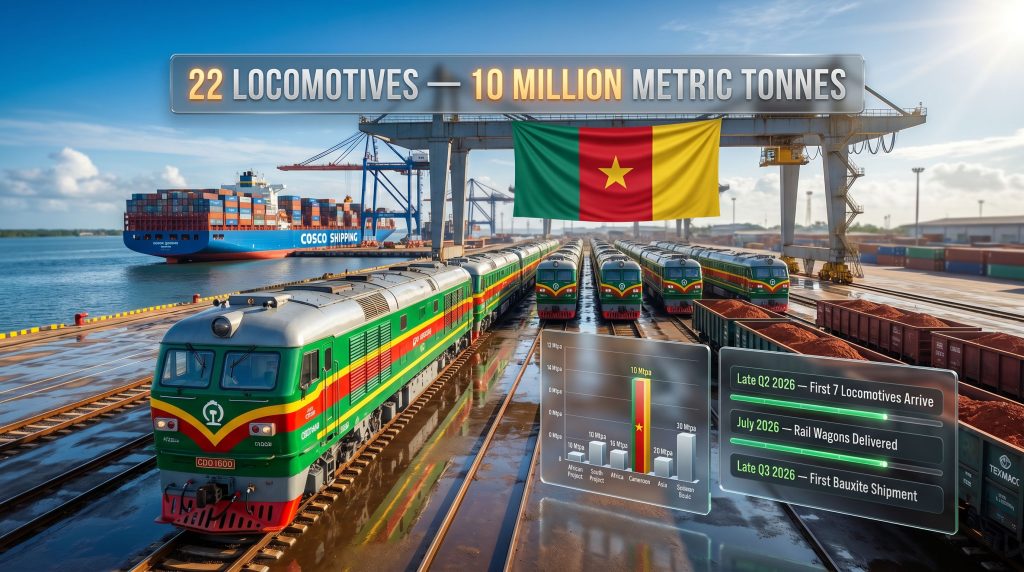
Logistics group COSCO Shipping confirmed the dispatch of 12 locomotives to Africa, with 7 units from that consignment designated for the Cameroon project and expected at the Port of Douala by the end of June 2026. These seven locomotives constitute the first physical delivery under the complete 22-unit contract between Camalco and CRRC, with remaining units scheduled across Q3 2026.
For context, a functional minimum of five to seven active locomotives is required to initiate controlled ore evacuation at low production volumes, accounting for routine maintenance cycles that typically take one to two units out of service at any given time. The initial seven-unit batch therefore represents the threshold minimum for commencing trial operations rather than a comfortable operational surplus.
The rail wagon consignment from Texmaco is anticipated to follow in July 2026, creating a narrow convergence window between locomotive arrival, wagon deployment, railway rehabilitation completion, and the commencement of trial mining operations.
The Commissioning Timeline: Aggressive by Any Standard
The following sequence represents Camalco's current project commissioning schedule:
- Late Q2 2026 – First 7 locomotives arrive at Port of Douala
- July 2026 – Initial 560-wagon consignment from Texmaco arrives
- Mid-Q2 2026 – Trial mining operations commence at the mine site
- Q3 2026 – Remaining locomotive units delivered from CRRC
- Late Q3 2026 (approximately September 2026) – First bauxite export shipment targeted
- Q4 2026 – Full-scale production operations expected to begin
The interval from first locomotive arrival to first ore shipment spans approximately three months. For a project of this scale, executing locomotive commissioning, wagon deployment, track system integration, trial mining, ore stockpile building, ship-loading readiness, and first vessel loading within a 90-day window is an operationally demanding target that leaves minimal tolerance for unforeseen delays.
This timeline should be understood as a target rather than a guarantee. Investors and observers should note that infrastructure commissioning programmes of this complexity routinely encounter sequential dependencies where a delay in one element cascades across subsequent milestones. The disclaimer here is that first shipment timing remains contingent on multiple parallel work-streams all executing within their current scheduled windows.
Capital Already Deployed: The USD $316.6 Million Railway Investment
Understanding the Financial Commitment to Infrastructure
Camalco and its rail infrastructure partner Camrail have together committed CFA 176.8 billion (approximately USD $316.6 million) toward railway equipment acquisition as of May 2026. This figure represents approximately 70% of the total planned rail budget of CFA 252.6 billion. The total project investment envelope stands at approximately USD $446 million, with railway infrastructure absorbing the largest single component of that capital commitment.
| Financial Metric | Amount |
|---|---|
| Rail equipment budget committed | USD $316.6 million (CFA 176.8bn) |
| Total planned rail equipment budget | CFA 252.6 billion |
| Remaining planned rail expenditure | ~USD $129.4 million (CFA ~75.8bn) |
| Total project investment envelope | ~USD $446 million |
| Rail capital as share of total investment | Over 70% |
This capital concentration in logistics infrastructure before a single tonne of ore has been exported reflects the fundamental economics of landlocked African mining development. The Adamawa region's geographic isolation creates a situation in which the rail system is not a supporting cost centre but the project's core enabling asset. Without functioning rail, the ore body has no commercial pathway regardless of its quality or volume.
The Camrail Partnership and Its Risk Implications
Camrail operates Cameroon's primary national rail network under a concession arrangement and functions as a co-investor in the rolling stock programme alongside Camalco. This partnership structure distributes capital risk between the mining operator and the existing rail concessionaire, theoretically reducing single-entity exposure. However, it also introduces coordination risk: if Camrail's rehabilitation schedule for existing network sections does not synchronise with Camalco's commissioning timeline, the operational readiness of rolling stock alone will be insufficient to move ore.
Canyon Resources carries the additional obligation of financing the construction of a new rail spur connecting the Minim Martap mine site directly to Cameroon's national rail network. This represents a capital commitment with no revenue-generating precedent until first ore shipment, meaning the company must sustain investment carrying costs on a non-productive asset throughout the construction and commissioning period.
Operational Challenges That Remain on the Critical Path
Railway Rehabilitation: The Work Running in Parallel
Several sections of the existing rail corridor between the Adamawa region and the Port of Douala require structural rehabilitation before heavy ore trains can operate safely at commercial frequencies. Priority remediation areas include track condition along high-gradient sections, bridge load ratings, and signalling systems that must accommodate higher train frequencies. Furthermore, many existing structures were engineered for lighter passenger and general freight loads than heavily laden bauxite trains require.
This rehabilitation work is running concurrently with rolling stock delivery and trial mining preparation. The parallel execution of construction rehabilitation and equipment commissioning creates operational complexity where multiple work-streams must coordinate across geographically dispersed locations under a compressed shared deadline.
Manufacturing Lead Times and the Chinese New Year Factor
Minor schedule slippage attributed to extended manufacturing lead times at CRRC's Ziyang facility, compounded by the annual Lunar New Year production shutdown (typically a two to three week pause in Chinese manufacturing output during late January and February), resulted in revised delivery windows from the original projected timelines. The project team has maintained overall commissioning targets despite these upstream adjustments, absorbing the schedule variation without abandoning the late Q3 2026 first-shipment objective.
This experience illustrates a supply chain reality that is underappreciated in African mining project planning: procurement from Chinese manufacturers carries inherent lead time variability associated with Chinese public holidays, export licensing procedures, and port congestion at major Chinese loading terminals. Projects with zero schedule buffer are consequently exposed to these recurring, predictable disruptions.
Port of Douala: Bulk Handling Readiness as a Determinant Variable
The Port of Douala serves as Cameroon's primary commercial gateway and the endpoint of the entire ore evacuation chain. Bulk bauxite handling imposes specific infrastructure requirements that differ meaningfully from containerised freight operations. These include dedicated stockpile areas with appropriate drainage and dust management, ship-loading conveyor or grab-crane systems capable of sustaining loading rates that keep bulk carriers on commercial layday schedules, and vessel draft capacity sufficient for Handymax or Supramax bulk carriers that typically serve the bauxite export trade.
Port infrastructure readiness at Douala will be a determinant of whether the late September 2026 first-shipment target is achievable. Regional competition for port handling capacity from other Central African commodity exporters adds another variable to this equation that project timelines do not explicitly address.
The next major ASX story will hit our subscribers first
How Minim Martap Compares to Africa's Operating Bauxite Projects
Competitive Context Within the African Supply Landscape
| Project | Country | Target Production | Current Status |
|---|---|---|---|
| Boffa (SMB-Winning) | Guinea | ~60 million Mtpa | Fully operational |
| Sangarédi (CBG) | Guinea | ~15 million Mtpa | Fully operational |
| Minim Martap (Camalco) | Cameroon | 10 million Mtpa | Pre-production/commissioning |
| Ayala | Ghana | ~5 million Mtpa | Development stage |
Guinea's operational dominance of African bauxite supply is immediately apparent from this comparison. The SMB-Winning consortium at Boffa alone produces six times Minim Martap's initial target volume. However, scale comparison alone misses the strategic value proposition that Cameroon offers to buyers: supply geography diversification away from a single country that currently accounts for the majority of African bauxite exports.
For alumina refiners in the Middle East, Europe, and parts of Asia seeking to reduce Guinea concentration risk in their bauxite procurement, a well-functioning Cameroonian supply corridor represents qualitative value beyond the raw tonnage figures. The broader bauxite and alumina market dynamics, furthermore, suggest that buyers are actively seeking new geographies to insulate against supply concentration risk. This is why offtake interest in Minim Martap should not be assessed purely against Guinea's cost-per-tonne economics.
The Long-Term Downstream Optionality
A dimension of the Minim Martap project that receives insufficient attention in near-term operational analysis is the potential for in-country alumina refining should Cameroon's energy infrastructure develop sufficiently over the coming decade. Alumina refining is highly energy-intensive, and Cameroon's current installed hydroelectric capacity of approximately 1.2 gigawatts is insufficient for primary aluminium smelting at meaningful scale.
However, if planned hydroelectric expansion projects on the Sanaga River proceed, the energy economics for an in-country refinery could shift materially, opening a downstream value-addition pathway that would transform Minim Martap from a bulk ore exporter into a partially processed alumina supplier commanding significantly higher margins per tonne.
This optionality does not feature in current project financials or commissioning schedules. It is a speculative medium-term scenario that depends on Cameroon's energy sector development proceeding on a timeline independent of Canyon Resources' operational planning. Investors should treat this as an asymmetric upside scenario rather than a basecase assumption.
What This Means for Canyon Resources and Its Investment Case
Converting Financial Commitments Into Physical Assets
Canyon Resources has advanced the Minim Martap deposit from exploration stage through to the pre-production phase as an ASX-listed junior miner, a developmental arc that requires sustained capital commitment without revenue offset. The Minim Martap bauxite project locomotive delivery represents a qualitative shift in the project's risk profile for external observers: it is one thing to announce equipment contracts, and another to have physical locomotives clearing a West African port.
For mining project finance, this distinction is commercially meaningful. Equipment procurement and delivery serve as tangible validation that financial commitments are converting into operational assets, reducing execution risk perception among prospective offtake partners and future capital providers. In addition, Canyon's approach stands in contrast to comparable ventures such as the Niagara bauxite project, which remains at an earlier development stage without equivalent infrastructure deployment.
The pre-commitment of approximately 70% of total rail capital before first ore export is simultaneously a confidence signal and a financial risk concentration point. It demonstrates that the project's developers have made irreversible infrastructure commitments that align their financial interests with delivery, but it also means that the project's invested capital is substantially at risk if commissioning encounters prolonged delays.
The information in this article is based on publicly available sources including Ecofin Agency reporting dated May 14, 2026. This article does not constitute financial advice. Forward-looking statements regarding production timelines, shipment schedules, and project milestones involve inherent uncertainty and should not be relied upon as guarantees of future outcomes. Readers should conduct independent research before making investment decisions.
Frequently Asked Questions: Minim Martap Bauxite Project
How Many Locomotives Has Camalco Ordered for the Minim Martap Project?
Camalco has contracted a total of 22 diesel locomotives from CRRC Corporation Ltd (specifically CRRC Ziyang). The first delivery batch of seven units is expected at the Port of Douala by the end of June 2026, with additional units to follow in Q3 2026.
Who Manufactured the Locomotives for the Project?
The locomotives were manufactured by CRRC Ziyang, a division of China's CRRC Corporation Ltd, one of the world's largest rolling stock manufacturers by production capacity.
When Is the First Bauxite Shipment From Minim Martap Expected?
Based on the current commissioning schedule, the first bauxite export shipment is targeted for late Q3 2026 (approximately September 2026), with full-scale production operations expected to commence in Q4 2026.
How Much Has Been Invested in Rail Infrastructure for the Project?
Camalco and Camrail have jointly committed approximately USD $316.6 million (CFA 176.8 billion) toward railway equipment acquisition, representing roughly 70% of the total planned rail budget of CFA 252.6 billion.
What Is the Annual Production Target for the Minim Martap Project?
The project is designed to produce 10 million metric tonnes of bauxite per annum at full operational capacity.
What Rail Wagons Have Been Ordered?
An initial order of 560 open rail wagons has been placed with Indian manufacturer Texmaco Rail & Engineering Limited, with a contractual option for an additional 1,040 wagons deliverable over a five-year period.
The Broader Lesson That Minim Martap Is Teaching African Mining Development
The Minim Martap bauxite project locomotive delivery illustrates something that financial models and feasibility studies routinely understate: in African resource development, physical infrastructure procurement is the real confidence threshold, not financial close. Announcing a capital raise or signing an equipment contract occupies a fundamentally different category of credibility than having locomotives physically documented at a receiving port.
The multi-supplier architecture that Camalco has assembled, combining Chinese rolling stock engineering, Indian wagon manufacturing, Australian project management, and Cameroonian rail concession partnership, represents an increasingly relevant template for how resource developers can structure landlocked African projects across multiple international supply chains without depending on any single national industrial base. This approach contrasts markedly with how many leading aluminium mining companies have historically managed supply chain risk on the continent.
The critical milestones to monitor in the coming months are the completion of railway rehabilitation works along the Douala corridor, the July 2026 arrival of the Texmaco wagon consignment, and the performance of trial mining operations as a sequential proof sequence for operational readiness. Each of these represents a discrete risk event. Each, if successfully cleared, brings Cameroon materially closer to establishing itself as a credible new entrant in the global bauxite supply chain.
Whether that ambition translates into first ore on a vessel by late September 2026 will depend not on the quality of the deposit, which appears commercially compelling, but on the cumulative execution of a logistics programme that is, by any objective assessment, operating with very little room for error. For further technical detail on the project's progress, Canyon Resources' advancement updates offer additional context on the pathway toward the September production target.
Ready to Identify the Next Major ASX Mineral Discovery Before the Market Does?
Discovery Alert's proprietary Discovery IQ model scans ASX announcements in real time, instantly translating complex mineral data into actionable investment opportunities across 30+ commodities — the same kind of infrastructure-backed resource plays that define projects like Minim Martap. Explore why significant mineral discoveries have historically delivered exceptional returns on Discovery Alert's dedicated discoveries page, and begin your 14-day free trial today to position yourself ahead of the broader market.