August 6, 2026
The Geological Bet That Most Investors Are Missing
There is a particular category of mining jurisdiction that institutional capital repeatedly overlooks until it is too late to secure meaningful exposure at attractive entry points. These jurisdictions share a common profile: genuine geological endowment, an underexplored resource base relative to international standards, improving regulatory architecture, and a government whose fiscal trajectory creates urgent motivation to attract foreign capital. Oman currently fits this profile with unusual precision, and the 2025 to 2026 concession rounds represent one of the more clearly defined windows of opportunity available in the broader Middle East and North Africa mining space.
The core investment thesis for Oman mining blocks investment opportunities does not rest on speculation. It rests on a convergence of geological reality, policy urgency, and global commodity demand that is increasingly difficult to ignore.
When big ASX news breaks, our subscribers know first
Why Oman's Mineral Endowment Is Structurally Different From Other GCC Jurisdictions
Most Gulf Cooperation Council nations lack the hard-rock geology necessary to support meaningful mining industries. Oman is the exception. The country's geological identity is defined by one of the world's most significant and best-preserved ophiolite sequences, a section of ancient oceanic crust that was thrust onto the Arabian continental margin during the Cretaceous period.
This ophiolite complex, spanning the Al Hajar mountain range across a corridor of approximately 700 kilometres, hosts the characteristic mineralization patterns associated with seafloor spreading environments. Furthermore, the VMS deposit geology of these sequences includes copper sulphide deposits, chromite seams concentrated in ultramafic rocks, nickel and platinum group element occurrences in peridotite bodies, and associated gold mineralization in hydrothermal zones.
The geological distinction matters enormously because it explains why Oman's resource prospectivity is categorically different from neighbouring states and why the country has attracted hard-rock mining expertise from Australia, the United Kingdom, China, and the United States.
This is not merely a modern discovery. Archaeological evidence confirms that copper extraction in Oman dates back approximately five thousand years, with the ancient region known across Bronze Age trade networks as a copper-producing civilization of regional significance. The geological legacy that supported ancient smelting operations remains substantially underexplored by modern international standards, a fact that creates the prospectivity premium that sophisticated mining investors seek when evaluating greenfield jurisdictions.
The Economic Diversification Imperative Driving Concession Activity
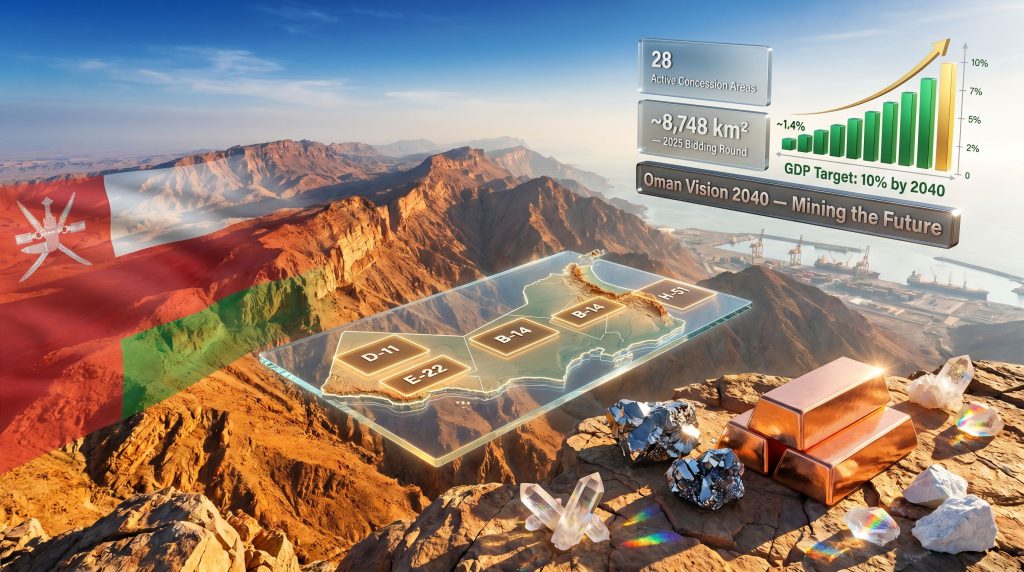
The structural case for investing in Oman's minerals sector extends well beyond geology. Oman's economy has historically depended on hydrocarbon revenues, creating fiscal vulnerability that becomes more acute as global energy transition accelerates. The minerals sector is now formally embedded within Oman Vision 2040 as a primary non-oil growth engine, targeting an expansion of the sector's GDP contribution from approximately 1.4% in 2020 to 10% by 2040, representing a sevenfold increase in economic significance over a defined planning horizon.
Minister of Energy and Minerals Eng Salim bin Nasser al Aufi publicly characterised 2025 as representing a meaningful inflection point for the minerals sector, describing mining as a central driver of economic diversification with accelerating growth expectations tied to new concession area operations commencing across the country (Oman Daily Observer, May 14, 2026).
This policy framing is significant because it signals multi-year institutional commitment rather than cyclical resource nationalism. Governments with this level of explicit GDP diversification dependency on a sector tend to maintain investor-friendly policy settings even through commodity price downturns, as the alternative carries greater fiscal cost. In addition, rising critical minerals demand globally reinforces the urgency of Oman's strategic positioning.
The 2025 to 2026 Concession Rounds: What Is Actually on the Table
The Ministry of Energy and Minerals formally launched a competitive bidding process in September 2025 covering four distinct concession blocks totalling approximately 8,748 km², with geological data packages accessible through the government's Taqa digital platform. The commodity targeting across these blocks reflects deliberate diversification across both metallic and industrial mineral categories.
| Concession Block | Governorate | Area (km²) | Primary Target Minerals |
|---|---|---|---|
| D-11 | Al Buraimi | 1,084 | Copper, gold, silver, chromite, basalt, gabbro |
| E-22 | North Al Sharqiyah | 810 | Copper, gold, silver, chromite, basalt, gabbro |
| B-14 | South Al Batinah | 2,673 | Copper, gold, silver, chromite, basalt, gabbro |
| H-51 | Al Wusta | 4,181 | Silica, salt, kaolin |
Block H-51 in Al Wusta warrants particular attention from investors focused on industrial minerals. At 4,181 km², it is the single largest concession area in the 2025 round and targets commodities with growing structural demand across glass manufacturing, semiconductor fabrication, solar panel production, and chemical processing. High-purity silica in particular is an input that is rarely discussed in mining investment circles but carries significant strategic value as photovoltaic manufacturing capacity expands globally.
The 2026 Pipeline: Sequenced Competition
Following evaluation of bids submitted under the 2025 round, the Ministry of Energy and Minerals confirmed the forthcoming release of three additional concession areas and three public investment sites during 2026 (Oman Daily Observer, May 14, 2026). This structured sequencing of block releases is a deliberate strategy to sustain competitive tension in the bidding process and prevent the investor fatigue that can emerge when too many opportunities are presented simultaneously.
The pipeline expansion reflects institutional confidence in sustained investor appetite, supported by the signing of six new concession agreements during 2025, which brought the total active concession portfolio to 28 areas operated by 13 companies. Prior to the 2025 round, Minerals Development Oman had tendered 14 concessions covering 23,763 km² targeting copper, chromite, nickel, platinum group elements, limestone, gypsum, phosphorite, silica, and lithium, with approximately USD $260 million deployed across copper, gypsum, and chromite projects.
The 2025 Production Snapshot: Sector Performance in Numbers
The minerals sector delivered measurable operational performance across 2025, with official data confirming the following benchmarks (Oman Daily Observer, May 14, 2026):
| Performance Metric | 2025 Value |
|---|---|
| Total mineral production output | ~65 million tonnes |
| Total sales volume | ~60 million tonnes |
| Total sales value | ~RO 159 million |
| Copper concentrate exports | ~95,000 tonnes |
| Total sector investment | >RO 105 million |
| Active concession areas | 28 |
| Operating companies | 13 |
| New concession agreements signed | 6 |
The production-to-sales spread of approximately five million tonnes reflects the typical lag between extraction, processing, and commodity delivery cycles rather than structural demand weakness. Copper concentrate exports of approximately 95,000 tonnes confirm operational viability at established mines, most notably the Yanqul copper-gold mine, which functions as the sector's primary proof-of-concept for large-scale hard-rock mining in Oman's interior regions.
The commissioning of the Sohar Titanium Dioxide Plant in Q1 2025 at a nameplate capacity of 150,000 tonnes per year represents a strategically important signal: Oman is actively moving up the mineral value chain from raw material extraction toward processed industrial outputs. This distinction matters for investors evaluating long-term revenue quality, as downstream processing captures significantly higher margins than concentrate exports alone.
Oman's stated strategic direction explicitly prioritises strengthening local manufacturing to reduce raw material exports, with the Minerals Trading Company positioned as the national marketing arm for processed mineral products. This upstream-to-downstream integration strategy is the clearest indicator of where the government expects capital to flow over the next decade.
How the Regulatory Architecture Actually Works for Foreign Investors
The post-2019 Mining Law restructured the governance framework that had previously created administrative friction for international operators. The revised architecture established clearer foreign participation pathways, standardised licensing processes, and introduced the pre-approved block system that has materially reduced entry barriers.
The Public Authority for Mining operates a chromite-specific pre-approved block inventory of 30 areas covering 13,948 km², allowing investors to bypass the full competitive tender process for this commodity class and access exploration rights with reduced administrative lead time. Concession durations of 20 to 30 years covering the full project lifecycle from exploration through to mine closure provide the long-horizon certainty that capital-intensive hard-rock mining projects require to justify initial exploration expenditure.
Omanization: The Tiered Workforce Structure
One of the more practically important but frequently misunderstood aspects of Oman's mining regulatory framework is the tiered application of Omanization workforce requirements:
- Exploration stage: No mandatory local workforce quotas apply, enabling international operators to deploy specialist geological and technical teams without restriction
- Development stage: Local content obligations begin to apply progressively as projects transition from exploration toward construction
- Production stage: Full Omanization commitments apply in accordance with sector-specific workforce development targets
This structure is meaningfully investor-friendly at the earliest and highest-risk stage of the project lifecycle. The ability to deploy international technical expertise during exploration without regulatory constraint reduces the operational cost burden precisely when capital is most scarce and geological uncertainty is highest.
The Taqa Platform: Reducing Information Asymmetry
The complete digitalisation of mining operations through the Taqa platform represents a material improvement in Oman's investment environment. The platform delivers three distinct advantages that non-residents should understand:
- Equal data access: Geological survey data, geophysical results, and technical packages for all tendered blocks are made available to all registered bidders simultaneously, eliminating the information advantages that typically accrue to locally-connected operators
- Remote due diligence: International investors can conduct meaningful technical assessment without incurring the cost of initial site visits, reducing the financial barrier to preliminary bid evaluation
- Operational governance: Smart regulatory monitoring systems integrated within Taqa provide compliance tracking and reporting infrastructure, directly addressing the ESG governance concerns that increasingly influence institutional capital allocation committees
Commodity-by-Commodity Investment Case
| Mineral | Global Strategic Role | Oman Status |
|---|---|---|
| Copper | Electrification backbone; EV infrastructure; renewable energy systems | Active production; 95,000t concentrate exports 2025; Yanqul mine operational |
| Chromite | Stainless steel; specialty alloys; China-concentrated supply chain | 30 pre-approved blocks covering 13,948 km²; MDO active |
| Silica | Semiconductors; solar panels; glass manufacturing | H-51 block (4,181 km²) tendered 2025 |
| Titanium Dioxide | Pigment manufacturing; aerospace coatings; industrial applications | Sohar plant operational Q1 2025 at 150,000t/year capacity |
| Salt | Industrial chemical feedstock; brine processing | Mahout extraction project active |
| Kaolin | Ceramics; paper coatings; pharmaceutical manufacturing | Included in H-51 industrial minerals block |
| Nickel and Platinum Group | Battery cathodes; catalytic converters | UK-based Knights Bay active in exploration |
| Lithium | Battery supply chains; EV manufacturing | Included in MDO's broader concession portfolio |
The chromite opportunity deserves additional technical context. Chromite in Oman occurs primarily in podiform deposits hosted within the dunite and harzburgite units of the ophiolite sequence, a geological setting that produces high-chromium-to-iron ratio ore well suited to metallurgical and chemical grade applications. This is distinct from the layered intrusion-hosted chromite deposits of southern Africa, which produce different grade profiles. Oman's ophiolite chromite has historically commanded premium pricing in Asian ferrochrome markets due to its high Cr2O3 content, a quality characteristic that receives limited attention in generalist investment commentary.
The next major ASX story will hit our subscribers first
The International Investor Landscape: Who Is Already There
The existing operator base in Oman's mining sector provides meaningful de-risking signals for prospective entrants:
- Australia: Alara Resources has been among the more prominent foreign operators in Oman's copper sector, reflecting strong alignment between Australian hard-rock technical expertise and Oman's geological profile
- United Kingdom: Knights Bay is engaged in nickel exploration targeting platinum group element potential within the ophiolite sequences
- China and India: Both nations have demonstrated active interest consistent with their broader strategic positioning in global critical mineral supply chains
- United States: The U.S. Trade and Development Administration has formally identified Oman as a best prospect market for American firms in exploration technology, geological services, and joint venture structures, with the first formal bilateral mining agreement signed in 2023
The diversity of national operator origins reduces the risk that any single jurisdiction's trade policy could disrupt the broader concession ecosystem, an important consideration for investors assessing geopolitical risk within the portfolio.
ESG Alignment: Responsible Mining as a Contractual Obligation
Oman's mining sector regulatory framework embeds environmental standards within concession agreements rather than treating them as discretionary operational choices. The key compliance requirements include:
- Mandatory Environmental Impact Assessments prior to commencement of operations
- Mine rehabilitation obligations contractually defined within concession terms, establishing end-of-life obligations at the point of agreement signing
- Adoption of low-emission mining technologies, including solar power integration at mine sites and water recycling systems
- Alignment with Oman's broader low-carbon transition strategy and developing carbon market regulatory framework
The minerals that Oman's sector produces are, with few exceptions, the physical inputs that global decarbonisation requires: copper for power transmission, silica for photovoltaics, lithium for battery storage. This positions Oman's mining sector as a structural beneficiary of energy transition demand rather than a casualty of it, a narrative that resonates effectively with institutional ESG mandates that increasingly screen against fossil fuel exposure while actively seeking critical mineral supply chain exposure.
Step-by-Step: How to Participate in an Oman Mining Concession Round
- Register on the Taqa Platform: Create an investor profile through the Ministry of Energy and Minerals' digital gateway to access geological data packages, block specifications, and bid documentation for all available concession areas
- Review Technical Data Packages: Download and assess geological surveys, geophysical data, and resource estimates provided for each block, made available to all registered bidders on equal terms
- Conduct Independent Due Diligence: Engage qualified geologists and legal advisors familiar with Omani mining law to assess the technical and regulatory risk profile of target blocks
- Prepare a Competitive Bid: Submit a technical work programme, financial capability evidence, and proposed investment commitments in accordance with Ministry evaluation criteria
- Await Evaluation Outcomes: The Ministry evaluates bids on technical merit, financial capacity, and proposed value-added processing commitments, not solely on financial consideration
- Execute Concession Agreement: Successful bidders enter into a formal concession agreement defining exploration obligations, reporting requirements, and transition milestones toward development
- Engage MDO for Joint Venture Structures: For investors seeking a government co-investment partner, MDO can participate as a joint venture entity providing both capital commitment and local institutional knowledge
Oman vs. Regional Peers: A Comparative Framework
| Dimension | Oman | Saudi Arabia | UAE |
|---|---|---|---|
| Geological Endowment | High (ophiolite copper, chromite, industrial minerals) | Very High (phosphate, gold, copper, rare earths) | Low (primarily industrial minerals) |
| Regulatory Maturity | Moderate-High (post-2019 Mining Law; Taqa platform) | High (MAADEN; Vision 2030 mining strategy) | Moderate (limited hard-rock mining) |
| Foreign Ownership | Open; joint ventures encouraged | Open with increasing foreign participation | Open but limited opportunity set |
| Concession Duration | 20 to 30 years | Up to 30 years | Varies |
| Digital Infrastructure | Advanced (Taqa platform operational) | Advanced (MAADEN digital systems) | Limited |
| GDP Diversification Target | 10% by 2040 (from ~1.4%) | Significant component of Vision 2030 | Minimal mining focus |
| Key Advantage | Underexplored ophiolite belt; port logistics | Scale; established producers; sovereign capital | Logistics hub; limited mineral base |
Saudi Arabia's mining sector, anchored by MAADEN, represents the GCC's most capitalised mining platform. However, Oman offers a distinct value proposition for explorers and mid-tier producers: lower competition for concession blocks, a well-defined geological target in the ophiolite-hosted copper and chromite system, and a government actively incentivising first-mover investment. Furthermore, the Saudi mining licence strategy demonstrates how structured concession frameworks can accelerate sector development, offering a useful regional benchmark for evaluating Oman's trajectory. Consequently, investors familiar with Saudi Arabia exploration licences will recognise the comparative advantages Oman's less contested blocks currently present.
Risk Framework: What Investors Must Evaluate Before Bidding
No mining jurisdiction offers risk-free exposure, and Oman is no exception. The following risk matrix structures the principal considerations:
| Risk Category | Nature | Mitigating Factors |
|---|---|---|
| Geological Risk | Exploration-stage blocks carry resource uncertainty | Pre-competitive geological data via Taqa; established mining districts reduce greenfield risk |
| Regulatory Risk | Policy changes affecting concession terms | 20 to 30-year agreements; post-2019 Mining Law provides stable framework |
| Commodity Price Risk | Copper, gold, and chromite are cyclically volatile | Diversified commodity exposure across blocks; long-term supply-demand fundamentals supportive |
| Operational Risk | Remote locations; infrastructure requirements | Sohar port and freezone provide logistics backbone |
| ESG and Environmental Risk | Rehabilitation obligations; EIA requirements | Contractually embedded; aligns with institutional ESG mandates |
| Currency Risk | Oman Rial pegged to USD | USD peg eliminates exchange rate uncertainty for dollar-denominated investors |
| Geopolitical Risk | Regional stability considerations | Oman maintains historically neutral foreign policy; rated stable by sovereign risk agencies |
One risk that receives insufficient attention in generalist investor analysis is the distinction between exploration-stage and development-ready blocks. The 2025 concession areas are exploration licences, not producing assets. Investors entering these rounds are accepting geological uncertainty and multi-year development timelines. The appropriate capital sizing and return horizon expectations need to reflect exploration risk profiles, not producing mine valuations. For additional context on how comparable regional licensing rounds are structured, the Oman oil and gas licensing framework provides a useful parallel for understanding how the government manages competitive concession processes across extractive industries.
Frequently Asked Questions
What minerals are targeted in Oman's 2025 and 2026 mining concession rounds?
The 2025 round targets copper, gold, silver, chromite, basalt, gabbro, silica, salt, and kaolin across four blocks totalling approximately 8,748 km². The 2026 pipeline includes three additional concession areas and three public investment sites, with specific commodity targets to be confirmed upon formal release by the Ministry of Energy and Minerals.
How long do Oman mining concessions last?
Mining concessions in Oman typically run for 20 to 30 years, covering the full project lifecycle from initial exploration through to commercial production and mine closure.
Can foreign companies fully own Oman mining concessions?
Foreign participation is actively encouraged. At the exploration stage, there are no Omanization workforce requirements. Joint venture structures with MDO are available for investors seeking government co-investment participation.
How do I access geological data for Oman mining blocks?
All geological and technical data for tendered concession blocks is available through the Taqa digital platform operated by the Ministry of Energy and Minerals, with equal access provided to all registered qualified investors.
How many active mining concessions does Oman currently have?
As of the end of 2025, Oman has 28 active mining concession areas operated by 13 companies, following the signing of six new concession agreements during the year.
The Strategic Outlook Through 2030: Four Defining Themes
Investors evaluating medium-term positioning across Oman mining blocks investment opportunities should orient their analysis around four structural themes:
- Upstream-to-downstream value chain integration: The Sohar titanium dioxide plant at 150,000 tonnes per year nameplate capacity is the clearest current expression of Oman's policy priority to reduce raw material exports and expand domestic processing. Similar downstream investment logic is expected to apply to copper, with smelting and refining capacity representing the logical next stage of industrial development
- Critical mineral supply chain realignment: As Western governments and major industrial economies accelerate efforts to diversify away from single-source critical mineral dependencies, Oman's copper, chromite, and nickel resources position it as a geopolitically acceptable supply chain alternative to more contested jurisdictions
- Digital governance as a competitive differentiator: The Taqa platform's full operational status represents a genuine governance advantage over comparable emerging mining jurisdictions where administrative opacity remains a persistent barrier to institutional capital deployment
- MDO as institutional anchor: The approximately USD $260 million already deployed by MDO across copper, gypsum, and chromite projects provides a sovereign co-investment signal that reduces perceived country risk for institutional capital committees conducting initial market assessment
This article is intended for informational purposes only and does not constitute financial, investment, or legal advice. Mining investment involves significant risks including geological uncertainty, commodity price volatility, and operational complexity. Prospective investors should conduct independent due diligence and seek advice from qualified professionals before making any investment decision.
Want to Be First to the Next Major Mineral Discovery on the ASX?
Discovery Alert's proprietary Discovery IQ model delivers real-time alerts the moment significant ASX mineral discoveries are announced, transforming complex geological and commodity data into clear, actionable insights for investors across all experience levels — explore the historic returns major discoveries have generated and begin your 14-day free trial today to secure a genuine market-leading edge.