June 9, 2026
The Integration Imperative Shaping the Future of Intelligent Resource Extraction
Across every major industrial economy, the mining sector finds itself at a technology crossroads that goes far deeper than equipment upgrades or software deployments. The question is no longer whether digital transformation will reshape resource extraction, but whether individual organisations can move beyond fragmented pilots toward something architecturally more ambitious: a fully connected, intelligence-driven operational ecosystem. This shift, now being articulated as Mining 5.0 in India, represents the most consequential technological evolution the sector has seen since mechanisation replaced manual labour at scale.
Understanding why this moment is different requires a clear grasp of what separates each phase of mining's industrial evolution from the one before it.
When big ASX news breaks, our subscribers know first
From Mechanisation to Intelligence: The Mining Technology Continuum
Each wave of industrial transformation in mining has not simply added tools to existing workflows. It has fundamentally reorganised how value is created, where decisions are made, and what human expertise is required. Mining 1.0 introduced mechanised extraction to replace manual labour. Mining 2.0 brought electrification and early process control. Mining 3.0 introduced computing and the first generation of process automation.
Mining 4.0, which many large Indian and global operations are still implementing, introduced digitisation at the level of individual processes: IoT sensors on equipment, basic automation at specific operational points, and isolated data collection systems. The evolution from Mining 4.0 to Mining 5.0 reflects a profound shift in how the sector understands intelligence, integration, and operational value.
The limitation of Mining 4.0 is not the quality of its individual components. It is their disconnection.
Why Fragmented Digitalisation Creates an Integration Debt
When digital investments are deployed as isolated tools rather than interconnected systems, they generate what analysts describe as integration debt: the compounding cost of delayed system convergence. Each siloed platform requires separate maintenance, produces data that cannot be shared across functions, and prevents the kind of cross-system learning that creates genuine enterprise intelligence.
A mine site might deploy predictive maintenance sensors on its haulage fleet, a separate environmental monitoring system for water management, and an independent geological database for resource modelling. Each system delivers value within its own domain. None of them speak to each other. The result is an operational architecture that is more complex than what preceded it but not fundamentally smarter.
Mining 5.0 resolves this by shifting from individual digital tools to integrated, AI-governed operating systems. Furthermore, the contrast between these two paradigms becomes immediately clear when examined side by side:
| Dimension | Mining 4.0 | Mining 5.0 |
|---|---|---|
| Core Focus | Isolated digital tools (IoT, basic automation) | Integrated, AI-driven operating systems |
| Data Management | Siloed datasets per function | Real-time, cross-functional data flows |
| Decision-Making | Rule-based automation | Predictive AI and cognitive systems |
| Sustainability Role | Compliance-oriented | Embedded into operational performance metrics |
| Human Role | Operator of digital tools | Collaborator with intelligent systems |
| Technology Scope | Single-site deployment | Multi-mine, enterprise-wide intelligence |
"Mining 5.0 is not simply the next iteration of automation. It represents a fundamental shift toward self-optimising, human-centric, and sustainability-embedded operational ecosystems that connect data, AI, and governance across the entire mining value chain."
Mining 5.0 in India: A Sector at a Strategic Crossroads
According to a report published in May 2026 by Deloitte India and the Indian Chamber of Commerce (ICC), titled Mining 5.0: Emerging Mining Technologies by 2030, India's mining sector is actively entering this next phase. The report's central finding is both encouraging and cautionary: India already possesses a strong digital foundation, but the sector's digital capabilities remain fragmented. The transition to Mining 5.0 is therefore not primarily a challenge of technology availability. It is a challenge of orchestration, integration, and governance.
The Digital Infrastructure Already in Place
India's national digital mining platforms represent a significant, and underutilised, strategic asset. The country already operates several interconnected national-level systems:
- NGDR (National Geoscience Data Repository): A centralised repository of subsurface geological data
- NMI (National Mineral Inventory): A comprehensive catalogue of India's identified mineral resources
- NDAP (National Data and Analytics Platform): A broader government data infrastructure with cross-sector applications
- Unified Mining Portal: A single-window digital interface for regulatory and operational engagement
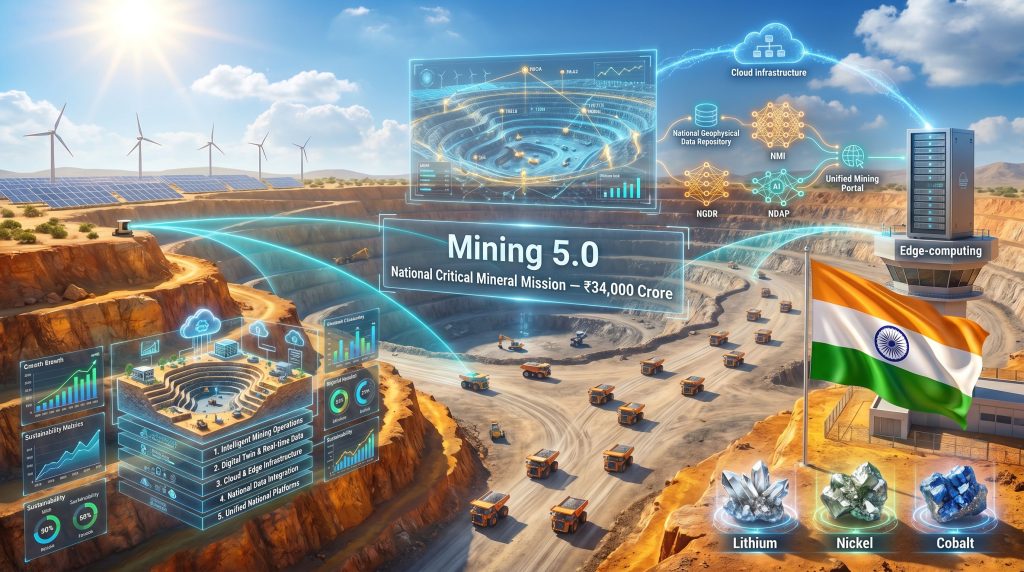
Each of these platforms holds significant informational value on its own. The Deloitte-ICC report identifies the transformative opportunity as connecting them through common Application Programming Interfaces (APIs), converting a collection of standalone databases into a unified Mining 5.0 intelligence backbone capable of supporting near real-time data flows, risk-based regulation, and improved national-level planning.
"India's most significant near-term opportunity in Mining 5.0 is not the introduction of new technologies. It is the orchestration and integration of what already exists into a coherent, AI-governed operating architecture."
The Fragmentation Problem: Digital Investment Without System Value
The report notes that whilst numerous Indian mining organisations have adopted elements of Mining 4.0, these capabilities remain unevenly distributed and functionally disconnected. Digital investments made across the sector risk delivering sub-optimal returns precisely because they are not generating the system-level intelligence that only integration can produce.
The strategic risk is compounding: every year that organisations maintain siloed architectures, the technical and organisational cost of eventual integration increases. The Deloitte-ICC analysis frames this clearly: without integration, digital investments risk remaining limited pilot projects with low enterprise value. Consequently, the pressure to act on this integration imperative is growing across both public and private sector stakeholders.
Policy Frameworks Enabling India's Mining 5.0 Transition
India's transition toward Mining 5.0 in India is supported by two significant policy mechanisms that are shaping the innovation and investment environment across the critical minerals value chain. These frameworks are particularly relevant given the growing importance of critical minerals and energy security to national strategic planning.
S&T PRISM 5.0: Funding the Innovation Layer
The Ministry of Mines' S&T PRISM 5.0 program (Science and Technology Programme for Research, Innovation, Stakeholders, Mining) is explicitly aligned with Mining 5.0 principles and targets startups, MSMEs, and innovators developing technologies across the full critical minerals value chain. The funding structure provides:
- Up to ₹50 lakhs for eligible startups entering the innovation pipeline
- Up to ₹2 crores for high-impact technology development projects
The program spans focus areas including exploration, mining, processing, refining, recycling, and waste minimisation, and is implemented through JNARDDC via the SATYABHAMA portal at research.mines.gov.in.
The National Critical Mineral Mission: A ₹34,000 Crore Strategic Mandate
The National Critical Mineral Mission (NCMM) represents a larger-scale policy commitment, with a budget allocation of ₹34,000 crore (approximately USD 4 billion). Its mandate covers the full critical minerals value chain with particular emphasis on lithium, nickel, and cobalt: minerals central to electric vehicles, energy storage systems, electronics manufacturing, and strategic defence applications.
The NCMM addresses infrastructure development, regulatory reform, and ecosystem building at the state level, with long-term alignment to India's net-zero target by 2070. Industry-government forums such as the Mining 5.0 ICC-WTC 2026 conference play an important role in translating these policy frameworks into practical operational roadmaps, showcasing low-carbon technologies and addressing domestic resource constraints alongside global supply chain vulnerabilities.
Disclaimer: Policy programs and budget allocations are subject to revision. Readers should verify current funding availability and eligibility criteria directly through official government sources.
The Technology Architecture of a Mining 5.0 Operation
Understanding what Mining 5.0 actually looks like in practice requires examining its layered technology architecture, from data infrastructure through to the human interfaces that make intelligent systems accessible to non-technical users.
AI as the Cognitive Backbone
The Deloitte-ICC report describes artificial intelligence as the enterprise cognitive backbone of Mining 5.0. Unlike rule-based automation systems, which execute pre-programmed responses to defined conditions, AI in mineral exploration and operational management integrates geological, operational, environmental, and workforce data simultaneously to support real-time risk management and decision-making.
Key AI applications across the mining value chain include:
- Geological intelligence: Integrating subsurface, environmental, and operational data for advanced resource modelling
- Predictive maintenance: Identifying equipment condition deterioration before failures occur, reducing unplanned downtime
- Predictive safety systems: Anticipating hazardous conditions before incidents occur, enabling proactive risk management
- Talk-to-data capabilities: Natural language interfaces that allow non-technical personnel to query complex operational datasets through conversational prompts
- Workforce augmentation: AI-powered virtual assistants and intelligent standard operating procedures (SOPs) that support human operators in real time
Cloud-Edge Hybrid Architecture: A Strategic Design Requirement
India's mining geography creates a specific technical challenge: a significant proportion of operational mine sites are located in remote, connectivity-constrained environments. A purely cloud-based architecture would introduce unacceptable latency for safety-critical decisions. A purely edge-based approach would sacrifice the analytical depth and multi-mine intelligence that enterprise management requires.
The Deloitte-ICC report positions the cloud-edge hybrid model not as a compromise but as the strategically correct design response to Indian conditions:
- Edge computing layer: Supports low-latency, safety-critical decisions at the point of operation, functioning even where connectivity is intermittent
- Cloud platform layer: Enables enterprise-wide analytics, multi-mine intelligence, and centralised AI governance across the organisation
Digital Twins and Advanced Sensing Technologies
Dynamic digital twins — real-time virtual simulations of physical mining environments — enable continuous scenario modelling, operational planning, and lifecycle optimisation. Their deployment requires the convergence of IT (Information Technology), OT (Operational Technology), and engineering systems: a significant integration challenge but one that creates substantial ongoing value.
Advanced sensing technologies extending the data collection layer include hyperspectral imaging for non-invasive mineral identification, and LiDAR (Light Detection and Ranging) for high-precision terrain and volumetric mapping. Furthermore, downhole geophysics techniques are increasingly being integrated into these sensing frameworks to improve subsurface data quality. The Operator Independent Truck Dispatch System (OITDS) automates hauling logistics and enables real-time fleet monitoring, whilst blockchain applications offer supply chain transparency and mineral provenance verification capabilities.
Embedding Sustainability as an Operational Performance Metric
One of Mining 5.0's most significant conceptual departures from earlier industrial phases is its treatment of sustainability. Traditional mining approaches have positioned environmental compliance as a regulatory obligation, external to core operational performance. Mining 5.0 integrates sustainability metrics directly into operational dashboards, making environmental performance visible, measurable, and optimisable in real time.
Key mechanisms enabling this integration include:
- Real-time environmental monitoring feeds embedded within operational control systems
- AI-driven energy optimisation algorithms reducing carbon intensity per tonne of output
- Renewable energy integration, including solar and wind generation, within mine site power systems
- Precision extraction and processing analytics enabling waste minimisation
This sustainability integration connects directly to three of India's national strategic priorities: energy security through domestic supply of critical minerals for the energy transition, inclusive growth through workforce upskilling and human-AI collaboration models, and net-zero trajectory supporting India's 2070 climate commitments. In addition, mining electrification and decarbonisation efforts are accelerating these sustainability outcomes across major operations.
The next major ASX story will hit our subscribers first
The Five-Layer Architecture of a Connected Mining Operating System
The Deloitte-ICC report outlines an integrated Mining 5.0 system architecture that can be understood as five distinct but interdependent layers:
| Layer | Function | Key Components |
|---|---|---|
| Layer 1: Data Infrastructure | Unified data lakes connecting all operational domains | Geological, operational, environmental, workforce datasets |
| Layer 2: Interoperability | Seamless communication between national platforms | Common APIs linking NGDR, NMI, NDAP, Unified Mining Portal |
| Layer 3: AI and Analytics | Real-time decision support and predictive modelling | Risk management, maintenance forecasting, safety prediction |
| Layer 4: Governance | Accountability frameworks and compliance automation | AI governance protocols, data sovereignty policies |
| Layer 5: Human Interface | Accessible tools for human-AI collaboration | Virtual assistants, intelligent SOPs, natural language queries |
Near real-time data flows through this architecture could enable a fundamental shift in how regulators interact with mining operations: moving from periodic audit-based oversight toward continuous, data-driven mining operations compliance monitoring. This shift would improve the quality and timeliness of national-level planning through aggregated multi-mine intelligence.
Key Barriers to Mining 5.0 Adoption in India
Despite the enabling conditions, several structural barriers remain that leadership teams must address directly:
Infrastructure and Connectivity
Remote mine site connectivity limitations affect the feasibility of real-time data transmission. Capital expenditure requirements for edge computing infrastructure are substantial. Interoperability challenges between legacy OT systems — many of which were not designed with digital integration in mind — and modern IT platforms represent a significant technical debt requiring systematic resolution.
Workforce Readiness
The skills gap between current mining workforce capabilities and the human-AI collaboration requirements of Mining 5.0 operations is significant. Bridging this gap requires structured upskilling programmes spanning both technical and digital competencies, alongside a broader cultural shift from compliance-driven operations toward value-led, data-informed decision-making.
Governance and AI Accountability
Deploying AI systems in safety-critical environments raises governance questions that the sector is still developing frameworks to answer. Data sovereignty considerations for nationally significant mineral assets add regulatory complexity. Accountability mechanisms for AI-driven decisions, particularly in contexts where those decisions affect worker safety, require careful design and regulatory alignment.
Global Benchmarks and India's Competitive Position
| Company/Region | Mining 5.0 Capability | Key Technology Deployed |
|---|---|---|
| BHP (Australia) | Autonomous haulage and renewable energy integration | Solar power generation, autonomous haulage trucks |
| Vale (Brazil) | Supply chain transparency | Blockchain-based mineral provenance verification |
| Global Leaders (General) | Predictive maintenance at scale | AI-integrated IoT sensor networks |
| India (Emerging) | Platform integration and AI governance | NGDR, NMI, OITDS, PRISM 5.0 innovation funding |
India holds a genuine structural advantage in this competitive landscape. Its pre-existing national digital platforms provide an integration-ready foundation that many emerging economies lack. Government-backed funding through PRISM 5.0 and the NCMM reduces the private sector risk associated with early-stage Mining 5.0 investment. Large domestic critical mineral demand from electric vehicle manufacturing, electronics, and defence creates strong pull-through incentives for the full value chain. India's growing engineering and technology talent base is, furthermore, increasingly capable of building indigenous Mining 5.0 solutions rather than importing them wholesale from international vendors.
The Road to 2030: A Three-Phase Transformation Roadmap
The Deloitte-ICC analysis points toward a structured transformation agenda for Indian mining organisations targeting Mining 5.0 capability by 2030. This can be understood as three sequential phases:
Phase 1: Integration Foundation (2025–2026)
- Conduct comprehensive audits of existing digital assets and identify integration gaps across platforms
- Deploy common API frameworks connecting NGDR, NMI, NDAP, and the Unified Mining Portal
- Establish cloud-edge hybrid infrastructure at priority mine sites
Phase 2: AI and Analytics Activation (2026–2028)
- Implement enterprise AI platforms capable of connecting geological, operational, and environmental datasets
- Launch predictive maintenance and predictive safety programmes across high-value operations
- Develop AI governance frameworks, data accountability protocols, and regulatory engagement models
Phase 3: System-Level Intelligence (2028–2030)
- Achieve dynamic digital twin deployment across major operations
- Enable near real-time regulatory compliance monitoring through integrated data flows
- Scale workforce augmentation programmes and embed human-AI collaboration models across the organisation
"The trajectory of Mining 5.0 in India will ultimately be determined by executive decisions around integration architecture, governance investment, cross-sector collaboration, and the pace of workforce transformation — not by technology availability alone."
Key Statistics: Mining 5.0 in India at a Glance
| Metric | Detail |
|---|---|
| National Critical Mineral Mission Budget | ₹34,000 crore (~USD 4 billion) |
| India's Net-Zero Target | 2070 |
| PRISM 5.0 Startup Grant Ceiling | Up to ₹50 lakhs |
| PRISM 5.0 High-Impact Technology Grant Ceiling | Up to ₹2 crores |
| Key National Platforms | NGDR, NMI, NDAP, Unified Mining Portal |
| Primary AI Applications | Predictive maintenance, safety systems, geological modelling, workforce augmentation |
| Critical Minerals Prioritised | Lithium, nickel, cobalt and broader strategic minerals |
| Source Report | Deloitte India and Indian Chamber of Commerce (ICC), May 2026 |
Frequently Asked Questions: Mining 5.0 in India
What Is Mining 5.0 in India?
Mining 5.0 in India refers to the transition from fragmented digital tool deployment toward fully integrated, AI-governed mining operating systems. It connects geological data, operational metrics, environmental monitoring, and workforce intelligence across entire value chains, embedding sustainability as a real-time performance dimension rather than a compliance function.
How Does Mining 5.0 Differ from Mining 4.0?
Mining 4.0 deploys individual digital technologies — such as IoT sensors and basic automation — at isolated points in the value chain. Mining 5.0 integrates these capabilities into a unified operating system with AI at its cognitive core, enabling cross-functional data flows, predictive intelligence, and human-machine collaboration at enterprise scale.
What Is S&T PRISM 5.0?
S&T PRISM 5.0 is a Ministry of Mines funding programme supporting startups, MSMEs, and innovators developing technologies aligned with Mining 5.0 principles across India's critical minerals value chain. Grants range up to ₹50 lakhs for startups and up to ₹2 crores for high-impact development projects.
What Critical Minerals Is India Targeting?
India's National Critical Mineral Mission prioritises lithium, nickel, cobalt, and a broader range of strategic minerals central to electric vehicles, energy storage, electronics manufacturing, and defence applications.
What Role Does AI Play in Mining 5.0?
AI functions as the enterprise cognitive backbone of Mining 5.0, integrating data from geological, operational, environmental, and workforce domains to enable predictive maintenance, safety forecasting, real-time risk management, and natural language data querying across multi-mine operations.
Integration Is India's Competitive Advantage, Not Its Challenge
The central insight to emerge from the Deloitte-ICC analysis is counterintuitive: India's Mining 5.0 challenge is not primarily a technology gap. The platforms exist. The funding mechanisms are in place. The policy direction is established. The real challenge — and the real opportunity — is the willingness of mining leadership to invest in the unglamorous but transformative work of integration and governance architecture.
The convergence of existing national digital platforms, targeted government funding, growing domestic demand for critical minerals, and an expanding indigenous technology talent base creates a rare alignment of enabling conditions. The question facing Indian mining executives is not whether Mining 5.0 is technically achievable. It is whether their organisations are prepared to shift from compliance-focused operations toward value-led, AI-governed, sustainability-embedded enterprises before the competitive window narrows.
Disclaimer: This article contains forward-looking analysis based on published research and industry reports. Technology adoption timelines, policy funding allocations, and transformation outcomes involve inherent uncertainty. Readers should not rely on this analysis as investment or operational advice. All financial and policy details should be independently verified through official government and company sources.
Want to Track the Next Major Mineral Discovery Before the Broader Market Does?
Discovery Alert's proprietary Discovery IQ model delivers real-time alerts on significant ASX mineral discoveries — instantly converting complex geological data into actionable investment insights for both short-term traders and long-term investors — so begin your 14-day free trial today, or explore Discovery Alert's dedicated discoveries page to understand how historic mineral discoveries have generated substantial market returns.