
May 19, 2026
Understanding Mining Access Frameworks in Complex Tailings Operations
Modern mineral extraction operations increasingly focus on reprocessing historical mining waste as primary ore deposits become more challenging to access economically. The technical complexity of these projects requires sophisticated legal and operational frameworks that differ substantially from traditional greenfield exploration. Tailings reprocessing operations must navigate multiple regulatory jurisdictions while coordinating resource extraction objectives with environmental remediation mandates, requiring comprehensive mining permitting insights to ensure successful project development.
Access agreements for tailings projects encompass far more than simple surface rights. These comprehensive frameworks must accommodate diverse technical requirements including geotechnical stability assessments, hydrogeological monitoring systems, environmental baseline studies, and metallurgical testing programs. The coordination required between mining companies, environmental agencies, and remediation organisations creates operational challenges that demand innovative contractual solutions.
When big ASX news breaks, our subscribers know first
Surface Rights vs. Operational Access in Historical Mining Areas
Surface access rights in tailings operations require fundamentally different approaches compared to conventional mining projects. Historical mining areas often involve fragmented land ownership, overlapping regulatory jurisdictions, and complex environmental liability frameworks. Companies must secure not only physical access but also operational authorisation across multiple technical disciplines.
The Quiulacocha Tailings Project demonstrates these complexities through its recent access and exploration agreement at Quiulacocha Tailings Project. The arrangement provides comprehensive operational access across the entire tailings deposit, extending beyond existing concession boundaries. This expansion from partial to complete access represents a qualitative shift in project development capability, enabling coordinated technical programmes rather than fragmented sectoral activities.
Key Components of Comprehensive Tailings Access:
• Surface use permissions across complete deposit footprint
• Technical programme authorisation for multiple investigation phases
• Environmental monitoring and baseline study protocols
• Historical data access and integration requirements
• Instrumentation installation and data collection systems
• Coordinated safety management across shared operational areas
Financial Structures in Modern Tailings Access Agreements
The commercial framework for tailings project access differs significantly from traditional mining agreements. The Quiulacocha access and exploration agreement involves consideration of approximately 7.2 million Peruvian Sol (approximately 2.1 million US dollars) over the initial term, demonstrating the substantial investment required for comprehensive project access.
This financial commitment reflects the complexity of tailings operations, where companies must fund not only standard exploration activities but also specialised environmental assessments and remediation planning. The investment timeline extends across multiple development phases, requiring agreements with sufficient duration and renewal mechanisms to support multi-year technical programmes.
| Development Phase | Duration | Primary Activities | Capital Requirements |
|---|---|---|---|
| Resource Definition | 12-18 months | Drilling, sampling, baseline studies | High initial investment |
| Feasibility Assessment | 18-24 months | Metallurgical testing, environmental impact assessment | Sustained technical spending |
| Permitting & Approval | 24-36 months | Regulatory compliance, community engagement | Administrative and consulting costs |
| Construction Preparation | 12-18 months | Detailed engineering, financing completion | Project development capital |
Technical Programme Requirements for Comprehensive Tailings Evaluation
Multi-Phase Investigation Protocols
Tailings reprocessing projects demand extensive technical validation through coordinated investigation phases. The scope extends well beyond traditional resource definition to encompass geotechnical stability, environmental characterisation, and process optimisation studies. Access agreements must accommodate these diverse programme requirements while maintaining operational flexibility for project evolution.
Essential Technical Programme Elements:
• Resource and Definition Drilling: Systematic sampling for tonnage and grade estimation
• Geotechnical and Hydrogeological Assessment: Stability analysis and groundwater characterisation
• Geophysical Investigations: Subsurface mapping and structural analysis
• Environmental Baseline Studies: Water quality, soil contamination, and biodiversity assessment
• Metallurgical Testing Programmes: Process optimisation and recovery parameter definition
• Monitoring System Installation: Real-time data collection and environmental tracking
Advanced Drilling Technologies in Tailings Characterisation
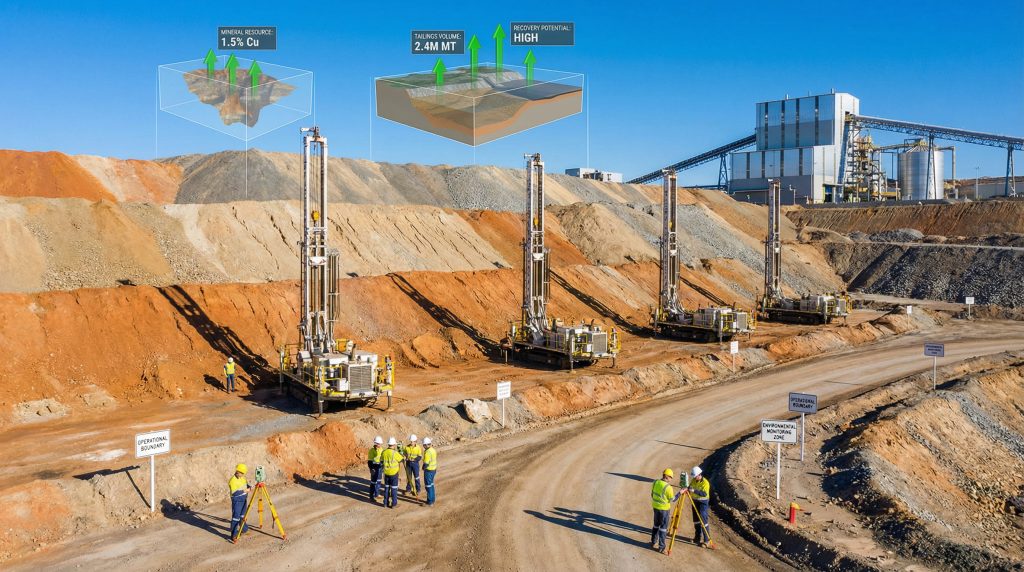
Sonic drilling technology provides superior sample quality for tailings characterisation compared to conventional drilling methods. This specialised approach enables continuous core recovery with minimal sample disturbance, ensuring accurate grade definition and metallurgical sample integrity essential for process optimisation. Furthermore, proper drilling results interpretation becomes crucial for maximising the value of these high-quality samples.
The technical advantages of sonic drilling in tailings environments include:
• Continuous core recovery maintaining sample integrity
• Reduced environmental impact through precise drilling control
• Enhanced metallurgical testing capability via undisturbed samples
• Improved resource estimation accuracy through consistent sample quality
• Reduced groundwater contamination risk during drilling operations
Regulatory Framework Navigation for Tailings Reprocessing
Multi-Agency Coordination Requirements
Tailings reprocessing operations must navigate complex regulatory environments requiring coordination between mining authorities, environmental agencies, and remediation organisations. The regulatory framework extends beyond traditional mining permits to encompass environmental impact assessments, historical liability management, and community consultation processes.
In Peru, this regulatory complexity is exemplified by the involvement of AMSAC (Activos Mineros S.A.C.), a state entity responsible for remediation of historical mining environmental liabilities. The cooperative framework established through tailings access agreements enables alignment between commercial resource extraction objectives and public environmental remediation mandates. Additionally, modern approaches increasingly incorporate mine reclamation innovation to ensure comprehensive environmental restoration.
Regulatory Compliance Hierarchy:
-
Mining concession rights validation and expansion
-
Environmental impact assessment preparation and submission
-
Surface access negotiation with multiple stakeholders
-
Community consultation and benefit-sharing arrangements
-
Technical programme authorisation across multiple disciplines
Environmental Assessment Integration Challenges
Comprehensive environmental impact assessments for tailings projects require extensive baseline data collection across entire deposit footprints. Unlike greenfield projects, tailings operations must address both potential future impacts and historical environmental legacies, creating complex assessment requirements that influence access agreement structures.
Critical Assessment Components: Water quality monitoring networks must encompass both current contamination levels and potential future impacts from reprocessing activities, while soil contamination mapping requires integration of historical data with contemporary analytical results.
The timeline for environmental assessment completion typically extends 12-18 months for baseline studies alone, with comprehensive Environmental Impact Assessment preparation requiring additional 18-24 months. Access agreements must provide sufficient duration and operational flexibility to accommodate these extended regulatory timelines.
Strategic Value of Integrated Project Access
Operational Efficiency Through Comprehensive Coverage
Securing access to complete tailings deposits enables coordinated technical programmes that maximise resource definition accuracy while minimising operational inefficiencies. Fragmented access creates substantial constraints on geological continuity understanding, environmental assessment capabilities, and technical programme coordination.
The transition from partial to comprehensive access and exploration agreement at Quiulacocha Tailings Project represents more than simple area expansion. It enables integrated drilling campaign design, systematic environmental monitoring, and coordinated resource estimation across geological and geotechnical boundaries that may not align with legal or administrative boundaries.
Operational Advantages of Complete Access:
• Integrated technical programme design optimising resource definition efficiency
• Comprehensive geophysical survey coverage enabling complete subsurface characterisation
• Coordinated environmental monitoring supporting regulatory compliance and operational planning
• Systematic resource estimation incorporating geological continuity across deposit boundaries
• Streamlined permitting processes through unified environmental and technical assessments
Investment Timeline Optimisation
Tailings reprocessing projects require extended development timelines spanning multiple phases from initial access through commercial production. The Quiulacocha project demonstrates this progression, with initial drilling activities targeted for mid-2026 following agreement completion, representing the beginning of a multi-year development sequence. This timeline aligns with broader industry trends toward sustainability transformation throughout the mining sector.
Projected Development Timeline:
• Years 1-2: Resource definition drilling and environmental baseline establishment
• Years 2-3: Feasibility studies and comprehensive environmental impact assessment
• Years 3-4: Regulatory permitting and project financing completion
• Years 4-5: Construction, commissioning, and production ramp-up
The next major ASX story will hit our subscribers first
Technical Coordination Challenges in Multi-Stakeholder Operations
Joint Technical Committee Structures
Tailings projects involving multiple organisational stakeholders require sophisticated coordination mechanisms that extend beyond traditional mining company operations. The cooperative model established through comprehensive access and exploration agreement at Quiulacocha Tailings Project must address technical programme scheduling, data sharing protocols, safety management systems, and community engagement alignment.
These coordination frameworks become particularly critical when projects involve both commercial resource extraction and public environmental remediation objectives. Technical programmes must be designed to serve dual mandates while maintaining operational efficiency and regulatory compliance across multiple jurisdictions. Moreover, implementing data-driven mining operations helps optimise coordination across diverse stakeholder groups.
Coordination Framework Elements:
• Joint technical committee structures for programme oversight and decision-making
• Shared data management protocols ensuring information accessibility and security
• Integrated safety management systems protecting personnel across organisational boundaries
• Coordinated environmental monitoring supporting both extraction and remediation objectives
• Aligned community engagement maintaining consistent stakeholder communication
Historical Data Integration and Management
Tailings reprocessing projects benefit significantly from systematic integration of historical technical and environmental datasets with contemporary field investigations. Access agreements must establish protocols for historical data access, validation, and integration with new technical programmes.
This historical data component often represents substantial value, encompassing decades of geological, geotechnical, and environmental information that can significantly reduce technical programme costs and timelines when properly integrated with modern investigation techniques. Furthermore, development financing opportunities continue to emerge for projects that demonstrate comprehensive data management capabilities.
Future Implications for Sustainable Mining Development
Scaling Technical Programmes for Commercial Viability
Successful tailings reprocessing requires systematic scaling from initial access through commercial production. Access agreements establish foundational frameworks that enable progressive technical validation while maintaining operational flexibility for project evolution as understanding of deposit characteristics improves.
The modular approach to technical programme design enables companies to optimise capital allocation across investigation phases while building comprehensive datasets required for feasibility assessment and regulatory approval. This approach particularly benefits projects with substantial resource potential but complex technical or regulatory challenges.
Scalability Factors for Long-Term Success:
• Modular technical programme design enabling progressive investigation expansion
• Expandable access area provisions accommodating project boundary adjustments
• Progressive permitting pathways supporting phased development approaches
• Flexible financial structures adapting to changing project requirements
• Adaptive environmental management responding to evolving regulatory expectations
Integration with Circular Economy Principles
Tailings reprocessing represents a fundamental alignment with circular economy principles within the mining industry, where historical waste becomes feedstock for modern metal recovery operations. This approach addresses both resource scarcity challenges and environmental legacy issues through innovative technical and commercial frameworks.
The success of comprehensive access agreements in tailings projects may establish precedents for similar approaches in other circular economy mining applications, including mine waste reprocessing, urban mining, and industrial waste metal recovery operations. However, recent land easement developments demonstrate the increasing regulatory support for such innovative mining approaches.
Industry Alignment Considerations:
• ESG reporting requirements driving corporate sustainability mandates
• Circular economy principles supporting waste-to-resource conversion projects
• Technology innovation adoption enabling previously uneconomic resource recovery
• Stakeholder engagement best practices balancing commercial and community objectives
• Regulatory framework evolution supporting innovative mining approaches
This analysis examines the technical, regulatory, and commercial frameworks governing comprehensive mining access agreements, with particular emphasis on tailings reprocessing operations. Investment decisions should consider the complex regulatory environments, extended development timelines, and technical uncertainties inherent in these specialised mining applications.
Ready to Capitalise on Complex Mining Operations?
Discovery Alert's proprietary Discovery IQ model provides instant notifications when ASX-listed companies secure major access agreements or advance complex tailings projects, turning intricate mining developments into actionable investment insights. Stay ahead of sophisticated opportunities in resource extraction and environmental remediation by exploring Discovery Alert's comprehensive discoveries database and begin your 14-day free trial today.