
June 16, 2026
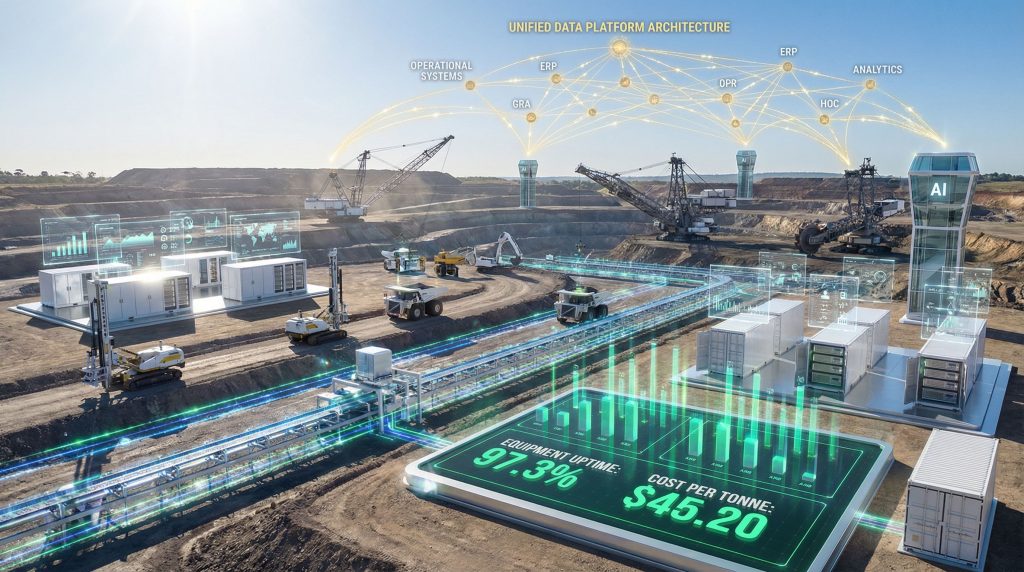
The digital transformation of mining operations has reached a critical inflection point where theoretical artificial intelligence capabilities must transition into practical operational value. While industry conferences showcase ambitious autonomous mining visions, the reality confronting most operations reveals a stark disconnect between technological potential and implementation readiness. Furthermore, understanding the technical infrastructure requirements for enterprise-wide AI deployment requires examining the foundational systems that enable reliable data processing, model governance, and building AI readiness in mining organizational capability development.
Understanding the Technical Architecture Requirements
Mining operations generate massive data volumes across multiple operational domains, yet many sites continue operating with fragmented systems that limit AI implementation potential. The challenge extends beyond simple data collection to encompass the architectural patterns needed for reliable AI model deployment and monitoring.
Data Integration Complexity in Mining Environments
Modern mining operations typically manage data across diverse sources including equipment telemetry, geological surveys, production metrics, maintenance logs, and financial systems. According to mining industry analysis, AI outcomes depend far more on data quality than on model complexity, yet mining companies often struggle with information that lives in separate systems or follows different standards.
Cloud-native ERP integration patterns have emerged as a foundational requirement for mining AI infrastructure. These platforms unify structured and non-structured data across all lines of business, providing the trusted foundation required for AI-driven insights and automation. Consequently, the architectural approach enables finance teams to gain faster access to operational data, helping accelerate month-end consolidations and enabling better cash flow and capital planning decisions.
Real-Time Processing Requirements
Mining environments demand specialised considerations for edge computing deployment due to remote locations and connectivity constraints. The technical architecture must account for:
- Latency-sensitive safety applications requiring sub-second response times
- Bandwidth limitations in remote mining locations affecting cloud connectivity
- Environmental durability for computing infrastructure in harsh mining conditions
- Power consumption optimisation for edge devices in energy-constrained environments
Time-series database optimisation becomes critical for processing equipment telemetry and environmental monitoring data. Mining operations typically generate terabytes of sensor data daily, requiring specialised database architectures optimised for high-volume ingestion and real-time query performance.
When big ASX news breaks, our subscribers know first
What Are the Core Components of Mining AI Infrastructure?
Unified Data Platform Architecture
The backbone of effective mining AI infrastructure rests on integrated ERP environments that connect production, maintenance, and financial data in real-time. This integration enables automated maintenance planning, improved operating cost visibility, and support for more accurate forecasting across operational domains through data-driven operations.
For junior mining companies, unified data platforms provide particular value in project capitalisation tracking during mine exploration and development phases. However, the visibility gained through integrated systems supports better resource allocation decisions during critical development periods when capital efficiency directly impacts project viability.
Structured vs. Unstructured Data Processing
Mining AI infrastructure must accommodate diverse data types:
| Data Type | Sources | Processing Requirements | AI Applications |
|---|---|---|---|
| Structured | ERP systems, sensor telemetry | Real-time ingestion, historical analysis | Predictive maintenance, production optimisation |
| Semi-structured | Maintenance logs, production reports | Natural language processing, pattern recognition | Anomaly detection, trend analysis |
| Unstructured | Geological surveys, imagery, documentation | Computer vision, document processing | Resource estimation, safety monitoring |
Enterprise Resource Planning Integration
Modern cloud ERP environments serve as the digital core for mining operations, enabling the connection of operational, financial, supply chain, and maintenance systems into a single trusted environment. In addition, this integration approach strengthens existing digital investments rather than complicating operational workflows.
SAP and Oracle Implementation Patterns
Mining-specific ERP implementations require specialised modules for:
- Mine planning and scheduling integration with production systems
- Commodity price management for revenue forecasting and hedging
- Environmental compliance tracking across regulatory jurisdictions
- Asset lifecycle management for heavy mining equipment
Financial consolidation automation through AI-driven reconciliation provides particular value for mining companies operating across multiple jurisdictions. The automation capabilities reduce manual reconciliation time while improving accuracy in complex international reporting requirements.
Which AI Governance Frameworks Minimise Operational Risk?
Establishing Model Validation Protocols
Effective AI governance in mining operations requires clear rules defining which AI platforms will be deployed, how data can be accessed and used, who can access the data, who validates model outputs, and where automation is allowed to act without human intervention. These governance structures enable companies to test and scale automation without sacrificing operational oversight.
Traceability becomes increasingly important as AI models begin drawing insights from multiple operational and financial systems. For instance, when organisations maintain clear data lineage and consistent reporting structures, automation becomes easier to validate and trust across diverse operational contexts.
Human-in-the-Loop Validation Requirements
Mining operations demand specialised validation protocols for safety-critical applications:
- Equipment shutdown decisions requiring dual human authorisation
- Blast timing optimisation with mandatory engineer review
- Personnel safety alerts with immediate human verification requirements
- Environmental threshold breaches triggering automatic regulatory notification
Data Access Control Implementation
| Access Level | User Type | Permitted Actions | Validation Requirements |
|---|---|---|---|
| Read-Only | Operations Staff | View dashboards, alerts | Single sign-on authentication |
| Model Interaction | Engineers | Query models, view outputs | Multi-factor authentication |
| Model Management | Data Scientists | Deploy, retrain models | Peer review + approval |
| System Administration | IT Leadership | Full system access | Executive approval required |
Audit trail requirements become particularly complex in mining environments due to regulatory compliance needs across safety, environmental, and financial reporting domains. Therefore, the governance framework must accommodate multiple regulatory jurisdictions while maintaining operational efficiency.
How Should Mining Companies Phase AI Deployment Across Operations?
Phase 1: Foundation Building (Months 1-6)
Successful AI deployment in mining operations begins with establishing reliable data foundations, governance structures, and internal capability before launching large-scale initiatives. This preparatory phase focuses on:
Data Quality Assessment and Remediation
- System inventory and data mapping across operational domains
- Quality scoring for existing data sources using standardised metrics
- Gap analysis identifying missing data streams for target AI applications
- Remediation planning with prioritised timelines based on AI use case requirements
Cloud ERP Migration or Optimisation
Mining companies must evaluate whether to migrate legacy ERP systems to cloud platforms or optimise existing on-premise installations. Cloud migration typically provides better AI integration capabilities, while optimisation may offer faster time-to-value for companies with significant legacy system investments.
Staff Training and Organisational Readiness
Building AI literacy helps employees identify which problems are good candidates for AI and which still require human judgement. Training programmes should focus on practical applications rather than theoretical concepts, emphasising the limits of automation in mining contexts.
Phase 2: Targeted Automation (Months 7-18)
Once foundational elements are established, mining companies can move forward with confidence in deploying targeted AI applications. This phase emphasises practical use cases that demonstrate clear operational value:
Predictive Maintenance Implementation
- Equipment failure prediction using historical maintenance data and real-time telemetry
- Spare parts optimisation through demand forecasting models
- Maintenance scheduling automation integrated with production planning systems
- Cost reduction tracking through reduced unplanned downtime
Anomaly Detection Systems
Workshops and focused pilots provide teams with opportunities to experiment with practical applications including chatbots, automation bots, and anomaly detection based on real-time data. Early wins build confidence, establish organisational capabilities, and create shared ownership for future scaling initiatives.
Phase 3: Advanced Analytics Integration (Months 19-36)
The final phase focuses on multi-system optimisation and advanced forecasting capabilities that leverage the foundational investments from earlier phases:
Cross-Functional AI Applications
- Integrated production optimisation spanning equipment, personnel, and supply chain
- Advanced resource modelling combining geological, operational, and market data
- Autonomous system integration in controlled operational environments
- Predictive business intelligence for strategic planning and capital allocation
What Technical Skills Must Mining Organisations Develop Internally?
Data Engineering Capabilities
The strongest AI programmes are led by teams who understand both their operations and the limits of automation. This understanding requires developing specific technical competencies aligned with mining operational requirements:
ETL Pipeline Development for Mining Data
Mining organisations need specialised data engineering skills for:
- Geological data processing from core samples and survey equipment
- Equipment telemetry integration across diverse manufacturer systems
- Environmental monitoring data from air quality, water, and noise sensors
- Production metrics consolidation from multiple processing facilities
Database Administration Expertise
Mining AI implementations require expertise in both relational databases for structured operational data and NoSQL systems for handling unstructured geological surveys, imagery, and documentation. Furthermore, the technical team must understand performance optimisation for time-series data processing and real-time query requirements.
AI/ML Technical Competencies
Model Selection and Optimisation
Mining-specific AI applications require understanding of:
- Predictive maintenance algorithms optimised for heavy equipment operational patterns
- Geological modelling techniques for ore body estimation and mine planning
- Safety prediction models calibrated for mining-specific risk factors
- Production optimisation algorithms accounting for equipment constraints and operational variables
Feature Engineering from Operational Data
Mining data presents unique challenges for feature engineering due to the complexity of geological variables, equipment interactions, and environmental factors. Technical teams must develop expertise in creating meaningful features from:
- Multi-dimensional geological datasets including grade distributions and structural geology
- Equipment performance metrics across different operational conditions
- Environmental variables affecting operational efficiency and safety
- Market and commodity factors influencing production optimisation decisions
How Can Mining Companies Measure AI Implementation Success?
Operational Efficiency Metrics
Equipment Performance Improvements
Predictive maintenance implementations in mining operations typically focus on critical equipment including haul trucks, excavators, crushers, and conveyor systems. Success metrics include:
- Unplanned downtime reduction measured as percentage improvement over baseline periods
- Maintenance cost optimisation through better parts inventory management and scheduling
- Equipment lifespan extension through proactive maintenance interventions
- Safety incident reduction related to equipment failures
Production Optimisation Gains
Real-time process adjustments enabled by AI in drilling & blasting systems can deliver measurable production improvements:
- Throughput increases in processing facilities through parameter optimisation
- Recovery rate improvements in mineral processing operations
- Energy consumption per tonne reductions through intelligent system management
- Quality consistency improvements in final product specifications
Financial Performance Indicators
Cost Management and Revenue Enhancement
| Metric Category | Measurement Approach | Typical Improvement Range | Implementation Timeline |
|---|---|---|---|
| Cost per Tonne | Direct operational cost tracking | 3-8% reduction | 12-18 months |
| Equipment Utilisation | Availability and performance metrics | 5-15% improvement | 6-12 months |
| Energy Efficiency | kWh per tonne processed | 2-12% reduction | 9-15 months |
| Inventory Optimisation | Working capital efficiency | 10-25% reduction | 12-24 months |
Capital Expenditure Optimisation
AI-driven planning and forecasting capabilities enable better capital allocation decisions through:
- Equipment replacement timing optimisation based on predictive maintenance insights
- Capacity expansion planning using advanced production forecasting models
- Resource allocation efficiency across multiple mine sites or operational units
- Project risk assessment improvements for exploration and development investments
Technical Performance Benchmarks
Model Accuracy and Reliability
Different AI applications in mining require varying accuracy thresholds:
- Safety-critical models (equipment failure prediction, personnel safety) requiring >95% accuracy
- Production optimisation models typically achieving 80-90% accuracy for operational value
- Maintenance scheduling models balancing false positives against operational disruption
- Financial forecasting models calibrated against commodity price volatility and operational uncertainty
System Performance Requirements
- Response time benchmarks for real-time decision support systems
- Data processing throughput for high-volume sensor data ingestion
- Model inference latency for time-sensitive operational applications
- System availability metrics for mission-critical AI applications
The next major ASX story will hit our subscribers first
What Are the Common Implementation Pitfalls to Avoid?
Technical Architecture Mistakes
Insufficient Data Governance Leading to Poor Outcomes
Many mining AI implementations fail due to inadequate attention to data quality and governance before model deployment. Common issues include:
- Inconsistent data standards across operational systems creating unreliable model inputs
- Missing data lineage tracking making it difficult to validate model outputs and identify errors
- Inadequate data security measures creating compliance risks for AI systems handling sensitive operational data
- Poor integration planning between AI tools and existing operational workflows
Over-reliance on Vendor Solutions
Mining companies that depend entirely on vendor solutions without building internal capabilities often struggle with:
- Limited customisation options for mining-specific operational requirements
- Vendor lock-in risks affecting long-term technology strategy flexibility
- Knowledge transfer gaps when vendor relationships change or contracts expire
- Maintenance and optimisation challenges without internal technical expertise
Organisational Change Challenges
Managing Resistance to Automation
Successful AI implementation requires addressing legitimate concerns from operational staff regarding job security, skill requirements, and operational reliability. Effective change management approaches include:
- Transparent communication about AI capabilities and limitations
- Retraining opportunities for staff to work with AI-augmented systems
- Gradual implementation allowing time for organisational adaptation
- Clear governance rules defining human oversight requirements for automated decisions
Setting Realistic Expectations
Mining companies must avoid unrealistic expectations about AI capabilities and implementation timelines. Common misconceptions include:
- Immediate ROI expectations without accounting for foundational infrastructure investment
- Over-estimation of AI decision-making capabilities in complex operational contexts
- Under-estimation of data quality requirements for reliable AI model performance
- Insufficient executive sponsorship for long-term capability development initiatives
Building Sustainable AI Capabilities for Long-Term Mining Success
Strategic Partnership Development
Technology Vendor Relationships
Successful mining AI implementations require carefully structured partnerships with technology vendors that provide:
- Mining industry expertise rather than generic AI solutions
- Integration capabilities with existing ERP and operational systems
- Ongoing support and optimisation services for deployed AI applications
- Knowledge transfer programmes building internal organisational capabilities
Academic and Research Collaborations
Mining companies increasingly partner with academic institutions for:
- Research and development of mining-specific AI applications
- Talent pipeline development through internship and graduate programmes
- Technology validation through independent research and testing
- Industry standards development for AI governance and safety protocols
Continuous Improvement Framework
Performance Monitoring and Optimisation
Long-term AI success requires systematic approaches to:
- Regular model performance reviews and accuracy validation
- Feedback loops between operational staff and technical teams for continuous improvement
- Benchmarking against industry leaders and emerging best practices
- Innovation pipeline management for evaluating and adopting new AI technologies
However, AI investment implications extend beyond immediate operational benefits. Companies must consider the long-term strategic value of building AI readiness in mining operations, including competitive positioning and organisational capability development.
The transformation from traditional mining operations to AI-enabled enterprises requires systematic technical planning, robust governance frameworks, and sustained organisational commitment. Moreover, AI copilot efficiency demonstrates the practical value of human-AI collaboration in mining contexts.
In conclusion, building AI readiness in mining is less about building complex models and more about creating the conditions for trust and efficiency. By prioritising governance and internal capability development first, mining organisations can move past technological hype and establish AI as a steady, practical driver of long-term operational performance.
Ready to Capitalise on AI-Driven Mining Discoveries?
Discovery Alert's proprietary Discovery IQ model delivers real-time alerts on significant ASX mineral discoveries, instantly identifying actionable opportunities as mining companies leverage AI for breakthrough exploration results. Explore Discovery Alert's dedicated discoveries page to understand how major mineral discoveries generate substantial market returns, then begin your 14-day free trial to position yourself ahead of the market as AI transforms mining operations.